Six months of infusion, handcrafted oak barrels: Amouage’s challenge to fast perfumery
Renaud Salmon left New York for Muscat, banned the word “launch” from his vocabulary, and started ageing perfume concentrates: the Creative Director of Amouage on the Essences collection
Amouage launches Essences – Act II in Rome: six fragrances built on double infusion, aged oak barrels, and a radical refusal to rush
Amouage, the High Perfumery house founded in the Sultanate of Oman in 1983, has expanded its Essences collection with three new entries — Line 618, Remain, and Sequence — presented at the end of January as Essences – Act II, joining the existing Reasons, Lustre, and Outlands. Together, the six fragrances form a collection named after geometric principles, time converted into form. What distinguishes Essences from virtually everything else in contemporary perfumery isn’t the naming logic. It’s the process behind it.
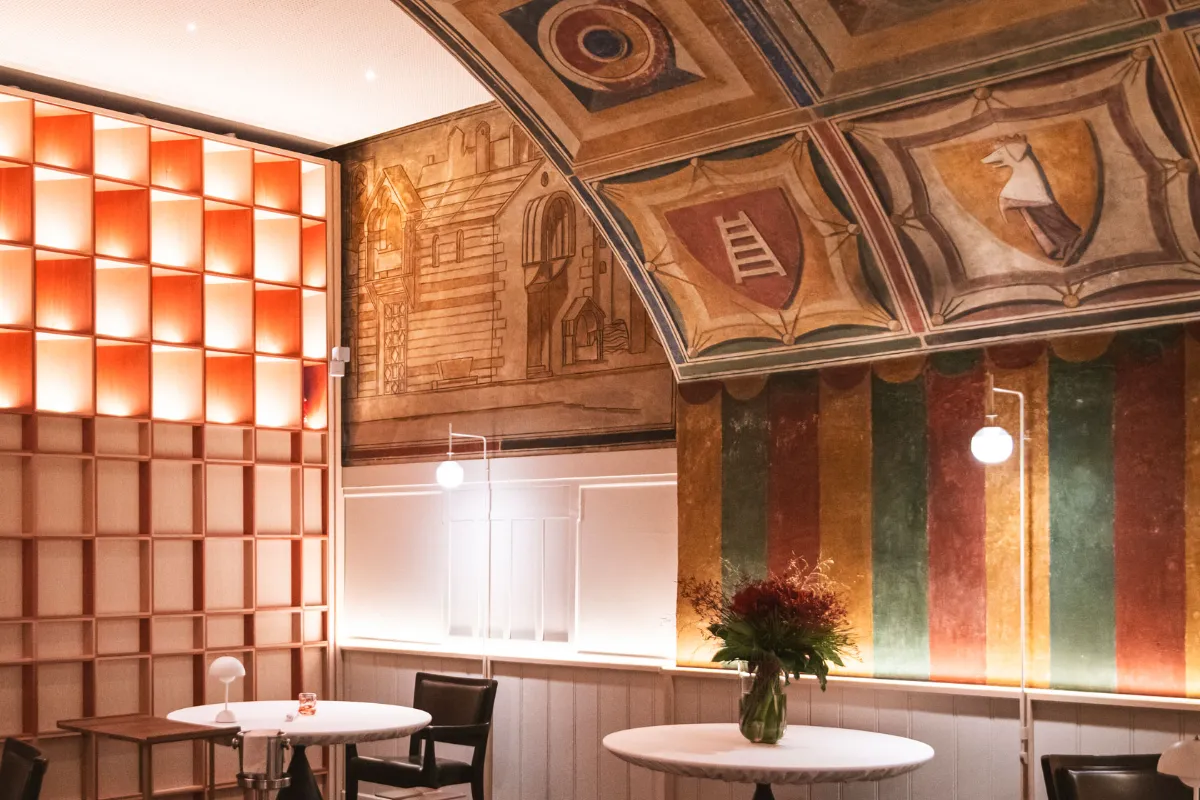
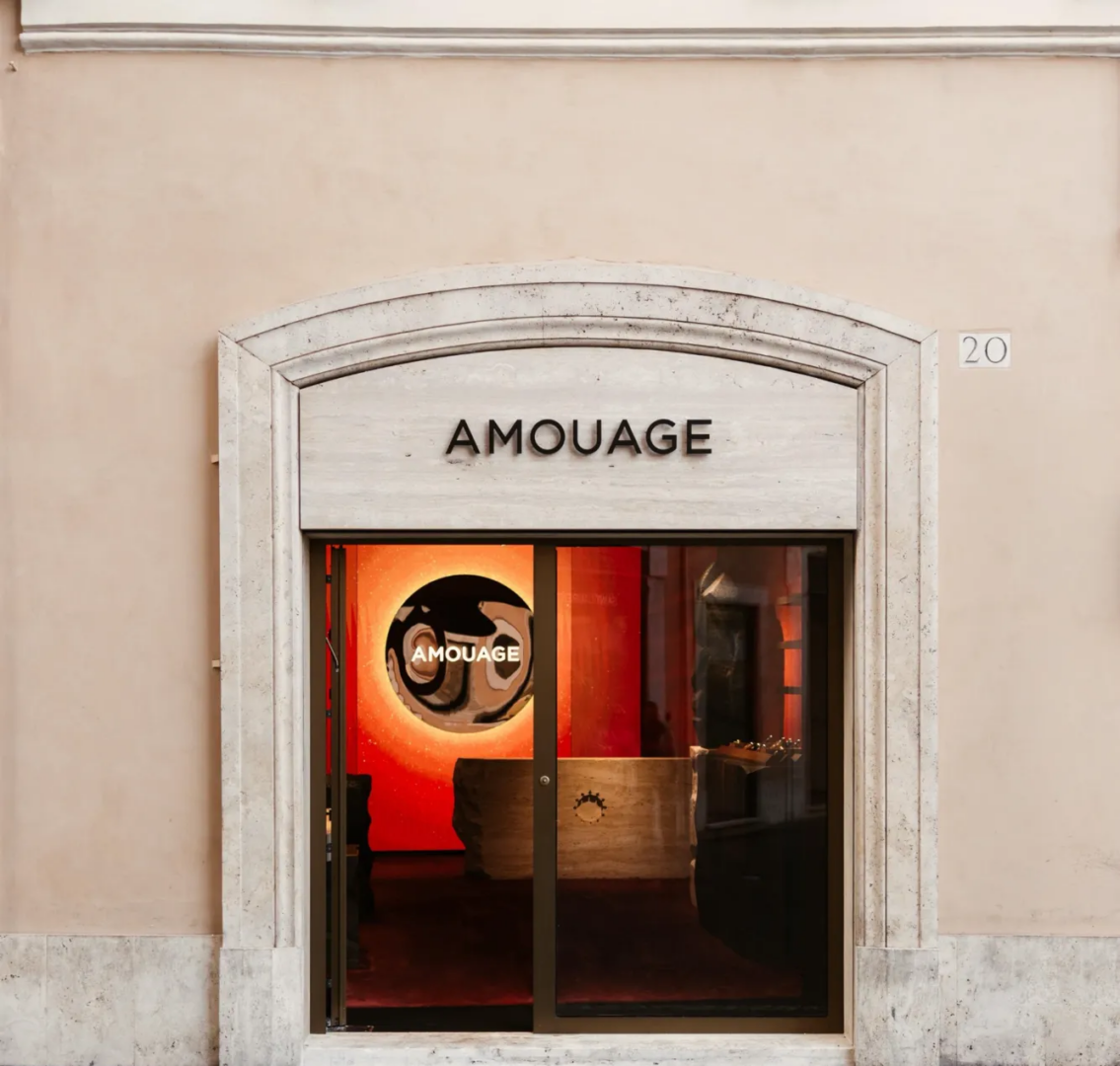
The launch coincides with the opening of Amouage’s first Italian boutique in Rome, in partnership with Olfattorio Bar à Parfums — a space conceived as an ephemeral outpost that is already laying the groundwork for a permanent address in the same location. Rome was not a decorative choice: along the ancient Incense Route, frankincense traveled from Oman to Europe long before luxury became an industry category. The city is where that history lands today.
How Amouage’s Essences – Act II collection uses six-month infusions and handcrafted oak barrels to redefine what concentration really means
Every concentrate in the Essences line undergoes six months of infusion with aged Australian sandalwood chips — at least double the ageing period commonly granted to most contemporary fragrance compositions, where time is routinely compressed to accelerate launch cycles. Separately, the alcohol matures in handcrafted oak barrels produced by Allary, French coopers working to traditional standards. This dual-track process generates what Creative Director Renaud Salmon describes as softened density: a 30% concentration of pure perfume oils that behaves differently than standard formulations.
The inquiry began with a question about duration. “Rather than ageing a concentrate for just a few weeks, I wondered what would happen if it was allowed to age for several months”, Salmon explains. “This led me to consider the magic of infusions — of letting the personality of one substance gradually seep into another. And that was when I realised the Essences would have to be about more than just ageing”. Extended contact changes the composition itself — a structural alteration via time, not simply a matter of patience.
Why Renaud Salmon believes the worst decisions in perfumery are the ones taken because you want to launch
Contemporary perfumery runs on compressed cycles. Launches multiply, extraction methods prioritize speed, and innovation gets measured by how quickly a concept reaches the market. Salmon identifies this as systemic pressure: “In perfumery today, everything is about going as fast as possible… But perfumery is not only about reproducing nature. It is about using all the tools we have to create something with character and personality”.
The industry rewards high-frequency output and relentless novelty, which means time becomes a resource to optimize and eliminate. Creation risks collapsing into performance — output measured in volume rather than depth. Salmon’s position on launch pressure is unambiguous: “The worst decisions in perfumery are the decisions you take because you want to launch”. He places time at the centre of everything: “Time is what gives an object its true value. Time is what shapes and sculpts all our lives. Time is the essence of everything. That’s why I knew it had to be at the centre of our Amouage Essences”. Accepting a slower operational rhythm, in a system organized around constant output, is itself a structural choice.
The new Essences bottle is the first entirely new flacon design Amouage has introduced in over fifteen years — and every detail encodes national identity
The Essences collection arrives in a vessel that took six years to greenlight. Developed with Jérôme Faillant-Dumas of L.O.V.E Paris, it marks the first entirely new bottle design Amouage has introduced in over fifteen years. “When I started at Amouage six years ago, the bottles were beautiful. I didn’t want to change them because I wanted to respect the history of Amouage. But my role is also to invent the future”, Salmon explains.
The flacon references ancient apothecary vessels without tipping into nostalgia. Glass is wrapped in matte, sand-toned ceramic. Ridge patterns evoke dunes and stratified Omani rock. An enamel plaque on the front carries the Amouage name and fragrance title. Beneath the magnetic cap, a crown motif signals royal origin. Under each bottle, a hand-attached medal records batch number, composition specifications, and a unique geometric identifier — assembled at the Muscat manufacturer. Even regulatory information is treated as design integration, not afterthought. The crown documents origin; the medal makes accountability visible.
Amouage was born from a royal decree, not a marketing brief — and that founding logic still shapes everything the house makes today
To understand what Essences represents, it helps to understand where Amouage came from. In 1983, Sultan Qaboos bin Said of Oman wanted his country’s identity articulated beyond ceremonial protocol. He entrusted Sayyid Hamad bin Hamoud Al Busaidi, a member of the royal family, with a precise task: translate Omani heritage into olfactory form.
In Oman, fragrance is not accessory — it is social fabric. Frankincense smoke accompanies domestic life, religious ritual, and state ceremony. It purifies, marks hospitality, defines space. Scent is not worn; it circulates. To represent Oman through perfume meant engaging one of its oldest and most persistent cultural languages. The instruction was pragmatic: dignitaries arriving in the Sultanate would encounter, in their hotel rooms, a distilled geography. The southern region known as the Land of Frankincense — a UNESCO World Heritage Site since 2000 — had been producing Boswellia resin long before luxury became an industry category. Smoke functioned as cartography. Resin as currency. Amouage was conceived within this logic: not to revive Arabian perfumery as folklore or decoration, but to rebuild it as contemporary structure under direct royal patronage.
Rome was chosen for a reason that predates modern luxury — the ancient Incense Route once carried Omani frankincense to the heart of Europe
Amouage openes its boutique in Rome with Olfattorio Bar à Parfums, pioneer of artistic perfumery in Italy. Rome is not a decorative choice. Along the ancient Incense Route, frankincense traveled from Oman to Europe, generating cultural and commercial exchanges that today find a new contemporary expression through the Maison. This is a city where history operates as accumulated density, and Amouage’s choice to land here reflects a reading of the city’s cosmopolitan reach and its ability to attract a sophisticated, internationally mobile audience.
For Renaud Salmon, heritage nonetheless presents a specific occupational hazard: “I respect history and I also protect the truth. But if you only do that, people will say: fine, we can put Amouage in a museum as an example of the best of what has been done in perfumery. But if it goes into a museum, it means you are no longer part of people’s everyday life”. A house founded as a cultural representation in 1983 cannot afford to become archival content.
The Rome space is an ephemeral boutique — but it’s already laying the groundwork for a permanent address in the same location
The Rome opening follows a strategic model Amouage has deployed in other key markets: an ephemeral boutique that establishes presence, builds local relationships, and prepares the ground for a permanent outpost. The same pattern preceded the house’s boutique in Dosan Park, Seoul, and the 2024 opening in Soho, New York. In Rome, a permanent boutique in the same location is planned for the coming months.
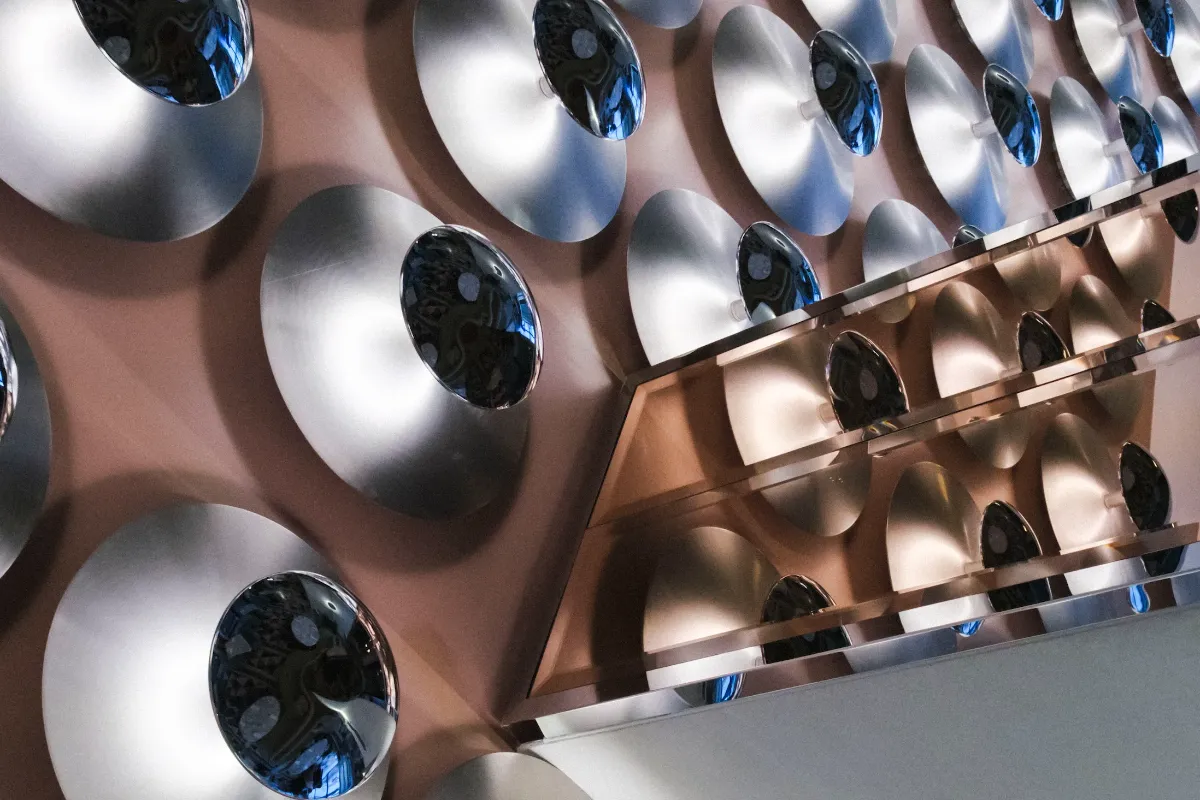
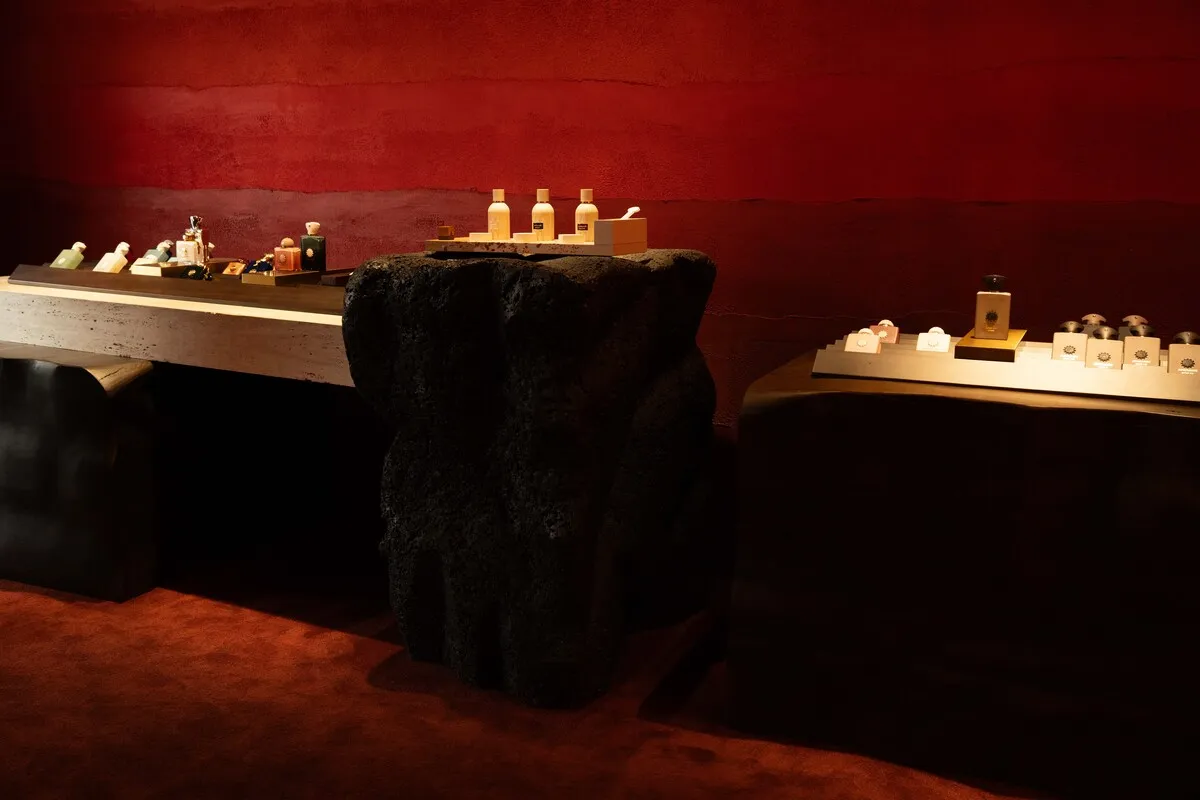
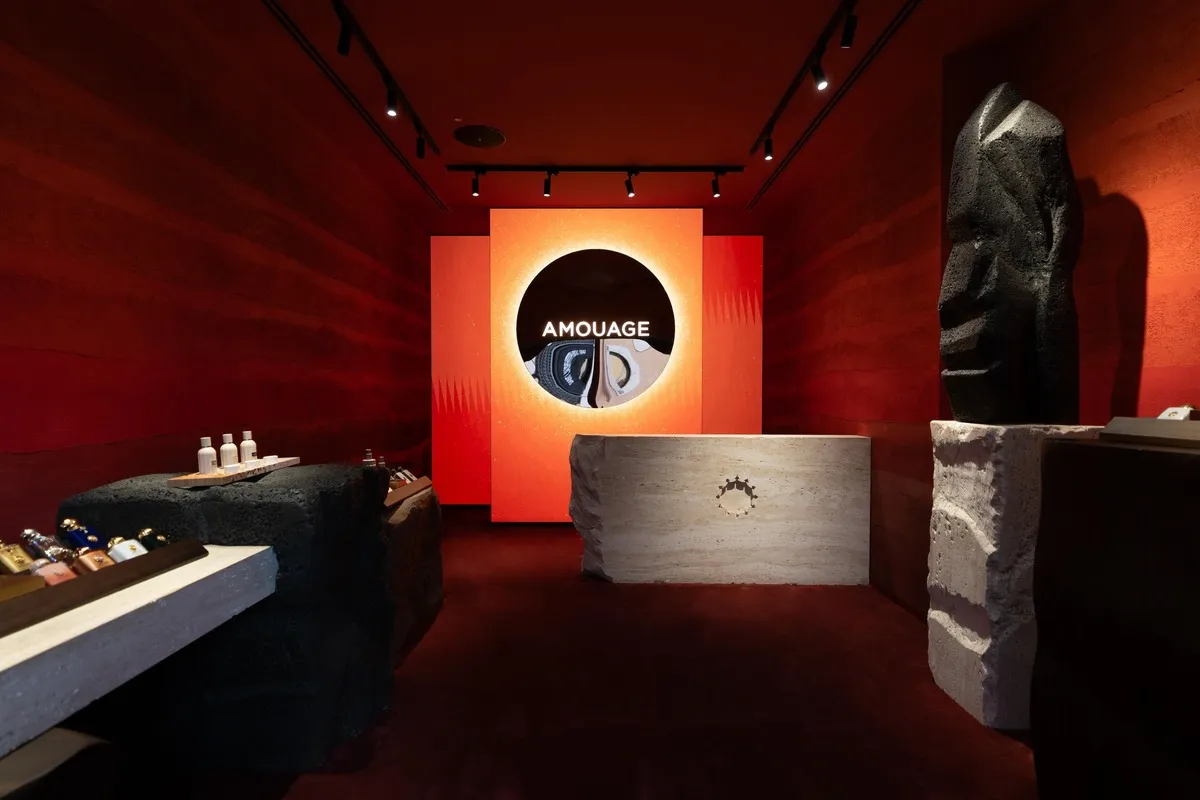
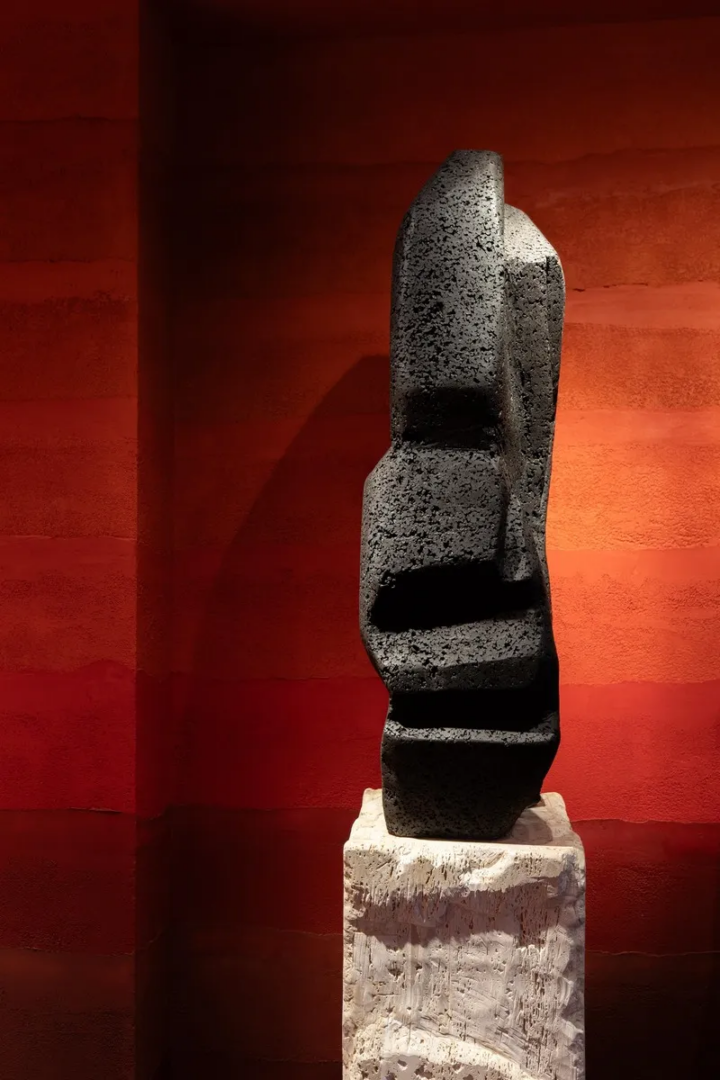
Each space is conceived as a meeting point between the Maison and the city that hosts it — part of a constellation of Amouage destinations worldwide reflecting the house’s ongoing international expansion. The store translates Salmon’s positions into physical space. Sculptural lines, warm tones, and material textures evoke desert light and the geometric motifs of Arab tradition, transporting visitors from Rome’s urban rhythm into something more contemplative. Monolithic forms in stone, wood, and cork dialogue with luminous and digital elements. Abstracted Omani topography runs throughout: deep red bands reference desert light at sunset, surfaces suggest sand underfoot, dark display structures echo the mineral compression of the Hajar mountains.
Inside, the full breadth of the Maison’s creative output is available: the Main, Secret Garden, Library, and Odyssey collections sit alongside the Exceptional Extraits, Attars, body line, and Gift of Kings — a complete ritual of High Perfumery. The Essences – Act II fragrances complete the picture.
Why Amouage defines generosity as a technical specification — not an aesthetic mood
Salmon describes Amouage through attitude rather than aesthetic category: “Amouage is not about one style of perfume. It is about a philosophy of generosity”. The term doesn’t signify excess — it means presence, diffusion, persistence, spatial occupation. A fragrance remaining perceptible hours after application doesn’t recede into background noise. “Arabic perfumery is a promise of diffusion. When you apply only two sprays and it lasts all day, that is generosity”. In practical terms, this means measurable projection radius, longevity duration, and sillage behavior — a counterweight to the frustration of fragrances that vanish within the hour.
Renaud Salmon relocated from New York to Muscat — and the move changed how he understands proportion, light, and material density
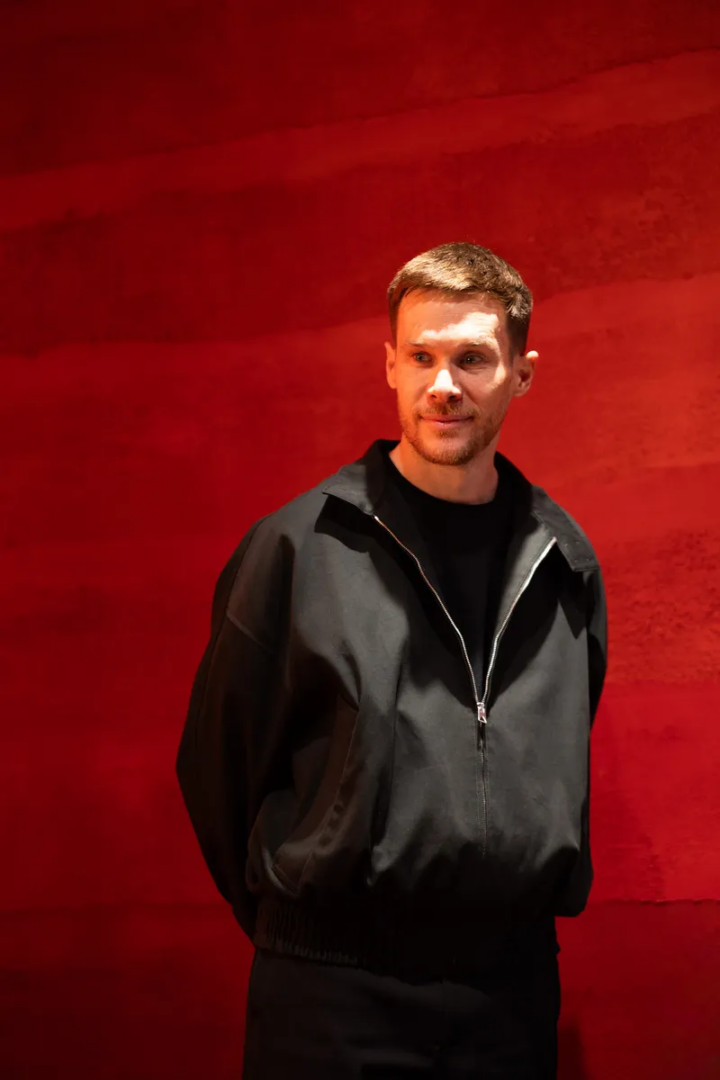
Renaud Salmon doesn’t work as a nose, the master perfumer composing formulas at the lab bench. He positions himself as creative director, building organizational structure around scent rather than authoring individual accords. After years oscillating between Europe and the United States, he relocated from New York to Muscat to lead Amouage. Long coastal walks and treks through the Al Hajar mountains altered his understanding of proportion, light, and material density.
“My role at Amouage is not to create a postcard of Oman. Amouage is not a tourist souvenir. The inspiration is anchored in reality, but the narrative is imagination and creation. I take distance from being only referential. In the end, I invent a new reality”. Living near production facilities means he can extend timelines rather than compress them — for Salmon, creativity comes from matching place, duration, and material into coherent form, not from individual virtuosity.
Influence over scale: why Amouage measures success by how much it shifts the conversation in perfumery, not by how many doors it opens
Salmon measures success through impact: “When people ask me what I want to achieve with Amouage, it is not about becoming bigger or making more money — those are consequences. What matters is to have an influence on perfumery. Perfumes can change your perception of the world, how you understand beauty, masculinity, femininity, and preciousness”. Fragrance constructs how bodies get read, how presence registers, how memory forms. To influence perfumery means affecting how these cultural codes evolve over time, which matters more to the house than expanding distribution.
That logic shapes retail strategy too: “It is much more expensive for us to have our creations in our own boutiques than to have them sitting on a shelf in an airport, but it is the right way to show the love we have for our products”.
Why Amouage refuses the ingredient inventory — and why Salmon thinks the best experts explain complexity in the simplest possible way
In high perfumery, vocabulary often precedes experience. Ingredient inventories function as value proof, and complexity signals authority. Salmon rejects this hierarchy entirely: “I don’t like speaking only about ingredients. If I tell you it contains lemon and patchouli, it means nothing“. Listing raw materials communicates nothing about structure, weight, or emotional register. “What impresses me most is when someone is an expert and can explain their expertise in the simplest possible way. I don’t want to speak an elite language”. Avoiding elite vocabulary means letting experience precede theoretical framework — a position that connects directly to everything else the house stands for.
With the Rome opening, Olfattorio Bar à Parfums and Amouage celebrate the meeting of two aligned visions: the excellence of international artistic perfumery on one side, the cultural and creative heritage of the Omani Maison on the other — an ideal dialogue between the millennia-old history of the Italian capital and the timeless landscapes of Oman.
Elisa Russo
Renaud Salmon is the Creative Director of Amouage, the High Perfumery house founded in the Sultanate of Oman in 1983. He oversees the brand’s creative direction, shaping its fragrance narratives, visual identity and product development.
Founded in Turin in 1981, Olfattorio Bar à Parfums pioneered the development of artistic perfumery in Italy and was the first to introduce the concept of olfactory tasting. Through the exclusive use of patented fragrance goblets, it transformed perfume into a sensory ritual and opened dedicated showrooms focused on public olfactory education. Today, Olfattorio operates boutiques and corners in major Italian cities, including 10 Bar à Parfums, 3 mono-brand Diptyque boutiques, 5 directly managed corners within La Rinascente department stores, and the mono-brand Amouage boutique in Rome.