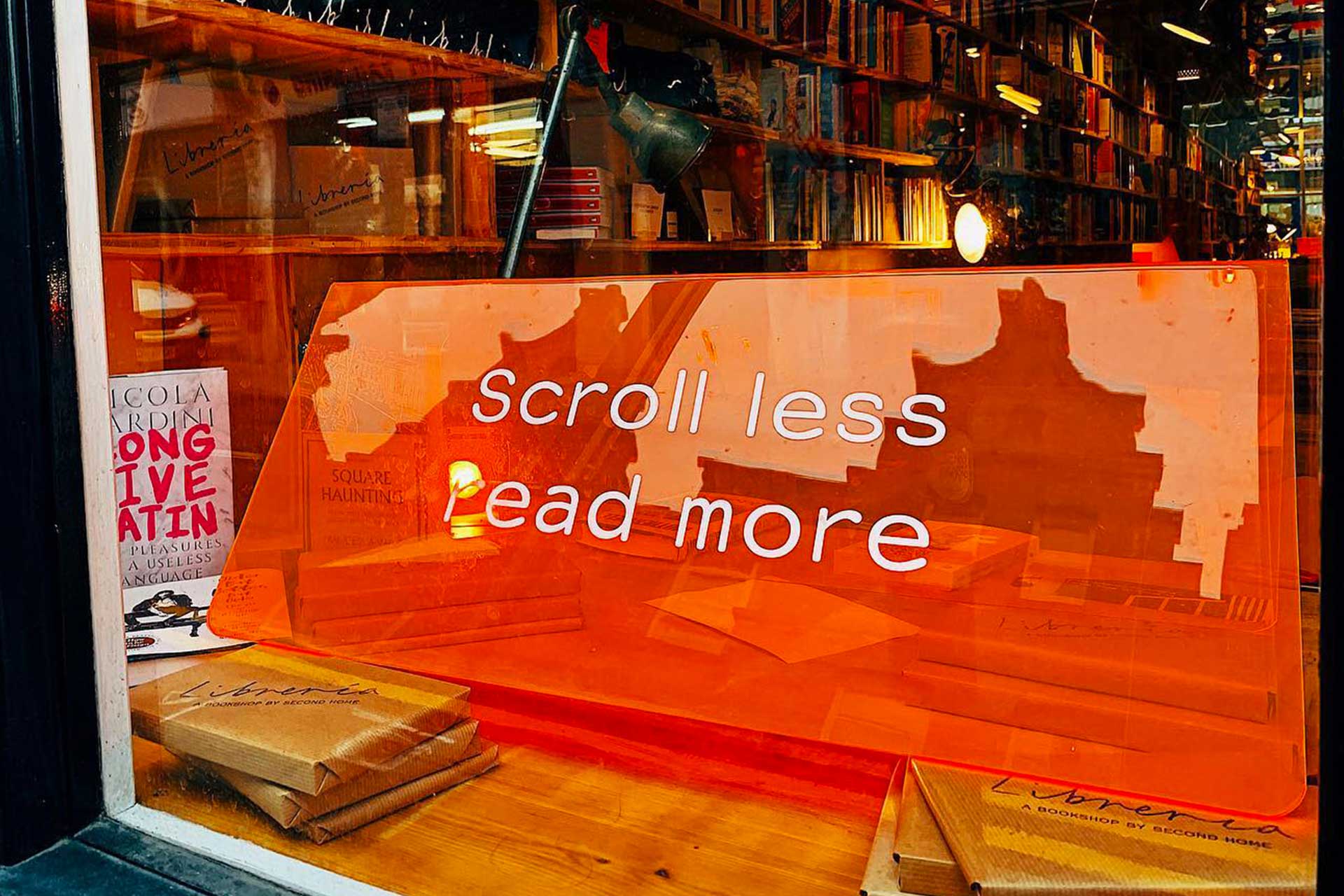
Libreria, London. A bookshop by Second Home, a labyrinth of books
Covering 830 square meters and housing more than 6,000 titles, Libreria is designed to go against the algorithm. No digital recommendations, no Wi-Fi, no distractions
The mind behind Libreria: Rohan Silva and his analogue refuge
Located at 65 Hanbury Street, E1 5JP, Libreria is the creation of Rohan Silva, a former Downing Street policy advisor turned cultural entrepreneur, and Sam Aldenton, his partner at Second Home, a network of creative workspaces across Europe. Their goal is to create a refuge from digital overload, where ideas and curiosity can grow. “We curate our books to maximise serendipity,” says the Libreria team.
Opened in February 2016, the shop rejects traditional categorization. Instead of fiction, biography, or travel, books are arranged under themes such as “Wanderlust,” “Enchantment for the disenchanted,” “The city,” and “The future.” This structure encourages readers to explore beyond familiar genres and encounter new authors and ideas by chance rather than through algorithms.
A bookshop against the algorithm: the art of getting lost
Libreria’s concept is built on an anti-digital approach. No Wi-Fi is available, and the use of smartphones or tablets is discouraged. The founders wanted to design a space where visitors could disconnect from devices and reconnect with reading.
Inside, order appears as disorder. Visitors move through shelves that form a labyrinth, where each turn leads to another discovery. The aim is not speed but exploration. In a world shaped by instant recommendations and personalised content, Libreria stands as a place that values curiosity and attention.
Design as experience: SelgasCano’s architecture
The space reflects the concept. Designed by Spanish architects José Selgas and Lucía Cano—known as SelgasCano and noted for the 2015 Serpentine Pavilion—the shop takes inspiration from Jorge Luis Borges’ “The Library of Babel.” The story, about an infinite library containing every book ever written and yet to be written, became the model for the design.
Floor-to-ceiling wooden shelves spiral around the room, handcrafted by artists from the Slade School of Fine Art. The walls emit an amber tone, while a black reflective ceiling made of barrisol gives an illusion of depth. Mirrors and irregular lines lead visitors through a shifting layout. Reading nooks cut into the walls contain cushions for those who wish to sit and read. Libreria becomes a spatial experience where architecture and literature meet.
Beyond the books: printing press, events, and community
Libreria includes a basement printing press where visitors can take part in workshops and print their own work.
The venue hosts a cultural program of book launches, readings, writing and bookbinding workshops, music sessions, and themed evenings. The space is also available for private hire, accommodating about 40 seated or 60 standing guests. It serves as a location for launches, talks, and gatherings.
For those unable to visit, Libreria’s online shop offers a selection of limited-edition books, signed copies, and special releases that change regularly, following the same curatorial approach as the physical space.
Inside East London’s cultural core: the neighborhood around Libreria
Between Shoreditch, Whitechapel, and Spitalfields, Libreria stands in London’s East End, an area known for its mix of cultures and creative energy.
Nearby is Brick Lane, with its Sunday markets, vintage shops, and food stalls. From Old Street to Kingsland Road, the area hosts galleries, studios, and venues that promote experimentation and diversity.
For visitors arriving from Liverpool Street Station, the walk through Spitalfields Market—a 19th-century structure—is part of the experience before reaching Libreria’s façade with its white lettering.