At Casa Perbellini 12 Apostoli in Verona, dinner starts three centuries ago
Roman remains beneath the dining room, Patricia Urquiola upstairs, Giancarlo Perbellini in the kitchen and Hemingway in the walls — the many lives of Casa Perbellini 12 Apostoli in Verona
Verona, Casa Perbellini 12 Apostoli. Can a restaurant alone justify a trip?
Can a restaurant be the sole reason of a trip? In the Michelin star universe, the answer is yes: that’s exactly what earning three stars means. And if the destination is Verona, the reason might well be Casa Perbellini 12 Apostoli, which after achieving its trio of stars in 2025 was also confirmed at the same level for 2026. Just a few steps from Piazza Erbe, the restaurant still stands guard over No. 3 Vicolo Corticella, where time seems frozen in history: it was already there in the 1700s. Rumor has it it’s among the oldest restaurants in Italy. Crossing the massive tufa-stone doorway feels like stepping into a sealed microcosm holding three centuries of memory: the city’s, the country’s, and that of chef Giancarlo Perbellini, who trained here in the 1980s when he was still a teenager. At these tables, everyone has eaten—from Dino Buzzati to Indro Montanelli.
From the Temple of Augustus to Patricia Urquiola’s stagecraft
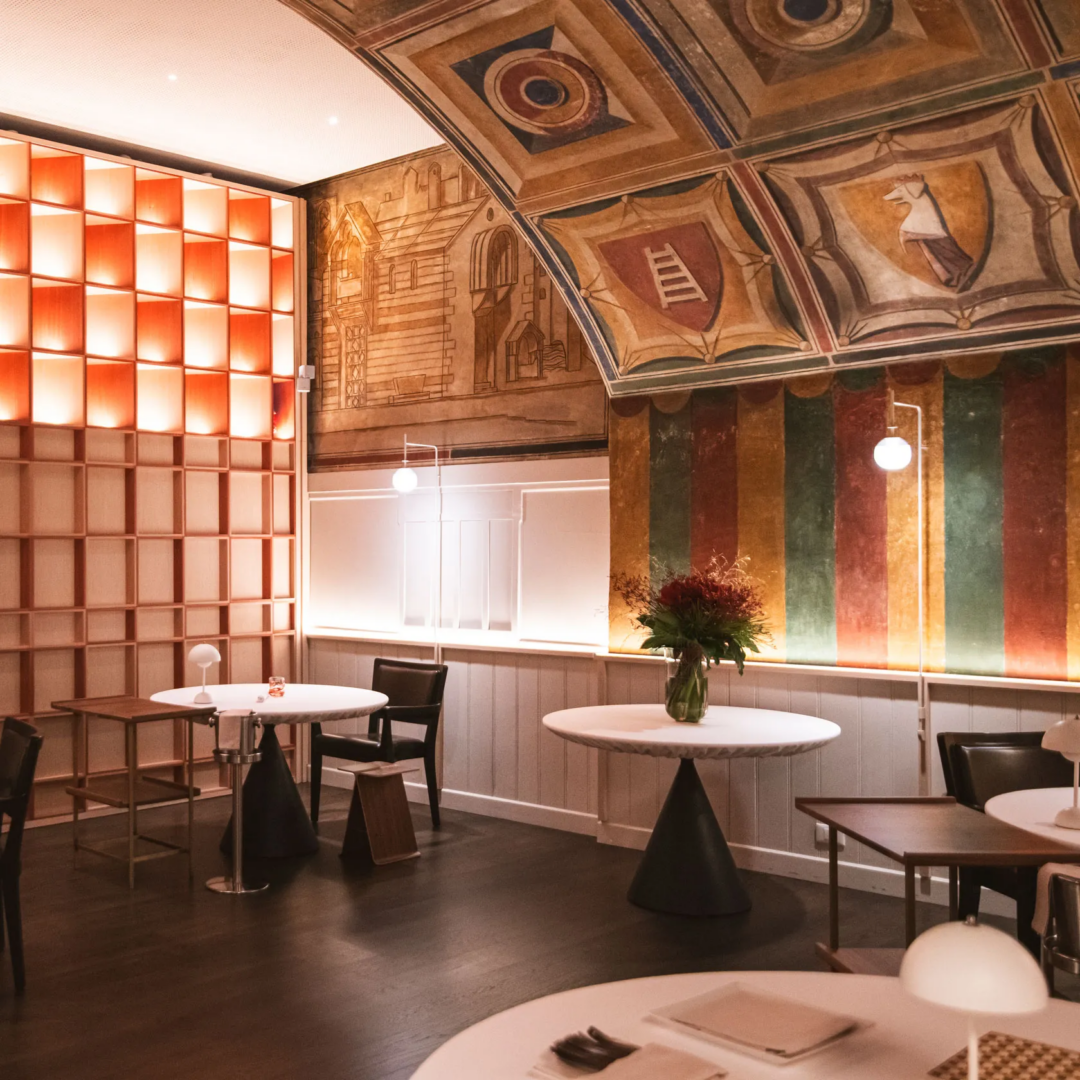
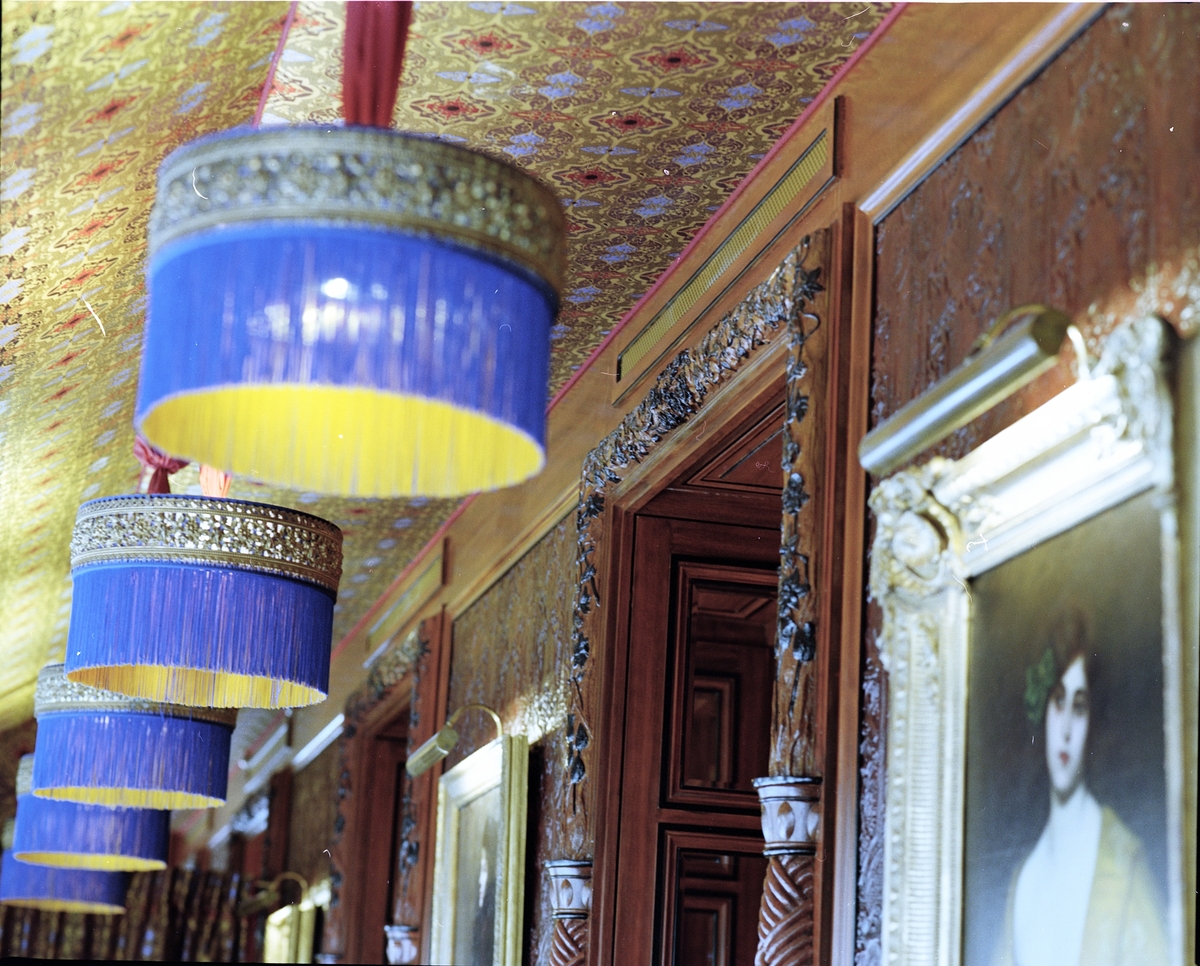
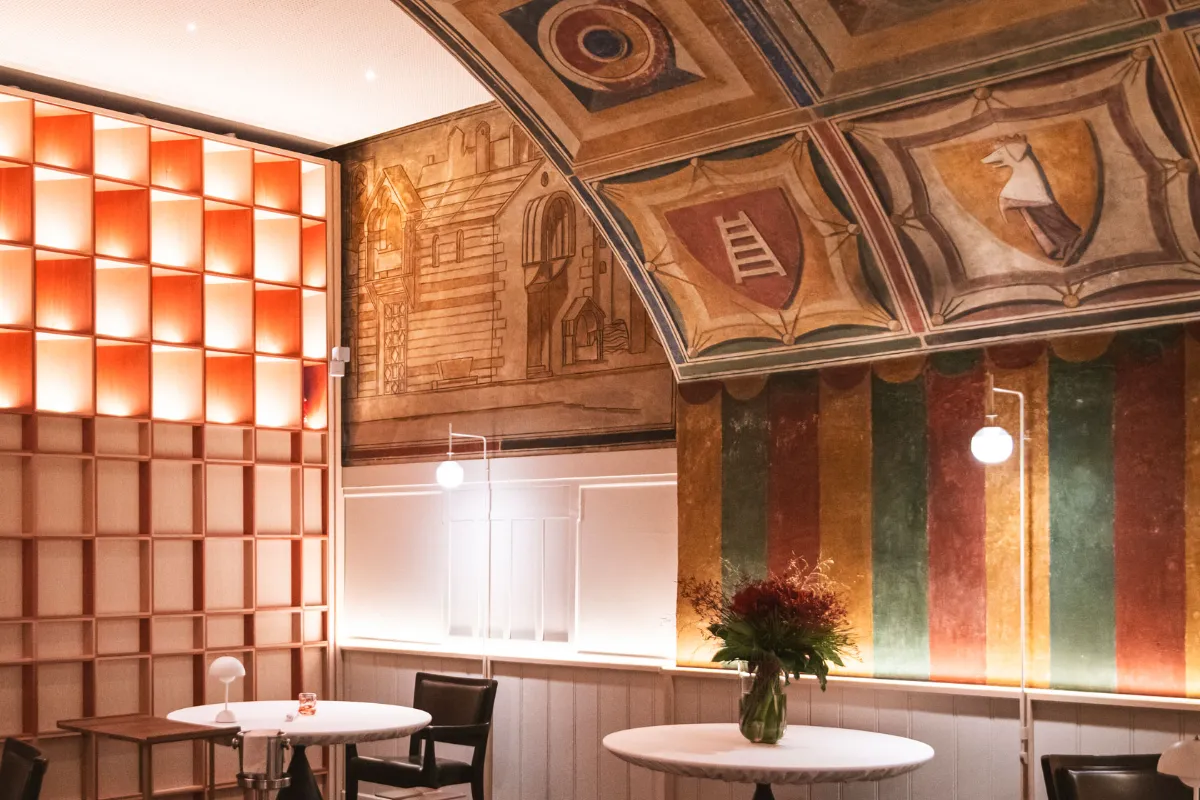
The restaurant’s 800 square meters are a collision of eras. Underground, you’ll find fragments of the walls of the Temple of Augustus, remnants of a Roman road, a well that once took water from the Adige River, and the base of a medieval tower. All of it was preserved during the construction of the new wine cellars a few years ago. Upstairs, frescoes painted in the 1940s by Pino Casarini evoke a theatrical vision of Romeo and Juliet. In 2023, when Giancarlo Perbellini took the reins of the restaurant, all of this was joined by the hand of Patricia Urquiola, working alongside architect Silvia Bettini, in an intervention that feels more like direction than a simple restyling. The entrance welcomes guests much like a living room does at home. A large suspended bookcase with a theatrical flair conceals the dining rooms, where warm tones—maple and terracotta—blend to restore the site’s medieval character: the palazzo dates back to the 1300s.
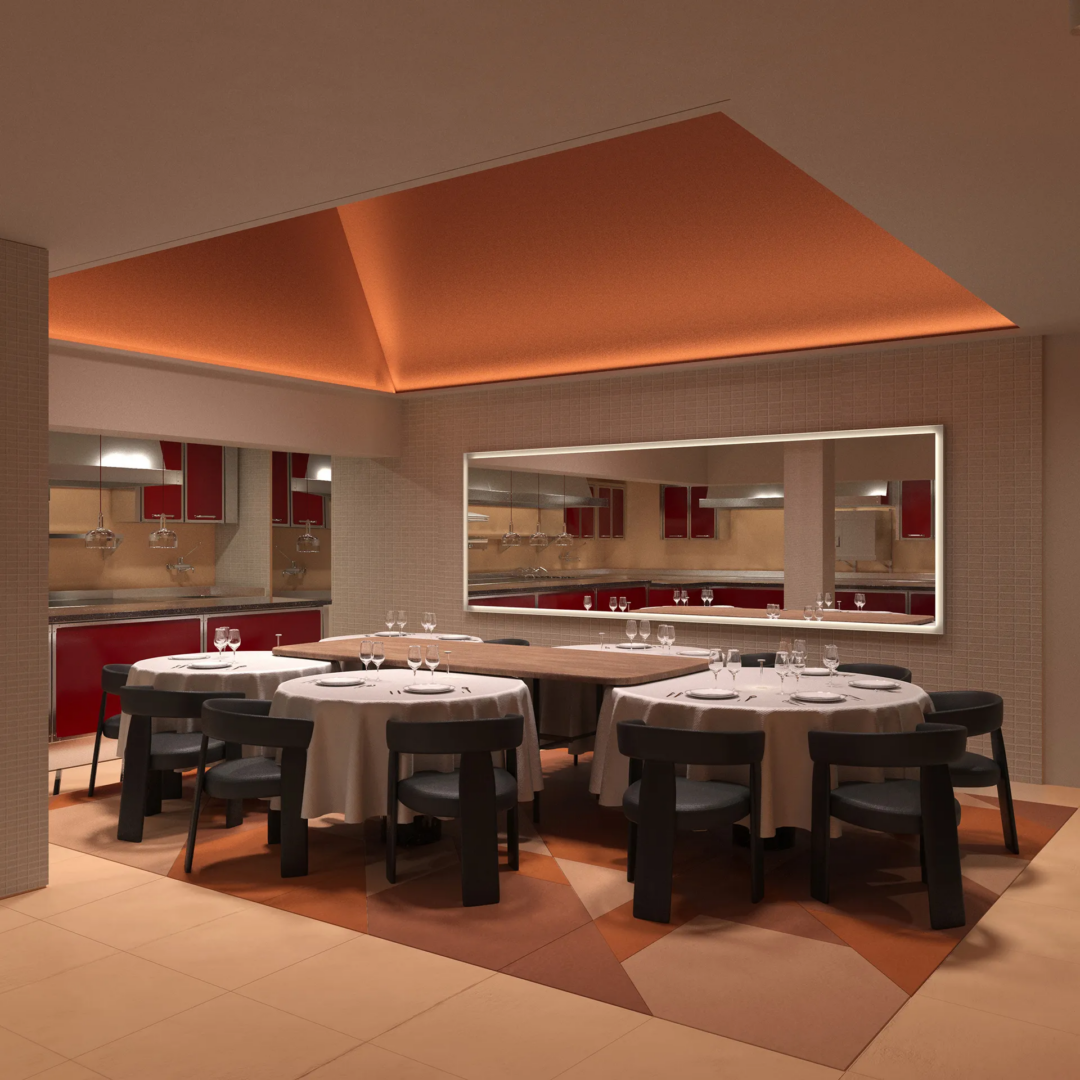
The past of Casa Perbellini 12 Apostoli is never hidden: it is on full-display, blended into the present. Each space functions as an act in its own right, part of a larger, cohesive project. In one room, guests dine beneath a frescoed ceiling; in another, under small spotlights that construct a starry sky. Among the various beating hearts of the restaurant, the Chef’s Table is its undisputed center. A single structure with modular tables that move like pieces in a theatrical production, positioned where the chef had originally planned to install the kitchen. The suspended hood—clad in sound-absorbing panels and illuminated by wall-washer lights—is an integral part of the set design, serving as a luminous curtain. The chef’s brigade (of a very young age) moving among the counters of the L-shaped kitchen is the cast. The meal is at once a private gesture and a public performance. On the floor stands out a ceramic carpet. The tiles are also designed by Urquiola: they belong to Mutina’s Tierras collection.
From a popular inn to Italy’s cultural hub: Hemingway, D’Annunzio, the 12 Apostoli Literary Prize
In the past, the restaurant hosted the merchants of Piazza Erbe: they are the twelve apostles referenced by the sign. This is where they would sit down to eat and conduct business. For a long time, it was a popular inn. Then, over the centuries, the kitchen gained increasing prestige. Its second life began in 1921, when Antonio Gioco—doorman at Verona’s Hotel Colomba d’Oro—decided he wanted to own it. The banks denied him a loan, until Arnoldo Mondadori entered the picture. He had met Gioco while staying at the hotel where he worked, and he agreed to guarantee the loan, allowing the deal to go through. It was the beginning of the metamorphosis that would place the restaurant at the center of Italy’s cultural world. When Maria Callas sang in Verona, she was a regular guest, as was Ernest Hemingway, who still has a corner dedicated. The same can be said for Gabriele D’Annunzio—whose letters to Antonio Gioco are still preserved inside—as well as Totò and Ezra Pound.
The first Michelin star arrived in 1959, when the restaurant was run by Giorgio Gioco. He’s the one who turn 12 Apostoli into something of a cenacle of intellectuals, by organizing the first edition of the eponymous literary prize in 1968, which for Verona is roughly what the Bagutta Prize is for Milan. Among those behind the idea were also Indro Montanelli, Giulio Nascimbeni, Enzo Biagi and Cesare Marchi. Each year, a jury of twelve awarded the prize to figures from the worlds of journalism, publishing, and culture at large. The prize continued until 2017. In 2023, management of the restaurant passed from the Gioco family to Perbellini.
Giancarlo Perbellini takes the lead at 12 Apostoli
When the offer to take over the restaurant came, Perbellini was at a crossroads. He had just ended the lease on Casa Perbellini in Piazza San Zeno, where he’d spent nine years. He had opened it after first trying to see if there would ever be room for him at 12 Apostoli—but at the time, the Gioco family wasn’t ready to let it go.
With Casa Perbellini closed, he was thinking about going itinerant—something mobile and flexible—rather than settling into a new permanent spot. It just wasn’t the right moment to look for another home. Then the phone rang. Antonio Gioco Jr., Giorgio’s son, was on the line. The chef was leaving, and they weren’t too keen on finding a replacement. Everything fell into place. Perbellini took the lead, the restaurant became Casa Perbellini 12 Apostoli, and a year later, it earned its third Michelin star.
A life in the kitchen and an entrepreneurial spirit
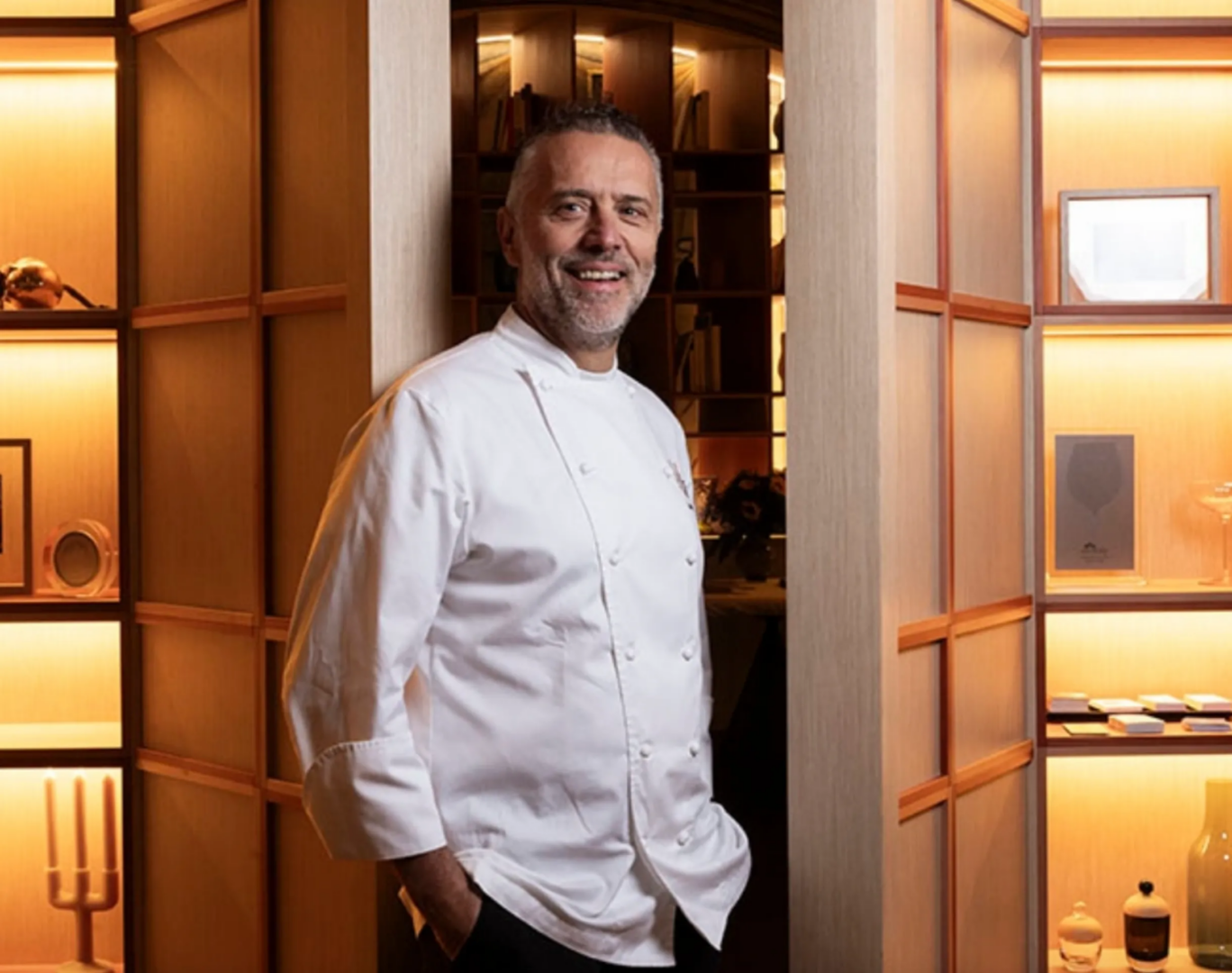
Born in 1964 in Bovolone, in the Verona area, Perbellini first stepped into 12 Apostoli before he was twenty. Food and cooking, in the broadest sense, had permeated his childhood: his grandfather Ernesto was a pastry chef, and his father Giovanni Battista—known as Tita—followed in his footsteps, turning the family business into a more structured, entrepreneurial venture. Giancarlo decided to pursue a career in restaurants. A choice that strained his relationship with his father, who passed away just a few months before Perbellini earned his third Michelin star.
As he grew, he carried with him everything he had learned at home, along with the knowledge gained at the hospitality school in Recoaro, Vicenza, and then in kitchens across some of the finest restaurants: Il Marconi, Il Desco, and 12 Apostoli in Verona, San Domenico in Imola. Then there was France: in Paris, Taillevent, L’Ambroisie, and La Terrasse in Juan-les-Pins.
Giancarlo Perbellini’s restaurants
At twenty-six, in 1989, he opened Perbellini in Isola Rizza. His career continued to rise: in 1992, he won the title of Chef Européen du Poisson in Copenhagen. The first Michelin star came in 1996, the second in 2002. In 2007 and 2008, he was nominated for the third, which didn’t come at the time, to much disappointment. Meanwhile, building a stronger entrepreneurial drive, he opened two more restaurants in Verona: the gourmet pizzeria Du de Cope (2004) and Al Capitan della Cittadella (2005). Many others would follow.
In 2012, Locanda Quattro Cuochi opened, also in Verona, followed a year later by tapas bar Tapasotto. In 2014, he moved from Isola Rizza to Piazza San Zeno, opening the stoves of Casa Perbellini. Four years later, Locanda Perbellini Bistrot landed in Milan. Two years after that came Locanda Perbellini al Mare, on the beach at Bovo Marina, Montallegro (Agrigento), followed shortly by Locanda Perbellini ai Beati on Lake Garda. The circle was completed when Casa Perbellini moved from San Zeno to Vicolo Corticella San Marco and merged with 12 Apostoli.
Perbellini’s signature wafer and a stroll through Verona as a dessert
With the history of the place and its chef established, it’s time to talk about the food. Today, Casa Perbellini 12 Apostoli offers three tasting menus for dining room guests: one inspired by his relationship with his wife and the idea of home, one reflecting his culinary past and evolution, and a vegetarian option. At the Chef’s Table, guests enjoy four courses that change daily, along with a fixed portion drawn from the menu dedicated to his wife.
The dish that best sums up Perbellini’s career is his wafer—which he always cites as his most successful creation. It’s not a dessert: it combines sea bass tartare, goat cheese, chives, and licorice. To close the circle, the meal ends with a tribute to the city of Verona. Together with pastry chef Luca Bnà and designers Anna and Gian Franco Gasparini, Perbellini created an edible walk through the city, with six pieces modeled after its most iconic landmarks: the Arena, the Madonna Verona Fountain, Via Mazzini and Torre dei Lamberti, Ponte Pietra, and the Roman Table.
Giacomo Cadeddu