Future Bookstore in Changshu and the question of what a literary space can become
In an ancient water town in Jiangsu province, Future Bookstore uses a traditional pagoda, a speculative interior by Mur Mur Lab and a reduced selection of titles to explore how bookstores might exist in the future
Futurism as something unseen: offering fragments of imagination at Future Bookstore
“Futurism is something that people can’t see now. The idea is to give them a fragment of your imagination and let them interpret the future the way they want,” says architect Samoon of Mur Mur Lab. The bookstore in Changshu, known as Future Bookstore, was conceived as a space where visitors are not given a fixed narrative of the future but are invited to read and project their own.
Located in an ancient water town, the bookstore is intended as a small but precise experiment in what a future literary space might be. Rather than predicting a single vision of what comes next, it offers a set of spatial cues, materials and atmospheres that suggest possible directions.
A futuristic bookstore embedded in a historic water town in Jiangsu
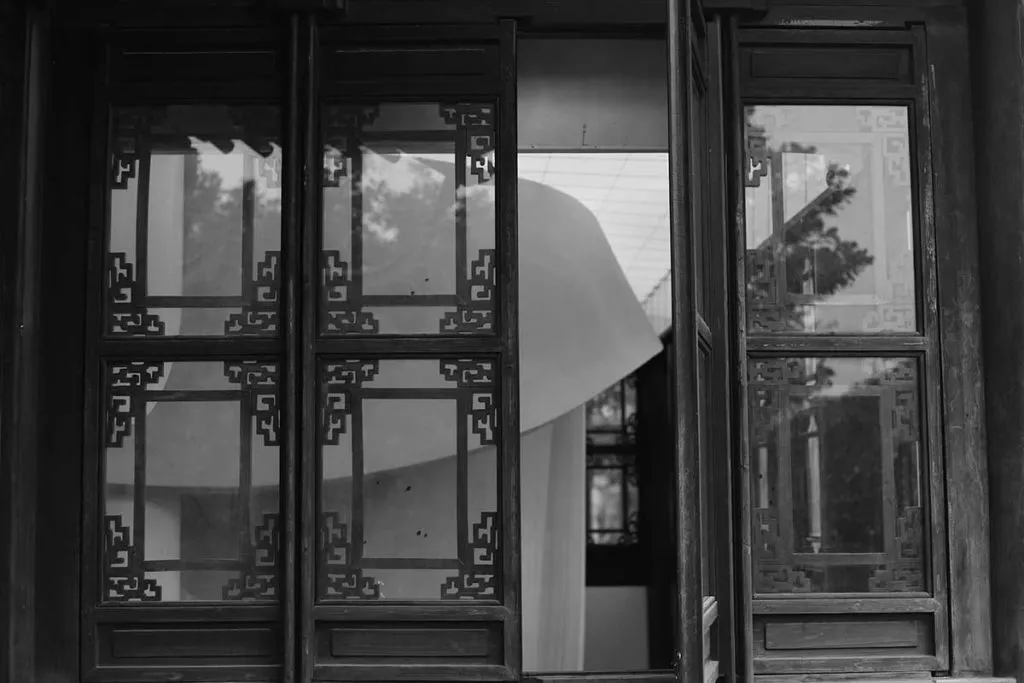
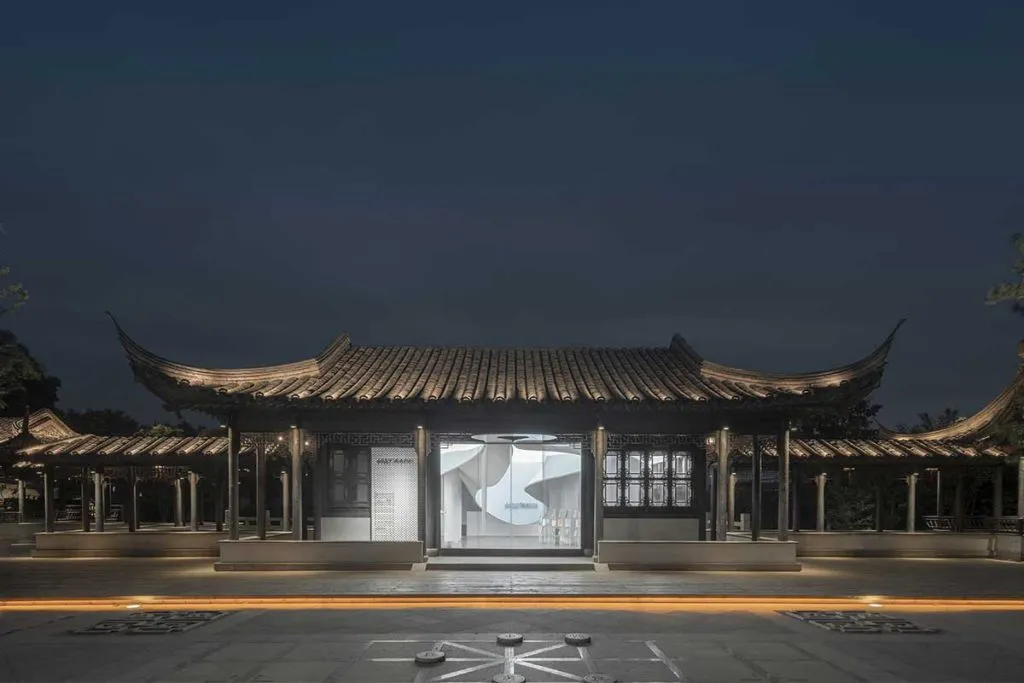
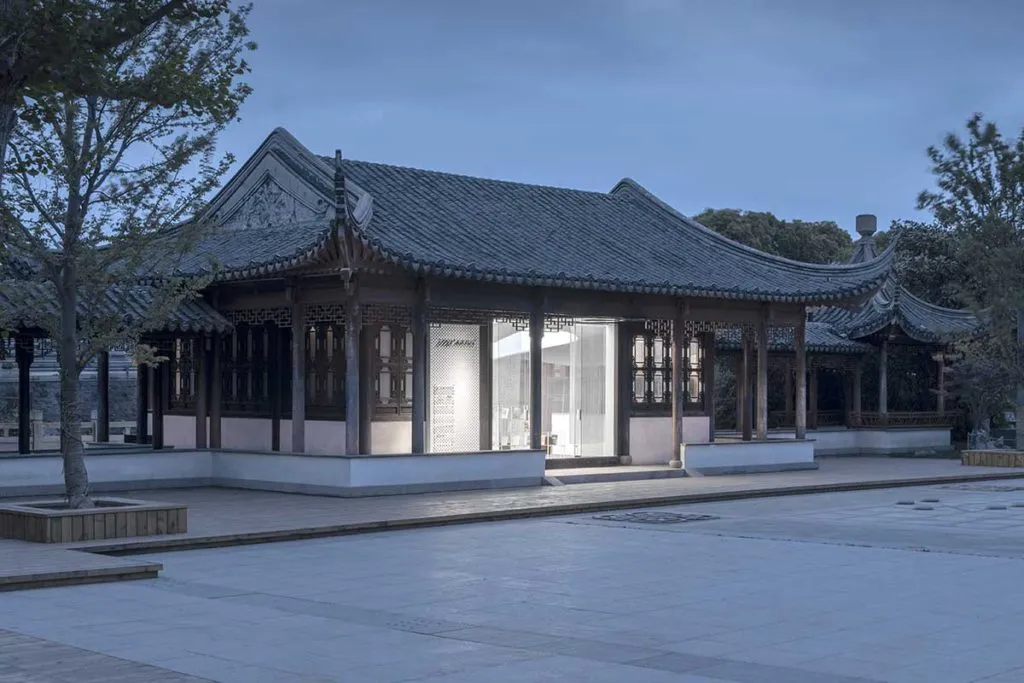
Future Bookstore is located in Changshu, a county-level city in Jiangsu province, China. It occupies a traditional pagoda structure in Guli, one of the area’s historic water towns. From the outside, the building retains the language of traditional Chinese architecture; inside, the atmosphere shifts towards a speculative, futuristic realm. The contrast between the old envelope and the new interior is central to the project, creating a kind of time-travel effect for visitors.
The interior was designed by Mur Mur Lab, a Shanghai-based architecture studio. “The client had the vision of a bookstore that could uphold a non-traditional function within a traditional context,” explains Samoon, partner and co-founder of the studio. The project was commissioned by Yuanjian Holding, a tourism developer established in 2003. In recent years, Chinese authorities and private actors have increasingly turned historic countryside areas into tourism destinations, introducing new programs—restaurants, bookstores, parks—into fragile urban fabrics. “It is a typical way China is now developing the countrysides. In the future, they want to create multi-functional environments,” Samoon adds.
Between an old library and a mall bookstore: design as a bridge from memory to imagination
Mur Mur Lab’s early ideas for Future Bookstore were shaped by memories. When they thought of the word “bookstore,” two contrasting images emerged. One was a reading hall in an old library: high ceilings, endless rows of shelves, the smell of paper and mildew. The other was a commercial bookstore in a busy shopping center, with strong lighting, displays and a contemporary retail logic.
Drawing from these opposing impressions—past institutional reading rooms and modern retail spaces—the architects began to build a third possibility. “Working in a historical location, memories became an important analogy in the design process. Imagination was triggered by memories and experience,” says Samoon. The future, in this account, is not detached from the past; it is layered on top of it.
Leaving space for interpretation was a guiding principle. “Futurism is something that people can’t see now; the idea is to give them a fragment of your imagination and let them interpret the future the way they want,” Samoon notes. For him, inner calm is a condition for this kind of work: “I’m always in search of inner peace for my creative flow. I find that in stillness, and when I am drawing.”
Future Bookstore was conceived as a space with no fixed moment of completion, drawing on notions of the “undetermined” and the “impermanent.” It aims to evoke stillness, folding that stillness into everyday life while maintaining a kind of quiet internal monologue.
A literary landmark next to a historic Qing dynasty collection
Future Bookstore stands near the two-hundred-year-old Tieqintongjian Pagoda, one of the private book collection houses of the Qing dynasty, the last imperial dynasty in Chinese history (1644–1912). The library holds more than one hundred thousand rare book editions. Built during the Jiaqing era and located at the center of Guli Jizhen, it condenses two centuries of book culture.
The neighborhood is defined by bluestone slabs, small-scale architecture, pagoda silhouettes, Su-style gardens and the presence of water. A river flows along the east and west sides of the town, reflecting houses on both banks and reinforcing the symmetry common to Chinese spatial design. Nearby landmarks include Tongjian Tower, Tieqin Bronze Swords and Gongnong Bridge over the Yangtze. Future Bookstore operates in this dense context of literary history and scenic tourism, proposing a contemporary counterpoint.
From store to museum: how display, rarity and visual focus reshape the idea of a bookstore
The architects reference a quote attributed to Andy Warhol: “In the future, a store would be a museum.” In line with this, Future Bookstore does not operate as a conventional retail bookstore. It presents itself more as a literary landmark, where books are exhibited for visual and intellectual engagement rather than primarily for sale.
Only about fifty titles are displayed, focusing on art, humanities, history and culture. The books are placed on transparent shelves, which make them appear to float in space. Acknowledging the uncertainty surrounding the future of printed books, Mur Mur Lab devised a circulation strategy that centers on content—whether physical or otherwise—rather than on quantity. The reduced number of titles encourages slower reading, closer attention and a museum-like experience of the objects.
Architecture and construction: a looped paper memory under a preserved roof
The store covers approximately seventy-five square meters on a single level. The original structure and many interior elements of the building were retained. “Under the old roof structure hides a new roof,” explains Samoon. “They share a similar logic of form: the ridge, the inner and outer cornice, the clear volume of the two slopes. We didn’t break the old walls and doors; instead, we added a second façade to everything. The idea was to create an image of the future that co-exists with the past.”
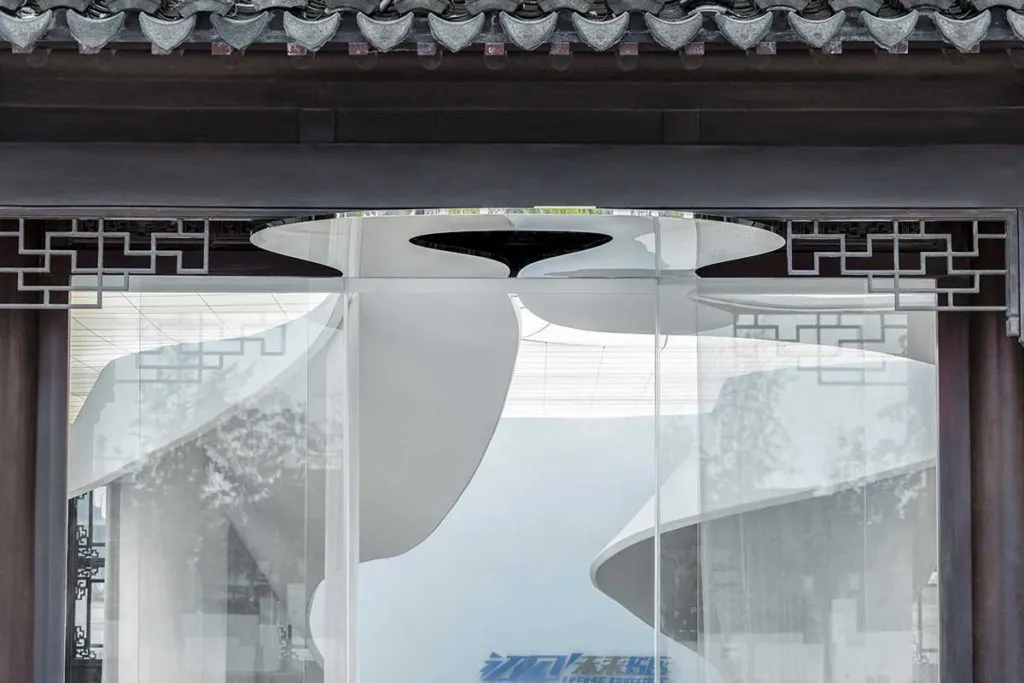
Suspended beneath the existing roof is a white curved loop that runs through the space and acts as a signature installation. Its form is linked to the tradition of long vertical paper books in China. “In China, we have a culture of long vertical paper books. Traditional drawing books often had long leaves. The long paper from the past turns into a loop in our imagination of the future,” says Samoon.
The loop is made from metal mesh, a material that allows light to filter through. Natural light from outside is softened as it passes through the mesh, creating a layered luminosity. “Metal mesh and semi-transparent glass are the two materials we like working with because they allow you to play with light, and they remain slightly clandestine,” Samoon notes.
Despite its futuristic appearance, the structure does not depend on advanced technologies. “Behind our form, we incorporate the use of logic and geometry. When you see the loop, people think it’s some sci-fi structure, when it is made with a wooden skeleton, wrapped with paper and then coated with putty,” he explains.
A speculative café: the robotic arm and a reduced model of social interaction
Future Bookstore also includes a small café component. Interpreting what a “future bar” might be, the architects installed a robotic arm to serve coffee to visitors. “The aim was to create a space that doesn’t encourage interaction among people. This was our interpretation of a future bar,” says Samoon. The gesture suggests a future in which service is automated and social contact is minimized, leaving visitors alone with their books, their screens or their thoughts.
Mur Mur Lab’s practice and their approach to future stores and micro-architecture
Mur Mur Lab was founded in 2015 by architects Samoon and Lee, partners in both their professional and personal lives. The two met while studying architecture at Southeast University and later established their practice in Shanghai. “I didn’t have the ambition to be a well-known architect around the world. We just wanted to work and do something in architecture, so we started the lab,” says Samoon.
The studio sees design as a tool for urban renewal and for social and environmental improvement. Their work often focuses on “future stores,” urban installations and small-scale architectural renovations. Feelings are a central element of their approach. “When working on a site’s architecture, feelings become an important attribute for us. We do not only create the form but also the feeling. The form contains the feeling. Feeling emerges from you; everyone interprets it differently, and that is what makes it so special,” he explains.
Future Bookstore as a glimpse into what bookstores might be
Future Bookstore is located in Guli, within Changshu, and was established as a way of offering a glimpse into the future of bookstores. It presents around fifty carefully chosen titles and operates more as a museum of reading than as a retail outlet: the books are there for visual and intellectual engagement rather than for purchase.
In this setting—between a historic pagoda, a reflective river and a mesh of light inside a traditional roof—Future Bookstore proposes that the future of literary spaces may not be about more content, but about more precise, carefully framed experiences of reading and looking.