Uroš Kramberger: at Grünwaschen, sustainability is not a marketing slogan
Greenwashing has become a buzzword – founded by Uroš Kramberger, Grünwaschen in Berlin supports independent designers with ethical fashion and fair labor standards
Grünwaschen: A Concept Store Redefining Sustainability Through Ethics, Community, and Care
Conceived by Berlin-based creative Uroš Kramberger, Grünwaschen introduces a concept store grounded not only in ecological awareness, but in a holistic understanding of sustainability that connects materials, makers, and social relations. Officially opening on December 1st, the project reclaims a commercial format that has become ubiquitous in urban culture and reinterprets it through a critical, human-centered lens.
Located at Rosa-Luxemburg-Straße 25, just minutes from Alexanderplatz and surrounded by galleries, theaters, and independent shops, Grünwaschen situates itself within Berlin’s cultural corridor while opening a broader conversation around value, community, and ethical production.
The opening will be followed by a gathering in December, inviting Berlin’s creative community, friends, and curious visitors to experience the inaugural collections alongside a collaborative matcha bar—an informal setting designed to encourage dialogue and connection.
Beyond the Typical Concept Store: Rethinking Fashion, Commerce, and Cultural Responsibility
Kramberger’s personal and professional journey shapes the ethos of Grünwaschen from the ground up.
“I come from Slovenia and have been in the fashion industry for fifteen years,” he explains. “My entry point was photography, which gradually drew me into the world of designers and production.” At eighteen, he moved to Ljubljana, where he spent three years working inside a fast-fashion company—an experience that exposed him firsthand to the mechanics of mass production. Later, after studying marketing, he came to understand the other side of the system: the narratives, seductions, and externalities of fashion communication.
An exchange program eventually brought him to Berlin. Immersed in the city’s ecosystem of independent designers and creative practitioners, Kramberger began envisioning a space that could gather these voices and transform commercial sustainability into an actual cultural practice.
“Concept stores are not revolutionary,” he notes. “What’s different here is the approach. Greenwashing has become a buzzword—everyone uses it as a cover. Brands talk about the environment to justify ignoring other crucial aspects of labor and production, especially the human element: fair salaries, psychological pressure, impossible working hours. They forget the people.”
At Grünwaschen, sustainability is not a marketing slogan. The name itself plays ironically with the term, reframing sustainability as a practice of care—for nature, for the people who make the garments, and for those who work within the retail space itself.
Sustainability as a Human Practice: Centering Labor, Ethics, and Fair Working Conditions
Greenwashing often reduces environmental discourse to recycled materials and idyllic nature imagery. In fashion, this narrow focus frequently obscures the human cost behind production. Workers are underpaid, exploited—particularly within large brands—and trapped in an industry shaped by insecurity and extreme competition, making it accessible only to those who can afford it both financially and psychologically.
“For me, sustainability is about nature, but also about people—too often disregarded or exploited,” Kramberger says. His goal is to support small independent brands that resist mass-production logic, prioritizing ethical labor conditions, transparent supply chains, and genuine human relationships.
“Behind every designer there are human beings,” he adds. “Ethics should go hand in hand with decency. I want to work with good people—not just talented ones, or those who claim to work sustainably, but people who treat others with respect.”
This philosophy translates into what Kramberger describes as a circular model, similar to the role agencies play for emerging talent. Grünwaschen operates partly as a retail space and partly as a support platform, helping designers gain visibility, access funding opportunities, and build networks. “The idea is circular,” he explains. “I support them, and they support me back.” In this way, the store becomes less a point of transaction and more an infrastructural node within a wider creative ecosystem.
Building Community Through Fashion, Activism, and Cultural Exchange
Looking ahead, Kramberger envisions Grünwaschen evolving into a small but active cultural platform—one that hosts conversations, gatherings, and collaborative interventions. “In time, I hope Grünwaschen becomes a cultural hub,” he reflects. He also aims to introduce activism into the space, drawing on connections with Slovenian activist communities from his homeland and his years in Ljubljana.
Situated between Berlin’s commercial center and its independent artistic networks, Grünwaschen occupies a uniquely liminal position. The foot traffic of Rosa-Luxemburg-Straße intersects with the intimacy of nearby galleries, studios, and local businesses, allowing the project to engage both inwardly and outwardly. While deeply rooted in its neighborhood, the store maintains an international resonance through its mix of Berlin-based and Balkan designers.
A Human-Oriented Curatorial Vision Focused on Values, Not Trends
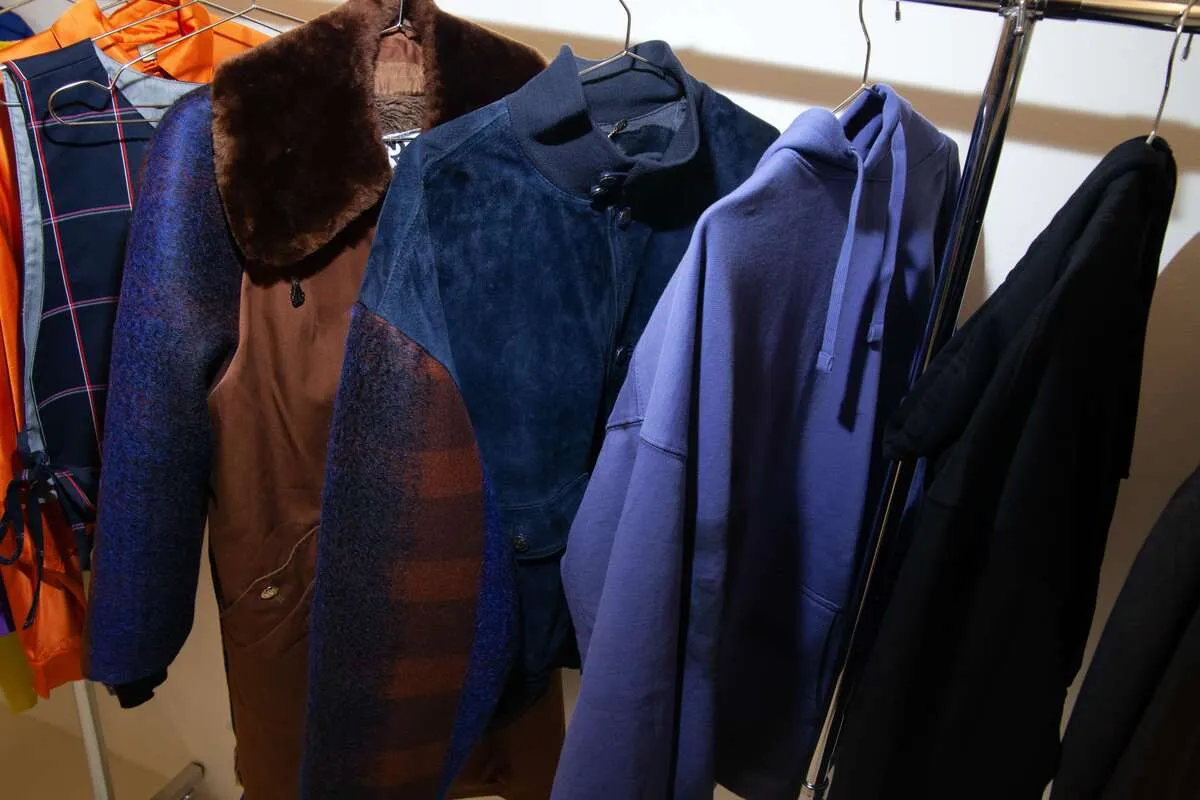
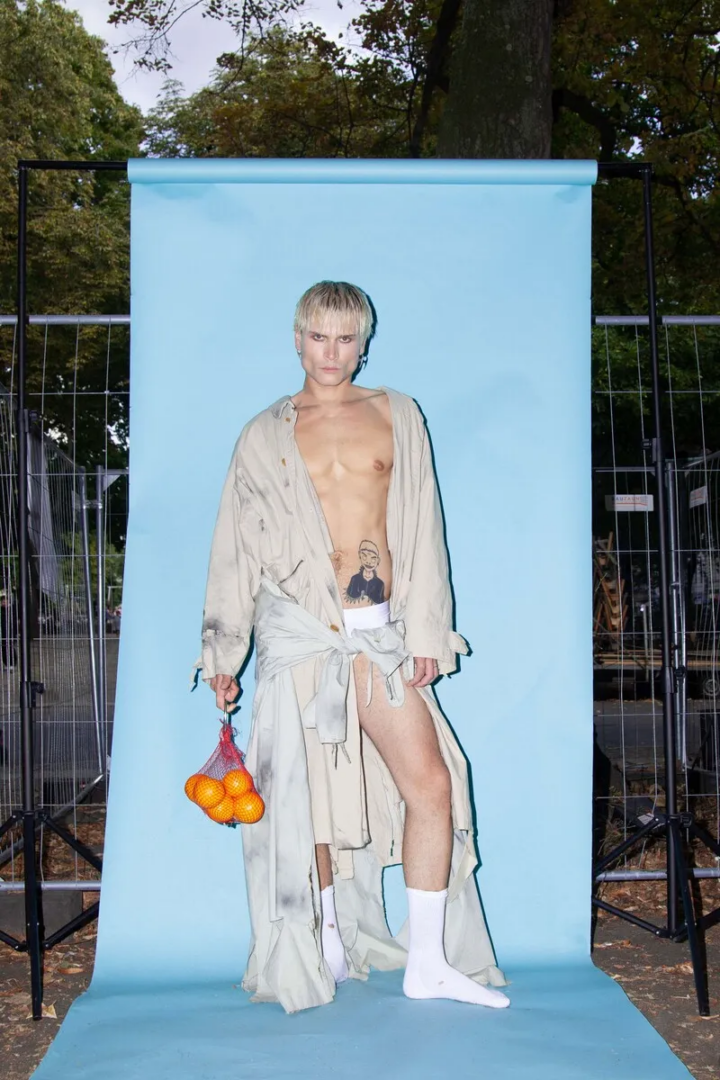
The store’s curatorial approach privileges shared values over fleeting trends. Brands are selected based on ethical principles, aesthetic sensibility, and—above all—the humanity of their makers. Labels such as a.ACHAT, Azul Ballestero, and Couture Reloaded exemplify this ethos, each offering a deeply personal approach to craftsmanship and design.
“I want to sell clothes made by nice people,” Kramberger says. “It might sound cheesy, but it’s very simple and honest: I want to be surrounded by love.”
The selection is intentionally diverse, spanning gender-neutral garments alongside distinctly feminine or masculine designs, and exploring a range of silhouettes, materials, and artistic foundations. Berlin-based designers such as dan0m00n, FELINE, and jurgen1300 form the core of the offering, complemented by Balkan voices like MemenTo, whose contemplative work reflects the founder’s personal history. Together, these designers form a coherent yet inclusive constellation of creative identities.
Sustainable Interior Design Through Reuse, Resourcefulness, and Material Honesty
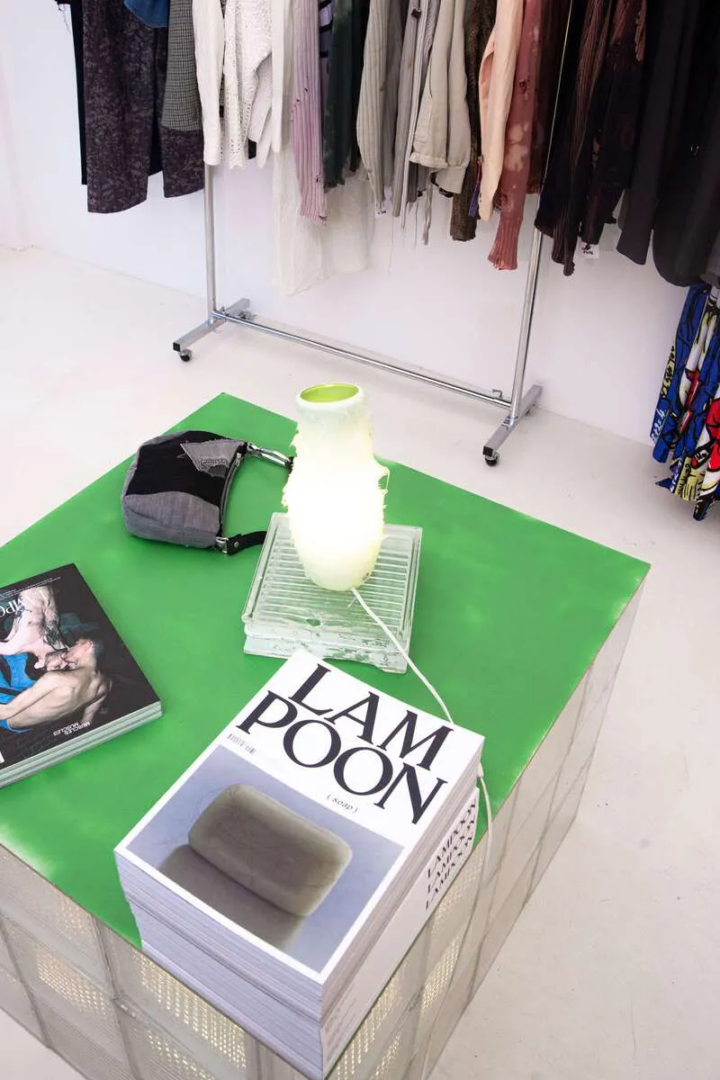
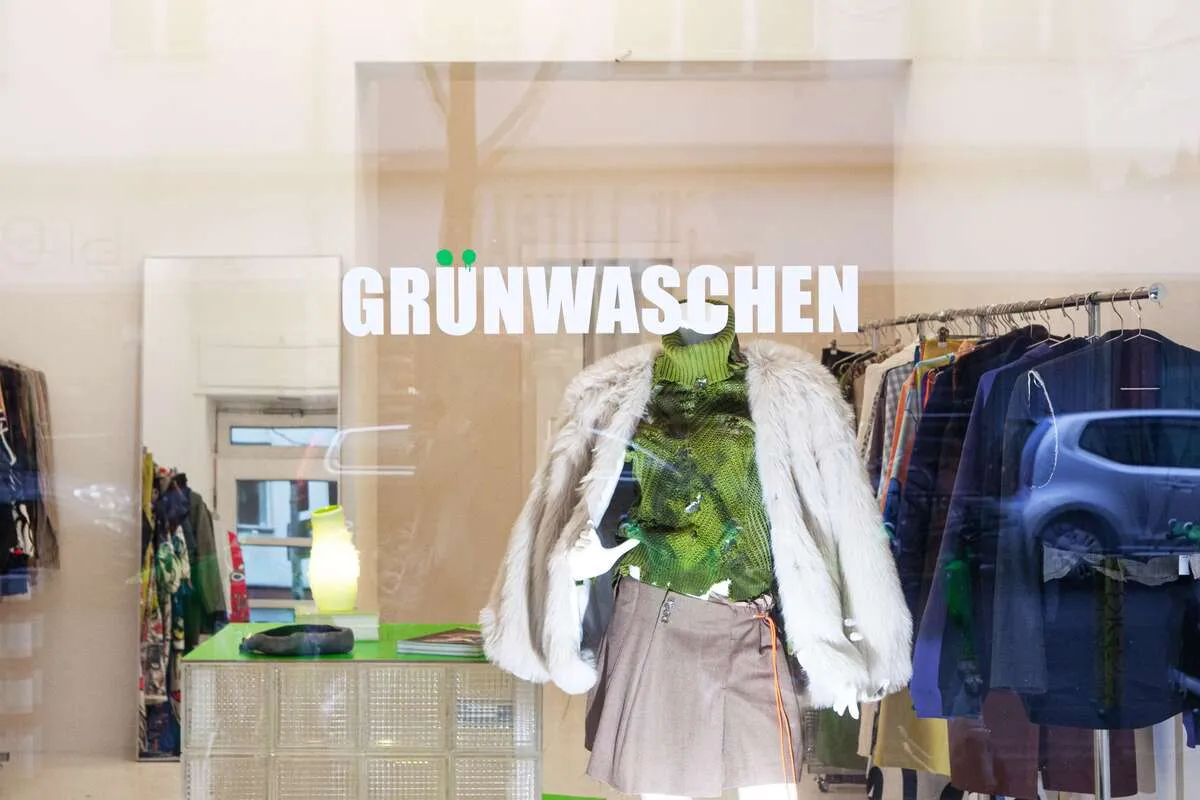
The physical space of Grünwaschen reinforces its ethical foundation. Delivered empty, the store was gradually assembled by Kramberger using repurposed and second-hand materials: glass bricks salvaged from an old house, recycled components, and reclaimed wood. The result is an environment shaped by intention, improvisation, and material consciousness.
“The approach is more important to me than the aesthetics,” he notes. Yet a quiet coherence emerges from the honesty of the materials and the architectural restraint. Grünwaschen reads simultaneously as a place of commerce and a subtle act of resistance—proof that beauty and responsibility can coexist.
Challenging Consumer Perceptions Around Pricing, Value, and Slow Fashion
Grünwaschen also addresses persistent misconceptions around pricing in slow fashion. For years, fast fashion dominated because independent or ethical brands were perceived as unaffordable. Today, that narrative is shifting. Major fast-fashion labels such as Zara have increased their prices to distance themselves from ultra-low-cost competitors like Shein or Temu, making them nearly as expensive as small independent brands—often without comparable quality or ethics.
As a result, purchasing decisions are increasingly shaped not just by price, but by transparency, values, and awareness of how garments are made. Ironically, fast fashion’s rising prices and declining quality have strengthened the counter-narrative around craftsmanship and ethical production.
At Grünwaschen, this shift becomes tangible through garments, materials, and stories, with prices generally ranging between €100 and €300, depending on techniques and raw materials.
A Concept Store That Extends Beyond Its Walls
By merging retail, agency work, and cultural programming, Grünwaschen proposes an alternative model of commerce—one that supports designers, invites dialogue, and nurtures a more conscious public. Within its modest footprint on Rosa-Luxemburg-Straße, the store offers a vision of sustainability rooted in transparency, community, and care.
Rather than relying on slogans or performative “greenness,” Grünwaschen suggests that meaningful change in fashion emerges from the careful cultivation of human relationships, ethical practices, and shared spaces.
Uroš Kramberger
Uroš Kramberger is a Berlin-based creative and marketer working at the intersection of fashion, digital media, and visual storytelling. He holds a degree in marketing and public relations and has collaborated extensively with independent designers, artists, and small creative teams, supporting their growth across different stages.
Originally trained as a fashion photographer, he remains closely connected to the industry through visual content creation. His work is defined by a critical approach to larger industry structures and social systems, paired with a curiosity for new technologies and online culture. At its core, his practice is guided by a desire to keep creativity honest, ethical, and deeply human.
Sara van Bussel