Apology of a complication: I love you because you are complicated
Humans crave complexity, simplicity is boring and mystery is exciting – from love to machines, from cars to watches, we never look for what everybody can have
Cover image: Tomás Saraceno’s Foam 91p/Mn (2017) is a suspended, delicate sculpture often presented by Esther Schipper Gallery, representing the artist’s exploration of interconnected, cloud-like structures and web-like forms. It was featured in 2017 Art Basel Miami Beach, showcasing his signature fusion of art, science, and ecology.
The comfort of the well-known and the lust of the intricate
There are mainly two kinds of desire in the world: the comforting thrust of the well-known and the slow burn lust of the intricate. Sometimes we chase simplicity because it gives us a glimpse of what serenity could be, if it even exists. Most of the times we’re begging for complexity because it seduces us, it forces us to lean in. This can be applied to a philosophical idea of love, but also to material grounds.
Let’s think of watches. When a watchmaker adds a layer of complexity, he’s creating a desirable item. When an engineer adds another calibration, when the structure is formed through a new material, the machine becomes less rational and more emotional to its owner. We could say it’s a paradox: the more complicated something becomes, the more it resembles a living thing and the more we want it. Same goes for cars. Engines and designs that historically pushed boundaries, not caring of how complicated it was, were always rewarded with great recognition. Watches and cars that did this became staples in the luxury market, they became desirable.
Breitling and Aston Martin – reshaping the boundary between tool and obsession
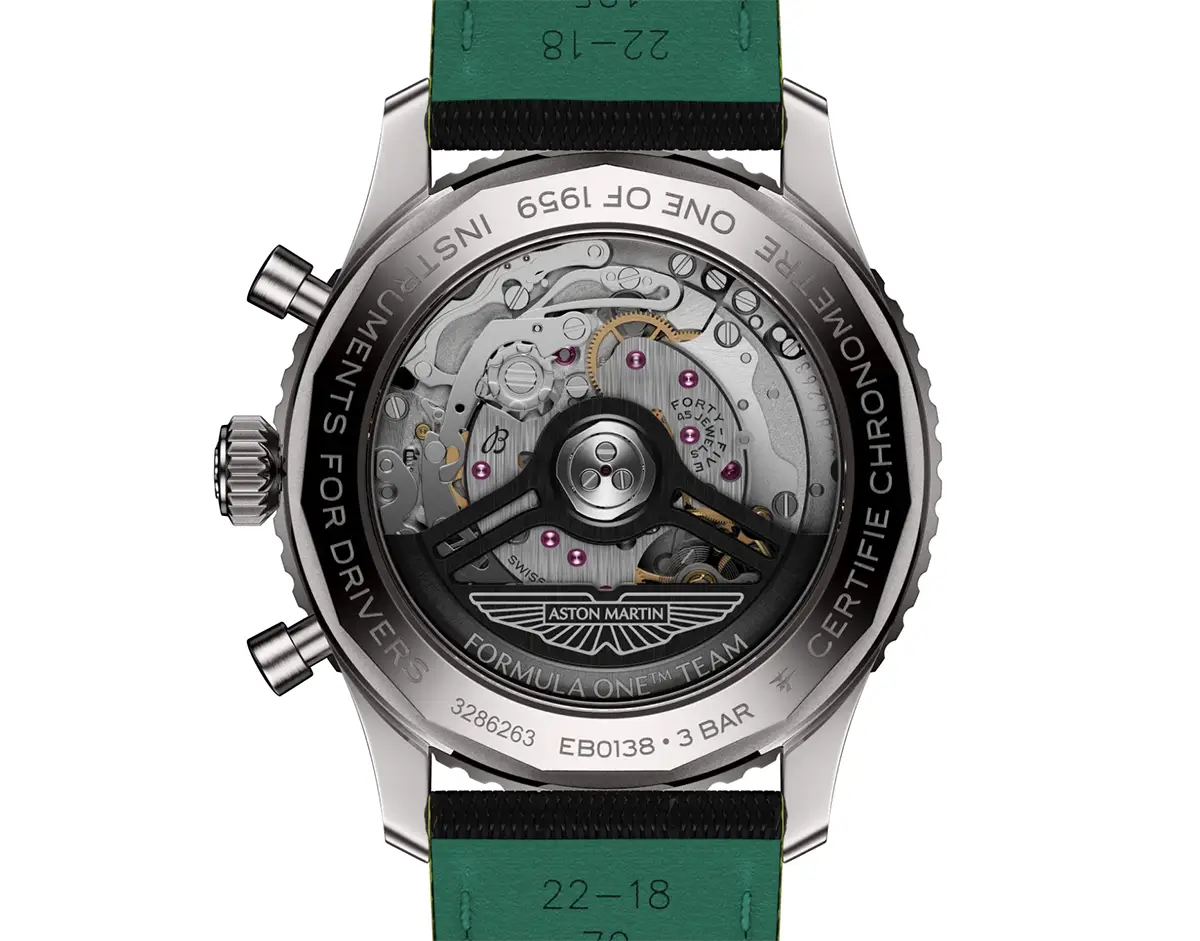
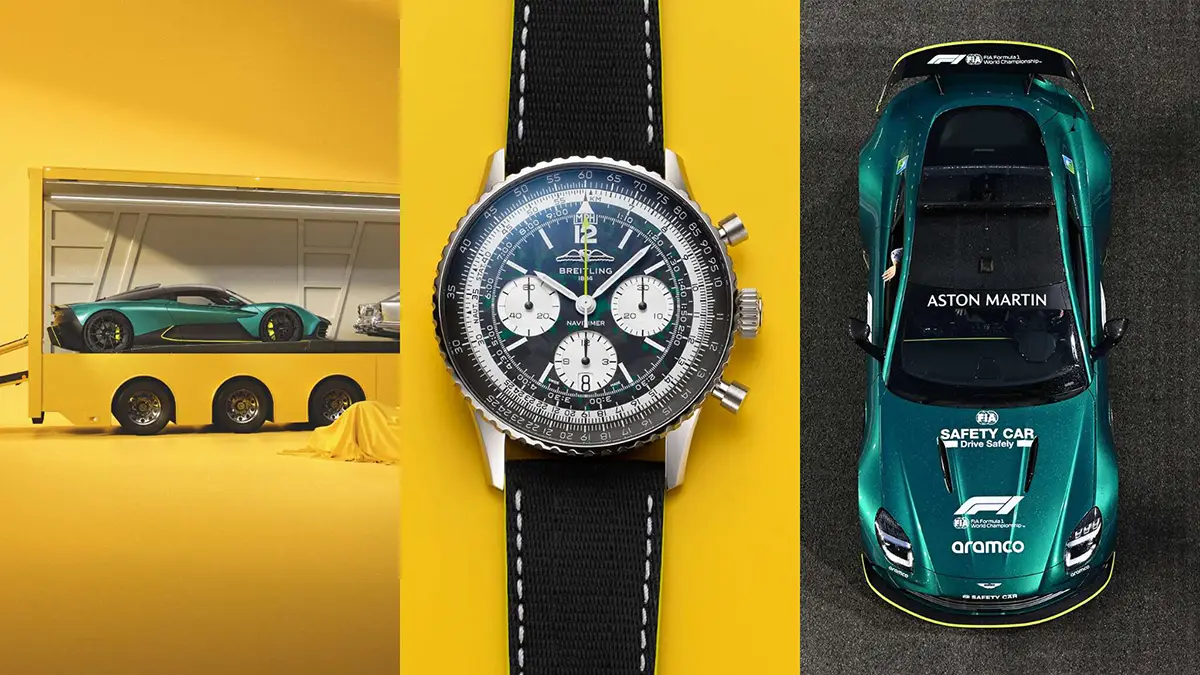
In the adventurous territory of mechanical seduction, collaborations usually turn into manifestos. The latest between Breitling and Aston Martin lays right on the surface of the intersection between top notch engineering and obsession. Their most recent joint-endeavor – Breitling Navitimer B01 Chronograph 43 Aston Martin Aramco Formula One Team – dresses one of horology’s most complex items in the materials and colors of contemporary motorsports. Lightweight titanium and carbon fiber, to resemble passenger compartments. Only 1.959 pieces were made: 1959 was the year Aston Martin’s debuted in Formula Uno. Reasoned scarcity is also one of the most immediate ways to fuel desire: it has long been recognized as a psychological trigger. Do we want something that we all can have, whenever we feel like? Most of the time, the answer is no.
Breitling’s Navitimer was never meant to be simple. From its birth in the 50s, it was made with a circular slide rule designed for pilot. An instrument capable of measuring speed, flight time, and fuel consumption, directly from the wrist. A revolution. This technical know-how, developed in aviation, would later migrate into the world of motor racing, where precision timing and performance calculations became just as essential as they were in the cockpit. It’s a watch that’s complex not for decoration, but for function. Still, it reshaped the boundary between tool and obsession, product and emotion. It became something people craved.
Where do Breitling and Aston Martin connect? Where complexity turns into attachement
In 1884, then-unknown Léon Breitling opened his workshop in Saint-Imier, Switzerland, to build watches. He was not trying to create luxury objects. He was designing instruments for an industrial world that was speeding towards the future: railways, navigation and, most of all, aviation. Timing mattered, precision became mandatory to survive the new world. Breitling worked around a traditional Swiss system, établissage, a decentralized method for assembling watches. His specialized in the production of chronographs, the perfect tools for a century obsessed with progress and results.
While Breitling’s descendants were redefining this mechanism, slowly turning the chronograph into a cultural symbol, in the United Kingdom another kind of obsession was taking shape. In 1913, Lionel Martin and Robert Bamford – a pilot and a mechanical – were building cars that could race up the Aston Hill climb track in Buckinghamshire. They managed to do it: that hill changed automotive history. It all started with the purpose of achieving speed. It was complex to achieve it. Yet, from the beginning, something was else present: a sense that performance could also be elegant, that power goes hand in hand with craftsmanship. Those cars later became James Bond’s favorites.
If we think about Aston Martin’s and Breitling’s heritage, complication – a word that recalls something problematic – takes a different form: a celebration of mastery. Hundreds of components interacting. A machine that is too simple disappears into its function. A machine that is complex demands contemplation. When it’s understood, attachment enters the equation. In psychology, what we call the uncertainty principle of attraction sums it up pretty well: relationships and experiences that preserve a certain level of unpredictability tend to maintain higher emotional engagement. In other words, the unknown keeps the mind active. Mechanical objects that reveal themselves slowly—like a chronograph with layers of function—produce a similar dynamic.
Why are we so drawn to mystery and complexity? A safe zone is never rewarding
The psychology of complication goes way beyond machines, whether it’s watches or cars. Us, as humans, do fall in love with what is understandable at first sight. Does it last? What’s blatant may attract momentarily, but it rarely beats the charm of fascination. Finding the right person that feels like ‘the right one’ and sticking together for a lifetime may seem like a dream, but when it happens, we feel like we’re may be missing out on something. We get anxiety over this. Mystery is one the main ingredients for a long-lasting desire: we need to constantly ask ourselves questions. Why does our partner behave like that? How can this car climb that hill so easily? Complication is therefore not plainly mechanical. It is somehow existential. Machines could be seen as simulacrums of love. Both of them need to be assembled to fully liberate their potential. Sometimes they must be calibrated and regulated.
Why are we so eager to mess up our life with complicated relationships? Maybe it’s because the reward tastes so much better when it finally comes, even if it’s temporary. Endless nights overthinking about the smallest of things, reliving scenarios in our minds. We’re on edge. It feels like we’re never done, we never arrive to an end. That can trigger insecurities, past traumas. It’s uncomfortable, but it is also how we actually grow. Lionel Martin and Robert Bamford were probably not so chill while trying to climb that hill for the first time. It could have been way easier to build a car that just ran faster on a straight road, but a safe zone never really pushes to go deeper. We almost never desire what is fully understood. We love what continues to reveal itself over time, unveiling layer after layer. Complexity it’s what ensures that discovery never ends. The thrill of uncertainty.
Seduction rarely survives absolute clarity
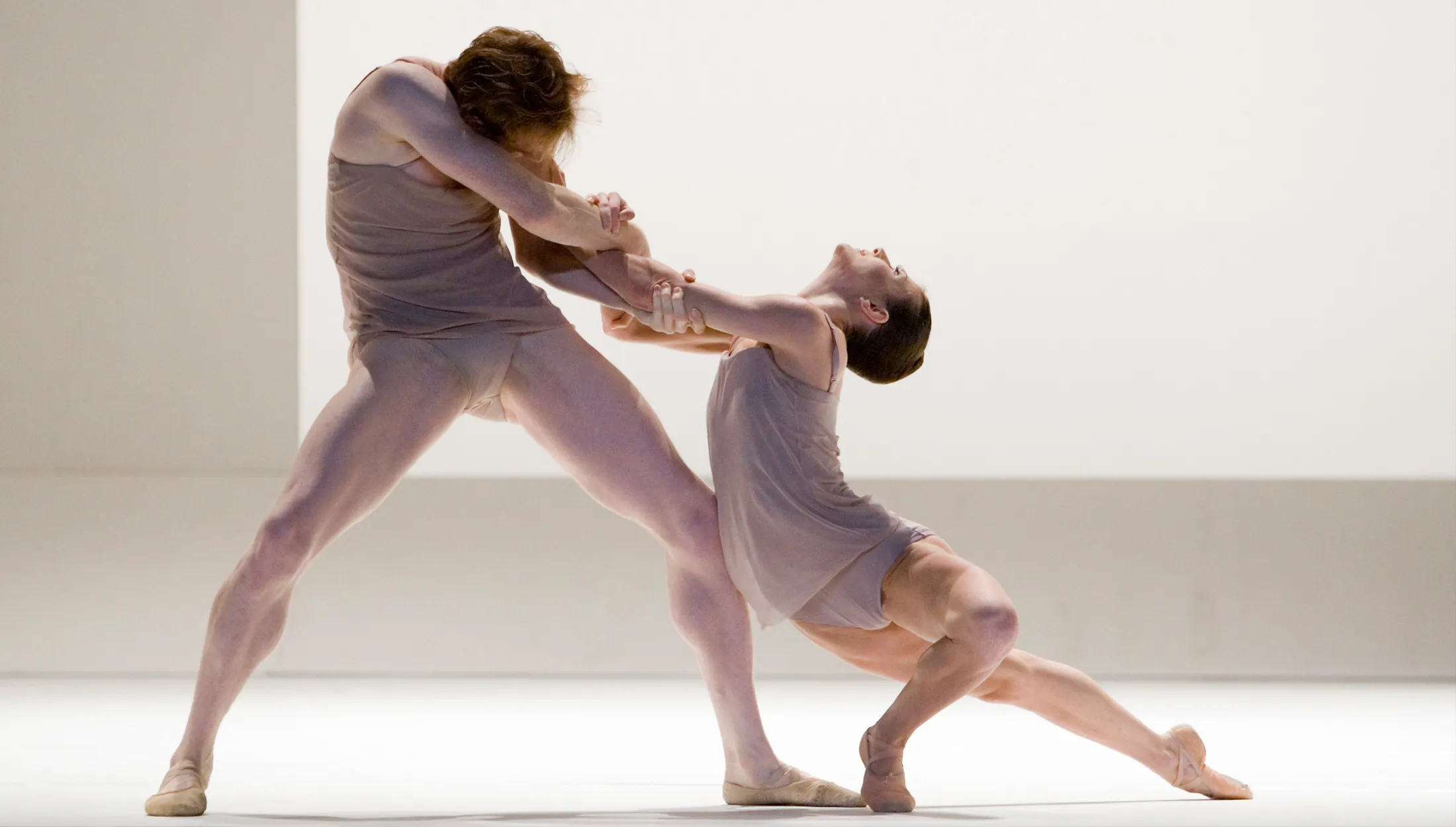
Sex follows similar logics. Anticipation, tension and slowly discovering a new body keep desire alive. When everything is given and known immediately, lust fades away quicker. What is hidden is often more erotic than what is offered. This is why seduction rarely survives absolute clarity. A relationship that remains entirely predictable tends to cool down, while one that continues to reveal subtle variations— new dynamics, new kinks, unexpected responses—maintains its fire. Desire, like an engineered mechanism, is composed by a lot of different elements: imagination, vulnerability, curiosity. When these parts align, intimacy is no longer mechanical, while also impossible to fully master.
Complication is not chaos, it’s discipline
From this point of view, complication is not chaos. It is a special kind of discipline. It teaches how to stay strong. Eventually, we do become stronger. It does not tolerate approximation. It forces to dig deeper. And yet, love feels effortless when it comes from this. Love and mechanics, they share a common trait. They’re most fascinating when they’re never finished, when there’s always time for refinement. Another material to experiment with, another shadow to run after. This perpetual striving gives complicated things a kind of vitality that doesn’t exist anywhere else. They’re always alive, because they are always evolving. A chronograph hand returns to zero and begins again. An engine decelerates and accelerates once more. The cycle repeats itself, endlessly. So does desire. To say I love you because you’re complicated, it means you resist reduction. You require attention, but you also reward patience. You’re engaging. Beauty often resides in effort, depth requires time, sophistication has never been simple.
Giacomo Cadeddu