Tadashi Kawamata for Maison Ruinart: shaping reclaimed wood in the vineyards of Champagne
Japanese artist Tadashi Kawamata brings three permanent installations in salvaged wood to Maison Ruinart’s estate in Reims, as part of the Conversations with Nature curatorial programme
Maison Ruinart and Tadashi Kawamata: art, nature and impermanence in the vineyards
Tadashi Kawamata became an artist because of an allergy. Trained as a painter at the Tokyo University of the Arts, he was forced to abandon oil on canvas when his body refused to tolerate the pigments. Without a studio, without a conventional technique, without much money, he began borrowing construction materials and unconventional spaces. Reclaimed wood — planks, pallets, fragments of discarded furniture — became his natural vocabulary, available wherever in the world he happened to be working. What began as a constraint quietly became a philosophy. It is that philosophy which brought him, decades later, to the vineyards of Champagne, where Maison Ruinart invited him to work on its historic grounds in Reims, resulting in three permanent installations: Tree Hut, Nest and Observatory — structures in salvaged wood embedded in a landscape defined, like his practice, by time, climate and impermanence.
During his student years, Kawamata read Merleau-Ponty, Foucault, Barthes, Sartre. Structuralist theory had convinced him that art should not be an object but a process — of deconstruction and reconstruction, of lived experience. He looked at the wooden stretcher supporting the canvas and asked whether that underlying structure might become the independent basis of his work. It was 1979. He has not stopped building since. Born in Mikasa — a mining town on the northern island of Hokkaidō — and for decades working between Tokyo and Paris, Kawamata has developed an international practice rooted in a single consistent gesture: constructing in-situ from salvaged material, always in response to the specific conditions of a site. Form emerges from what is available, from what has already been used or damaged. Wood carries memory: nails, cuts, pressure, previous functions. Each plank is already a record: building becomes a way of reactivating that memory.
Conversations with Nature: Ruinart’s curatorial programme between art and ecology
The invitation from Maison Ruinart arrived in the context of Conversations with Nature — an integrated curatorial framework that Ruinart has developed over several years. Founded in 1729 and recognised as the first established champagne house, Maison Ruinart has been building its own relationship with contemporary art long before the language of brand partnerships existed. In 1896, Maison Ruinart commissioned Alphonse Mucha to create what is considered the first advertising poster for a champagne house — a gesture that announced the centrality of artistic culture to its identity across generations.
Conversations with Nature is the contemporary heir to that tradition. Previous chapters have involved Tomás Saraceno, Nils-Udo, Eva Jospin and Marcus Coates, each addressing the relationship between art and ecological systems from different positions. Kawamata’s intervention extends this trajectory, focusing on the porosity between built structures and living environments — between what human hands assemble and what surrounds, absorbs and eventually reclaims those structures.
The Ruinart site in Reims: architecture, landscape and climate observation
The 4 Rue des Crayères site itself underwent a transformation in 2024, with the inauguration of a contemporary pavilion designed by Japanese architect Sou Fujimoto — a stone-and-glass structure standing opposite the Maison’s three-hundred-year-old buildings, within a landscaped environment redesigned by Christophe Gautrand. Visitors today move through more than twenty installations distributed across the main courtyard, the gardens and the underground chalk cellars, listed as UNESCO World Heritage since 2015. The address has become a cultural destination where champagne production, hospitality and contemporary art occupy the same physical and conceptual space.
In Champagne, the landscape is not static: soil composition, water reserves, temperature variations and drought indexes are monitored continuously. Climate change is not an abstract condition here but a measurable transformation affecting plant cycles and the aromatic profile of chardonnay. Within this context, Kawamata’s work does not simply “dialogue” with nature. It operates within a field already defined by observation, measurement and adaptation. His structures do not illustrate ecological concern — they expose what is already in flux.
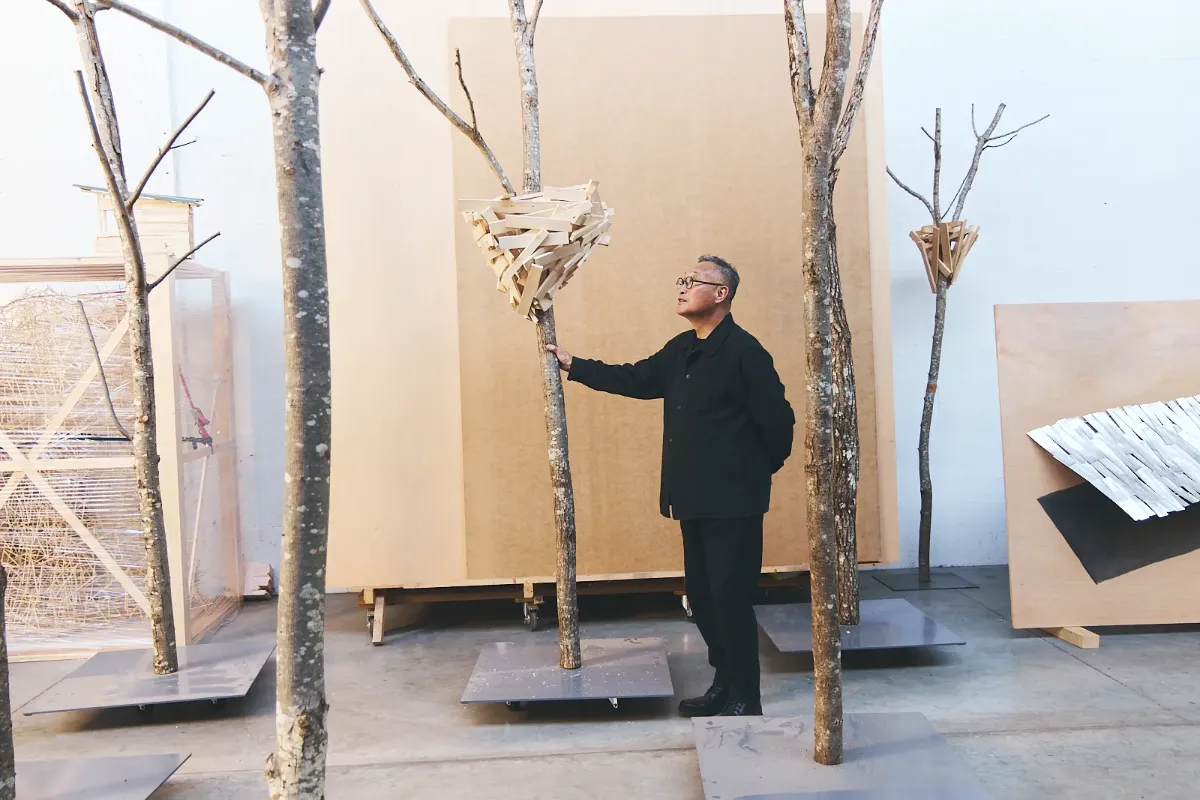
Tree Hut, Nest, Observatory: three installations by Tadashi Kamawata between shelter and perception
When Kawamata visited Reims, his attention settled on what he described as the “porous barriers” between the Maison and its surrounding environment: morning mist over the vines, wind moving through leaves, the presence of birds and insects. His practice has always begun with looking before thinking, with letting the site suggest the form rather than imposing one upon it. The origins of Tree Hut and Nest reach back to a longer, more urban history: Kawamata’s first shelters were false refuges built for the homeless, erected in city streets and regularly demolished within hours. It was then that he thought of trees — an elevated structure would offer more safety, more durability, more distance from the street.
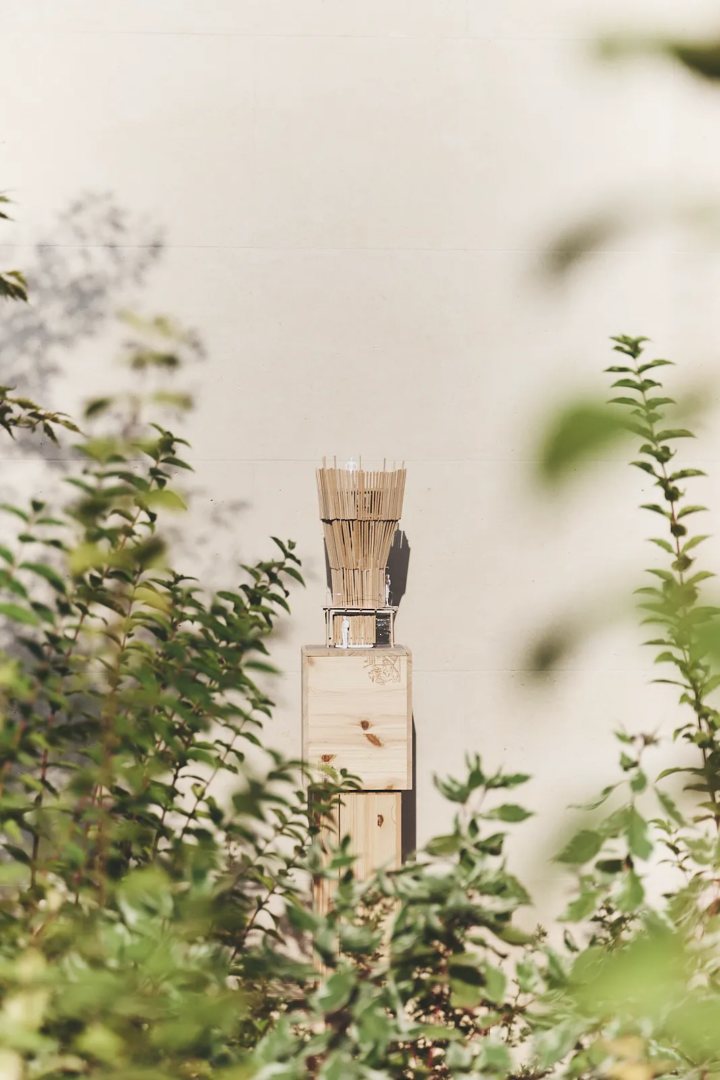
“The tree huts I build are not the ones you dream of as a child,” he has said. “The idea refers to birds’ nests: it is their natural way of finding shelter.” At Ruinart, these structures are recontextualised entirely. Nest, installed against a façade of the Maison, evokes local fauna — birds, insects, bats — and establishes a connection between vineyard biodiversity and the built architecture of the estate. Tree Hut, suspended among trees, introduces a displaced point of view within the landscape, inviting physical and sensory engagement with the environment rather than passive observation of it. The displacement is not metaphorical: on more than one occasion, birds have actually moved in.
Observatory operates differently. Rising approximately six metres above the crayères, it functions as a belvedere: a structure whose purpose is not shelter but elevation, offering a vantage point over vineyards, planted forests and the full range of atmospheric conditions — light quality, wind direction, seasonal variation in colour and texture. The altered perspective is not incidental. It is structural to Kawamata’s thinking: perception depends on position, on height, distance and exposure. To look out from Observatory is to understand that the landscape visible from ground level and the landscape visible from above are not the same landscape. The work insists on that difference without resolving it.
Scale, process and the autonomy of drawing
Scale is central to Kawamata’s methodology, and he holds both ends of the spectrum simultaneously. He works with monumental constructions and small-format structures, moving between architectural intervention and handheld object without treating either as primary. Crucially, the final form of any work is never entirely predetermined — it takes shape during the building process itself, through decisions made in the moment according to available materials, the resistance of the site and the logic that emerges only once construction has begun. This is not improvisation in any casual sense. It is a disciplined openness to what the process reveals: form as something discovered rather than designed.
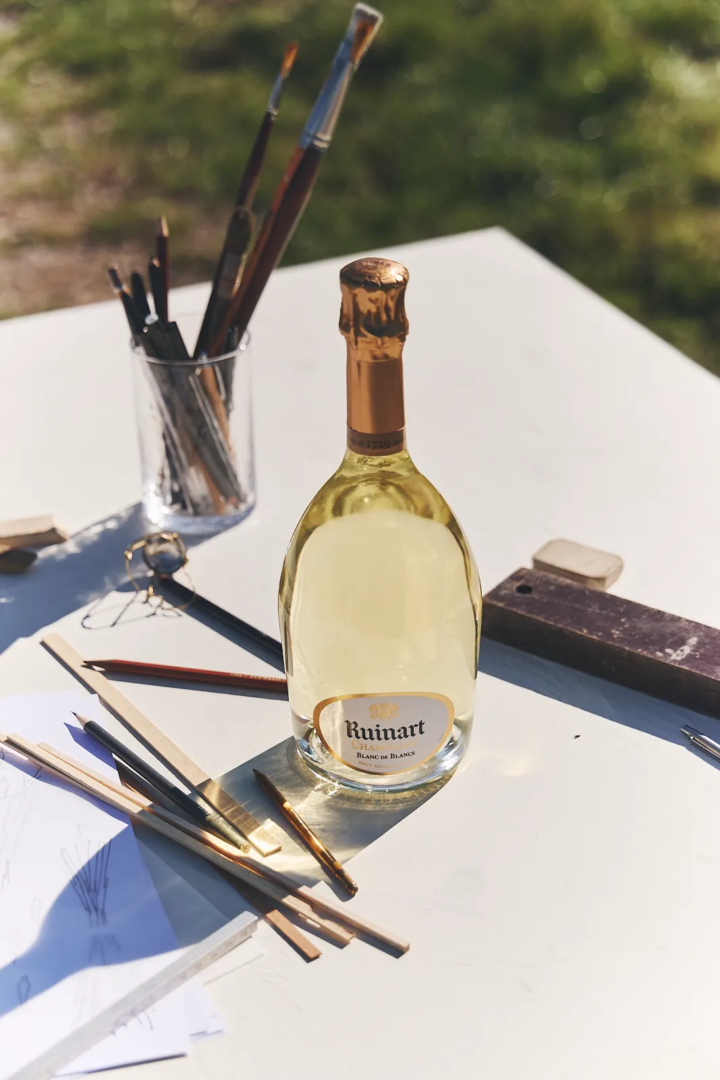
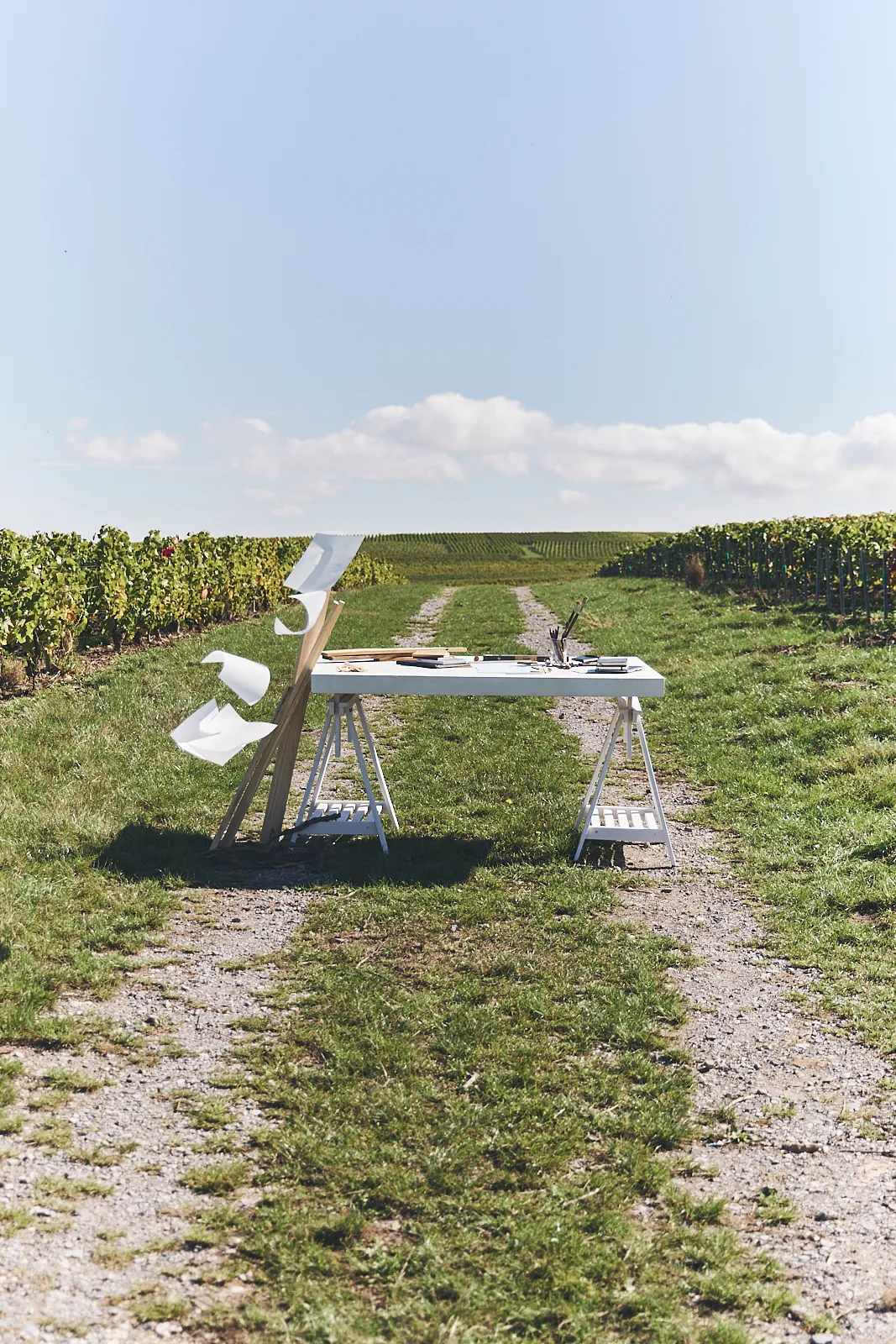
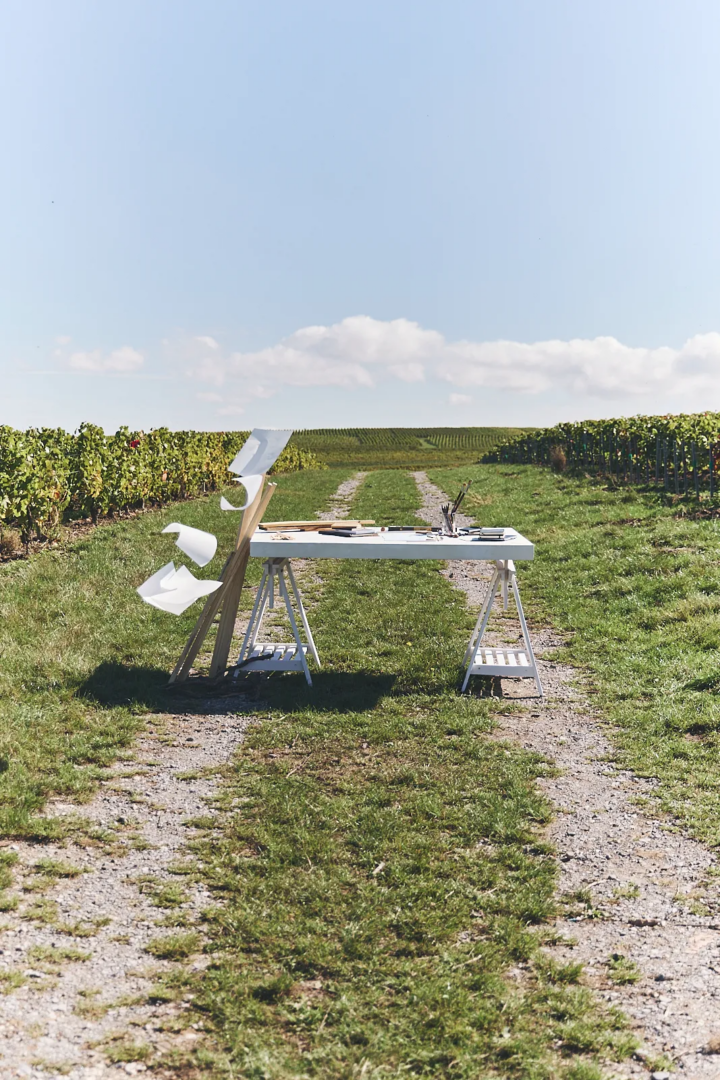
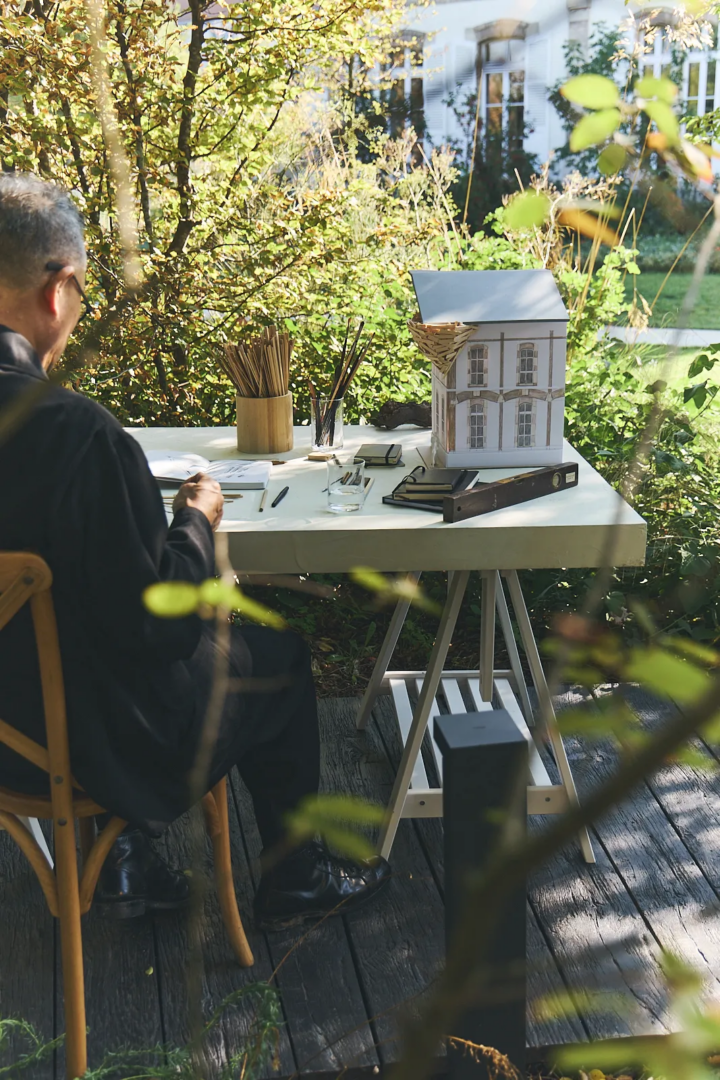
A series of preparatory sketches, drawings and models — developed during his stay in Reims — formed the conceptual groundwork for the three permanent pieces. The project was first presented in Paris at the Palais de Tokyo before being installed at the Maison’s historic address in Champagne. Yet for Kawamata, drawing is not preparatory in any subordinate sense — it is autonomous. His Site Sketches, collages and models are independent works in their own right, translating perception into form through a logic that differs from, rather than anticipates, the logic of construction. “I’m always drawing,” he has said. “It’s a way for me to think with my hands. The drawings prepare my mind; the wood connects with my body.”
Impermanence and process: Kawamata’s philosophy of time
Constructed from reclaimed wood and embedded within the Champagne landscape, the three installations carry the full weight of Kawamata’s central idea: shelter, fragility, temporariness as a fundamental condition of material existence. “Nothing is lasting, nothing is permanent,” he has said. “No material can survive forever.” In the vineyards of Champagne — where each harvest is a negotiation with climate and time, where the same vine yields differently from one year to the next — that observation finds a precise and unforced correspondence. The installations do not illustrate impermanence as a theme. They embody it structurally, in the wood itself: in the nails, the cuts, the pressure marks, the previous functions that each salvaged plank carries into its new configuration.
The work requires physical engagement to be completed. You climb, you pass through, you look out from an elevated position. It is not static, and it is not addressed to a viewer who remains at a distance. Kawamata has described all his installations as forming a single, continuous work — “I build, deconstruct, build, deconstruct…” — a cycle with no fixed terminus. In the vines of Champagne, where the cycle of growth, harvest and dormancy structures the entire year, that rhythm finds its most natural and least rhetorical form.
From installation to object: the Ruinart Blanc de Blancs case
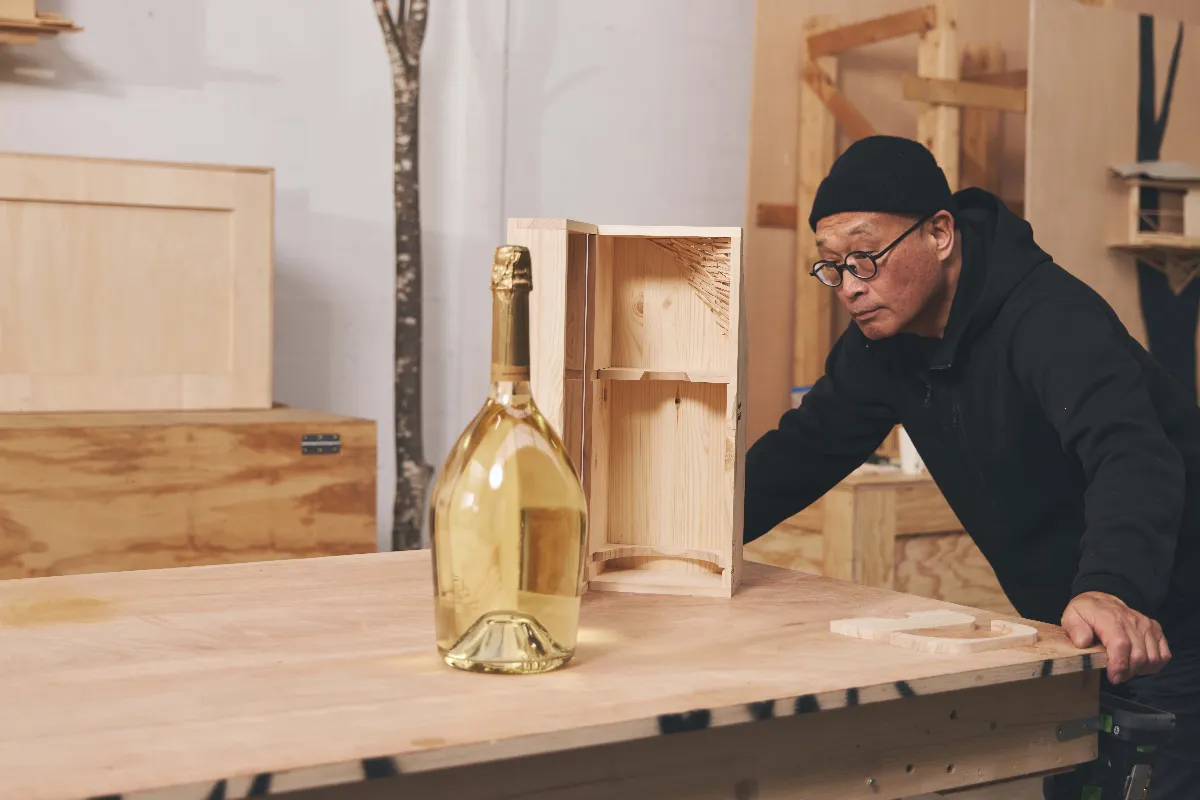
The collaboration with Maison Ruinart also extends into a limited-edition collector’s piece: a case designed to house a jeroboam of Ruinart Blanc de Blancs. Kawamata hollowed out a portion of the wooden structure, then reused that fragment to create a miniature nest inside the case. The gesture is simple, almost elementary — remove, reuse, reassemble — and it condenses, within a handheld object, the same process that governs the installations in the vineyard. Fragility, openness and transformation remain visible even within a luxury artefact. The same logic operates across every scale.
Where to see Tadashi Kawamata’s works
Tadashi Kawamata’s works are presented in the Ruinart lounge at miart from April 17 to 19. They will then be exhibited at the major international art fairs where Maison Ruinart is a partner — TEFAF Maastricht, Art Basel Hong Kong, Art Basel Basel, Frieze London, Art Basel Paris and Art Basel Miami Beach.
Matteo Mammoli