Do you still want gossip? We talk about stainless steel cigarette holders
A wall fitted with steel holders marks out a small sanctuary for gossip: Chisme Corner by Ananas Ananas shows how durable materials can contain forms of speech
Wall installation as a social device for informal speech and bodily pause
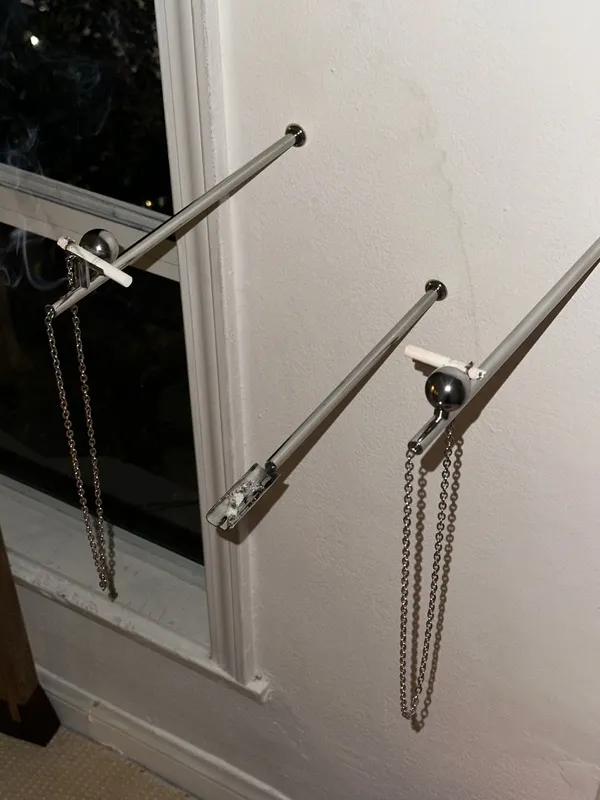
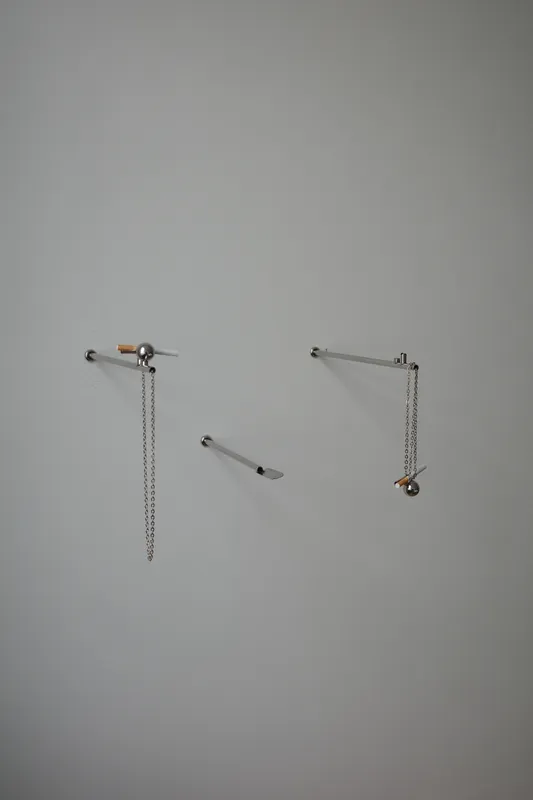
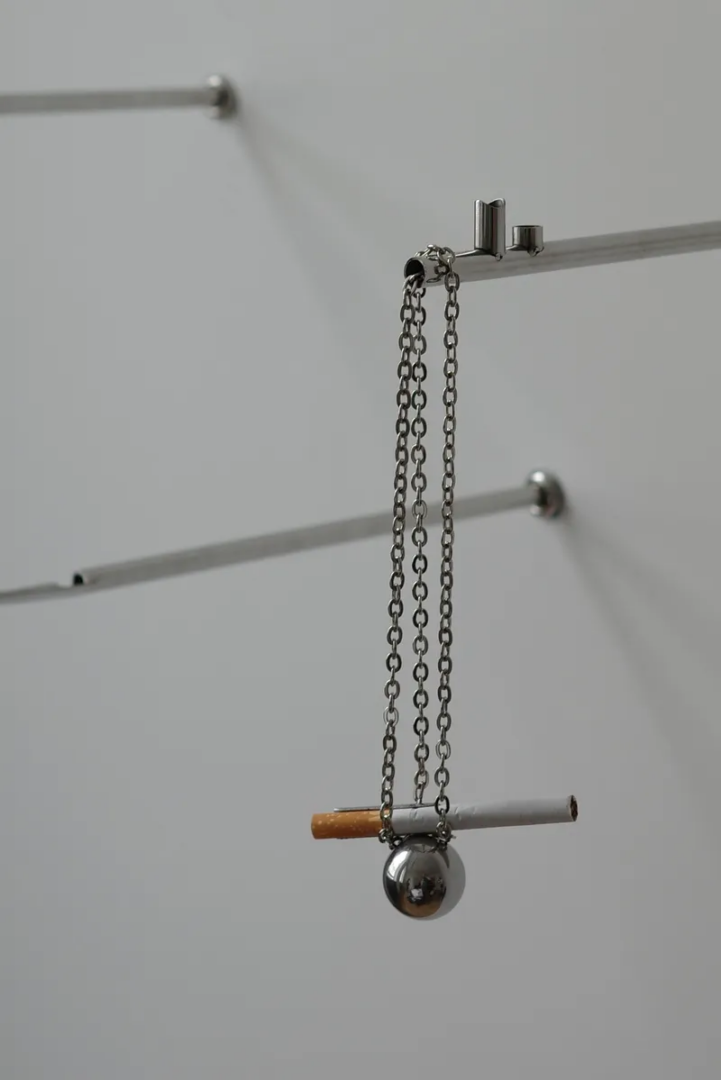
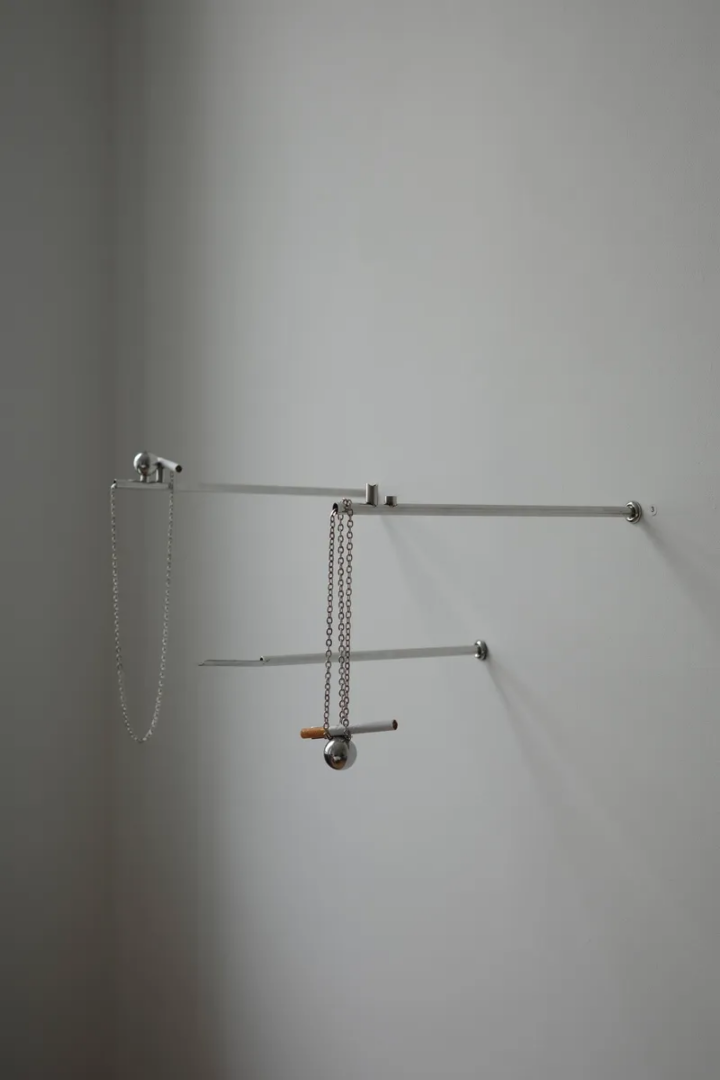
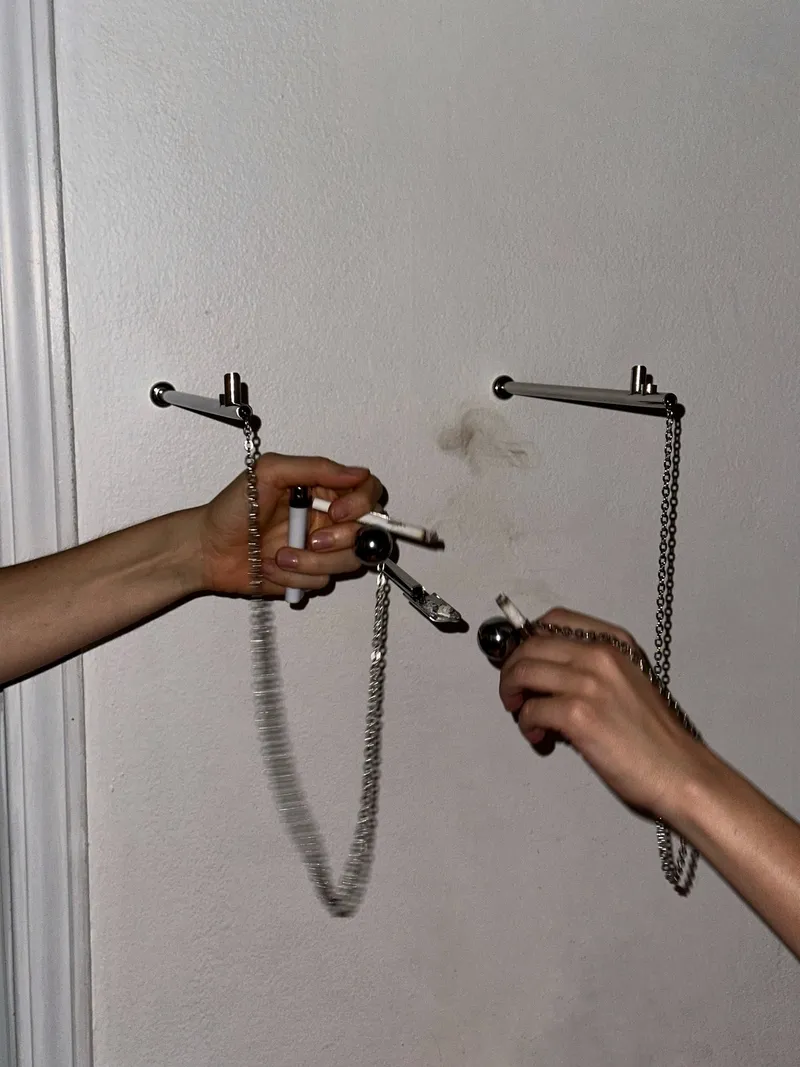
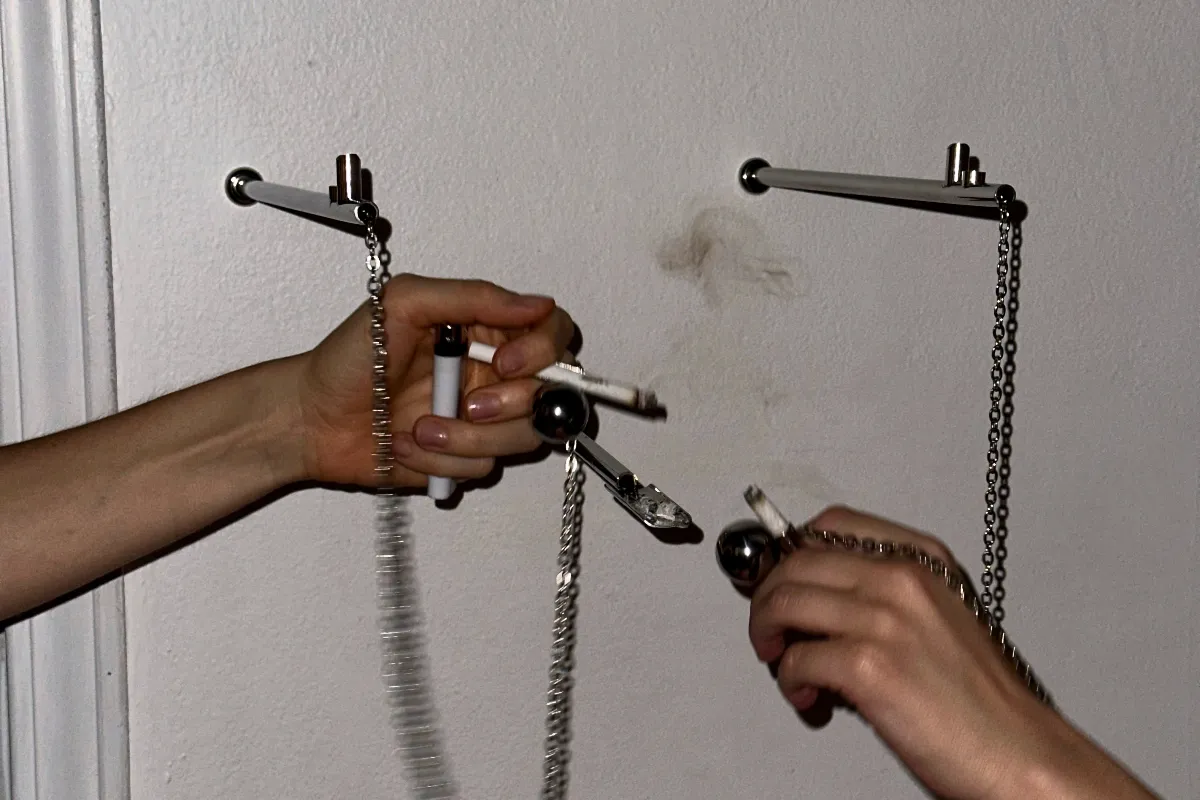
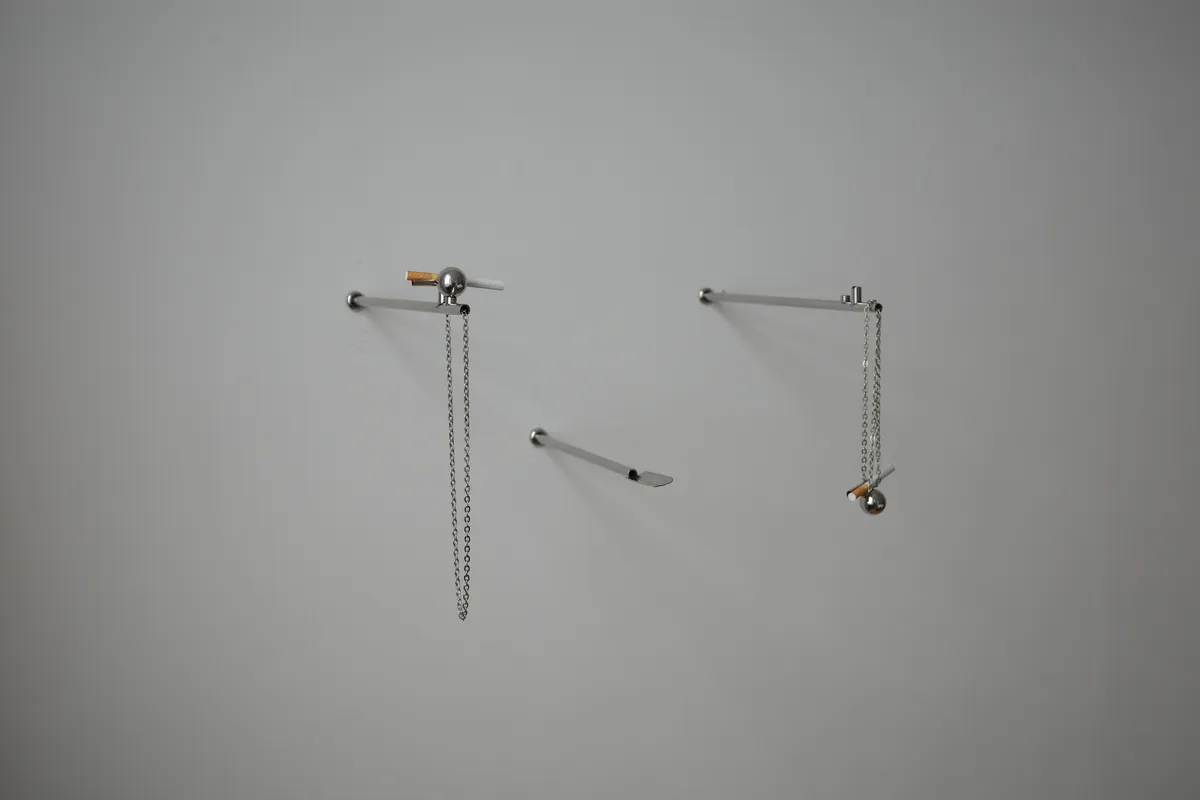
Chisme Corner is a wall installation by Ananas Ananas composed of stainless-steel cigarette holders fixed to a horizontal bar, each attached by a short chain, with a shallow tray placed below. The work does not announce itself as a social device; it establishes a small arrangement of objects around which behaviour gathers for a pause. When the pause ends, the holder is returned to its place, and the wall resumes its neutral state. Nothing is retained beyond the moment of use.
The polished steel plays with it. The reflective surface returns partial images at close range: faces appear briefly, then slip out of view as people move. The chains keep the holders within reach while fixing the distance between bodies and the wall. Nothing here is decorative. Each element contributes to how long someone stands, where they look, and how the interaction holds before dissolving back into the room.
Spatial thresholds in interior architecture and the loss of informal conversation spaces
Inside an interior, the installation reads as part of the furnishing, with a subtle BDSM inflection. Its scale and placement allow it to be encountered peripherally rather than sought out. It becomes active only at certain moments: during a pause between activities, at the edge of a gathering, when someone steps away from the room’s centre. Use is informal and uneven. Some people approach deliberately; others arrive by chance, following someone else.
In this way, Chisme Corner reinstates a spatial threshold largely lost in contemporary interiors shaped by remote work and platform-based communication. Informal speech was once absorbed by corridors, kitchens, stairwells, and other third spaces. Conversation could circulate without preservation, remaining bound to those present.
As those thresholds have thinned, informal speech has not disappeared, but the environments that once contained it have changed. Communication now circulates by default. Statements detach from their setting and persist beyond their original duration. Tone becomes harder to sustain once posture, timing, and shared attention fall away. The distinction between a thought in formation and a position taken becomes unstable. Chisme Corner responds by reinstating a limit, using material structure to shape how speech enters and exits a space.
Behavioural constraints shaping proximity, duration, and embodied interaction
The installation functions as both object and behavioural framework. Its components are minimal yet specific: the chain limits reach and slows movement; the holder fixes the hand at a set height; the wall redirects attention away from the room’s centre. Together, these elements organise a short interval in which speech is shaped by proximity and duration rather than visibility or circulation.
Within that interval, conversation changes quality. It does not need to resolve or declare a position. What is said remains bound to the exchange and to the bodies present. This mode of speech performs a structural role in social life, allowing impressions to be tested, accounts compared, and uncertainty registered before thought hardens into statement. Ideas can be adjusted, withdrawn, or left incomplete.
Gossip functions here as social maintenance. It circulates through small remarks and shared observations, helping people gauge proximity, trust, and mood. Rather than advancing decisions, it supports orientation within a group, especially where formal channels leave little room for informal adjustment.
Gossip, durability of speech, and the erosion of contextual boundaries
These exchanges rely on conditions that are rare. In environments governed by platforms, speech tends to outlive the moment that produced it. Words persist as fragments, open to reinterpretation, without the cues that once held them in place. Context becomes difficult to sustain once speech is separated from the physical situation that shaped it. What was once time-bound becomes durable by default.
This durability alters behaviour. When speech is preserved automatically, speaking without anticipating its afterlife becomes difficult. Informal talk begins to resemble public statement as the margin for error narrows. People revise themselves in advance, not from lack of opinion, but because the conditions no longer support provisional expression. What disappears is the space where disagreement can be explored without consequence.
Material limits, non-circulating speech, and resistance to accumulation
Chisme Corner intervenes by reintroducing a boundary. The work does not promise privacy or agreement; it offers a setting in which speech can remain limited to its duration. When the pause ends, the conversation ends with it. Nothing travels beyond the space that held it. The installation does not filter content; it filters circulation.
This boundedness has material effects. The interaction produces no record and requires no storage. It generates no data and invites no replication. The installation consumes no energy beyond use and does not extract attention beyond the pause itself. Its sustainability lies in the kind of exchange it supports. What disappears does not accumulate.
Accumulation links environmental exhaustion and information overload. Systems designed to retain everything, whether objects or data, rely on constant extraction. Chisme Corner operates differently, supporting repetition without growth. The same gesture can recur without producing surplus. The wall remains; the interaction passes through it.
Architectural absorption, sustainability, and the endurance of informal exchange
The work also resists optimisation. It cannot be expanded without losing function. It does not translate into a scalable system. Its effectiveness depends on smallness and specificity. The wall holds only a few people at a time; the chain enforces a physical relation that cannot be extended without alteration.
By fixing an informal practice in place, Chisme Corner draws attention to the role architecture once played in absorbing speech that did not belong elsewhere. Offices, schools, and shared buildings previously contained such spaces, often without explicit design intent. Their disappearance has been gradual, and with it the loss of settings where thought could remain unsettled. The installation does not replace those spaces; it makes their absence legible.
What emerges is a broader view of sustainability. The question shifts from resource management to interaction: how environments support exchanges that do not demand preservation. Durable objects can sustain fragile behaviours. A surface that remains can allow speech to pass through without residue.
When the installation is not in use, it remains inactive. Holders hang in place; the tray is empty; the wall offers little spectacle. This inactivity is part of its design. It does not solicit engagement or advertise function. It remains.Chisme Corner operates at the scale of a pause, addressing a condition that has become difficult to name. As informal speech loses architectural support, spaces that once absorbed it give way to systems that retain everything. The work responds by setting a boundary, using material constraint to protect a mode of exchange that depends on disappearance.
Text: Reeme Idris