Fashion and Power: How the Creative Director replaced the Designer
“Fashion is not dead. It is a creeping paralysis.” From bodies on the runway to billions in revenue, today’s creative director is a multitasking human brand selling views as much as clothes
Designer vs Creative Director: Tom Ford, the person and the product, was the first creative director
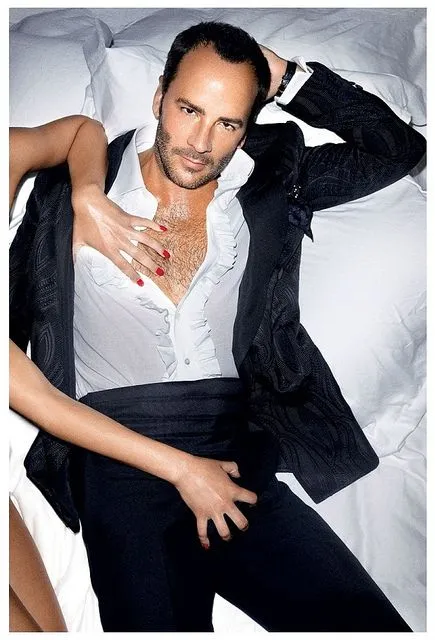
More than the low-waisted velvet trousers, more than Sophie Dahl wearing nothing but a gold sandal for the Opium perfume campaign, Tom Ford’s most compelling creation was his public persona. “I consider myself a product.” A longtime friend once said he had always thought of Ford as a black lacquered box with a platinum handle from the 1920s. He had never imagined there was anything inside it. The meticulous attention to surface — the ability to read a milieu and turn it into what people want — had turned Ford himself into a surface. In any case, what people wanted in 1990 was sex.
That was the year Dawn Mello — former fashion director at Bergdorf Goodman and a cool hunter credited with launching Donna Karan and Michael Kors — took charge of Gucci’s creative operations. She quickly understood that the Florentine maison had lost its appeal: a dusty leather goods brand purchased mostly by customers over sixty living in Florida. Little else. She hired Tom Ford, a twenty-nine-year-old from Austin with a fashion design degree from Parsons in New York. She hired him because no one else wanted the job.
By 1992 Ford was design director for men’s and women’s collections, fragrances, accessories, retail and advertising. In 1994 he was appointed creative director of anything carrying the double G — including the one formed with pubic hair in one of the brand’s most controversial advertisements. At the time everyone was still called a designer: Martin Margiela, Miuccia Prada, Gianni Versace. All arbiters of style, forms and silhouettes. Tom Ford was the first creative director.
The 1990s: minimalism, AIDS and the need for a vision
The 1990s were the decade of minimalism. A subtraction that followed the technicolor glitter diet of the 1980s, , the recession of 1991 and the AIDS crisis. Tom Ford understood the demands of a world that no longer wanted only beautiful clothes. It wanted a face capable of narrating and selling them.
Some compared him to Don Draper from Mad Men. Ford staged a palette of white, black, electric blue and neon green. Pale pink to close. Daywear did not interest him — unless your idea of daytime involved a silk suit with bondage seams or a lunar white coat with fur draped over the collar.
He did not translate emotions into garments, as other designers did. He had a vision: a new religion of the body. An anti-Catholic creed oriented toward sex and commerce. Many forget that in 1990 Gucci was a leather goods house on the verge of bankruptcy. Under Ford, the Gucci Group acquired Yves Saint Laurent and reached billion-dollar revenues. During his ten years as creative director at Gucci and the Gucci Group, sales grew from 230 million dollars in 1994 to nearly 3 billion in 2003, turning Gucci into one of the most profitable brands in the world.
Of designers we know almost nothing: Michael Rider “spent three years sincerely believing he would become a backup dancer for Janet Jackson”
Thirty years later, almost no one uses the word designer — to refer to the people who design collections. The entire profession seems to have been replaced by that of the creative director. Of the others — the team members who shape brands — we know almost nothing.
Michael Rider, whose name was little more than hearsay before his appointment as creative director of Maison Céline in 2025, provides the example. Everything known about him could fit on an A4 résumé: a degree from Brown University in 2002, six years as senior designer at Balenciaga under Nicolas Ghesquière, ten years as design director at Céline under Phoebe Philo. Senior positions.
In 2018 Polo Ralph Lauren appointed him head of womenswear, a role he held until his return to Céline. Only after the appointment did journalists begin searching for personal details, family interviews, anecdotes, a Wikipedia page. The most revealing biographical fragment came from the April 28, 2000 issue of the Brown Daily Herald. Rider was photographed “wearing a rugby shirt, aviator glasses and, inexplicably, a pair of roller skates.” The article briefly mentioned studies in Latin American culture and pedagogy. Born in Washington D.C., he “spent three years sincerely believing he would become a backup dancer for Janet Jackson.” That is all. If you are not a creative director, that is the maximum biography you can expect.
The same could be said of Veronica Leoni: born in Rome in 1984, a degree in literature and philosophy — a background visible in the references of her statements and silences — and a voice described as “dated yet subtle” within the industry. Quira, the independent project she launched in 2020, followed years spent inside the design offices of Jil Sander, Céline, Moncler and The Row, where she served respectively as designer for the 2 Moncler 1952 line and later as design director. She identifies as a “veteran.” Her name carries weight inside the industry — particularly after her appointment as creative director at Calvin Klein in May 2024, when many assumed the brand had ceased operations. Outside that circle, the public is only now learning her name, under the shadow of Klein and of an aesthetic already defined — a mandate she inherited rather than designed.
The cult of the creative director: the religion of contemporary fashion
As with Leoni and Rider — or Dario Vitale, the recent successor to Donatella Versace as artistic director of Versace, himself previously replaced by Pieter Mulier, responsible for much of the development of the Miu-Miu-girl aesthetic — we know almost nothing about the designers working inside brands today.
The cult of the individual is so entrenched that it erases the rest, as if the design studio were a marginal appendix. It is not. These are two distinct roles. On one side stand the designers responsible for specific sectors — knitwear, leather goods, jewelry, outerwear, bridal. On the other side stands the director, carrying the full vision of the brand and responsible for implementing or redefining its mission.
The role is one of maximum leadership and responsibility. The creative director ensures that every input coming from the design offices — every idea and technical insight — resonates within a coherent melody. The principle resembles that of a conductor and orchestra, with one difference: the audience of an opera sees the entire ensemble. They recognize the human authenticity of the collective. With few exceptions, after fashion shows we see only the conductor.
It would be a mistake to imagine the two paths diverging in a forest. Equally mistaken would be to assume that when a creative director falls, the court remains intact. Anonymous sources interviewed by 1Granary explain that new directors often arrive with their own teams, sometimes without even meeting those already working under the previous regime. Each change dismantles the entire room.
“Killing the fathers” is a matter of numbers and statistics
Responsibility does not lie entirely with the creatives. Chief executives — men of numbers and statistics — have normalized the practice over the past year and a half. Nearly all seventeen recent leadership changes followed the same logic.
There are exceptions. Silvia Venturini Fendi has occasionally presented her team on the runway at the end of shows, acknowledging the open secret that a collection cannot come from a single mind — even less from ten, as Jonathan Anderson is currently expected to produce annually for Maison Dior. Anderson may be famously tireless. He is not alone.
Even when collective bows occur, little is known about the faces standing beside Fendi. That will remain the case as long as newly appointed directors are expected to “kill a father” — the expression Anthony Vaccarello used to describe the mandate given to him by Saint Laurent. Honor Yves Saint Laurent, Alber Elbaz, Tom Ford and Stefano Pilati — yet climb onto the horse of the maison by pushing them aside. The cult of the creative director is a pantheistic religion.
The others — the designers — remain part of the forest. Like Dario Vitale, despite his role in positioning Miu Miu at the top of the Lyst Index. That information surfaced only after Vitale was appointed at Versace. Perhaps we would learn the names of the people responsible for the eighth-ranked Uniqlo socks priced at 3.80 dollars only if an Arnault or Pinault one day appointed them to a directorship — perhaps after the recession ends, and with a vision of brands as polyphonic entities rather than the co-creations (creative director plus celebrity aesthetic, such as Zendaya x Louis Vuitton) currently favored by the industry. The narrative will continue to revolve around the solitary hero — occasionally heroine — assisted by a loyal sidekick.
The 2020s: social media, paralysis and the need for visualization
“Fashion is not dead. It is a creeping paralysis.” So argues Valerie Steele, curator and director of the Museum at the Fashion Institute of Technology.
Years have passed since the summer of 1999, when John Galliano presented his couture show for Dior at the Orangerie in Versailles. Models bounced on a waterbed wearing fragments of jackets, leather skirts twisted around their bodies, makeup melting as if they had passed through flames. Male models appeared pale, bare-chested, wearing short skirts. The audience looked shocked. Shock is what fashion should provoke. Sexuality has long been one of its primary creative engines.
Today several forces contribute to the slowdown of the maisons: a certain prudishness and a new profile for the creative director. Industry veteran Kathy Kalesti explains that brand owners — the conglomerates — now search for a hybrid figure: sensitivity to business and marketing, a cultural vision capable of addressing a global audience, the ability to build and nurture communities, a strong public presence, solid digital skills and a natural talent for storytelling.
“A unicorn.”
Pharrell Williams offers the example. The American musician was appointed successor to Virgil Abloh as head of menswear at Louis Vuitton. His debut show in summer 2023 brought 1,900 guests, blocked streets, a performance by Jay-Z and 1.1 billion online views.
“If I were a young designer with a vision and I heard that, I would think: why should I even try? In the end they will appoint a TikTok influencer with 150 million followers as creative director. But that person can only create attention.” So says Demna, the recently appointed creative director of Gucci.
We have returned to the same point. As in the 1990s, the industry must confront new beliefs and values if it wants to avoid irrelevance.
Stella Manferdini