Feminine literacy, when the feminine is methodology
Feminine literacy looks at design from a different angle. It listens to voices and places that are ignored and asks how we can create things that care for people, nature and future. An interview with Doyenne studio’s founders
How feminine literacy is reshaping design methodology and expanding contemporary practice
Mara Bragagnolo and Giulia Angelucci are cofounders of Doyenne, a studio that moves between design, research, and cultural practice. Their collaboration grew from a commitment to inclusion and community-building and evolved into a broader investigation of how design might operate when detached from dominant, extractive methodologies. Coming from different lineages — Bragagnolo through inclusive architecture and design history, Angelucci through textiles, fashion systems, and deep ecology — they converged around a shared intuition: that the feminine, when understood as methodology rather than identity, reveals forms of intelligence that design has long overlooked.
Feminine Literacy emerges from this intuition. It is both a curatorial framework and an ongoing research field that examines how feminine approaches manifest across interspecies collaboration, rooted craft, ecological care, and holistic material systems. Rather than presenting a fixed theory, Bragagnolo and Angelucci open a space where methods historically marginalized within design can be seen, named, and expanded.
The following conversation traces the development of this framework through their experiences, influences, and curatorial choices. It also highlights the practices of twenty-seven designers whose work demonstrates how these methodologies operate in real systems rather than speculative futures. Together, they outline a shift in design thinking — one that prioritizes life, reciprocity, and systemic awareness at a moment when imagination and ecological resilience are urgently needed.
Reclaiming the feminine as a way of seeing how design has been shaped
Doyenne Studio: Reclaiming the word feminine means acknowledging how we have been trained to design. Across interiors, product, and fashion, the predominant methodology centers form and aesthetics. It encourages designers to treat design as an isolated practice, detached from the systems that sustain it. There is also a hierarchy that places the human experience at the center, overlooking the fact that we are part of ecosystems, not outside them. With this curation, we wanted to explore how to reintegrate the counterpart that naturally exists in every living environment, including within design itself. The feminine counterpart is tied to collaboration, systemic and holistic thinking, and an embedded approach rather than an isolated one. This project is about imagining alternatives and moving beyond terms like sustainable or regenerative. It is about understanding what happens when we integrate both sides. We need both; not only the feminine.
The truth about feminine methodology as a new design consciousness
Doyenne Studio: We wanted to ask an open question: what is a feminine methodology? We didn’t want to define it. We wanted to show different ways of designing while acknowledging that feminine and masculine exist in all of us. We focused on women and queer designers because social norms often lead them to express this dimension more visibly. This does not mean men do not have it, but we found more women-led practices working on these themes. Many designers, especially older generations, reject the idea that such differences exist, which made it important to open the conversation.
Feminine Literacy is an ongoing project. This exhibition is only the beginning. We want to bring it to other cities, involve more designers, create a publication, and host talks. It is a long-term exploration into these methodologies and how they evolve.
Life-centered design as a shift in what innovation requires
Doyenne Studio: A life-centered approach is essential. We cannot talk about innovation without centering life and what sustains it. Ways of thinking that are grounded in empathy, learning from other organisms, and decentralized systems are crucial for the future of design. They create resilience and adapt to the specific needs of communities. The selected projects reflect this and bridge our shared backgrounds.
Where practice begins and how lineages shape methodology
Doyenne Studio: Doyenne started as a skateboarding brand rooted in inclusion. We collaborated with charities and built collections around themes like disability, feminism, and queer rights. We did this for seven years. Eventually we wanted to step outside skateboarding and explore research connected to our interests.
I am an interior designer and have worked across various disciplines, specializing in inclusive architecture. I recently started Her Space, a research project on the history of women in architecture and design. Through this research, especially when looking at collaborators overshadowed by their male counterparts, I noticed how women historically used methodologies that were more political, more community focused, and less concerned with grandiosity. This sparked my interest in feminine methodology historically and in the present.
Doyenne Studio: I entered fashion industry through textiles, which is a practice that connect you directly to plants, fibers, and the ecosystem of hands that collaborate in the creation of a garment. After textile design, I moved into trend forecasting, researching the futures of fashion and interior through anthropology, innovation, materials, and color. Later I studied fashion communication in the UK to explore the visual side.
During those years I grew closer to ecology. Researching newness in fashion revealed ecological grief, which reshaped my practice. I specialized in innovative and regenerative material approaches, exploring how to achieve color and materiality without extraction.
I integrated a holistic and intersectional approach that included inclusive design, responsibility, and deep ecology. Over eight years researching, I saw how valuable knowledge gets lost in publications often accessible to only a few, while corporations rarely invest in these ideas. I left publishing because it no longer aligned with regenerative values.
Working in sustainable and innovative fields revealed that most designers in these areas were women or queer, not by intention but because they are often the ones allowed to explore the feminine side of design. I now work as an art director, futures researcher, and lecturer teaching deep ecology, belonging, and systemic perspectives of design. This curatorial project was a natural merging of our backgrounds.
How curation becomes a navigational structure rather than a hierarchy
Doyenne Studio: We created this framework to assemble research and build narrative structures that made sense for both our experiences as designers and curators.
We had twenty-seven designers, and exhibitions with that much content can be overwhelming. Without structure, visitors lose connection. Compartmentalizing into categories made relationships clearer. You move through ideas step by step instead of encountering isolated works. The color coding supported this process.
Interspecies collaboration as a shift in hierarchy and a method of listening
Doyenne Studio: This category is emblematic because it requires deep listening and acknowledges that learning does not only come from human systems. Other species hold ancient knowledge, alternative structures, and new pathways for innovation. Material intelligence and application guided our choices.
Among the works are acoustic panels designed by Mathilde Wittock, grown from roots and shaped through cymatics, where sound frequencies form organic patterns, and Resting Reef Creating underwater death-care sculptures that generate new ecologies. These practices emerge from horizontal relationships rather than extractive ones. In this sense, feminine methodologies become catalysts for innovation.
Future craft as continuity, resilience, and cultural survival
Doyenne Studio: Craft is often perceived as traditional, yet it holds endangered knowledge formed through repetition and mastery. It connects us to ancestry and long-standing stewardship. In the exhibition, this appears in the work of Lameice Abu Aker who collaborates with artisans in Palestine, and Paula Camiña Eiras who works with Galician basket weaving reimagined with biomaterials from ecological waste. These practices show that alternative design models grounded in ritual and place already function. They are not speculative; they are active systems.
A culture of care as design intelligence
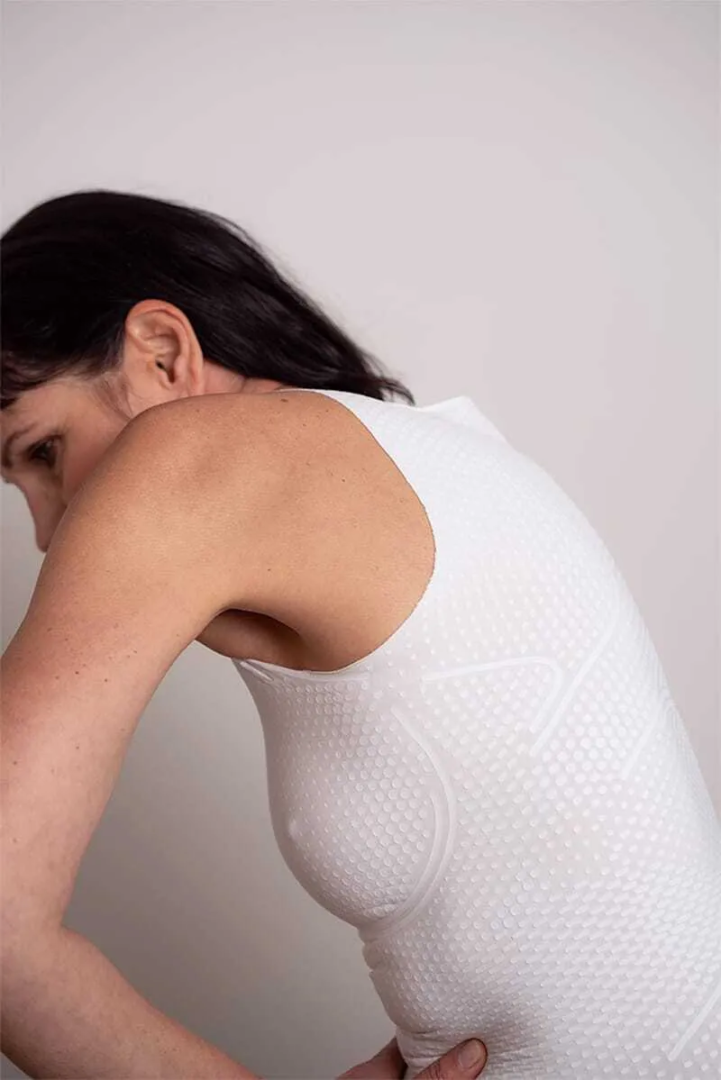
Doyenne Studio: Care work is associated with the feminine. It is often unpaid and undervalued, yet foundational to many design disciplines. We wanted to celebrate care without reinforcing stereotypes. Alma Futura presents tools for self-examination and vaginal microbiome restoration. Rosie Broadhead develops probiotic clothing that nurtures the skin. Lena Bernasconi confronts gender bias in industrial environments by designing workwear fitted for women working in construction. These works articulate care as design intelligence.
Holistic systems as an orientation toward connection and continuity
Doyenne Studio: Holistic systems thinking asks designers to consider the full cycle of materials and processes, treating waste as resource and continuity as principle. Agne Kucerenkaite’s Make Waste Matter transforms construction byproducts into pigments and glazes. Sanne Visser explore fibers made from human hair, proposing infrastructures for harvesting and reuse. Jessica Redgrave’s sunflower-based garment system questions whether an entire material ecology can exist within a single plant.
Across categories, the feminine appears as an orientation toward other organisms, toward craft and earth, toward embodied knowledge as resilience.
Exhibition experience and how visitors navigated possibility
Doyenne Studio: We didn’t want the exhibition to be linear. The colors and categories allowed fluid navigation, to reflect the feminine approach. Doyenne was always a starting point for something bigger. Increasing diversity in skateboarding and connecting communities globally led naturally to this curatorial project.
As a studio we focus on design and campaigns rooted in authenticity, championing a sense of community. Responses to the exhibition were hopeful and inspired. Feminine approaches value open-source knowledge and decentralization rather than competition. Creativity becomes abundant when knowledge is shared.
The tension between feminine methodologies and the systems they must survive in
Doyenne Studio: We wanted to emphasize that these are designers, not artists. Their projects function in the real world. It is difficult for these practices to exist in a capitalist system that values speed, extraction, and instant gratification. How inherently feminine methodologies are valued in a society that does not value them remains an open question.
Decentralization, imagination, and the need for new worlds
Doyenne Studio: The curation was an exercise in decentralization and in resisting attachment to a single center. We did not arrive with answers. The exhibition functions as a question meant to inspire reflection rather than define anything. Feminine methodologies need space for experimentation and imagination.
We are living in a crisis of imagination. Systems are collapsing and new worlds must be built. Visitors expressed surprise that such work exists in a world where destruction and fear dominate public life. These containers of joy and possibility matter.
Cross-industry collaboration and shared resources are essential, especially across the Global South, where leadership in feminine methodology is deeply established but underrecognized. These voices must be integrated.
Doyenne Studio: Feminine Literacy is an open movement. Anyone can join.
Feminine literacy as a framework for rethinking how design relates to life
Feminine Literacy reframes the feminine as methodology rather than identity. It centers interspecies knowledge, rooted craft, ecological attention, and cultures of care. Developed through the combined practices of Mara Bragagnolo and Giulia Angelucci, it highlights how women and queer designers put forward forms of innovation that resist extraction and prioritize life.The framework offers a vocabulary for understanding design as a collaborative, systemic practice shaped by material memory and ecological responsibility. It opens the possibility of new systems of making that do not exhaust the world but contribute to its renewal.
Melis Özek
![Oyster[Crete] - Metamorphosis - Matter Forms](https://lampoonmagazine.com/wp-content/uploads/2026/01/OysterCrete-Metamorphosis-Matter-Forms.webp)