What are the limits of timber architecture? The case of the Grand Ring after Expo Osaka
Built as the world’s largest wooden structure, the Grand Ring raises questions of lifespan, reuse, governance, and fire risk in large-scale timber architecture
The Grand Ring of Expo 2025 Osaka: from timber world record to a circular economy test
In early December 2025, just weeks after Expo 2025 Osaka closed its gates, dismantling began on one of its most celebrated structures. The Grand Ring—a continuous wooden megastructure that had framed the entire exhibition grounds and earned a Guinness World Records title as the largest wooden architectural structure ever built—entered a phase that would ultimately define its environmental legacy.
Only a short segment, roughly 200 meters, is set to remain on Yumeshima Island as a permanent landmark. A limited portion may be carefully dismantled and relocated for reuse. The majority, however, is expected to be demolished and processed into wood chips for fuel.
For a project presented as a flagship of sustainable architecture, the irony is difficult to ignore. The Grand Ring was built to demonstrate timber’s future at infrastructural scale. Its end-of-life trajectory now risks transforming that demonstration into a case study in the limits of sustainability narratives when material afterlives are left unresolved.
The Grand Ring as Expo infrastructure, not architectural object
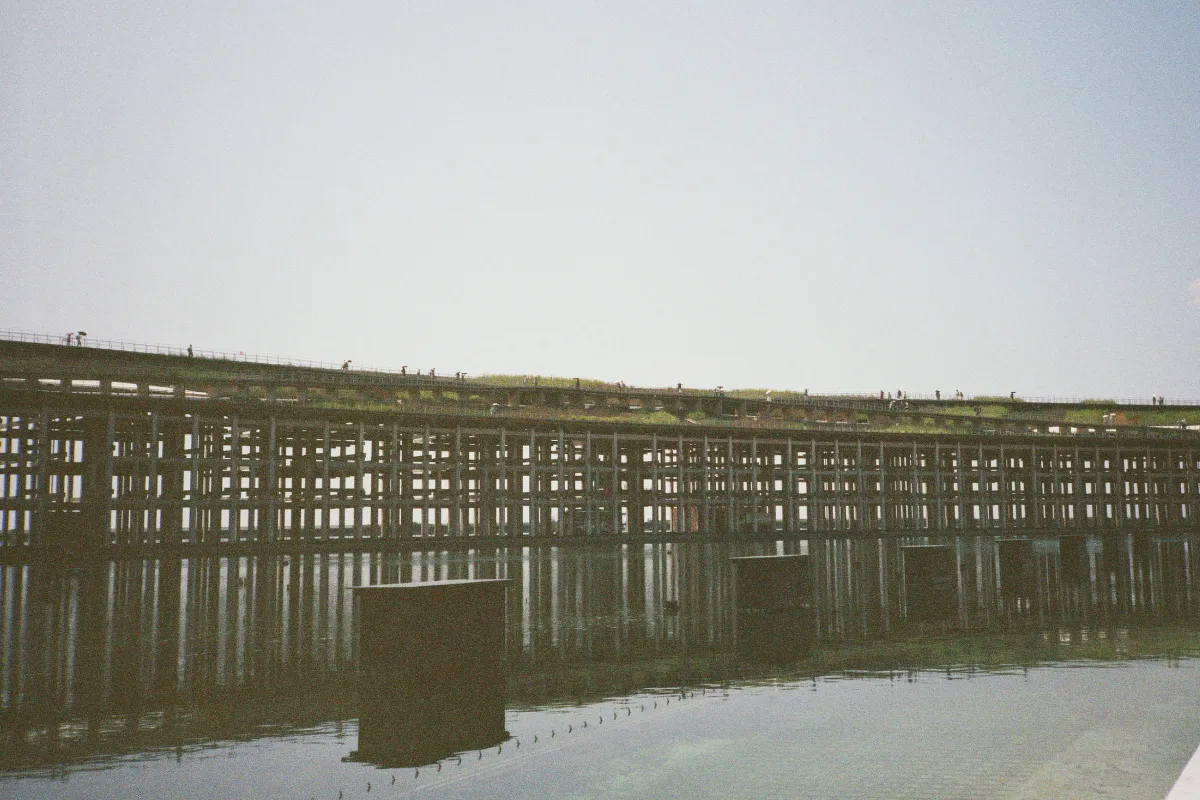
The Grand Ring was conceived as the primary spatial and infrastructural framework of Expo 2025 Osaka. Designed by Japanese architect Sou Fujimoto, it enclosed the exhibition grounds on Yumeshima Island through a continuous wooden loop, functioning simultaneously as circulation route, climatic buffer, and architectural landmark.
With a diameter of approximately 675 meters and a total circumference close to two kilometers, the Ring offered a continuous elevated walkway from which visitors could traverse the entire Expo site. Rather than acting as a pavilion among others, it organized the event spatially, providing orientation, boundary, and legibility across a vast and heterogeneous landscape.
Expo organizers framed the Ring’s circular form as a metaphor for global connectedness and “unity in diversity,” aligning architectural geometry with the Expo’s conceptual ambitions under the theme Designing Future Society for Our Lives. Timber, in this narrative, became both structure and symbol: a material choice positioned as ethical, forward-looking, and environmentally responsible.
Timber as a promise of architectural and environmental transition
From the outset, the Grand Ring was presented as evidence of a material shift in architecture. Timber was promoted as a viable alternative to steel and reinforced concrete, capable of delivering structural performance at infrastructural scale while reducing embodied emissions.
This positioning placed the Ring squarely within a broader global discourse around mass timber and engineered wood. As cities and institutions search for pathways to decarbonize the built environment, timber has been framed as a key lever—renewable, carbon-storing, and increasingly capable of meeting modern structural demands.
The Ring amplified this argument through scale and visibility. It was not a quiet experiment but a superlative one, intended to demonstrate that wood could move beyond buildings and into the realm of urban infrastructure. The Guinness World Records designation reinforced that ambition, turning the structure into a benchmark as much as a design.
Yet timber’s environmental credibility has always depended on more than its use. It depends on how long it remains in material circulation and what happens once its initial function ends.
Traditional Japanese joinery adapted to contemporary infrastructure
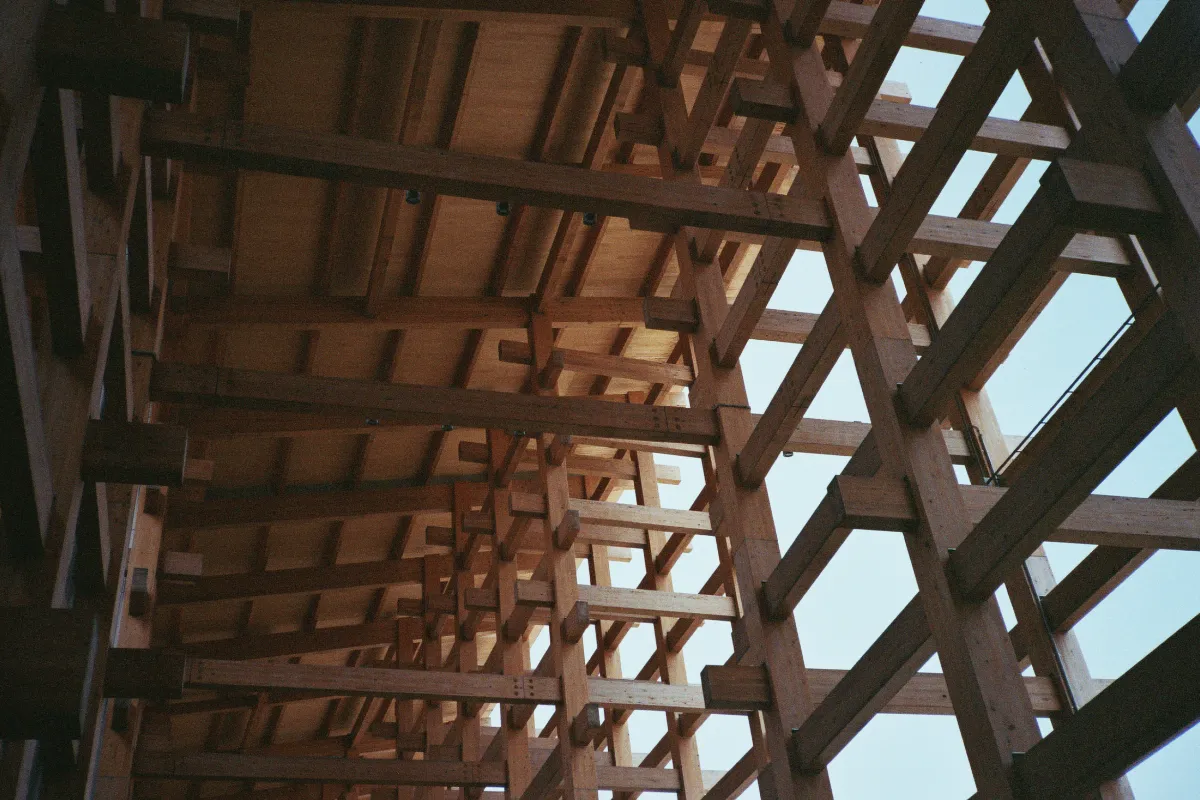
Structurally, the Grand Ring combined contemporary modular construction with a joinery principle deeply rooted in Japanese building tradition. The system was based on nuki connections, in which horizontal members pass through vertical posts.
Historically, this method enabled partial dismantling, component replacement, and long-term maintenance—one reason many Japanese wooden temples and shrines have survived for centuries. In the context of the Ring, nuki joinery was not merely a cultural reference. It was presented as a technical strategy aligned with ideas of reversibility and reuse.
At the scale required for the Expo, this joinery logic was implemented through engineered timber, specifically glued laminated timber (glulam). Glulam enabled long spans, predictable mechanical behavior, and compliance with modern structural standards while maintaining a formal and conceptual link to vernacular construction techniques.
The implication was clear: the Ring was not only structurally ambitious, but theoretically prepared for a second life.
Engineered timber and the realities of Expo-scale construction
Glulam was essential to translating traditional joinery into an infrastructural system capable of spanning hundreds of meters. Engineered timber allowed the Ring to meet performance requirements typically associated with steel or reinforced concrete, while retaining timber’s lower embodied carbon profile.
This hybridization—traditional logic supported by industrial precision—helped position the Ring as a prototype for future large-scale timber infrastructure. It also reinforced the sustainability narrative surrounding the project: wood was not chosen for aesthetics alone, but as a technically and environmentally rational material.
However, the industrialization of timber at this scale also carries consequences. Engineered wood requires significant processing, energy input, and logistical coordination. Its environmental performance cannot be separated from questions of sourcing, lifespan, and end-of-life management.
Sustainability claims shaped by lifespan and post-Expo decisions
World expositions carry a structural contradiction. While they increasingly present themselves as platforms for sustainable innovation, their architecture is often designed around a fixed and relatively short timeline. Buildings are erected quickly, celebrated intensely, and dismantled soon after closing.
The sustainability claims attached to the Grand Ring therefore depended not only on its material composition, but on decisions made after the Expo. As with all large-scale timber architecture, environmental performance is inseparable from lifespan. Timber stores carbon only while it remains in material use. Its climate benefit diminishes rapidly if that use is short-lived.
In this sense, the Ring’s environmental impact did not begin with architecture. It began with forestry and extended into governance, logistics, and policy. Without a credible long-term plan, even the most materially “green” architecture risks becoming environmentally ambiguous.
27,000 cubic meters of wood and their climate implications
The timber used for the Grand Ring has been consistently reported at approximately 27,000 cubic meters, placing it among the most material-intensive timber structures ever built. Around seventy percent of this volume consisted of domestically sourced Japanese cedar and cypress, with the remainder largely made up of imported pine.
At this scale, the Ring constitutes a substantial material reservoir with measurable climate consequences. Wood contains roughly fifty percent carbon by dry mass. When kept in structural use, that carbon remains stored. When burned, it is rapidly released as carbon dioxide.
The environmental justification for extracting and processing such quantities of timber therefore depends on whether the material remains in long-term use, storing carbon and displacing more emissions-intensive alternatives. Short-lived use followed by demolition undermines the carbon rationale that legitimizes extraction in the first place.
Timber, circular economy, and the failure of reuse hierarchies
Within circular economy frameworks, materials are valued not only for renewability but for their ability to remain at high functional value. For timber, this means prioritizing structural reuse before recycling or energy recovery.
Once wood is converted into fuel, all future material cycles are eliminated. Replacement materials must then be produced elsewhere, increasing overall environmental burden. Energy recovery represents the lowest-value outcome in circular hierarchies, extracting energy once and permanently removing the material from productive circulation.
Early communication around the Grand Ring suggested alternative pathways: careful disassembly enabling reconstruction in other locations, or reuse in post-disaster housing projects. These scenarios aligned with both circular economy theory and the structure’s joinery-based reversibility. But they required coordinated logistics, regulatory alignment, and long-term planning beyond the temporal horizon of an Expo.
The gap between design intent and implementation highlights a systemic problem. Architecture can be designed for reuse, but without institutional frameworks to support that reuse, technical potential collapses into waste.
Sou Fujimoto on longevity, maintenance, and Expo temporariness
Sou Fujimoto has consistently articulated the Ring as a structure capable of longevity. Drawing on Japan’s historical precedent of wooden buildings surviving for centuries, he has argued that exposed timber does not inherently imply short service life when properly maintained.
In public statements, Fujimoto suggested that with structural adaptations and long-term maintenance, the Ring could remain in use for several decades—potentially up to a century. He has also expressed disagreement with the policy tendency to treat Expo architecture as intrinsically temporary, arguing that pre-determining demolition undermines meaningful sustainability ambitions.
From this perspective, the Ring’s fate is not a material failure but a governance choice. Timber’s durability is well established. What remains uncertain is whether institutions are willing to commit to long-term stewardship rather than short-term spectacle.
Demolition, partial preservation, and the turn toward biomass fuel
Following the Expo’s closure, dismantling of the Grand Ring began in early December 2025. Current plans indicate that only a limited segment will remain as a permanent landmark. While some portions may be relocated for reuse, the majority is expected to be demolished and processed into wood chips for fuel.
This outcome has generated substantial criticism. Fujimoto has described the conversion of structural timber into fuel as environmentally counterproductive, arguing that it contradicts the principles of material circularity used to justify the Ring’s construction.
The controversy illustrates how quickly sustainability narratives can unravel when end-of-life decisions prioritize cost and expediency over material value and climate performance.
Carbon release, carbon debt, and near-term climate impact
From a climate-accounting perspective, burning the Ring’s timber has immediate implications. Combustion rapidly oxidizes stored carbon into carbon dioxide, releasing it into the atmosphere within a short time frame.
Applying conservative density estimates, the wood used in the Ring corresponds to tens of thousands of tons of CO₂ emissions if burned. This excludes upstream emissions from harvesting, processing, and transportation.
The central issue is timing. While trees can regrow and reabsorb carbon, this process unfolds over decades. During that interval, atmospheric carbon concentrations remain elevated, contributing to near-term warming. This phenomenon—often described as carbon debt—challenges assumptions that biomass energy is inherently climate neutral.
Beyond carbon: air quality and public health
Wood combustion also has local environmental consequences. Biomass burning can generate fine particulate matter (PM2.5), associated with respiratory and cardiovascular health risks. While emissions vary depending on combustion technology, these impacts are absent in reuse scenarios.
From an environmental perspective, converting high-quality structural timber into fuel introduces additional costs that do not exist when materials remain in structural use.
Cost-driven decisions and the governance gap of large-scale reuse
One of the primary arguments in favor of demolition and fuel processing is cost. Estimates for long-term preservation and maintenance of the Ring have been reported at several billion yen over a decade. Financial constraints are real, but they do not inherently align with environmental performance.
Circular reuse at this scale requires infrastructure: systems for dismantling, grading, certifying, transporting, and redeploying large timber elements. In the absence of such systems, even architecture designed for disassembly is often reduced to waste or low-value byproducts.
This gap between design intent and outcome reflects a governance failure rather than a material limitation.
The Grand Ring as a test of sustainable outcomes
The Grand Ring demonstrated that timber can operate at unprecedented architectural scale. As an experiment in material ambition, it succeeded. As a test of circular economy implementation, its legacy remains unresolved.
If most of its timber is converted into fuel, the project will stand as a clear example of the difference between sustainable design and sustainable outcomes. The Ring shows that material symbolism alone is not enough. Sustainability depends on time, stewardship, and the systems that govern what happens after the applause fades.
In this sense, the Grand Ring is less a failed experiment than a revealing one. It exposes the limits of sustainability narratives when long-term material responsibility is subordinated to short-term event logic. What remains is a lesson that will likely shape the future of large-scale timber architecture long after the Ring itself is gone.
Melis Ozek