Jonathan Anderson and the Power at Dior: creativity, merchandising and celebrity crush
Between atelier discipline and graphic t-shirts, from cinephile obsession to the collective wardrobe: JW Anderson converts film into product; and celebrities into a distribution channel for couture
JW Anderson’s pop ability: is he the Andy Warhol of contemporary fashion?
The entanglement of fashion and art is Anderson’s operating system. He collects the rough and the handmade before he designs. He produces memes and garments. It’s pop. It’s immersed in the present tense. Jonthan Anderson flattens the images of the now into something deliberately compressed. Culture is a printable surface.
It happened with Challengers, widely discussed as a fashion film disguised as a tennis movie. It happened again with Queer (2024), Luca Guadagnino’s adaptation of William S. Burroughs’s autobiographical novel. In both cases, Anderson did more than design costumes. He extended the films into product.
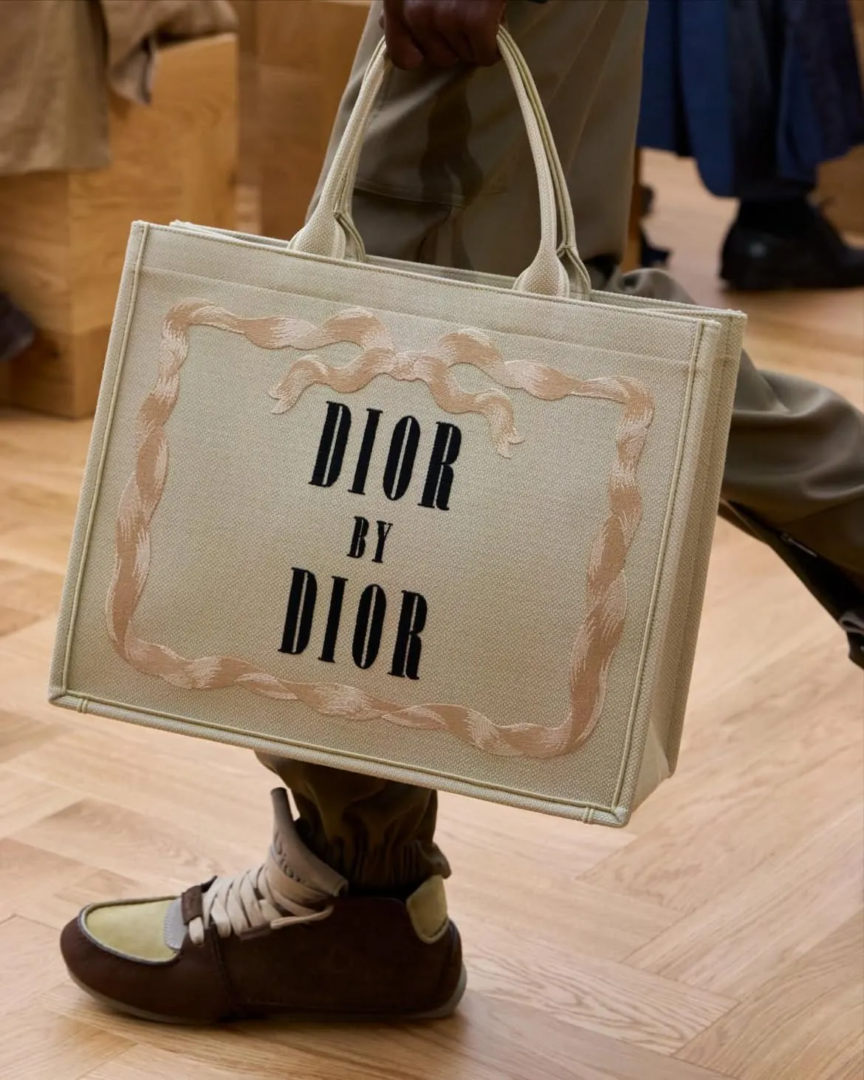
For Queer, the costumes referenced 1940s and 1950s vintage. The merch translated that into canvas totes, knit sweaters, T-shirts printed with stills, props, fragments of dialogue turned into trademarks. A frame becomes a logo. A line becomes IP.
The gesture exposes the automation of image culture. Cinema collapses into retail. Narrative flattens into surface. Anderson doesn’t resist the mass-media machine; he formalizes it. He makes visible the folk-pop instinct of the contemporary wardrobe—the desire to wear the moment, reduced to graphic shorthand. The closet as low-resolution archive.
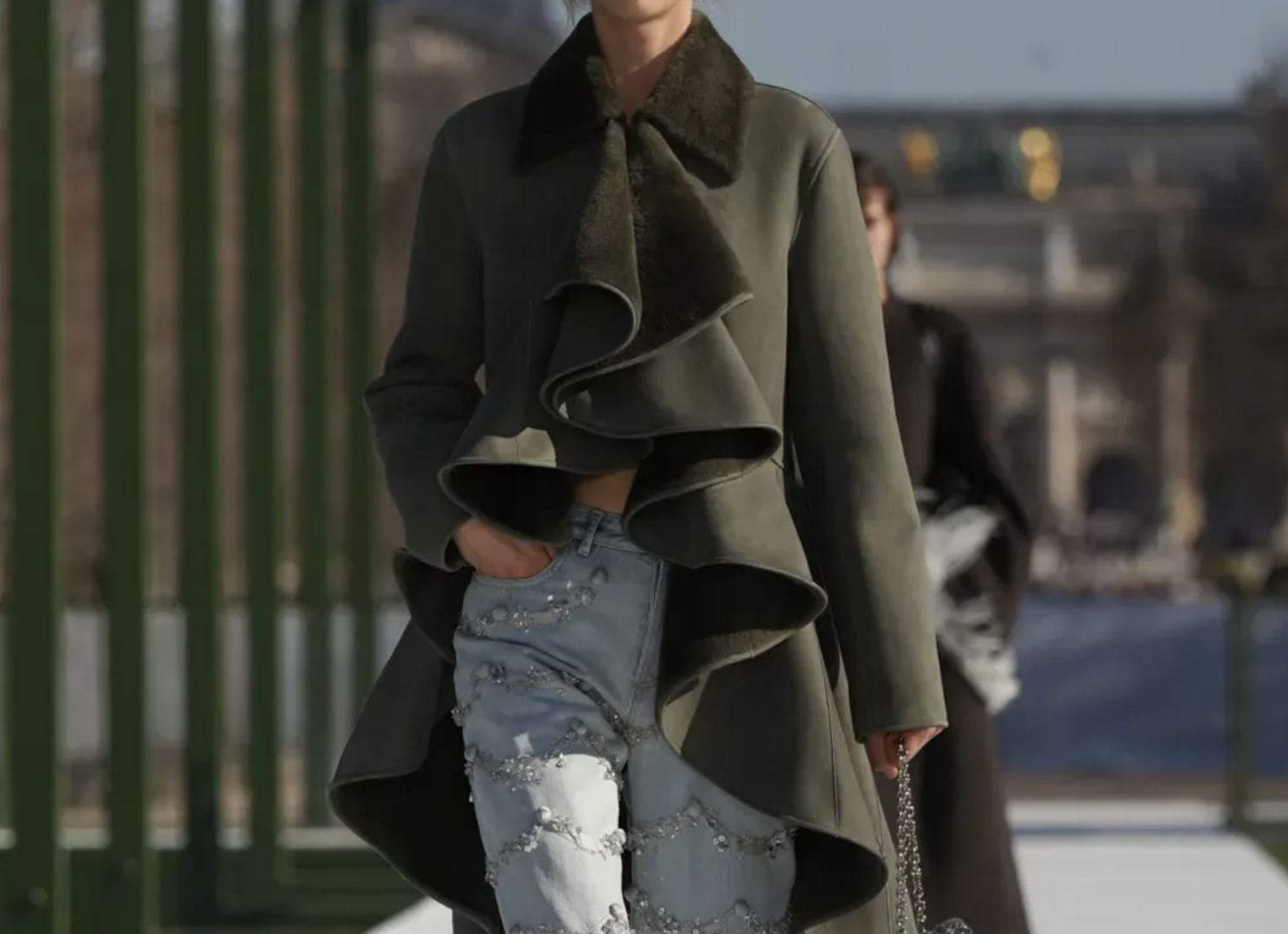
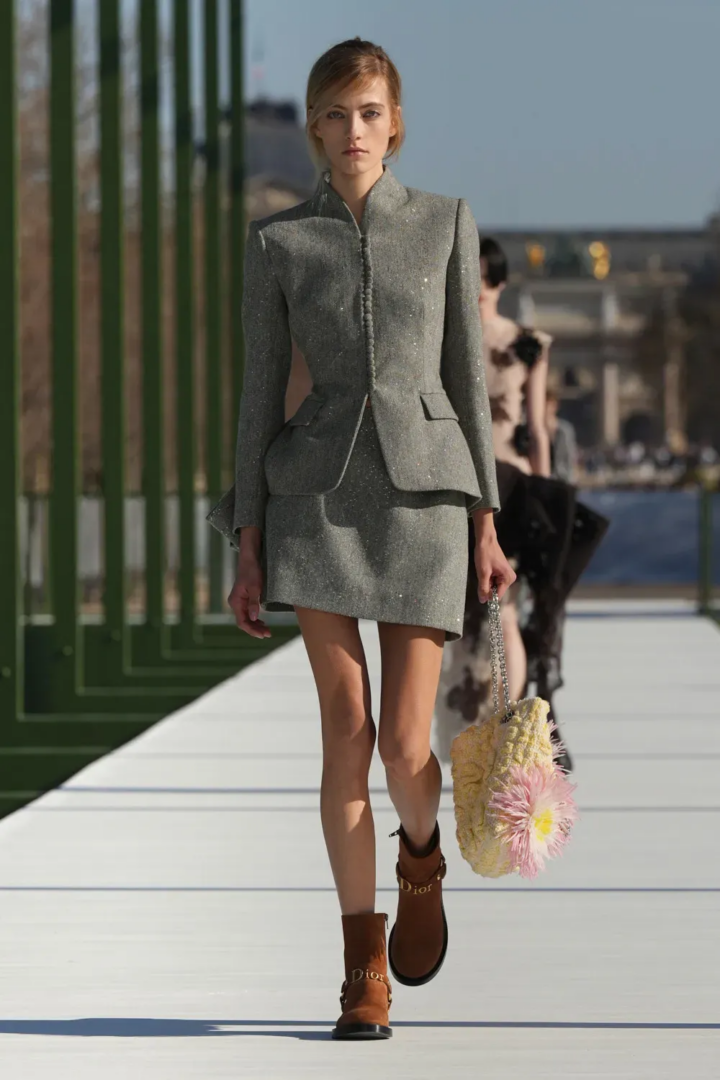
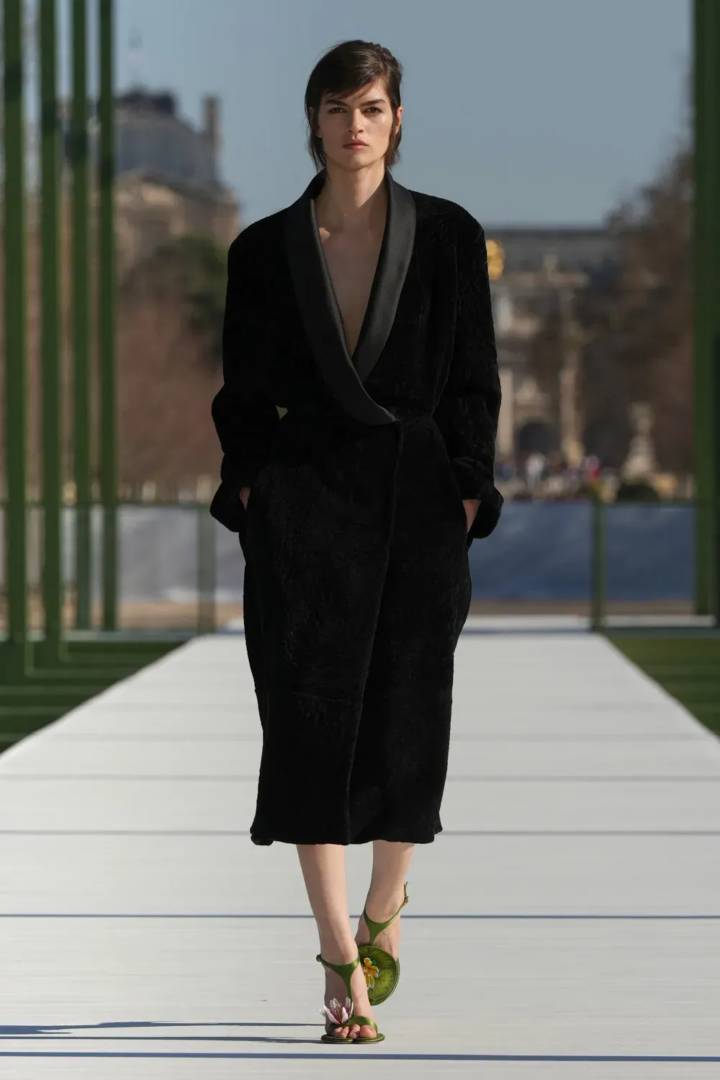
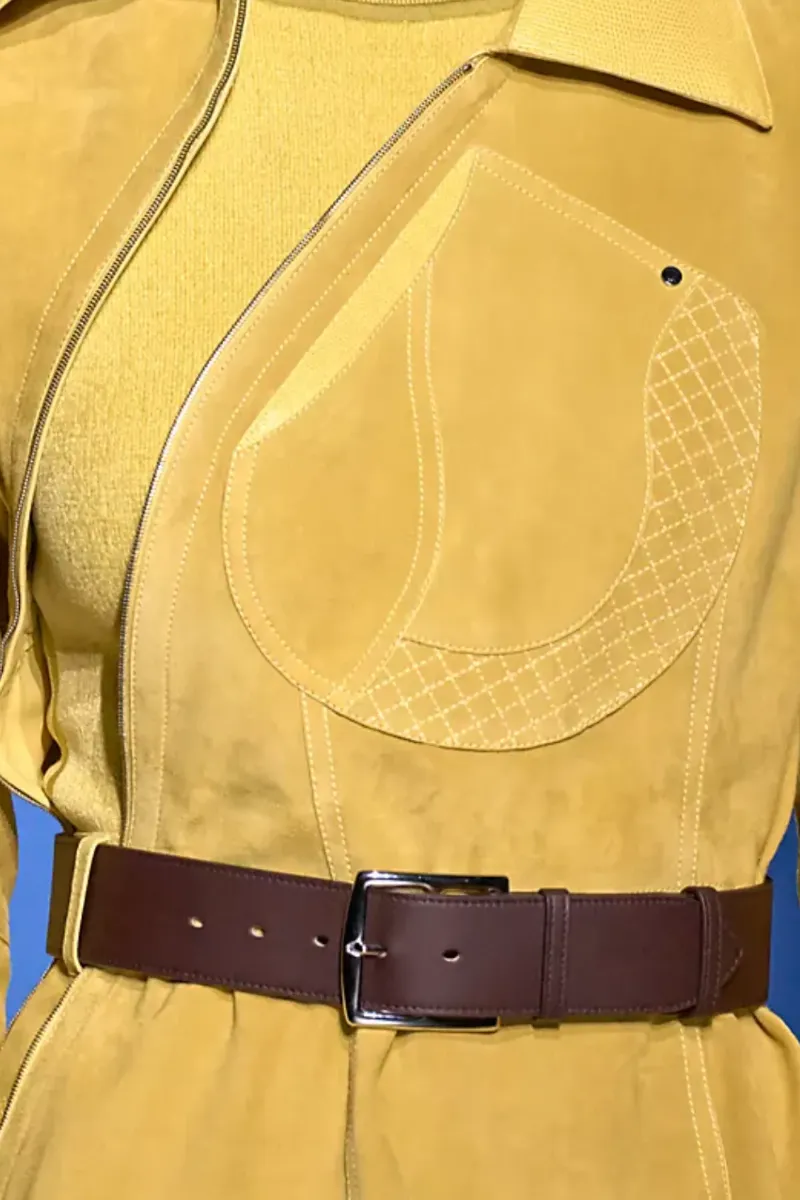
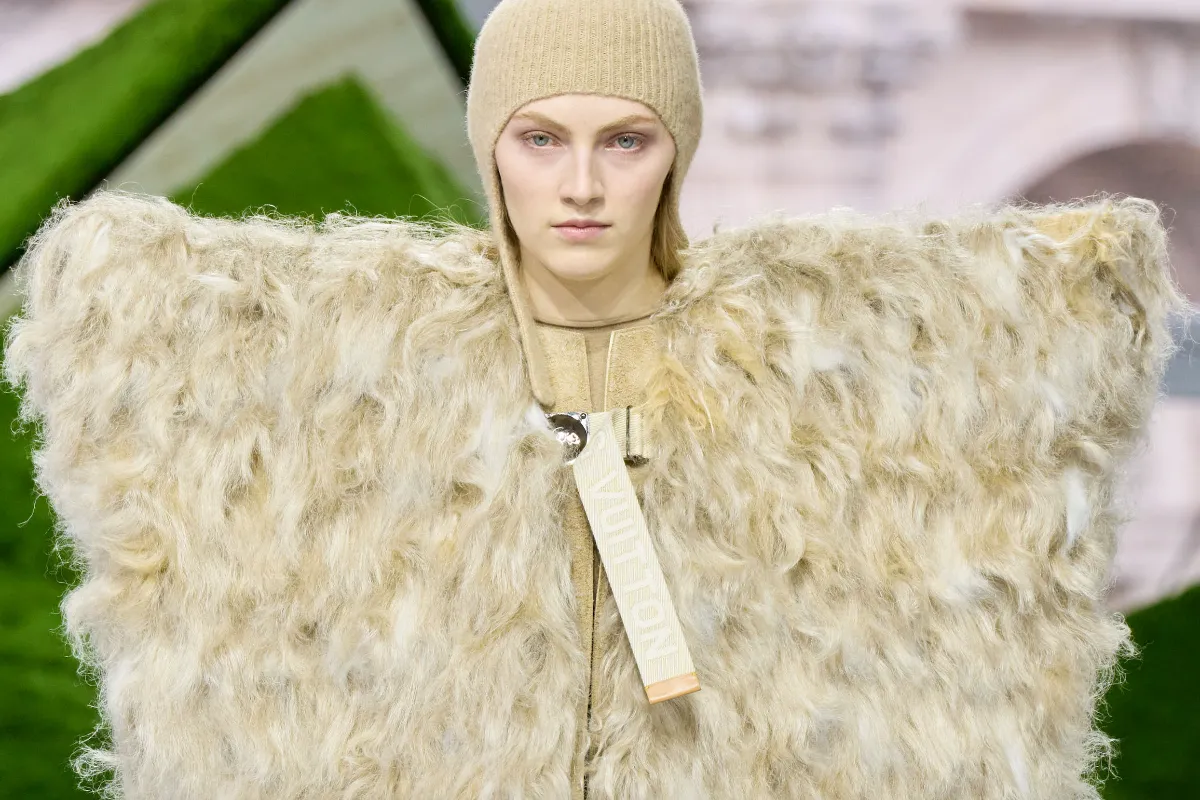
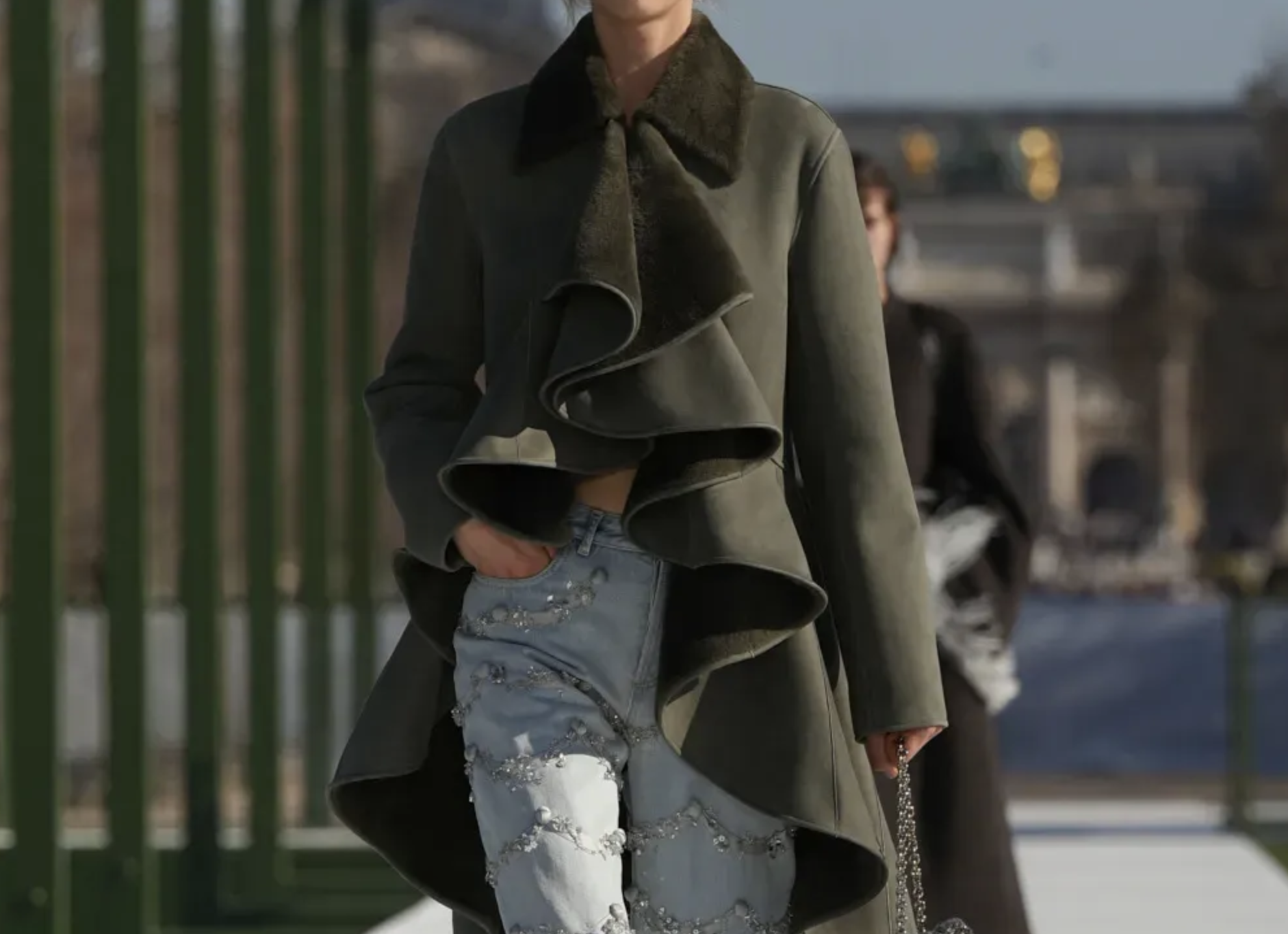
In his opening moves—two menswear shows and a couture debut—Anderson staged a thesis: aristocrat meets outsider. The men’s looks spelled it out. Donegal tweed Bar jackets, eighteenth-century ties, cargo bermudas. On the feet, intentionally beat-up sneakers. The moodboard ranged from Andy Warhol to Lee Radziwill to Jean-Michel Basquiat. Couture shifted into theater. Florals inflated into cyclamen-shaped earpieces. Tulle halos, Marie Antoinette style. Ballooned skirts. Silk georgette pleated so it wrapped the body like clay turned on a wheel. The word “sartorial” appeared so often in press releases and reviews it began to read like a compliance requirement.
JW Anderson’s couture shows up in Salomons. The question isn’t styling. It’s economics. Can you posture as the outsider when your valuation runs in the millions?
Anderson stands for a fashion system that markets the authority of Made in France. Then—predictably—he wears Salomon. Trail shoes that sit near the top of the Lyst Index. Until 2020, many pairs were produced in Turkey at roughly seven euros. In mid-2021, a French production site opened. Add five euros, subtract shipping. Around twelve euros a pair.
The collection was strong. Reviews were generous. The contradiction passed. As with the film merchandise, Anderson understands low-popular fashion—jeans and a T-shirt, elevated by context. Salomons sit squarely in that vocabulary.
Pop, not popular. JW Anderson’s clothes function like Campbell’s soup cans.
Charli XCX, Rihanna, Beyoncé, Ayo Edebiri, Kendall Jenner—over the past decade, celebrity culture has amplified the Anderson effect. He moves comfortably inside pop spectacle without dissolving into mass blandness. The Warhol parallel is structural. Think of the Campbell’s cans suspended against white: repetition, isolation, control. The surface reads accessible. The composition is exact.
Anderson works with a similar discipline. Beneath the noise sits couture-level hygiene. His real references are not models or actors but early twentieth-century craft masters. When he founded the Loewe Craft Prize in 2016, he institutionalized that allegiance. Craft was no longer subtext; it became policy.
When he was appointed creative director of Loewe, skepticism was predictable. A niche designer, known mainly for his own label and a brief stint in Prada merchandising, was expected to revive a heritage Spanish leather house that had drifted creatively—and to manage its economics. He did both. He brought narrative and margin into alignment. Few designers manage that balance between commerce and culture.
Loewe campaign, he styled Daniel Craig—the most domesticated iteration of Bond—in grandmotherly knits, tinted glasses, a ‘90s grunge leather jacket. Masculinity inverted and recalibrated. Some labeled it queer baiting. It reads instead as strategy: use ambiguity to generate volume. The non-mainstream as a delivery system for highly mainstream objects—logo tees, film-title totes, retail-ready irony.
If ambition in fashion is measured by authorship and scale, the trajectory is clear. This is how you build the case for being the best living designer.
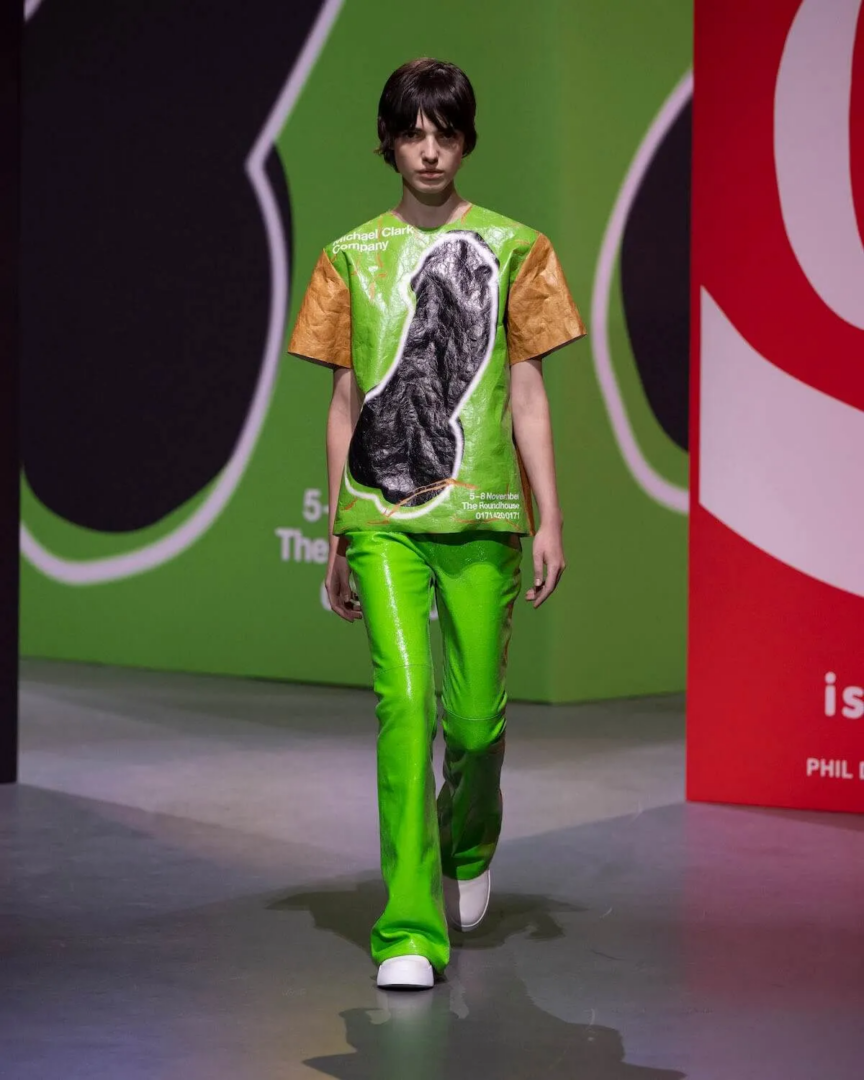
JW Anderson: when clothes make the movie. Pop, couture, merch, celebrity crush—the Anderson unilook
In life, appearance is not destiny. In cinema, Luca Guadagnino argues, the opposite applies. Before plot clarifies character, costume does. It delivers a starter kit for interpretation.
“Actors,” JW Anderson has said, “are strange people, in a good way. They’re vessels. You can pour into them whatever you want.” He and Guadagnino met in an Italian hotel. It felt inevitable. Guadagnino had been watching him from a distance. He saw Anderson’s first collection and reportedly thought, What the hell is this? Years later he described the reaction as a revelation—like Bertolucci hearing Stravinsky’s Rite of Spring for the first time. After that, nothing looked the same.
The inflection point reached a mass audience in spring 2024 with Challengers, directed by Guadagnino, costumes by Anderson. A ménage à trois set in professional tennis. Tashi Donaldson (Zendaya), a champion sidelined, channels her ambition into her husband, Art Donaldson (Mike Faist). Patrick Zweig (Josh O’Connor) is Art’s former best friend and Tashi’s former lover. The story stretches across a decade. Guadagnino builds it on rhythm. The audience becomes the tennis ball—volleyed across the court, visually and emotionally.
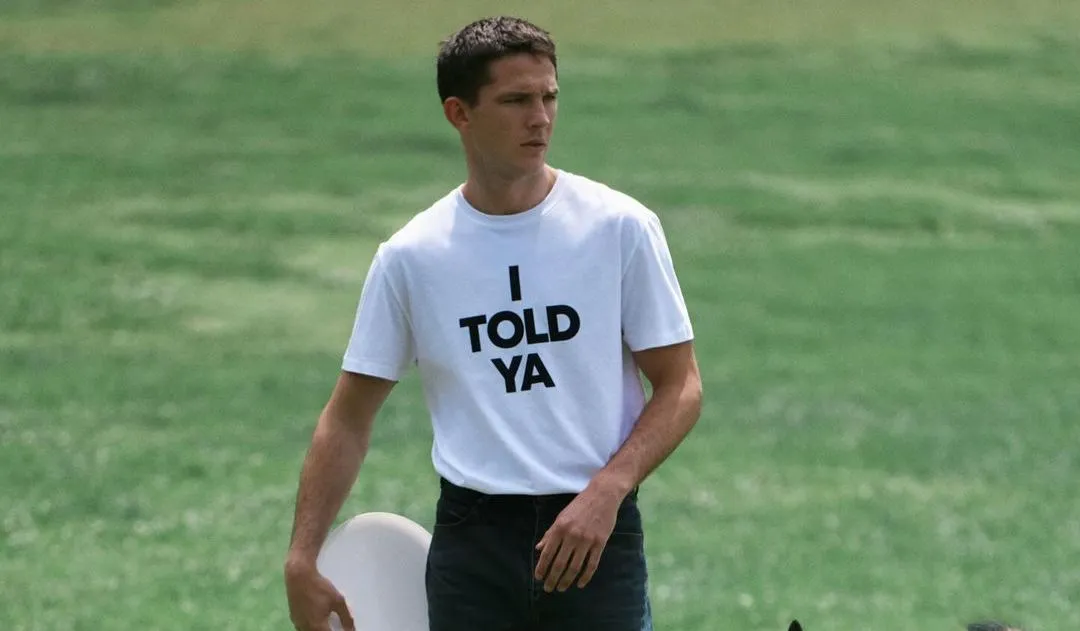
Clothing carries the thesis. Anderson wanted to show how success breeds uniformity. At a certain level, everyone owns the same suitcase, the same watch, the same signifiers. Art is coded in Adidas minimalism and Uniqlo restraint. Patrick signals inherited wealth—Loro Piana, Hermès, Louis Vuitton. Yet by the end, viewers want to be Zendaya. They want her authority. They want her “I Told Ya.”
The line moved from script to sweatshirt. Printed on tees and hoodies, sold as unisex essentials. Couture by attribution: the signature on the label does the elevation. This is the compression of fashion into culture and back into product. Pop, couture, merch, celebrity fixation—collapsed into a single formula.
JW Anderson: a field guide to becoming the best living designer
Most designers are identified by a silhouette—a jacket cut, a waistline, a repeatable look. Anderson built a reputation on volatility. No fixed origin story. No single signature. The impression of drift. The reality is intent. His stated goal is blunt: to be the best living designer. “People will probably say that sounds arrogant.”
Before his arrival, a critic described Loewe as “Madrid Whenever.” Three designers had cycled through, attempting incremental refreshes—sharper pencil skirts, adjusted suede shoulders. None shifted the narrative. What it required was not a stylist but a constructor of meaning. An Irish version of Miuccia Prada: limited formal training, expansive intellectual appetite. Politics, sexuality, bourgeois codes—treated as design material. A collector’s mind. A house filled with early nineteenth-century French ceramic mushrooms, eighteenth-century embroidery, studio nudes, pale pink porcelain buttons by Lucie Rie.
Aligned with Pop Art’s logic, he absorbs the mass-produced object without hierarchy. A pigeon-shaped bag becomes desirable. Balloon shoes circulate globally. Safety pins pierce luxury fabric. A beefsteak tomato can be declared “very Loewe.” The trick is not irony. It is authorship at scale—turning the trivial into system, the system into value.
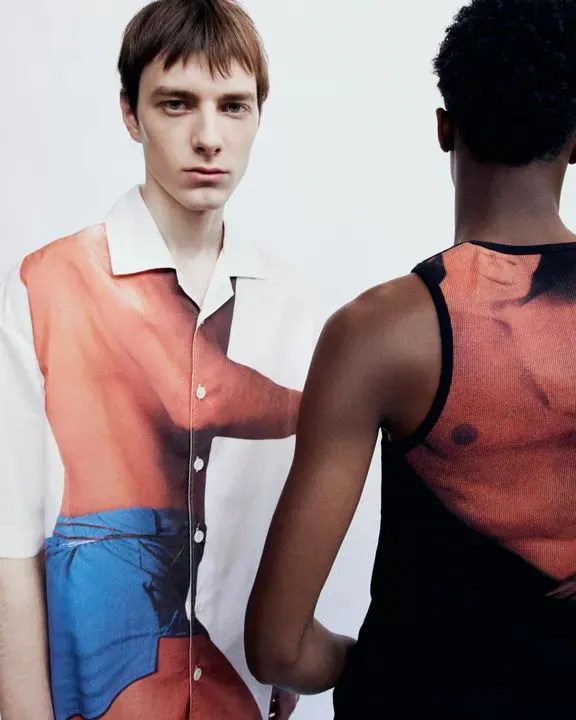
JW Anderson: the anatomy of cool
Until about a decade ago, the career path for a successful designer was linear. Launch an independent label. Capture industry attention. Take over a heritage house. Anderson’s trajectory follows that script: a self-financed brand shown in a basement in 2008, creative director of Loewe by 2013, Dior—historically the summit for a couturier—by 2025.
“Coolness” is the word most often attached to his rise. It is also a lazy word—elastic, politically overused, drained of precision. Anderson reframed it. For him, cool is not attitude. It is method. Creativity anchored in craft.
His exclusivity does not rest on scarcity marketing or insider codes. It rests on competence: exacting processes, complex leather treatments, ceramic techniques preserved across generations. He dresses contemporary celebrities—energetic, visible, rarely austere—without surrendering technical rigor.
When TikTok began to reshape fashion’s distribution model, many houses resisted. Too chaotic. Too literal. Too close to the ground for clothes meant to elevate. Loewe leaned in. The strategy mirrored the garments: playful, ironic, deliberately off-center. A kind of tongue-in-chic. Balloons became heels. Leather coats clipped onto bags. The corset of traditional “cool” loosened.
By the time he arrived at Dior, the question was inevitable: could that elasticity translate to the most codified name in couture? Cool, in his vocabulary, is not rebellion for its own sake. It is the ability to move between craft and mass culture without collapsing into either.