White socks, dirty thoughts. Do you smell, lick, or look?
From pulled-up socks in high fashion editorials to sweaty gym floors, the male white sock has evolved into a fetish-soft icon, marking subtle eroticism and personal desire
Sweat, scent, and calves: the sock turns the ordinary into desire
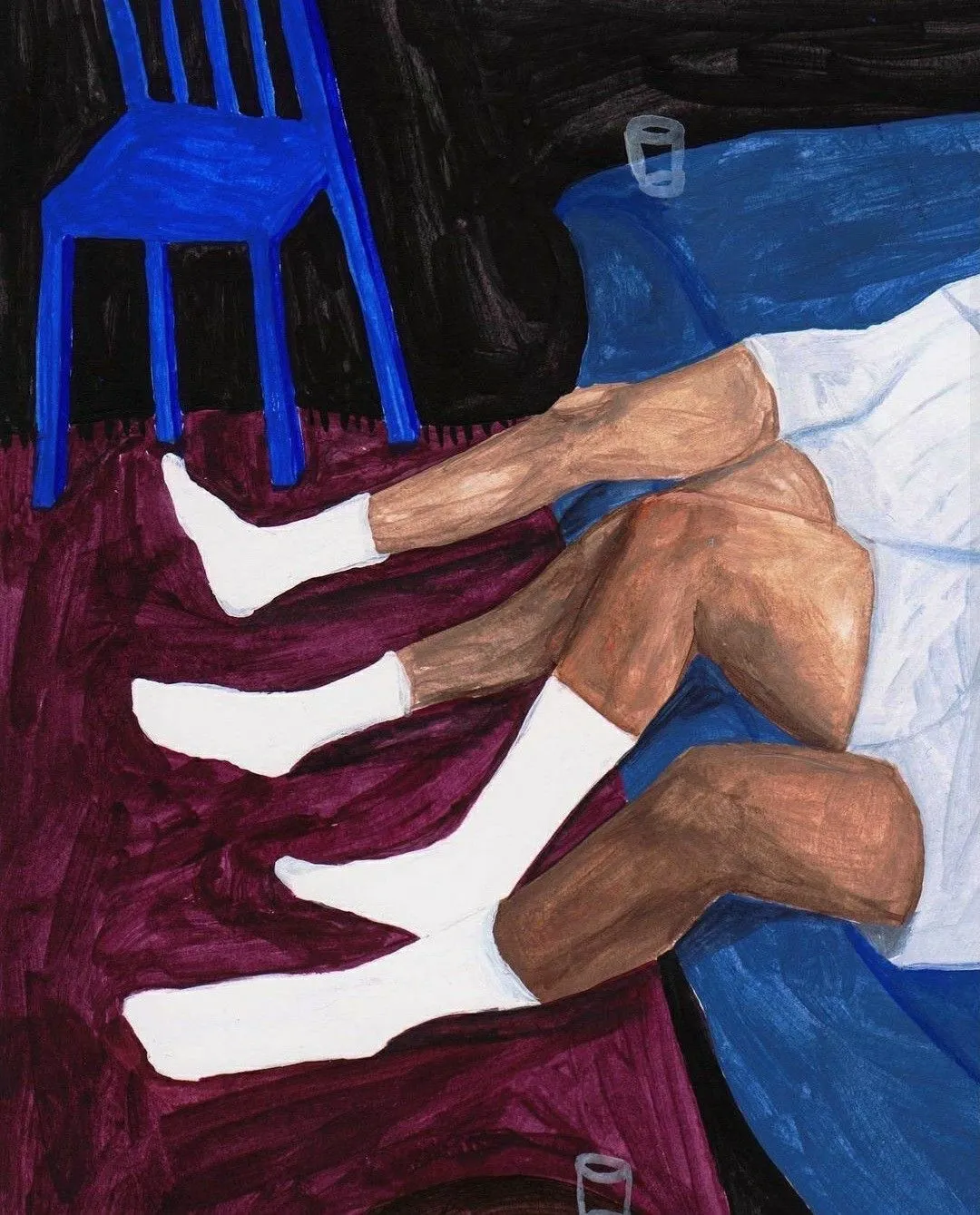
A pair of socks pulled up to the calf, white, terry cotton, fresh from the laundry or soaked in sweat. Yesterday, modest garment. Today, provocation. An object of desire. A threshold. They are not the act; they are the anticipation. Not nudity, but what delays it. The fetish that does not demand complete undressing, only that something remains.
Some smell them. Some lick them. Some sell them online; others buy them — the dirtier, sweatier, more pungent they are, the higher the value. They are the last garment left when everything else has been removed. The detail upon which the eye rests without admitting it. The accidental, private fragment that strikes us. A personal matter.
Roland Barthes writes in Camera Lucida: I am interested in the texture of the material. A detail attracts me. I feel that its mere presence changes my reading, that I am looking at a new photograph, marked in my eyes with a higher value. This detail is the punctum.
In the language of sexology, this is called fetishism: sexual attraction shifts from male or female genitals to other body parts (feet, armpits, hair), bodily fluids (sweat, saliva), or inanimate objects (underwear, stockings, shoes). Among the most widespread is foot fetishism, alongside sock fetishism and shoe fetishism — also known as retifism, named after the eighteenth-century writer Restif de la Bretonne, who wrote Fanchette’s Foot, describing his passion for women’s feet and shoes.
Among reputed fetishists: Italo Svevo, Thomas Mann, William Shakespeare, James Joyce, David Foster Wallace, Dostoevsky, Musil, Nabokov, Ariosto. And Francis Scott Fitzgerald, who was said to have met a prostitute and returned to her simply to look at her feet.

Desire lies in the detail: Wolfgang Tillmans turns the white sock into a visual fetish
From June 13 to September 22, 2025, the Centre Pompidou in Paris hosted the exhibition Nothing could have prepared us – Everything could have prepared us by German photographer Wolfgang Tillmans. The artist intervened across all 6,000 square meters of the former Bibliothèque publique d’information (Bpi), creating a large-scale installation combining photography, video, sound, and performance.
Among the works on display: the foot of a man, perhaps a boy, slipped into a white sock worn thin at the edge, resting on the seat of a bus or train. He wears short blue trousers. In one crop we see only the right foot in the foreground; in another, the horizon widens to reveal the calf and the left foot. The muscle is toned, defined, dusted with short blond hair.
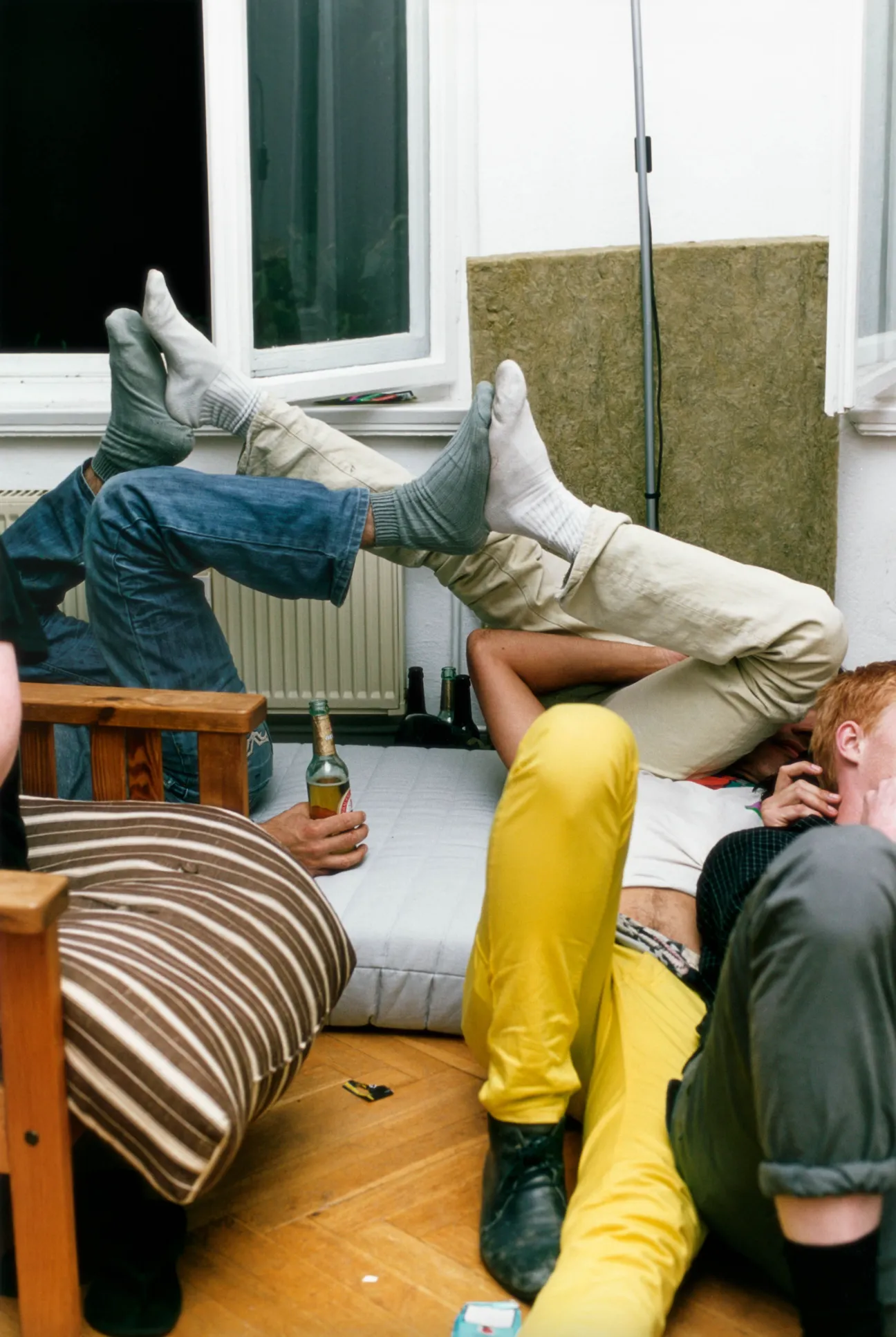
Men’s socks recur throughout Tillmans’ work. They appear again in Birthday Party, a wide shot of a night celebration. Two boys lie on a mattress thrown onto the floor. We see only legs and feet. They wear jeans and socks — one dressed in dark tones, the other in total white. Knees bent, feet touching mid-air, like the childhood game of riding an imaginary bicycle.
In Strümpfe, around ten socks, balled up into themselves, are scattered across a green sofa. They seem freshly washed, waiting to be folded into a drawer or closet. All mid-calf length. White, blue, black. Light grey, dark grey.
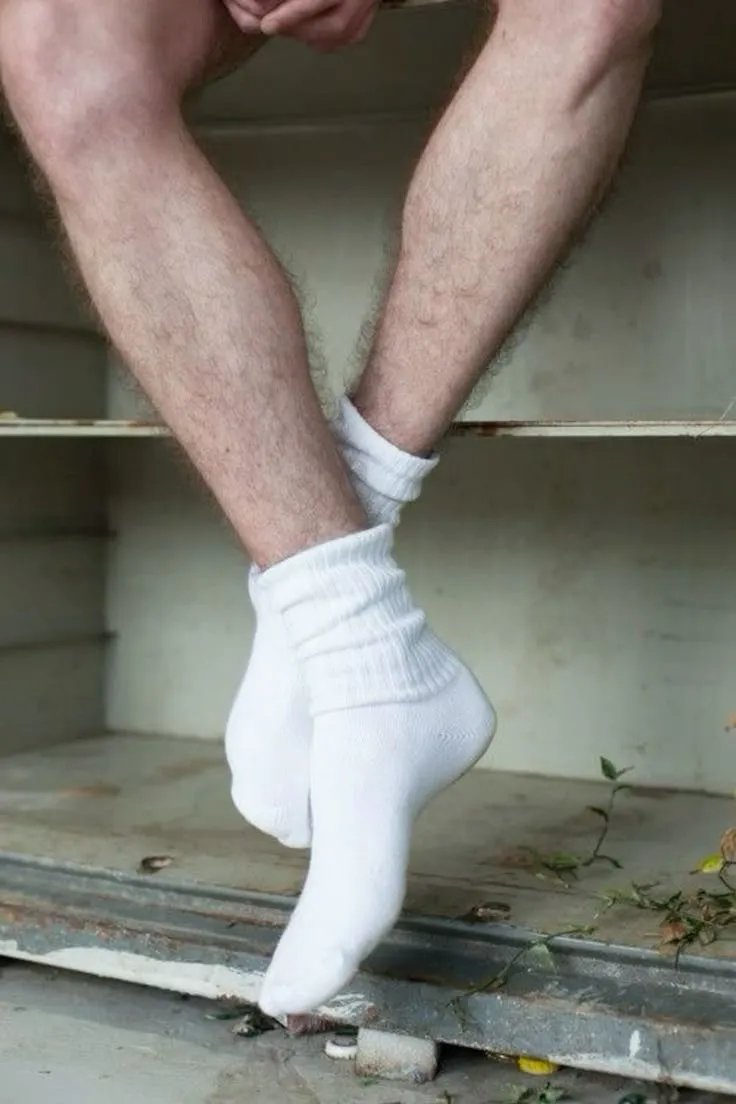
In Fire Safe, a pair of white terry socks returns to the foreground. They are worn by a boy of whom we see only hairy calves and knobby knees. He sits on a hollow iron cabinet.
Tillmans’ males are faceless boys. Perhaps they are reading a newspaper or smoking a cigarette. Perhaps they are kissing someone or taking drugs. Their hair may be blond or brown, their eyes blue or green. They might be sad; they might be happy. We see their socks, nothing more. We know nothing about them, yet that strip of fabric is enough to make us want to discover everything. Tillmans understands: a pair of socks is an invitation to desire.
From Harry Styles to Bad Bunny: the white sock as contemporary fetish
March 2020. Harry Styles is photographed by Casper Wackerhausen-Sejersen for Beauty Papers magazine. In one image, he wears a black T-shirt reading “Treat people with kindness,” briefs, and white socks. He stands on a floral armchair. His left foot stretches toward the floor. Legs and arms covered in tattoos, beard untrimmed, hair messy. He looks like a pirate, like a ballet dancer. In another shot, he resembles a Belle Époque Parisian stage diva: seated in profile on the same chair, face painted white, wearing a black-and-white striped robe, dangling pearl earrings, and a dramatic yellow feathered headpiece brushing the ceiling. A figure from another era — yet his feet remain hidden inside thick white terry socks.
Fast forward. June 2025. Bad Bunny, photographed by Greg Swales for Variety. He appears on the cover seated at a kitchen table in the house where he grew up in Puerto Rico. He wears a red tracksuit and white socks. His right foot rests on a chair in the foreground, the sole dusty. The other foot stays on the floor. Legs open, pose confident. In another image he sits wide-legged again, arms crossed, red tracksuit, feet and socks still foregrounded. In the opening image of the feature: leaning against the kitchen counter, refrigerator open, bowl of cereal in hand. He raises a spoon to his mouth. He wears a pink furry hoodie with long bunny ears stitched onto the hood, black boxer shorts, and the same white Calvin Klein socks. Hairy calves and thighs. Wide, muscular. Small tattoos scattered across the skin.
Clean cotton, dirty thoughts: gym selfies, normcore loafers, and the male body as theater of desire
Paul Mescal. Light blue shirt unbuttoned at the bottom, revealing a sliver of stomach. Mid-thigh shorts, perhaps English-style briefs or pajama bottoms. Loafers and white socks. Also Pharrell Williams, Tyler, the Creator, Justin Bieber.
Three classic pieces of menswear, seen and seen again from early twentieth-century patriarchs to today’s post-streetwear era of performative masculinity. Some recall Harrison Ford at Cannes in the 1980s. Others, Paul Newman stretched out on his sofa in shorts and white socks.
On Instagram and TikTok, the clean boy aesthetic dominates. The 1990s revival. The American college silhouette. The white sock as marker of belonging to a fetish-soft class that does not seek excess yet provokes without crossing the line. A uniform that is never neutral. It conceals sexual tension. Ready to be unlaced for effect. An invitation hidden beneath normcore styling.
And again: gym reels. Athletic socks and technical leggings. Workout videos. Heat. Sweat. Advertising campaigns that turn the locker room into a stage. The sock hugging nerves, muscular calves, shaved or hairy.
The term is “gym thirst trap”: content created during workouts and posted to attract attention, to display physical and aesthetic progress. Mirror selfies. Close-ups of muscles and technical apparel. A sock always appears. The eye falls there.
Nicolò Bellon