Surreal but not fiction: Mat Maitland on what animals and machines actually share
Mat Maitland’s cybernetic artworks for Lampoon Meccano explore the blurred boundary between animal bodies and mechanical systems — and why science suggests the two were never truly separate
Mat Maitland and the cybernetics of artworks: visual epistemology and systems thinking
What unites these four works, beyond their formal elegance, is the consistency of their underlying argument. Maitland is making epistemological images: images that ask questions about how we know and categorise the world, about the boundaries we draw between the natural and the artificial, the living and the mechanical, the original and the copy.
The cybernetic tradition that Wiener inaugurated in 1948 has by now permeated almost every field of contemporary knowledge — from neuroscience to economics, from ecology to computer science. Its central insight, that living systems and mechanical systems are structurally homologous, has moved from controversial hypothesis to something close to scientific consensus. What Maitland’s work for Lampoon Meccano does is give that insight a visual form that is both rigorous and seductive — images that make the argument through the precise placement of a cat on a robot, a wing beside an arm, an egg beside a capsule, a cow beside its own reflection.
Cybernetics and artworks: Norbert Wiener and the collapse between animal and machine
In 1948, Norbert Wiener published Cybernetics: Or Control and Communication in the Animal and the Machine, a slim but seismic volume that proposed one of the twentieth century’s most unsettling ideas: that the distinction between a living organism and a mechanical system was, at its core, a distinction of material rather than of principle. Both animals and machines, Wiener argued, operate through feedback loops — they receive information from their environment, process it, and adjust their behaviour accordingly. The nervous system and the thermostat, the eye and the camera, the muscle and the motor: all variations on the same underlying logic of control and communication. It was a hypothesis that collapsed centuries of philosophical separation between the organic and the artificial, and it laid the theoretical groundwork for everything from computer science to robotics to contemporary artificial intelligence.
Wiener was not alone in this intuition. In the same decade, the biologist Ludwig von Bertalanffy was developing General Systems Theory, proposing that all complex entities — whether biological, mechanical, or social — could be understood through the same structural principles: input, transformation, output, feedback. The living body was a system. The factory was a system. The ecosystem was a system. What differed was the substrate, not the architecture. A few years later, in 1960, the cyberneticist Heinz von Foerster pushed the argument further, suggesting that self-organisation — the capacity of a system to generate and maintain its own structure — was the fundamental property that united the living and the mechanical. Life, in this framework, was an engineering problem that nature had solved first.
It is within this intellectual tradition that the artworks Mat Maitland has produced for Lampoon Meccano demands to be read. A series of images that propose, with the calm confidence of a scientific diagram, that the animal and the mechanical were never meaningfully separate to begin with.
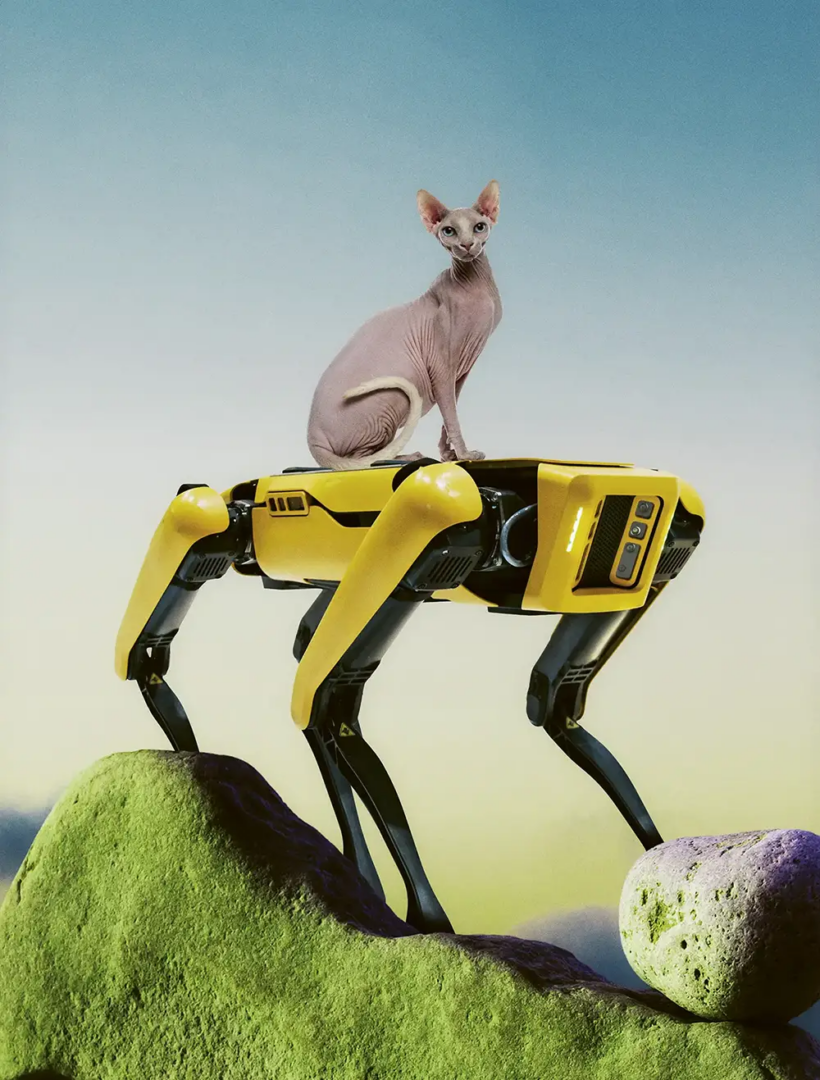
Sphynx cat and Boston Dynamics Spot: biomechanics, replication and the machine animal
The first of the four works places a hairless Sphynx cat atop a Boston Dynamics Spot robot — the four-legged autonomous machine that has become, over the past decade, one of the most visible and culturally charged objects in contemporary robotics. Spot was designed by studying the biomechanics of quadruped locomotion: the distribution of weight across four limbs, the articulation of joints under dynamic load, the subtle postural adjustments that allow a dog or a horse to navigate uneven terrain. Boston Dynamics engineers spent years analysing animal movement — frame by frame, force plate by force plate — in order to replicate it in steel and servomotors. The machine is, in the most literal sense, a copy of the animal.
Maitland’s artworks returns the original to its replica, placing them in the same frame with the matter-of-fact clarity of a comparative anatomy plate. The cat sits on the robot the way a specimen sits beside its skeletal reconstruction in a natural history museum — as evidence. The image asks, without raising its voice, the question that biomechanics has been circling for over a century: if the mechanical can perfectly replicate the biological, what was the biological in the first place, if not a particularly elegant mechanism?
Descartes, in the seventeenth century, proposed that animals were automata — biological machines operating according to purely mechanical principles. The bête-machine was a troubling idea in its time, but one that the history of science has quietly vindicated. The more precisely we have come to understand animal physiology — the electrochemical signalling of neurons, the hydraulic engineering of the cardiovascular system, the computational efficiency of the visual cortex — the more it resembles, structurally, the systems we design and build. Maitland’s cat on its robot double is Descartes made image: the boundary between animal and machine rendered visible only to be dissolved.
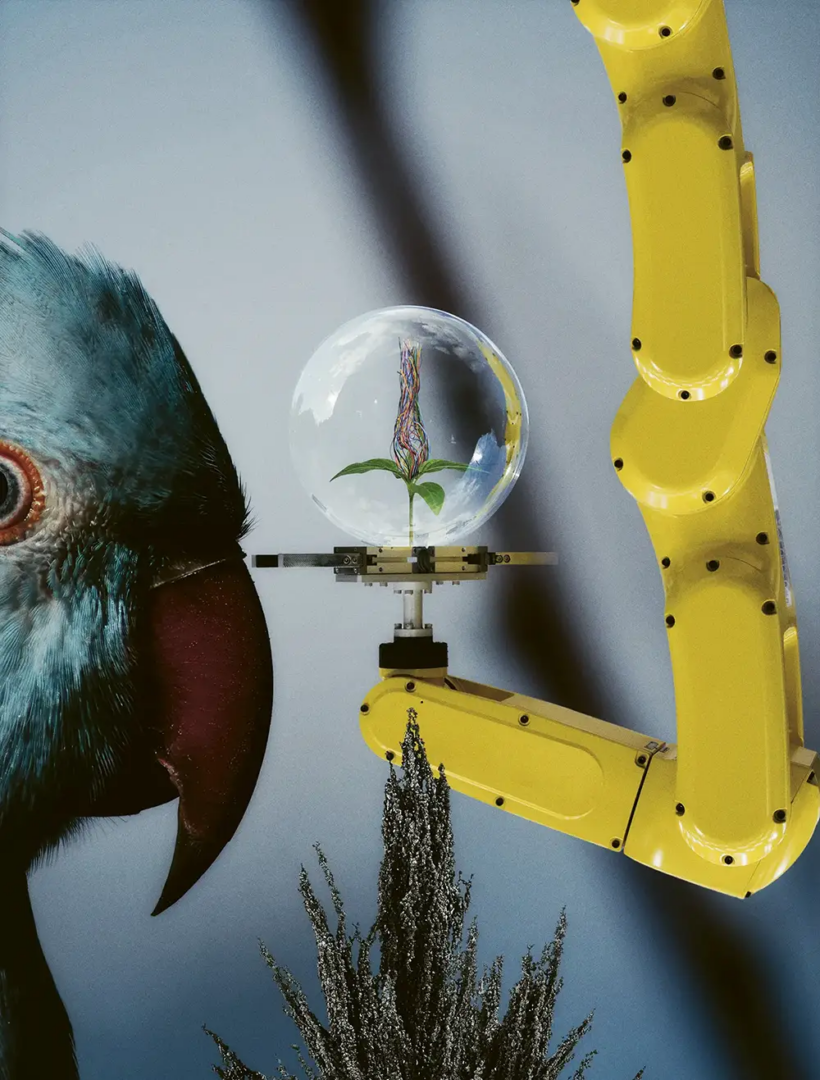
Bird and robotic arm: biomimicry, engineering and functional equivalence
The second artwork shifts register but sustains the argument. A large tropical bird — vivid, feathered, biologically extravagant — is placed beside a yellow industrial robotic arm, the kind found on automotive assembly lines. Between them, suspended in a glass sphere, a small plant. The chromatic rhyme is immediate: the yellow of the robotic limb echoes the yellow of the bird’s plumage, the mechanical and the organic brought into visual alignment through colour. The deeper resonance, though, is structural. The bird’s wing and the robotic arm are homologous structures in the functional sense — both articulated appendages designed to extend reach, to manipulate the environment, to project force or precision into space. The bird evolved its wing over millions of years of selective pressure; the engineer designed the robotic arm over decades of iterative refinement. The processes are radically different. The results are more similar than we might be comfortable admitting.
The history of technology is dense with direct borrowings from biological systems — what contemporary engineering calls biomimicry. Velcro was inspired by the way burdock burrs attach to fur. The bullet train’s nose was redesigned after studying the beak of the kingfisher. Termite mounds informed the passive cooling systems of the Eastgate Centre in Harare. Neural networks, the backbone of modern artificial intelligence, are modelled on the architecture of the biological brain. Nature has been solving engineering problems for hundreds of millions of years, and the most intelligent thing the engineer can often do is look carefully at what evolution has already produced. Maitland’s second artwork is a meditation on this debt: the yellow arm reaching toward the yellow wing, as if trying to remember where it came from.
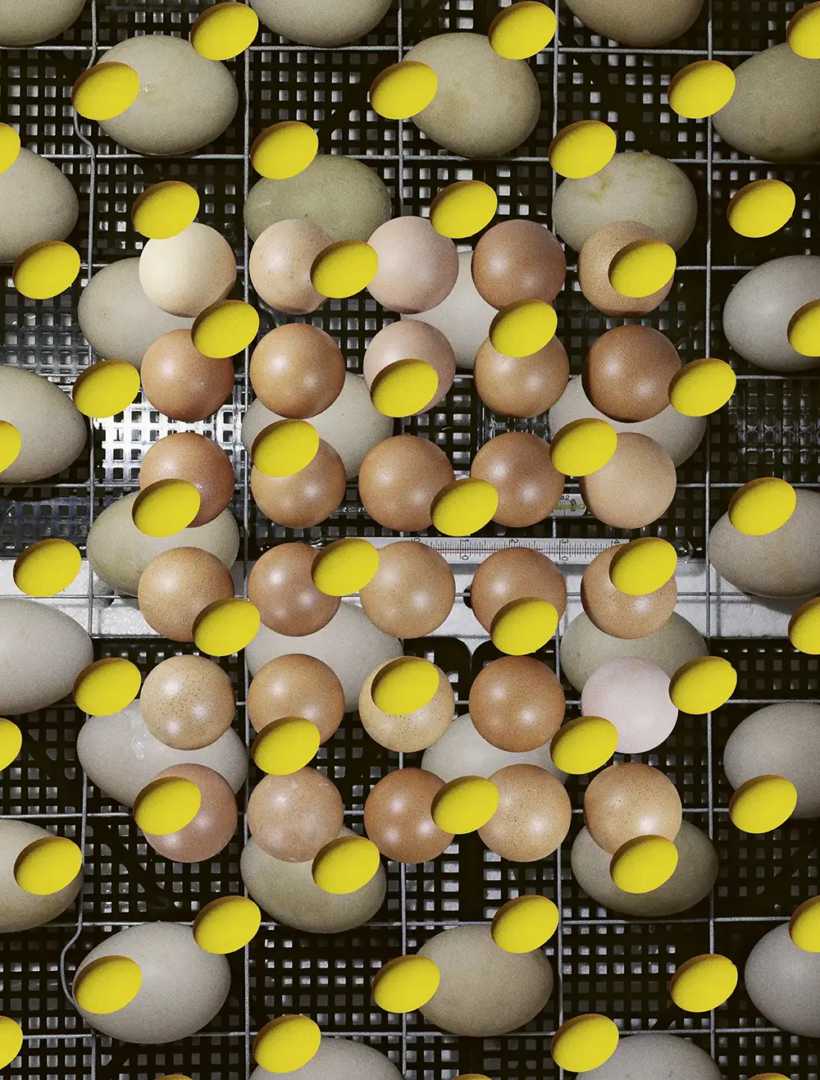
Eggs and capsules: industrial agriculture, pharmaceuticals and biological standardisation
The third image abandons the individual organism for the aggregate. A dense field of eggs — brown, beige, the muted tones of biological production — is punctuated rhythmically by yellow oval capsules, pharmaceutical in character. The grid beneath them is mechanical, precise, unforgiving. The effect sits somewhere between a photograph from an industrial farm and an abstract painting, between documentation and composition.
What Maitland is mapping here is the logic of biological standardisation — the process by which the products of living bodies are absorbed into industrial systems of measurement, classification, and reproduction. The egg, one of the most ancient symbols of organic life and potential, becomes an object of production: counted, graded, packaged, distributed. The yellow capsules — so formally similar to the eggs that they seem almost to be growing among them — complete the argument. The pharmaceutical industry, like the agricultural industry, operates by extracting, refining, and repackaging the chemistry of living systems. The capsule contains molecules that were once part of a plant, an animal, a microorganism. The boundary between the biological and the manufactured has been crossed so many times, in both directions, that it has effectively ceased to exist as a meaningful category.
This is territory that Bruno Latour mapped in his work on the relationship between nature and culture, and that Donna Haraway explored in A Cyborg Manifesto — published in 1985 — arguing that by the late twentieth century the distinction between organism and machine had become thoroughly permeable: “we are all chimeras, theorised and fabricated hybrids of machine and organism.” Maitland’s third artwork makes the same argument in eggs and capsules, in the yellow of organic matter and industrial production laid side by side on a mechanical grid.
Repeated cows on grid: replication, data systems and industrial livestock
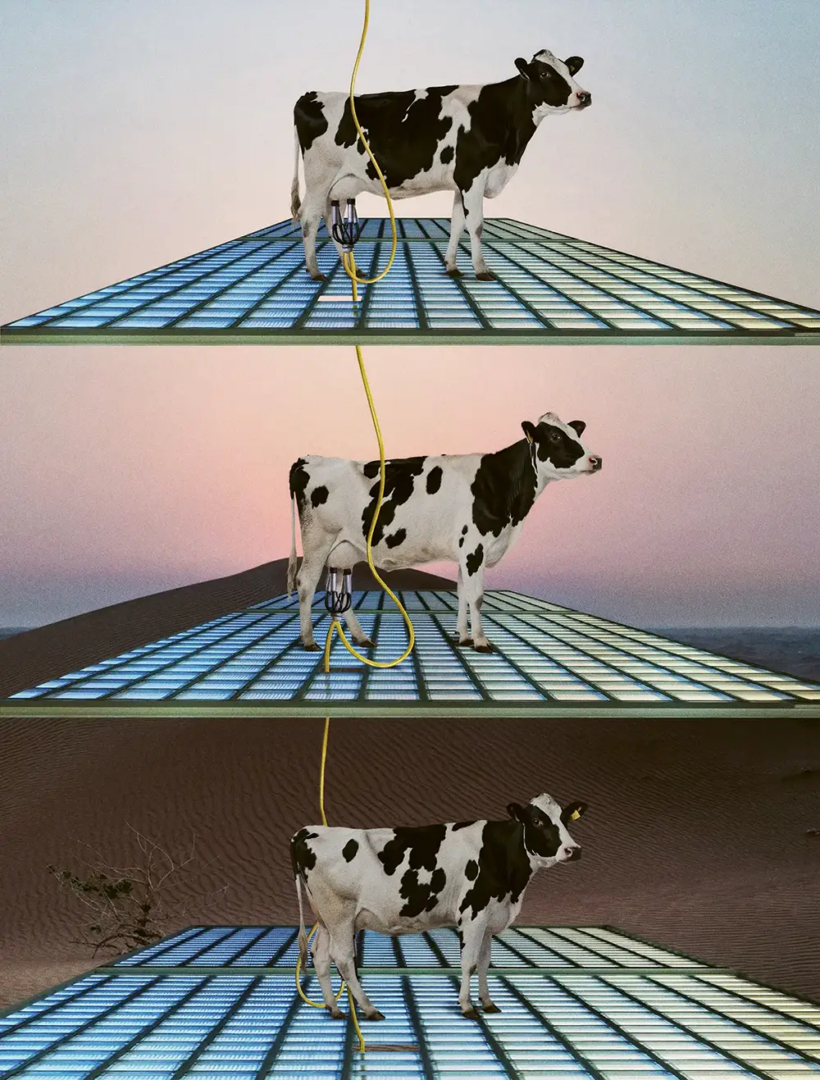
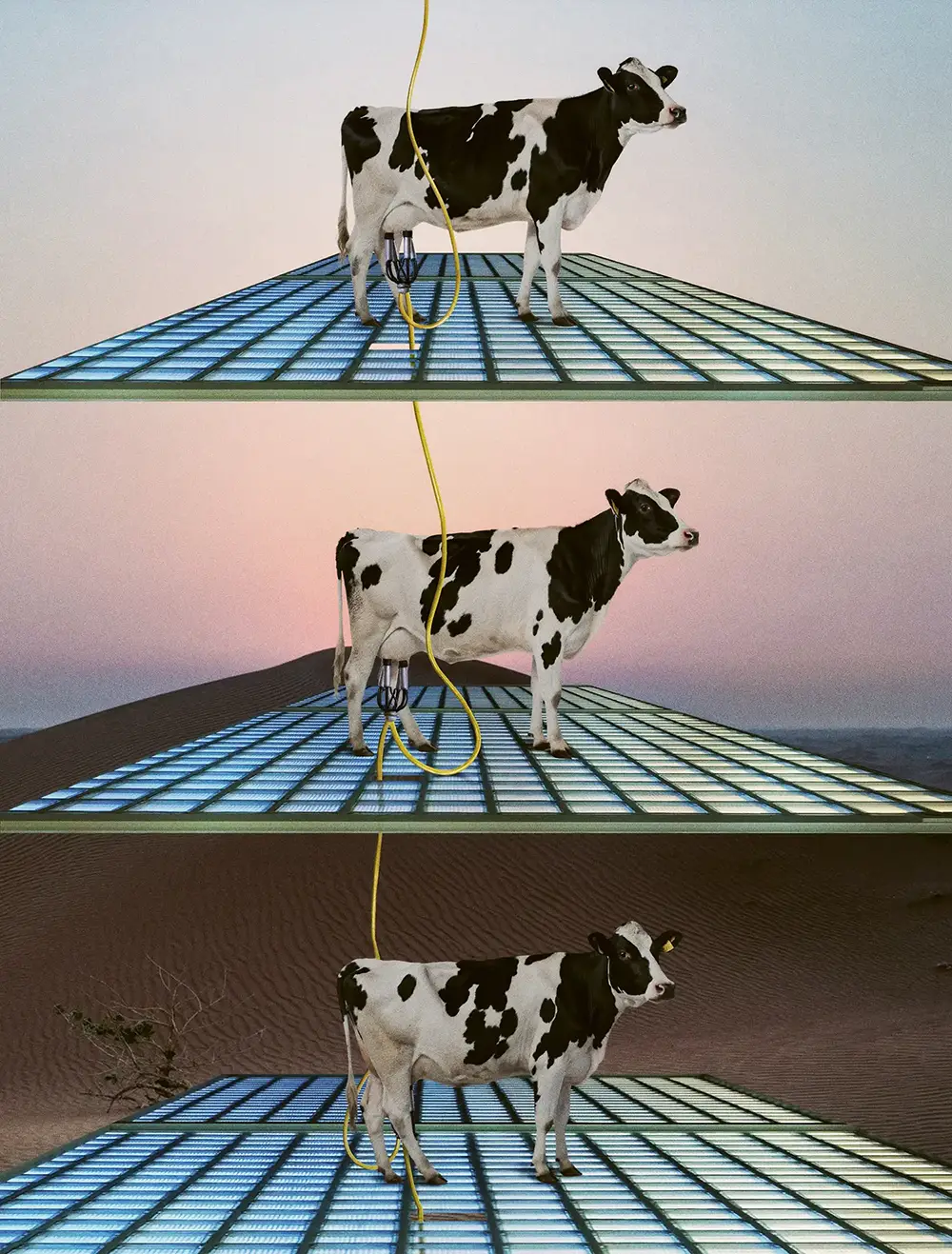
The fourth artwork returns to the animal, but now multiplied. Three identical cows are distributed across three horizontal bands of a blue architectural grid — a surface that reads simultaneously as the facade of a modernist building, a surveying instrument, and a scientific coordinate system. Each cow occupies a different register of light: the top panel bright and overexposed, the middle panel warmer, the lower panel fading toward dusk. The animal is the same. The light changes. The grid remains constant.
The repetition is Warholian in its syntax, but its content is more specifically scientific. The multiplication of the individual within a coordinate system evokes the methodology of observational science: the controlled experiment, the repeated trial, the isolation of variables. Classical ethology required that the animal be placed within a defined, measurable space — the grid of the observation field, the numbered enclosure, the camera trap with its GPS coordinates. Science has always needed to fix the living thing in space and time in order to know it. Maitland’s cows, pinned to their architectural grid, are specimens as much as animals. They are data as much as they are bodies.
In the repetition there is also something that speaks to the contemporary reality of biological reproduction itself. Cloning, selective breeding, genetic standardisation in industrial agriculture — all processes by which the singular animal is made multiple, by which biological individuality is subordinated to the logic of replication. The cow that appears three times is one cow, reproduced. Which is, increasingly, how the industry that produces most of the animal protein consumed on Earth actually operates.