Oysters: what the Mediterranean Sea produces
Paolo Varrella farms oysters in the Gulf of Poets whose phytoplankton exists nowhere else in Italy; while Red Oyster and Julia Qiu rebuild a culture Rome had before France did
The Gulf of Poets takes its name from literature—Lord Byron swam it to reach the Shelleys at Lerici. What the water produces is harder to romanticize. Enclosed by mountains and protected by a breakwater, the Gulf of Poets is the common name for the Gulf of La Spezia, in northern Italy, opening onto the western Mediterranean. On a calm morning, the surface appears still. Beneath it, currents move without pause, carrying phytoplankton in from the open sea.
Paolo Varrella has been reading that surface for twenty years. He farms oysters in La Spezia and presides over the Cooperativa Mitilicoltori Associati, a shellfish consortium working the same water. His day begins before dawn. By the time his boat reaches the farming site, he has assessed the light, the wind, and the color of the water.
The oyster he farms takes fifteen months to reach market size. It is eaten alive, raw, with nothing between the sea and the mouth. That directness—shell, hand, palate—has been accumulating cultural weight for two thousand years.
Why the phytoplankton of the Gulf of La Spezia exists nowhere else in Italy
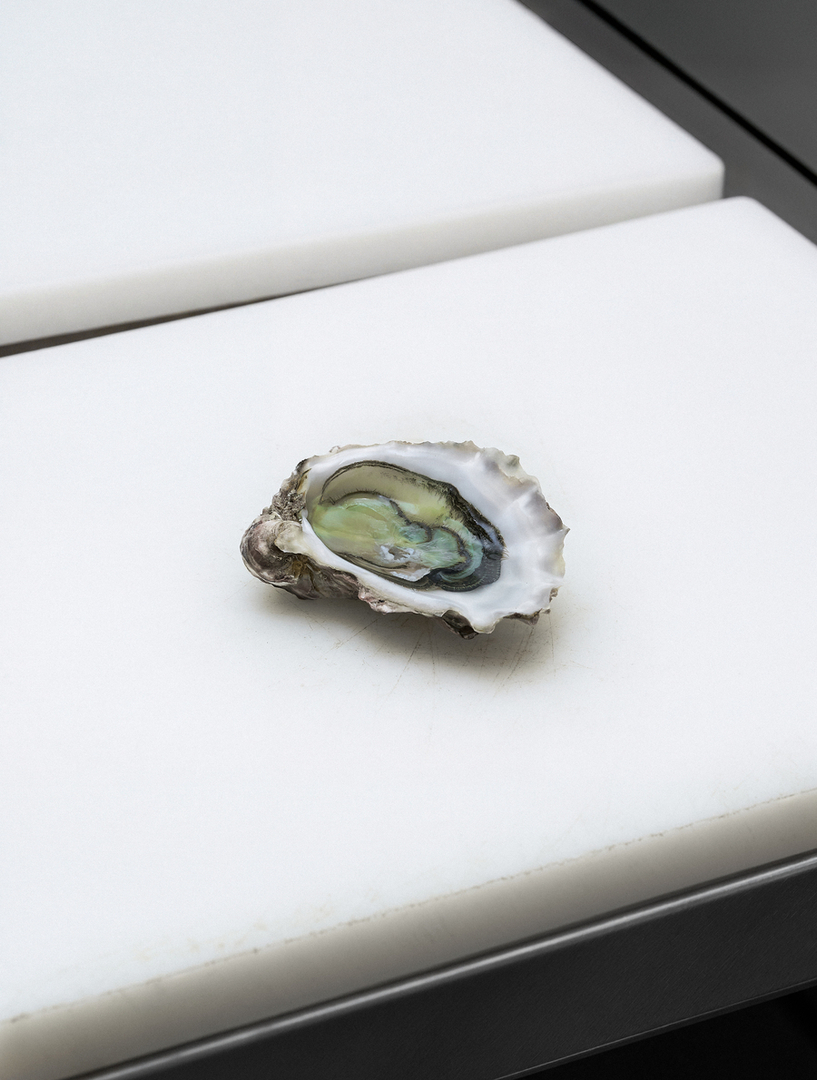
“An intimate sea,” Varrella calls it. The description is physical. The Gulf of La Spezia receives freshwater from rivers descending out of Tuscany, while the western Mediterranean circulates through it. What results is a phytoplankton community found in this configuration nowhere else along the Italian coast. That phytoplankton is the diet of the oyster, and the source of what makes a Gulf of Poets oyster identifiable: a green hue in the flesh, an herbaceous aroma.
Floating baskets and weekly air exposure: how glycogen makes an oyster sweet
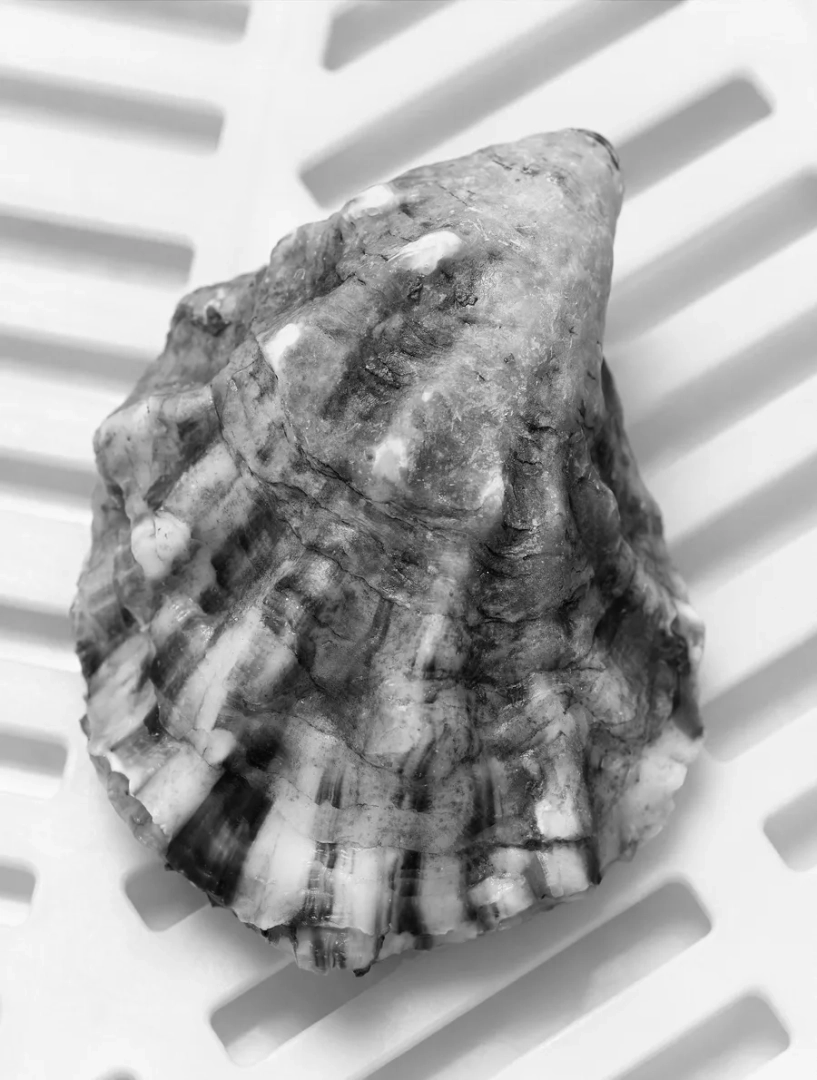
Varrella uses floating systems in place of bottom cultivation, so his oysters feed on the water column. Phytoplankton passes through, carried by current, and the oysters stay in constant low-grade motion. Wind and wave action slow growth against permanently submerged systems. The same motion produces smoother shells, firmer flesh, and more developed muscle.
Sweetness in an oyster comes from glycogen. The animal produces it under stress: the more physical resistance it meets, the more it accumulates. The floating systems supply that resistance—wave motion, air exposure, the weekly removal from water. Varrella manages pressure more than growth.
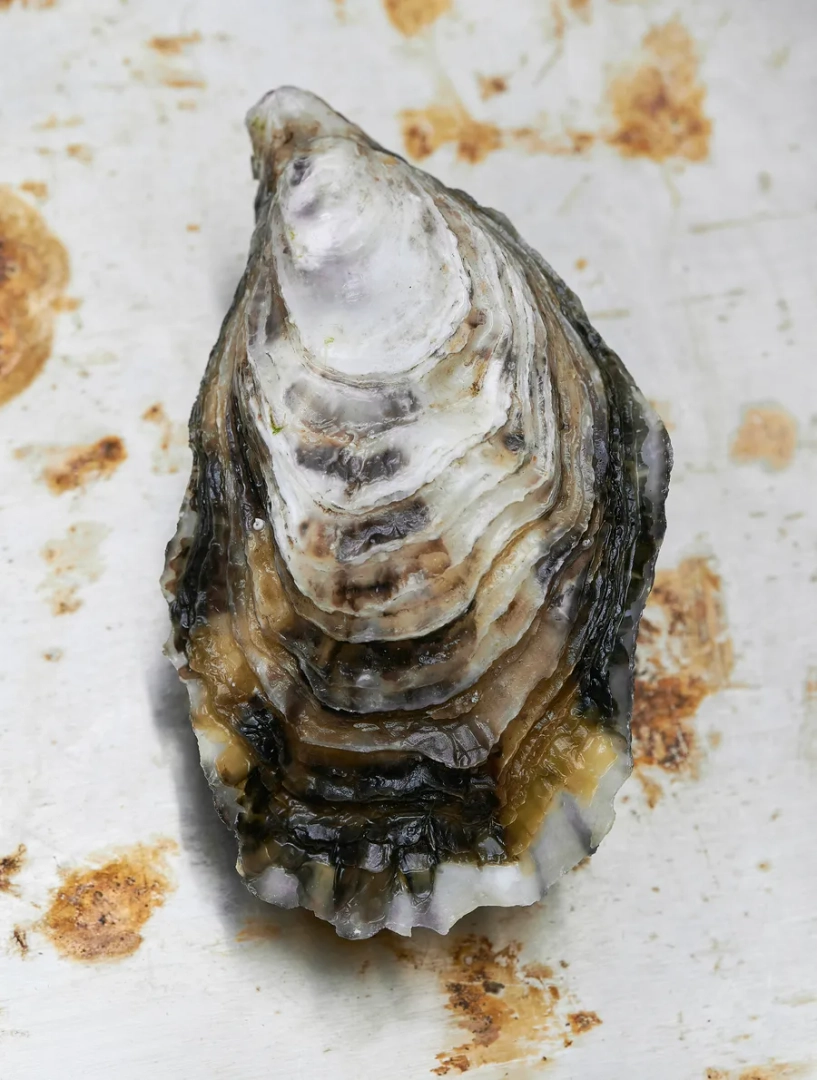
Once a week, every oyster undergoes air exposure. Varrella inverts the floating baskets or brings them aboard, leaving the animals out of water for several hours. The adductor muscle, which holds the shell closed, strengthens under the strain. The shell hardens, and glycogen reserves increase.
“The oyster invests less energy in extending its shell and more in developing the meat itself. This practice hardens the shell, strengthens the adductor muscle and increases its glycogen reserves, giving the flesh a sweeter, richer flavor.” The farmer imposes a periodic scarcity. The animal concentrates itself in response.
A day on the water: thinning, cleaning, removing fouling, repeating
Varrella is on the water before dawn. Minutes from shore, the baskets wait. Every basket requires the same attention: growth stage, stocking density, the condition of the shells. The work varies little from day to day, and that is the point. Thinning. Cleaning. Removing fouling. Removing sediment. Repeating. The farm runs on direct observation, with no climate-controlled facility and no instrument that stands in for the eye. The conditions are the sun, the wind, and the rhythm of the sea. “It’s a profession built on observation.”
A change in current alters the available phytoplankton. A temperature shift changes the rate at which the oysters feed. Rough weather changes the condition of the shells.
Chlorophyll in the flesh: the green that records where an oyster fed
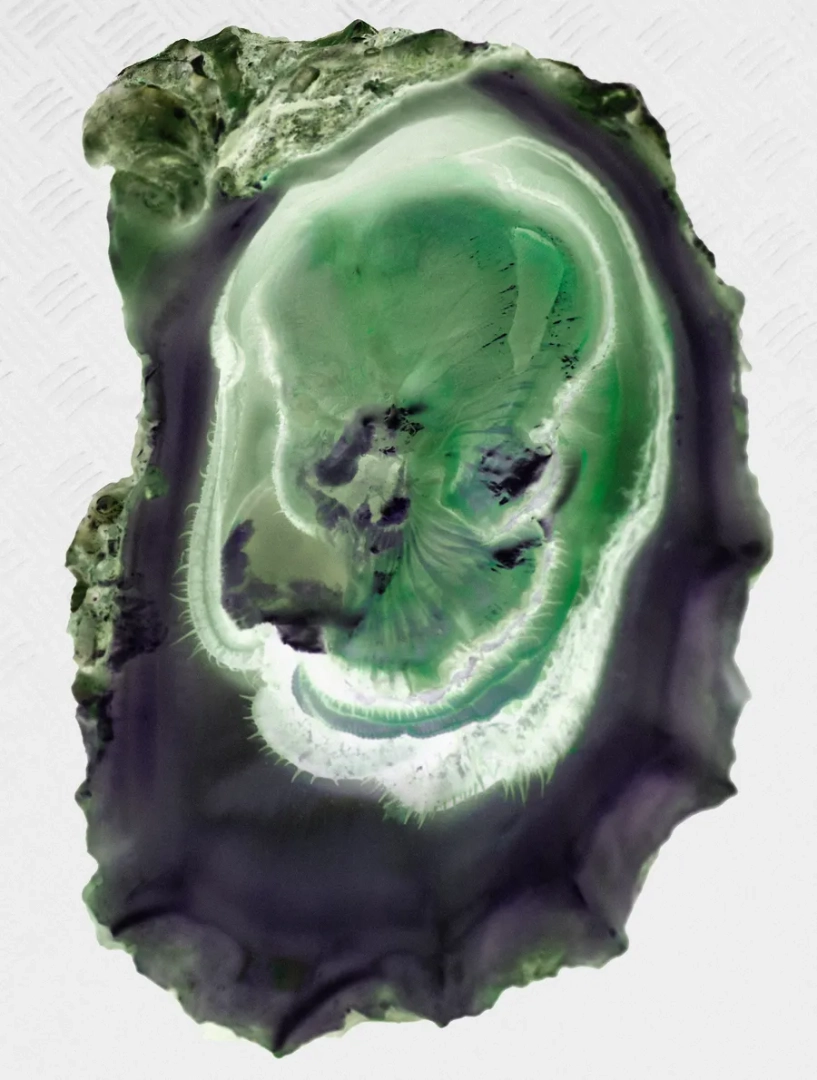
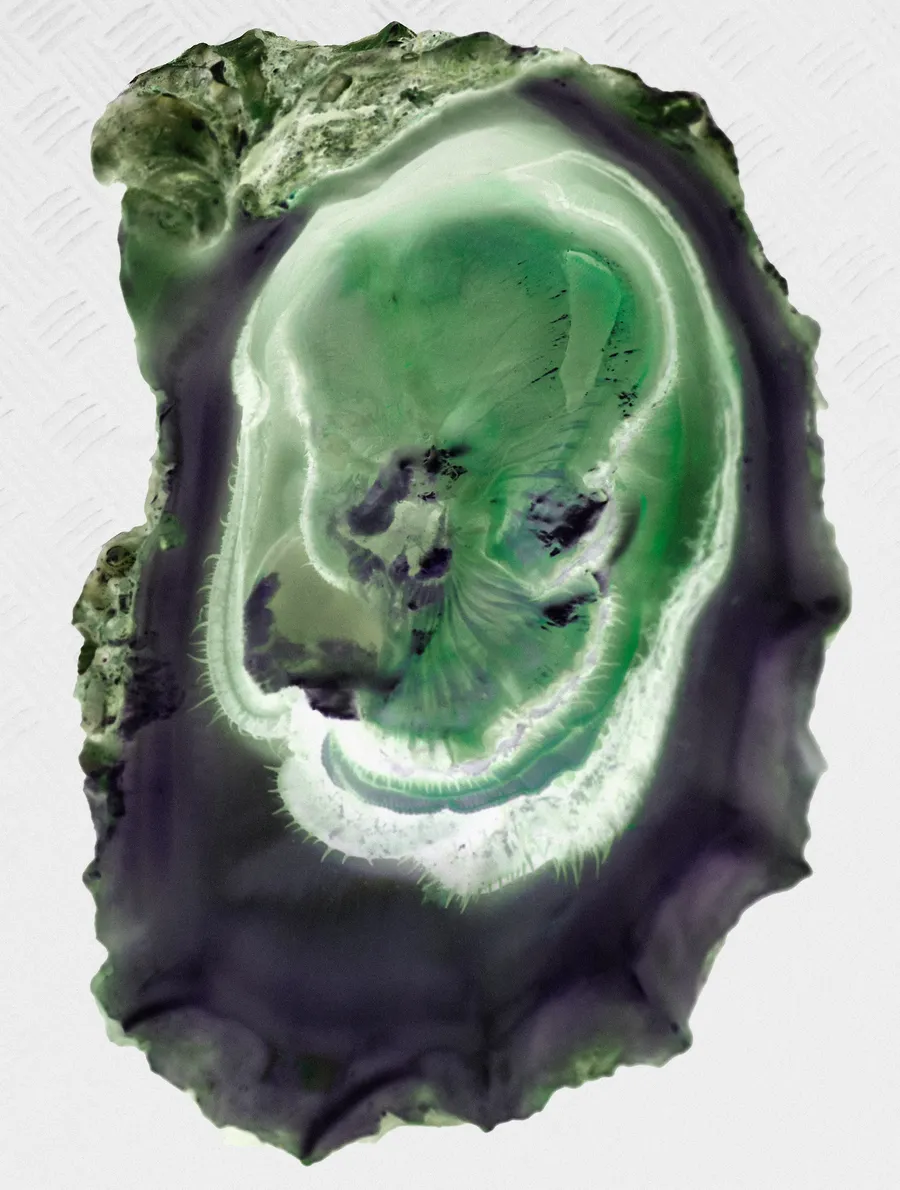
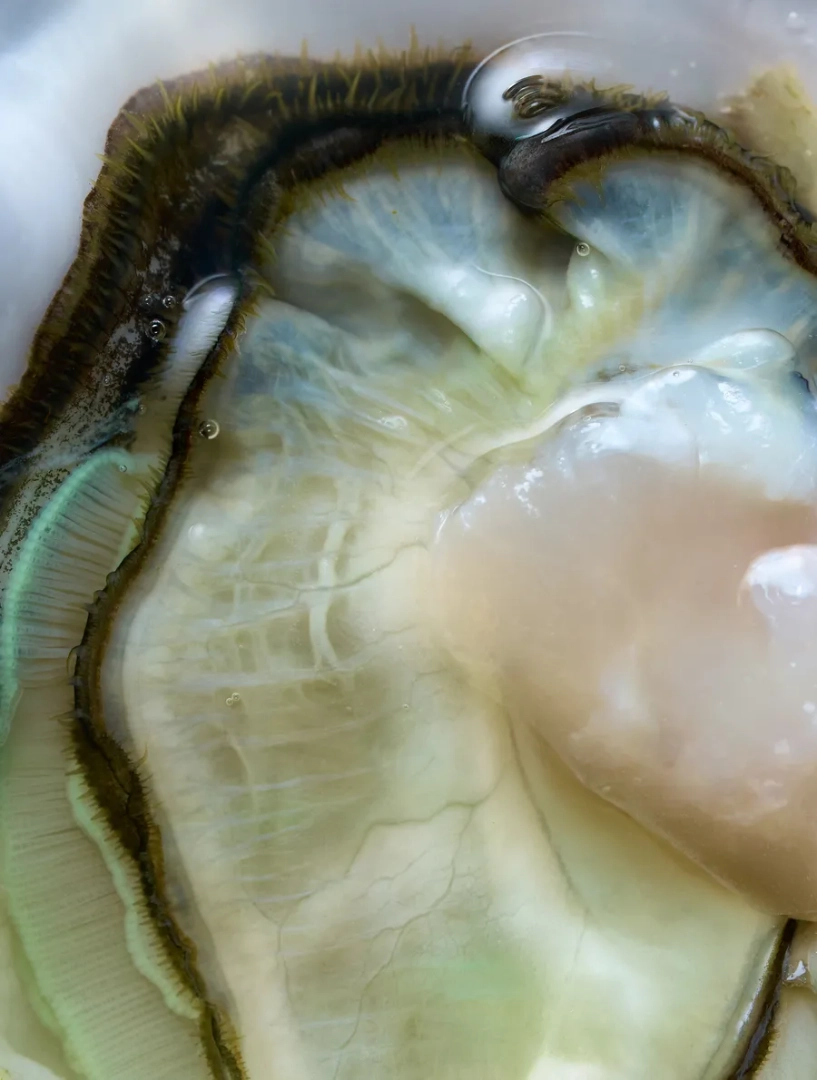
Open a Gulf of Poets oyster and the flesh is green, a pigmentation set against the pale interior of the shell. For a first-time consumer, that color could read as a warning. “We often say: if they’re not green, they’re not from La Spezia.” The pigmentation comes from chlorophyll compounds in the phytoplankton the animal has consumed across its life. It is a dietary record inscribed in the flesh, evidence of where the oyster fed and on what. The color is an index of quality rather than an accident of it.
A single adult oyster moves one hundred ninety liters of seawater through its body every day, stripping out suspended particles, excess nutrients, and organic matter as it goes. A farm of sufficient scale becomes a water treatment operation that also produces food. “Many of the research and innovation projects we are developing begin with this idea: producing high-quality food while helping to regenerate the marine environment.”
Thirteen producers, one body of water: what the Cooperativa Mitilicoltori Associati holds in common
Varrella farms independently, as does every other member of the Cooperativa Mitilicoltori Associati. The cooperative occupies the space between those independent operations, holding a purification facility, administrative services, and shared equipment that would burden any single producer to maintain alone.
Beyond the infrastructure, the cooperative generates something harder to quantify. Oyster and mussel farming rests on years of observation specific to a single body of water. Thirteen producers doing that learning close to one another generate what a single farmer cannot: a shared body of observation that grows every season.
The Gulf of Poets produces about one thousand tons of mussels a year, with oyster volumes growing. The cooperative accounts for a share of that output, an arrangement built on the premise that certain problems exceed what any single producer can meet. Varrella has been making that case, in the Gulf of Poets, for twenty years.
Sergius Orata on Lake Lucrino: the Roman industry Italy forgot and France inherited
When he began, the objection he met most often was categorical. “Many people would stop me and say, ‘You can’t grow oysters in Italy—they grow in France.’ That single sentence revealed how disconnected we had become from our own past.”
The disconnection has a traceable history. By the first century BCE, Roman producers had developed oyster farming into a structured coastal industry. Sergius Orata is credited with establishing the earliest systematic cultivation beds on Lake Lucrino, near modern Naples. The industry expanded along the Italian coastline. Then, across centuries, it fell out of Italian food consciousness, leaving France to become the cultural authority on a product Rome had farmed first. Italy is rebuilding it.
Francesca Lugli founded Red Oyster Italy in Turin in 2016, the first mobile oyster catering service in the country. She corrects the instinct to call it a return. “Oysters are not returning to Italy. They are being rediscovered.” The words carry different weight. A return implies continuity. A rediscovery implies a gap, one in which the cultural fluency was lost and had to be rebuilt.
Julia Qiu is an oyster expert, educator, and brand strategist who has been studying global oyster culture since launching her blog In A Half Shell in 2009. Oysters, she notes, once occupied both ends of the economic spectrum at once. When wild reefs were healthy, the oyster was both a common resource and a prized one. Overharvesting, industrialization, and coastal pollution collapsed those reefs across the nineteenth and twentieth centuries. Scarcity created a market position, and perception locked it in. The oyster became associated with occasion, with wealth, with ceremony, and with France. Italy is now building a network of farms—La Spezia, Sardinia, Veneto, Puglia—producing evidence that challenges that association.
The oyster tasting wheel: appearance, taste, aroma, mouthfeel, aftertaste
Qiu has kept an oyster tasting journal since 2009. She describes the process as language acquisition. The categories: appearance, taste, aroma, mouthfeel, aftertaste. “Many of these words have been put into an oyster tasting wheel that I developed for Oyster Master Guild.” Her forthcoming book, The Oyster Palate (Rock Point, spring 2027), maps the chemistry of common oyster tastes—salt, sweet, umami—and the corresponding aromas: ocean, seaweed, vegetable, fruit, earth, mushroom. The difference between eating an oyster and tasting one is a matter of attention more than skill.
Casanova and his fifty oysters: the aphrodisiac claim younger consumers ignore
The aphrodisiac mythology around oysters is old. Casanova claimed to eat fifty oysters each morning. The association runs through classical sources, Renaissance painting, and two centuries of restaurant menus, and it has proved resistant to time. Qiu is impatient with it. “It’s tired and overused. The stereotypes that some brands continue to use don’t speak to today’s younger consumers.”
Varrella’s terms for the oyster are different. “I understand those cultural associations, and they are part of the oyster’s history.” Asked to describe the taste of his oysters without reference to the sea—no food comparisons, no familiar anchors—he begins with a scent. “The smell of freshly cut grass on a summer morning.” He names no salt, no cold of the shell, no liquor that pools in the cup before the hinge gives. The morning air, away from the table.