Mille Edicola Milan: a newsstand in Porta Romana expands beyond newspaper distribution
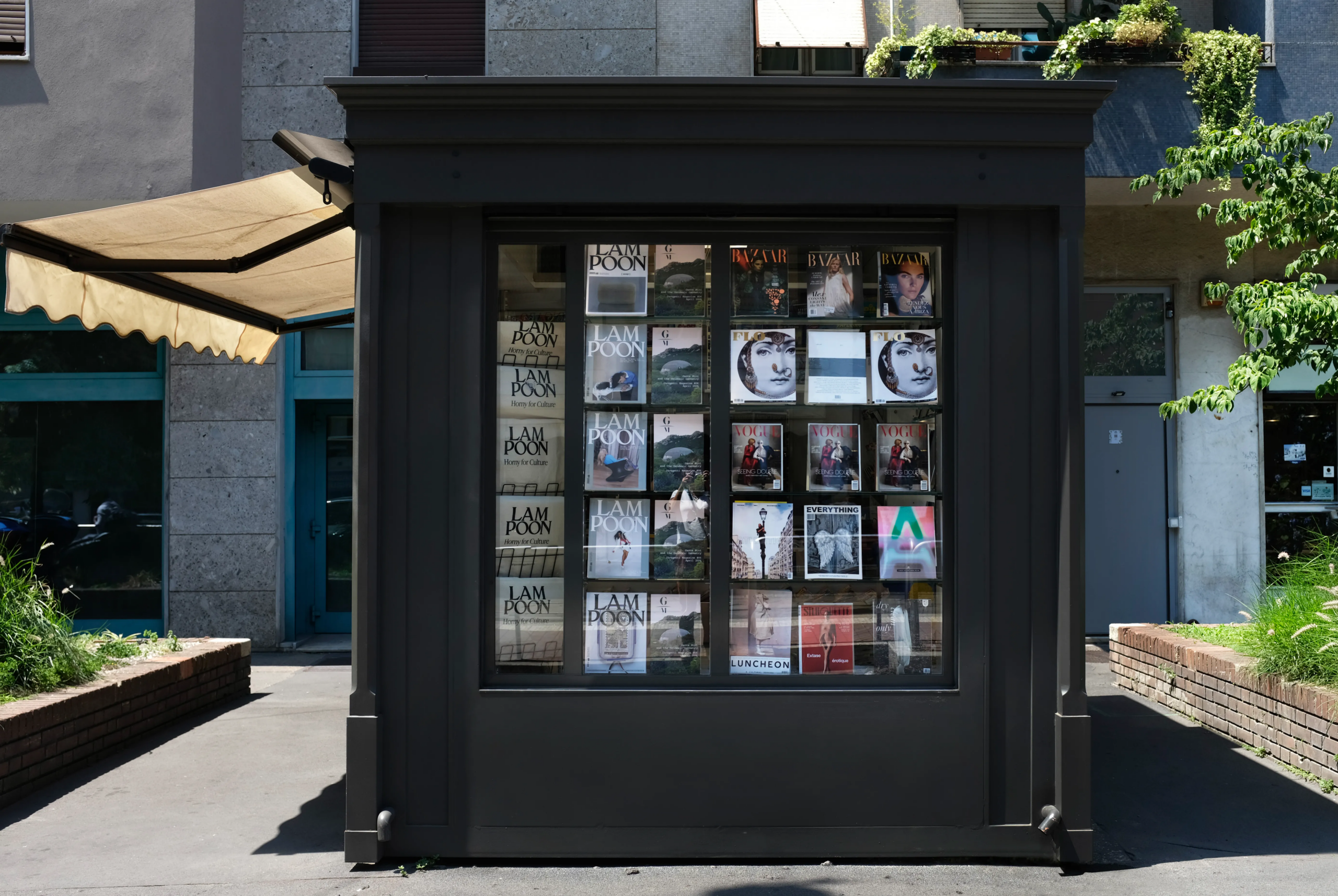
Mille Edicola in Milan – a historic Porta Romana newsstand featuring newspapers, independent magazines, books, exhibitions and publishing events while preserving its original retail function
At Via Giuseppe Ripamonti 2, Mille Edicola combines newspaper distribution, independent magazines, books and public programming within a historic Milan newsstand
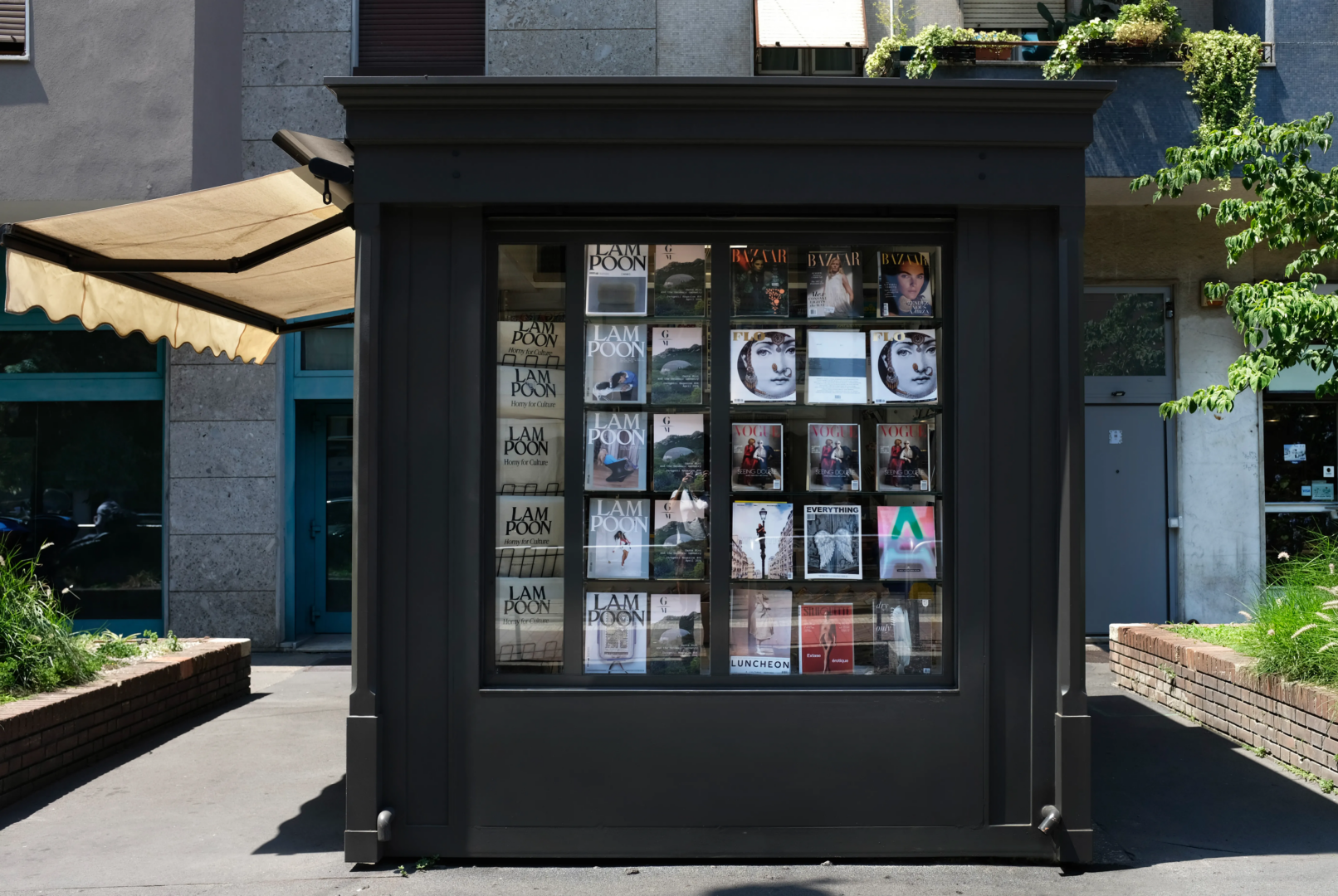
At the intersection of Via Giuseppe Ripamonti, Viale Bligny and Viale Beatrice d’Este, a newsstand that has served the Porta Romana district for decades has entered a new phase. The kiosk at Via Giuseppe Ripamonti 2 now operates as Mille Edicola, a project that retains the traditional function of newspaper distribution while introducing a broader program centered on publishing, public events and cultural programming.
The transformation arrives at a time when the role of the newsstand is under discussion across Europe. As print circulation patterns evolve and independent publishers seek new channels of visibility, some newsstands are moving beyond retail and positioning themselves as public spaces where printed matter, conversation and urban life intersect. Mille Edicola follows this direction while maintaining its role as a point of sale for newspapers and magazines.
The history of the Italian newsstand and its place in public life
For more than a century, the newsstand occupied a specific position within Italian cities. It functioned as a retail outlet, a source of information and a daily meeting point. Before the rise of digital media, newspapers represented one of the principal ways through which citizens accessed political debate, local reporting, sports coverage and cultural commentary. The edicola became part of the urban landscape, appearing in city squares, transportation hubs and residential neighborhoods.
The Italian newsstand developed alongside the growth of mass publishing during the twentieth century. Newspapers, weekly magazines and specialist publications relied on dense distribution networks that reached even small towns. For publishers, the newsstand represented visibility. For readers, it offered access to a broad range of editorial voices.
The arrival of digital platforms altered this relationship. News consumption migrated online, advertising revenues shifted and circulation figures declined. Throughout Italy, thousands of newsstands closed. Industry associations have repeatedly highlighted the reduction in the number of active kiosks, particularly in smaller municipalities and peripheral districts. Yet the disappearance of newsstands has not occurred uniformly. In several cities, entrepreneurs have begun experimenting with alternative formats that combine publishing with hospitality, cultural programming and retail.
A publishing-focused selection of newspapers, magazines and books
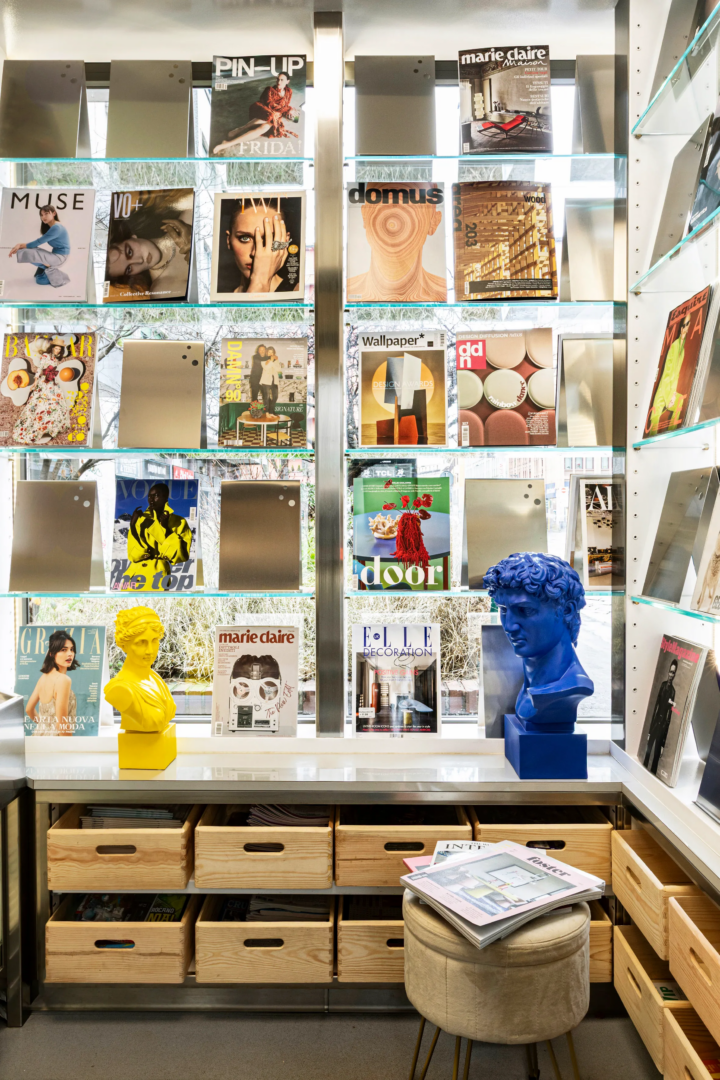
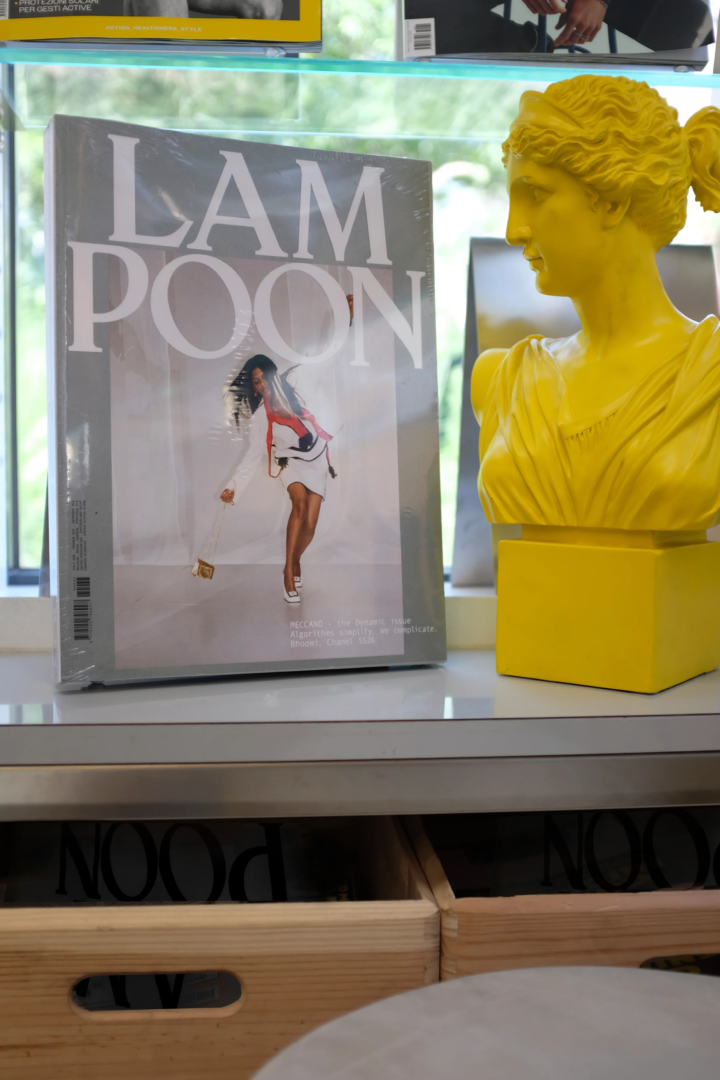
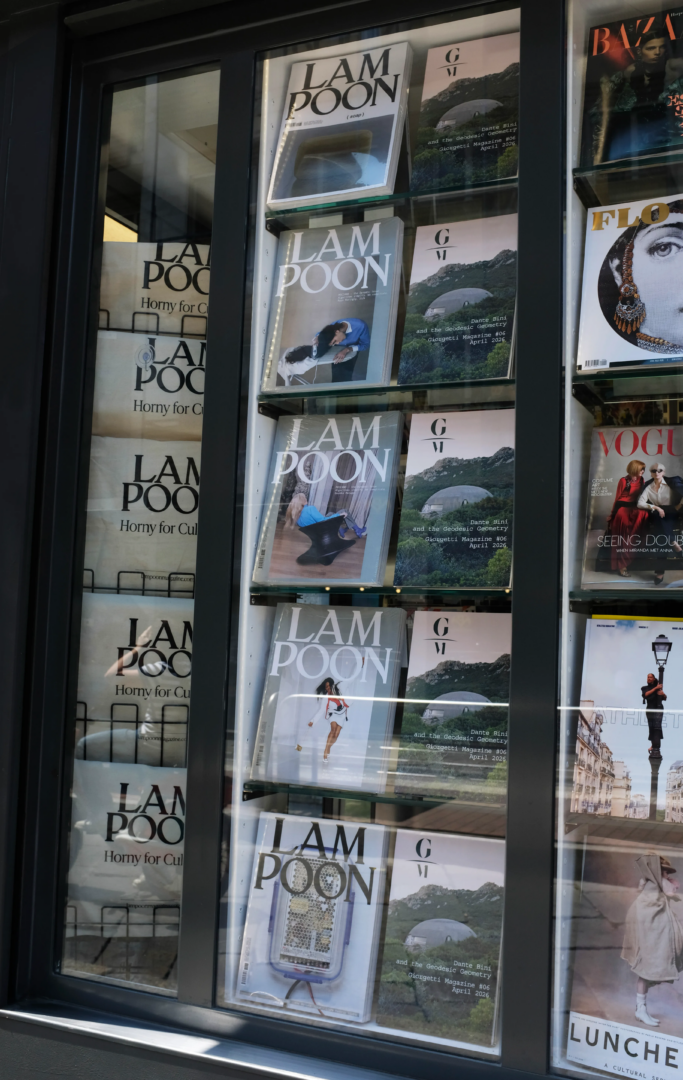
Mille Edicola concentrates on printed publications. The selection includes Italian and international newspapers alongside specialist magazines covering fashion, architecture, design, music, sports, automotive culture and nautical industries.
The decision to focus on specialist publishing reflects a broader shift within the print sector. While mass-market circulation has declined, independent magazines have continued to develop audiences interested in specific subjects and editorial identities. These publications often rely on dedicated retail channels because conventional distribution networks rarely provide extensive shelf space.
Alongside magazines, Mille Edicola stocks books, comics and graphic novels. The emphasis remains on editorial production rather than branded merchandise. Publications occupy the center of the project both physically and conceptually.
The format reflects a pattern visible in several international cities. Independent magazine stores increasingly function as intermediaries between publishers and readers, creating environments where discovery becomes part of the retail experience.
From New York to Tokyo: how independent magazine stores evolved
The development of projects such as Mille Edicola follows a broader international phenomenon. Across the last two decades, independent magazine retailers have emerged as cultural destinations rather than simple points of sale.
In New York, specialized magazine stores helped preserve visibility for independent publishing at a moment when mainstream distribution contracted. In London, retailers focused on niche editorial production built audiences around architecture, design, fashion, photography and current affairs. Similar developments occurred in Paris, Berlin and Tokyo, where bookstores and magazine shops became places where readers could access publications rarely available through conventional channels.
The success of these spaces often depends less on volume sales than on their ability to create relationships between publications and communities of readers. Events, launches and exhibitions become extensions of editorial activity.
Mille Edicola enters this international landscape while remaining rooted in a specifically Milanese context. The project does not attempt to reproduce a bookstore model. It retains the physical structure and public visibility of a traditional edicola while expanding the range of activities associated with it.
A venue for presentations, conversations and exhibitions
Beyond retail activity, the project introduces a program of public events. The space is designed to host magazine launches, book presentations, exhibitions and conversations involving journalists, publishers, content creators and podcasters.
These activities extend the role of the newsstand beyond distribution. Publications become the starting point for discussion rather than simply products available for purchase. Readers encounter editors, writers and publishers in the same environment where printed material is displayed and sold.
This approach responds to changes within contemporary publishing. Independent magazines increasingly operate through networks of events, memberships and direct relationships with audiences. Physical spaces play a growing role in these ecosystems, providing opportunities for interaction that digital platforms cannot replicate.
The organizers also intend to make the venue available for temporary initiatives developed with brands and cultural organizations. Proposed formats include pop-ups, presentations, installations and site-specific projects connected to communication and publishing.
The transformation of newsstands in Milan
Milan offers a particular context for this type of experiment. The city remains one of Italy’s primary centers for publishing, advertising, design and fashion. Editorial offices, universities and cultural institutions generate a concentration of readers and media professionals that differs from many other urban areas.
At the same time, Milan has experienced the same contraction in newsstand numbers observed elsewhere in the country. Many kiosks have disappeared from central neighborhoods and suburban districts. Others have sought alternative revenue streams through parcel services, ticketing operations and commercial partnerships.
Projects such as Mille Edicola propose a different strategy. Rather than reducing the role of print, they attempt to strengthen it by creating additional reasons for people to visit the newsstand. The publication remains the central object, but it is surrounded by programming, conversation and public activity.
This approach aligns with recent discussions within the Italian publishing sector regarding the future of physical distribution. Industry organizations including SNAG-Confcommercio have argued that innovation will be necessary if newsstands are to remain economically viable in the coming decades.
An exhibition system built around printed matter
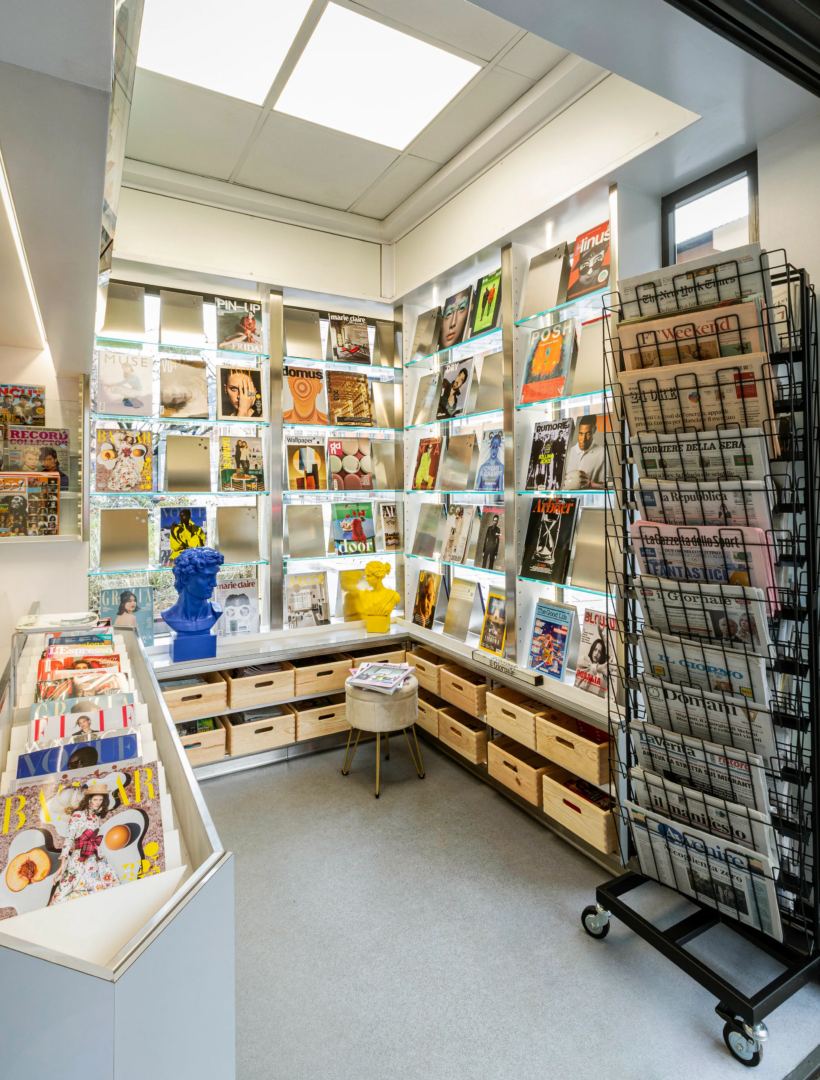
The physical layout of Mille Edicola centers on a display system developed specifically for the project. The installation uses satin-finished steel structures produced by a metalworking company based in the Milan area.
Each display presents publications on both sides, allowing magazines and newspapers to remain visible from multiple viewpoints. The system emphasizes the publication as an object. Covers remain visible from a distance, while the repetition of structures creates a rhythm across the space.
When occupied, the displays function as retail supports. When partially empty, they become part of the architectural composition. The absence of printed matter becomes as visible as its presence, drawing attention to the physical format of newspapers and magazines themselves.
The recurring graphic element throughout the project is a set of three dots derived from the Mille Edicola logo. The symbol appears on the display structures and throughout the visual identity, connecting graphic communication and spatial design.
Porta Romana and the geography of cultural production in Milan
Location contributes to the identity of the project. Mille Edicola sits within Porta Romana, one of Milan’s residential districts, close to Bocconi University, the former Spanish Walls and the area surrounding Piazza Medaglie d’Oro.
Historically, Porta Romana developed as one of the city’s southern gateways. During recent decades, the district has experienced significant transformation. New residential developments, educational institutions and commercial activities have altered its demographic composition while preserving elements of its historical character.
The proximity to Bocconi University contributes to a daily flow of students, researchers and professionals. The surrounding streets host cafés, bookstores, offices and independent businesses that shape the area’s urban life.
For a project centered on publishing, this environment provides access to readers already engaged with media, education and cultural production. The location also benefits from connections to the wider city through the M3 metro line and tram routes nine and twenty-four.
The legacy of Luigi Santoro and the future of the site
The current project builds upon a pre-existing history. For approximately thirty years, the kiosk was managed by Luigi Santoro, who became a familiar figure within the neighborhood and established relationships with generations of customers.
Rather than replacing that legacy, the new team presents Mille Edicola as an extension of it. The objective is not to abandon the traditional role of the edicola but to explore how it can continue operating under contemporary conditions.
This continuity distinguishes the project from many newly created cultural venues. The site already possessed a public function before the transformation. The challenge lies in adapting that function without losing the relationship between the newsstand and its surrounding community.
Mille Edicola, Milan
Mille Edicola is located at Via Giuseppe Ripamonti 2 in Milan’s Porta Romana district, at the intersection with Viale Bligny and Viale Beatrice d’Este. The project occupies the site of a long-established neighborhood newsstand and opened in its current form in 2026. The space combines newspaper and magazine retail with an event program dedicated to publishing, books, exhibitions and public conversations. The location is within walking distance of Bocconi University, the Spanish Walls and Piazza Medaglie d’Oro, and is accessible via the M3 metro line and tram routes nine and twenty-four.
Editorial Team