Happy Valley Melbourne. A store whose entity is unclear until you step into it
Chris Crouch, the figure behind Polyester Records and The Tramway Hotel, brought the theatrical language of independent retail to Collingwood, Melbourne
Happy Valley: books, vinyl, design and objects in Collingwood
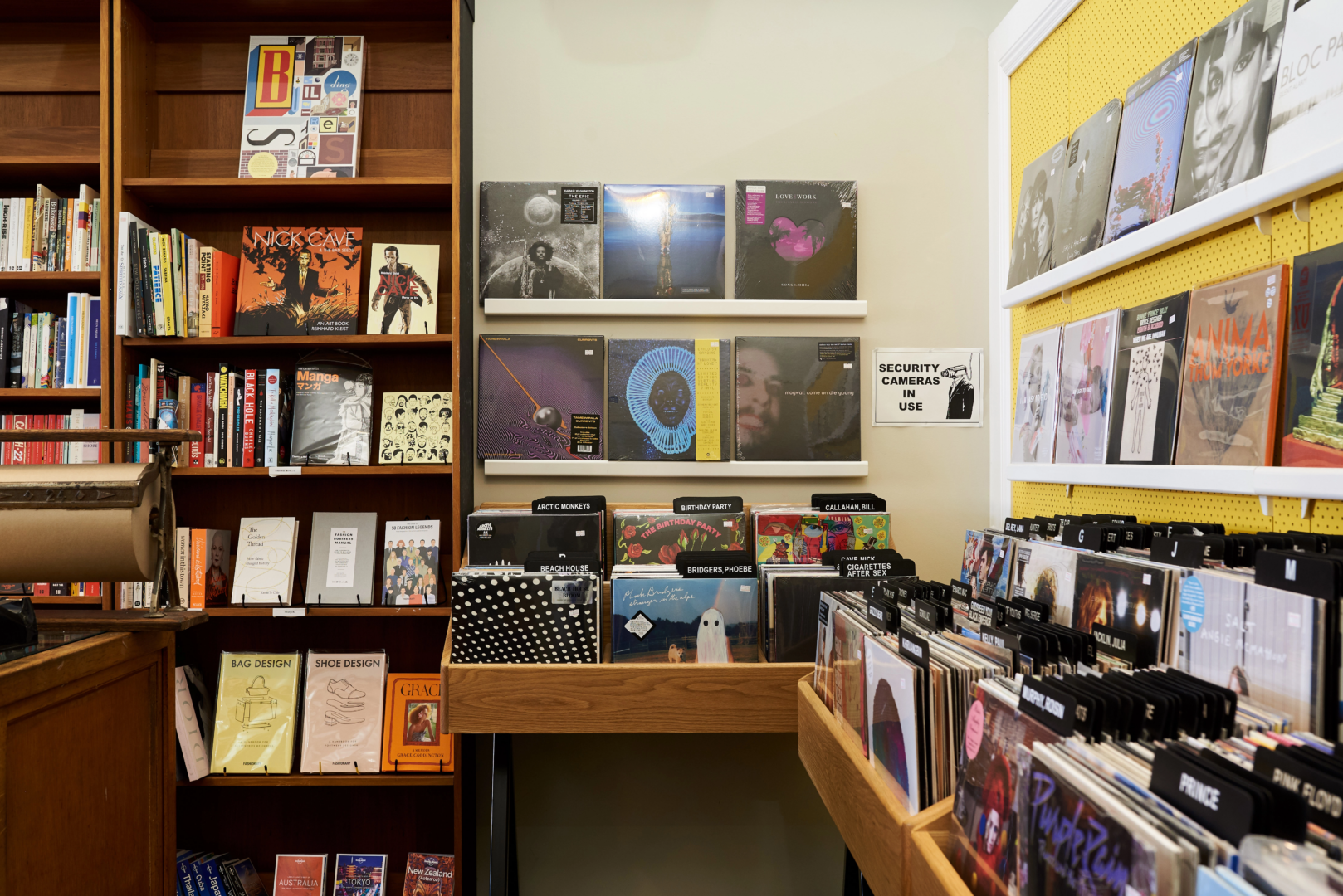
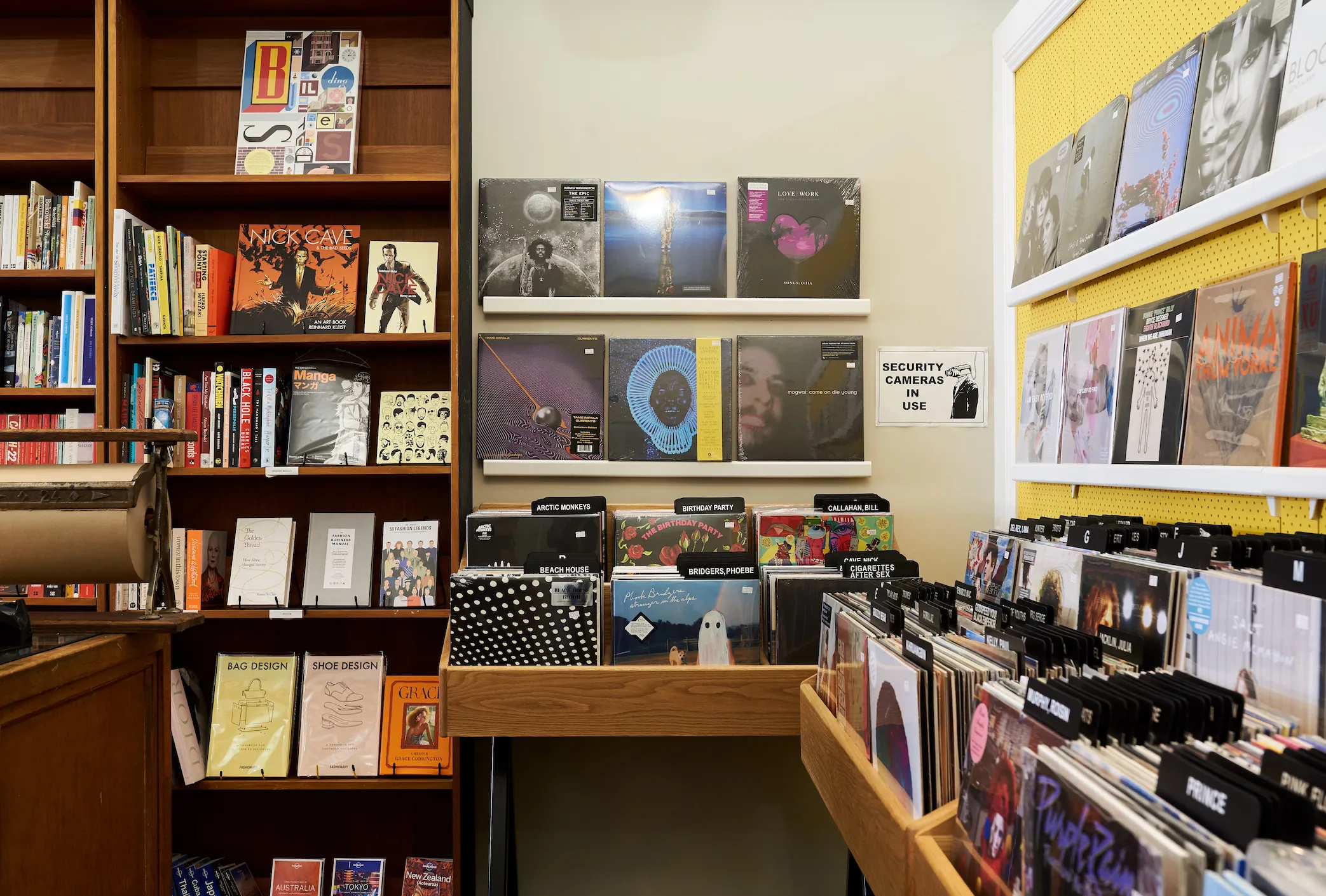
Happy Valley opened in November 2013 on Smith Street, Collingwood, with more than four thousand books, a vinyl selection and over one hundred gift lines. From the outset, its identity was not meant to be immediately legible. It was not a conventional bookstore, nor a record shop, nor a design store. It was conceived as a hybrid space, where books, records, art prints, objects and stationery could share the same commercial and visual language.
The name came from Chris Crouch’s wife, who grew up near a town called Happy Valley in South Australia. Crouch chose it for a store whose nature, he explains, only reveals itself once you’re inside. “A name selected for a store whose identity is unclear until you step into it. I deal with books but did not want to be acknowledged as a bookstore.”
That ambiguity remains central to the project. Happy Valley does not present retail as a flat transaction. It borrows something from the art gallery — a space where visitors move slowly, investigate objects, pick up books, follow images, study covers, spines, prints and surfaces. The store is arranged to encourage browsing, not only buying.
Chris Crouch: from Polyester Records to Happy Valley
Before Happy Valley, Chris Crouch had already moved through several corners of Melbourne’s independent cultural economy. He studied radio at university, then founded Candle Records, an independent label he ran for thirteen years. He later bought Polyester Records, one of Melbourne’s well-known independent record shops, together with Warwick Lobb.
Polyester Records was deeply embedded in Melbourne’s identity. Crouch and Lobb understood the shop as something that could only exist in that city — sustained by its music culture, its independent retail habits and its devoted local audience. After parting ways with Polyester Records in 2010, Crouch moved into hospitality, purchasing The Tramway Hotel in North Fitzroy, formerly The Napier Hotel, alongside Warwick Lobb and Jess Tregonning.
Running a pub gave him another angle on retail: how people gather, how a place builds regulars, how a business becomes part of a neighbourhood. Happy Valley came after those experiences, shaped by music, hospitality, independent publishing and the conviction that a shop could function as a cultural room.
“At that stage, I didn’t know whether to open an art gallery, a bookstore or a design store.” That uncertainty became the form of the store.

The design of Happy Valley
It took Crouch twelve months to find the right space. The result was a 100-square-metre shop in Collingwood that won the Melbourne Design Award in its opening year. The interior was designed by local architect Harley Vincent, with display units, counters and central entrance tables built by Gordon Johnson and Huw Smith.
The design supports the store’s hybrid nature. Books climb the shelves. Art prints by Séverin Millet hang between them. Objects sit close to printed matter without forcing any hard separation between categories. The space resists a single reading. A visitor can enter for a book and leave with a print, a record, a card or a design object.
Happy Valley’s books span non-fiction, classic novels, humour, art, food, music, graphic novels and culture. Its shelves have carried titles by Florence Given, Daniel Clowes, Hetty McKinnon, David Byrne and Ernest Hemingway. The vinyl selection was introduced after the store opened and has since become a defining part of its identity.
Happy Valley and the theatrics of retail
Crouch’s vision for Happy Valley was shaped by the theatrical quality of retail in Paris. The reference is not about luxury as a price point. It is about staging. A store can build expectation before a product is even touched, choreographing attention through displays, sightlines, tables, shelves and small visual interruptions.
Happy Valley applies that principle without becoming merely decorative. Its objects are selected, placed and rotated. The store carries books and gifts from Australia and abroad, sourcing from Canada, the United Kingdom and the United States. At the same time, it has grown increasingly rooted in Melbourne itself.
In its early years, sourcing was not straightforward. Many brands were reluctant to supply Happy Valley. The gift market in Melbourne, Crouch explains, was shaped by territorial retail habits: if a nearby shop already stocked an item, another store in the area could find itself excluded from carrying it.
“The gift world in Melbourne means you can’t supply an item if another retailer close by stocks it. I found it difficult to attain familiarity in the early days of launching Happy Valley.”
Over time, that difficulty pushed the store toward a sharper, more personal selection — one more closely tied to Crouch’s own taste and to the customers who kept coming back.
A Collingwood store shaped by local businesses
Happy Valley is not simply a store in Collingwood. It is part of the neighbourhood’s independent business network. Crouch has lived in the area for more than twenty years and has run several businesses within walking distance of one another. That proximity matters. The store’s audience is not anonymous — it is made up of people who live, work, read, buy records, attend launches and return over time.
“I’ve lived in the area for twenty years; I know the people who work and live in the neighbourhood. I have had three businesses within a kilometre of each other over those years. We release brands, arrange author conversations and conduct magazine launches in the store.”
Happy Valley has hosted book launches, magazine events, brand releases and conversations with authors. Mystery Books approached Crouch to launch its publishing house there, and six months later the publisher became an upstairs tenant. The episode captures the kind of ecology the shop generates: retail, publishing, events and neighbourhood relationships folding into one another.
Today, much of Happy Valley’s offer has a strong local dimension. Many of its gifts and objects come from Melbourne-based makers and businesses. Crouch supports the local scene not as a slogan but as a practical retail decision. The store gains its identity partly through the community it helps sustain.
Books, technology and independent retail
When Crouch opened Happy Valley, books were widely treated as a risky category. Amazon, Kindle and digital reading were cast as threats to physical retail. Crouch did not share that reading of the situation.
“When I started doing books, people advised me against it because Amazon and Kindle were taking precedence.” His view was more pragmatic: technology was not the retailer’s enemy. Used well, it could extend the shop.
“Technology isn’t your foe as a retailer. It kept our business going. I research and order online.”
Happy Valley had a website from its first week. Crouch wanted it to function as an extension of the store, not as a separate system. That online presence proved essential during the pandemic, when local restrictions changed how people bought books, gifts and records. The store organised home deliveries and click-and-collect services, reaching customers well beyond its usual foot traffic.
That period widened Happy Valley’s audience. People who had never visited the Collingwood shop discovered it online. Social media reinforced that relationship — Instagram in particular gave the store a visual extension, a way to show new arrivals, displays, covers and objects without replacing the physical experience.
Happy Valley today
Happy Valley continues to operate as a store built on selection rather than category. It remains difficult to define from the outside, and that is precisely the point. It is a bookstore, but not only a bookstore. A record shop, but not only a record shop. A design store, a gift shop, a space for art prints, launches and local exchange.
Crouch’s approach does not follow a fixed long-term formula. The store evolves through new releases, new books, new objects and the people who return to it.
“It is not a five- or ten-year plan. There are people who have never been to the store, and there are people who come in once or twice a week.”
Happy Valley works because it treats retail as culture in use. The shelves carry books, vinyl, prints and objects. The space carries the habits of a neighbourhood. The result is a shop whose identity stays open — until the moment someone steps inside.
Happy Valley 294 Smith Street Collingwood Melbourne, Australia
Happy Valley
294 Smith St, Collingwood, Melbourne, Australia