XYZ Books, Lisbon: endorsing experimentation without compromise
At XYZ Books, Pedro Guimarães and Tiago Casanova work through intuition, editing and production. The focus is not aesthetics, but the construction of books as spaces for photographic experimentation
Pedro Guimarães and Tiago Casanova: XYZ Books
Pedro Guimarães and Tiago Casanova did not know each other before XYZ Books came into being. It was Casanova’s background in architecture that first brought them together. Guimarães wanted to open a bookshop in Lisbon and was looking for someone to design the space. Through mutual contacts, he found Casanova, who was living in Porto at the time.
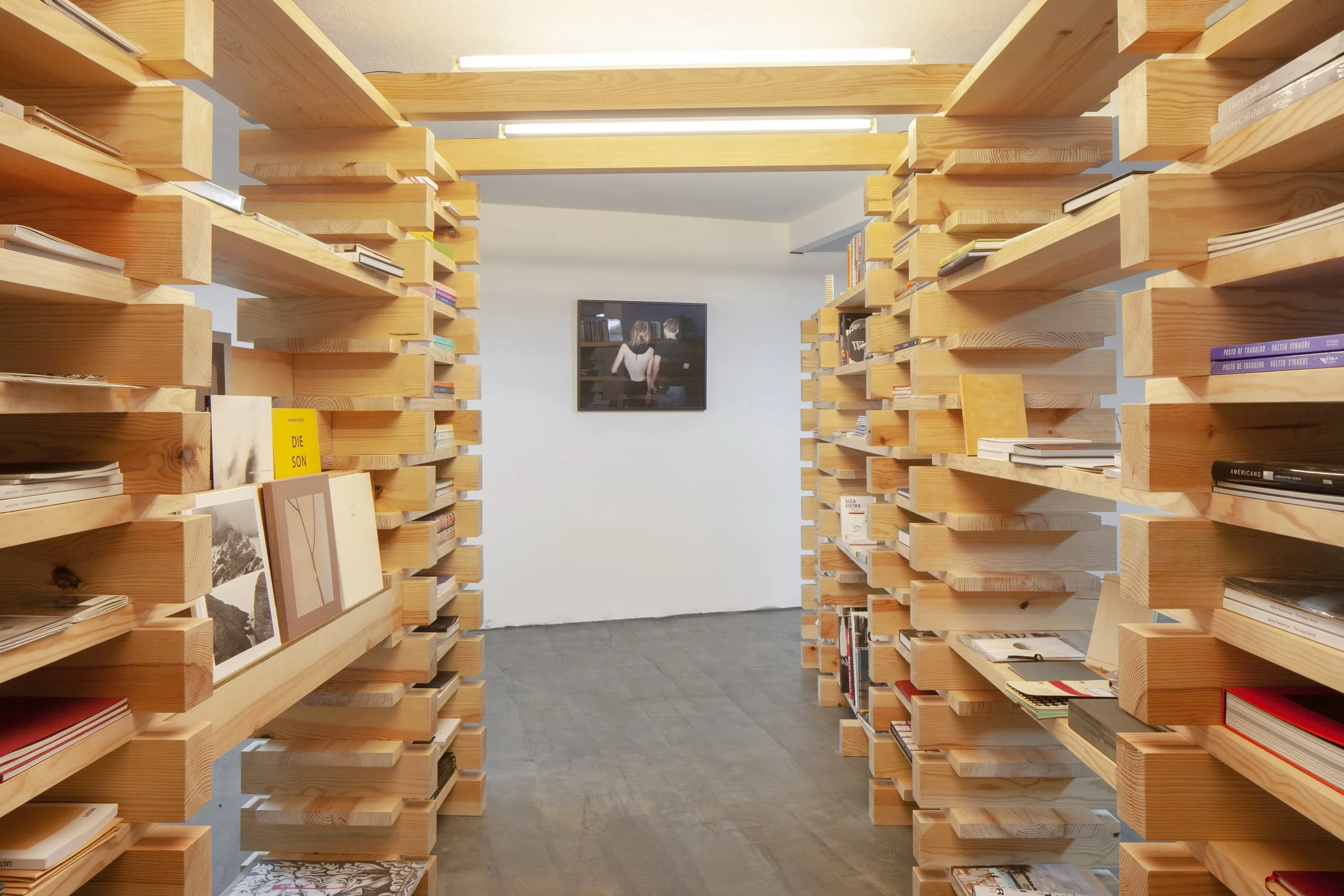
Casanova remembers the beginning as immediate. “Pedro sent me photographs of the place he was about to rent. I spent the night working on an idea, built a model of it and shared it with him.” Guimarães asked him to come to Lisbon. “The next day I was there. We went to see the space and headed straight to a woodworker to furnish the shop.”
XYZ Books started as a bookshop devoted to photobooks. For Guimarães, it was the material expression of a long-held wish: a place dedicated to photography books, independent publishing and printed image-based work. The shop quickly revealed the limits of that first model. Running a bookshop required continuous presence, daily attention and an economy that was difficult to sustain.
“I wanted to remain connected to books, but it was draining my energy. Confining the store’s activities to those of a bookshop was not viable. That is how we became a publishing house.”
That shift defined XYZ Books. The project moved from selling books to making them. At first, Guimarães and Casanova published their own work. Later, they began inviting artists to collaborate. XYZ became known for supporting debut projects and for accompanying photographers and artists who were entering the world of photobook publishing for the first time.
Pedro Guimarães and Tiago Casanova: editing through intuition
Guimarães and Casanova rarely work on projects that are already finished. Their involvement begins earlier — when a body of work still needs structure, sequence, form and a language of production. When deciding whom to work with, they rely on intuition.
The two look for freshness rather than polish. They are drawn to artists who are building a practice, not simply managing a career. At XYZ Books, the concern is not aesthetic coherence or a recognizable style. The question is whether a project contains potential that can be clarified through editing.
Guimarães describes the process: “When people come to us with a proposal, it can be difficult to see the beauty of the work at first. It may lack editing or coherent presentation. Our role is to see the potential behind a project and help the author grow without altering their message. It takes courage for the artist to accept what we suggest.”
Editing, in this context, is not correction applied from the outside. It is participation. It means understanding what an artist is trying to say, then finding the structure that allows the work to hold together. For Bénédicte Blondeau’s Ce qu’il reste, published by XYZ Books in 2020, the process required a fundamental shift in approach. The founders worked closely with the artist to understand the core of the project, then changed its form without displacing its message.
The book as a photographic space
Guimarães and Casanova share a deep interest in photography, but their practices and temperaments differ. Guimarães centers his work on bookmaking and researches ways to speak about photography through the book as a medium. He also works across magazine commissions, portraiture and documentary photography. Casanova has worked as an artist since his university years, developing a practice built around photography and the book format.
Their collaboration depends on disagreement as much as on alignment. “When we disagree, we keep working and discussing until we find common ground. To do that, we divide our responsibilities between design and editing,” says Casanova.
The division is not rigid. Depending on the artist, the project and the nature of the idea, one founder may take the lead on design while the other focuses more closely on editing. What matters throughout is the relationship between image, sequence, material, paper, binding, scale and rhythm. For XYZ Books, a photobook is not a container for images. It is a medium in its own right.
Building a photobook culture in Lisbon
When XYZ Books opened in 2013 in Lisbon’s Chiado neighborhood, specialist photobook shops in Portugal were rare. Guimarães and Casanova were working in a context where the culture of buying photobooks was still limited compared to countries such as France, Germany or Italy.
Casanova describes the challenge plainly: “Portugal is not Italy, France or Germany, where there is an established appreciation for photobooks and a willingness to invest in photographs or artist books. Asking someone to spend fifty euros on a book with no text inside is a genuine challenge.”
Facing the street was part of the project from the outset. XYZ Books was never conceived as a hidden archive for specialists. The aim was to build an audience, raise awareness around photography books and contribute to the growth of Lisbon’s photobook community.
After two years of activity, XYZ Books moved from Chiado to Anjos, in the Anjos-Arroios district. The relocation changed the rhythm of the project. Anjos was more residential, less oriented toward tourism and marked by the presence of artists, small studios and relatively affordable rents — before the acceleration of gentrification. Moving there allowed XYZ Books to work with visitors who arrived with a specific interest in what the space was doing.
Ilha: a space for books, exhibitions, printing and production
In Anjos, XYZ Books became connected to Ilha, a nonprofit space dedicated to the discussion and promotion of artistic practices. The name means “island” and identifies both a physical place and a structure of work.
Ilha functions as a framework for a range of activities around photography and printed matter. It brings together exhibitions, a photobook-focused shop, printing facilities and shared studio space for people and studios working across design, photography and visual culture.
For XYZ Books, access to this broader ecology transformed what a publishing project could be. Artists could work, print, bind, exhibit and discuss their projects within the same environment. The book was no longer only the final object. It became part of an extended process of research, production and public presentation.
This structure also gave rise to XYZ’s residency program. The residencies were designed to offer guest artists time, space and technical support. Participants could access a workspace, scanning and printing facilities, bookbinding workshops, conversations with the founders and exchanges with local designers, artists and curators. The outcome was not always a finished work — more often a book dummy, a body of new research and a public presentation.
XYZ Books as a research and production platform
XYZ’s work as a research center unfolds through residencies, workshops and production processes. The founders introduce participants to editing, sequencing, bookbinding, printing and the technical decisions that transform an image-based project into a book.
“Our program is built around giving artists and photographers the tools they need to think about how to make a book — enabling them to develop ideas and concepts from the ground up,” says Casanova.
Those tools are not only technical. They are also conceptual. A book can be linear or fragmented. It can work through sequence, repetition, interruption, blank space, inserts, varied paper stocks, unconventional binding or non-standard formats. XYZ encourages artists to test these possibilities without treating experimentation as mere decoration.
“When we work on our research, we are constantly looking for techniques that allow us to diversify our language,” says Casanova.
Guimarães adds: “There are no rules set in stone. We are open to testing binding techniques, printing on unconventional materials, or combining different methods altogether. We actively welcome experimentation.”
This is the core of XYZ Books’ working method. Experimentation is not an aesthetic surface. It is the means by which the right structure for each project is found.
A catalogue built through relationships
XYZ Books works primarily with image-based projects. Its bookshop selection follows the same logic as its publishing activity: relationship, trust and genuine curiosity. The founders choose books they would buy for themselves. Many titles in the catalogue are connected to people they know directly.
The selection includes artists who have passed through XYZ Books, friends, acquaintances and publishers encountered at fairs. Those fairs remain an important source for acquiring stock and for building a wider network around independent photobook publishing.
Over time, the founders have gradually reduced the bookshop’s role as a broad retail operation and concentrated more firmly on publishing, production and support for artists. The objective is sustainability — a structure that can support itself, allow them to hire staff, reduce dependence on sales pressure and give more time to the publishing work they care about most.
XYZ Prints and the technical dimension of publishing
In January 2021, the team opened XYZ Prints, a studio and printing space dedicated to fine-art printing on demand, high-end scanning and film processing, with services available well beyond Lisbon.
This activity complements XYZ Lab and the broader technical infrastructure surrounding the publishing house. Film processing, scanning, large-format inkjet printing and book production support are not secondary services. They are part of the same editorial thinking that animates everything else.
For XYZ Books, publishing is inseparable from the material means of production. The founders’ attention to paper, binding, printing, sequencing and format requires direct, hands-on contact with process. Technical knowledge becomes editorial knowledge. The way an image is scanned, printed, folded or bound changes the way it is ultimately read.
Lisbon’s artistic community and the limits of proximity
Casanova describes Lisbon’s artistic context as divided into compartments. Groups exist close to one another but do not always exchange knowledge, experience or resources. Physical proximity does not automatically produce community.
“If we consider the global photobook community, everybody knows each other — yet the neighbors in our building have no idea what we do. If we bring our artist friends and photographers into the space, you wouldn’t necessarily conclude that there is a thriving art scene or cultural hub in the neighborhood,” says Casanova.
The observation points to one of XYZ Books’ continuing tasks. The project does not only publish books. It builds conditions for encounter: workshops, exhibitions, residencies, printing services, book launches, conversations and informal exchanges. Community is not assumed to exist. It has to be constructed.
Guimarães frames the issue through the gap between geography and artistic relation: “We are close in proximity, but artistically there is still work to do.”
XYZ Books today
Today, XYZ Books operates as an independent publishing house, bookmaking studio, photobook platform and production space based in Lisbon. Its activity extends from publishing to workshops, residencies, printing, editing and sustained support for artists developing image-based projects.
The project’s enduring strength lies in its refusal of a standard publishing formula. Guimarães and Casanova do not seek out finished works that simply require production. They enter the process earlier, at the point where structure is still open and a book can still become something unstable, precise, difficult or genuinely unexpected.
At XYZ Books, experimentation is not a style. It is a working method. The aim is not to make a book look experimental, but to find the form that allows a project to exist — fully and without compromise.XYZ Books Rua Ilha do Príncipe 3A, Porta E — 1170-182 Lisboa, Portugal