Hemp and wheat flour: combined, they can produce a nutritionally complete flour
The starting point is always a cultivated plant. Differences in the composition of the fruit, known as a caryopsis (the grain), and its suitability for milling and processing into flour give rise to a range of variables
Wheat or common wheat flour, corn flour, rice flour and hemp flour. The starting point is always a cultivated plant. Differences in the composition of the grain, known as a caryopsis, and its suitability for milling and processing into flour give rise to a range of variables. These differences can be observed both in nutritional terms and in production yields. Consider wheat flour, produced from Italy’s most widely cultivated cereal, and food-grade hemp, which returned to the country’s fields relatively recently, around a decade ago.
Lampoon interview: Marina Carcea – CREA
«The only thing they have in common is the generic term flour, meaning a powder. They are almost opposites because they come from different types of plant material and from two botanical species that are not even related. Their composition and the physiological properties of the finished product will therefore also differ», explains Dr Marina Carcea, Senior Technologist and Scientific Adviser at the Council for Agricultural Research and Economics (CREA), Research Centre for Food and Nutrition.
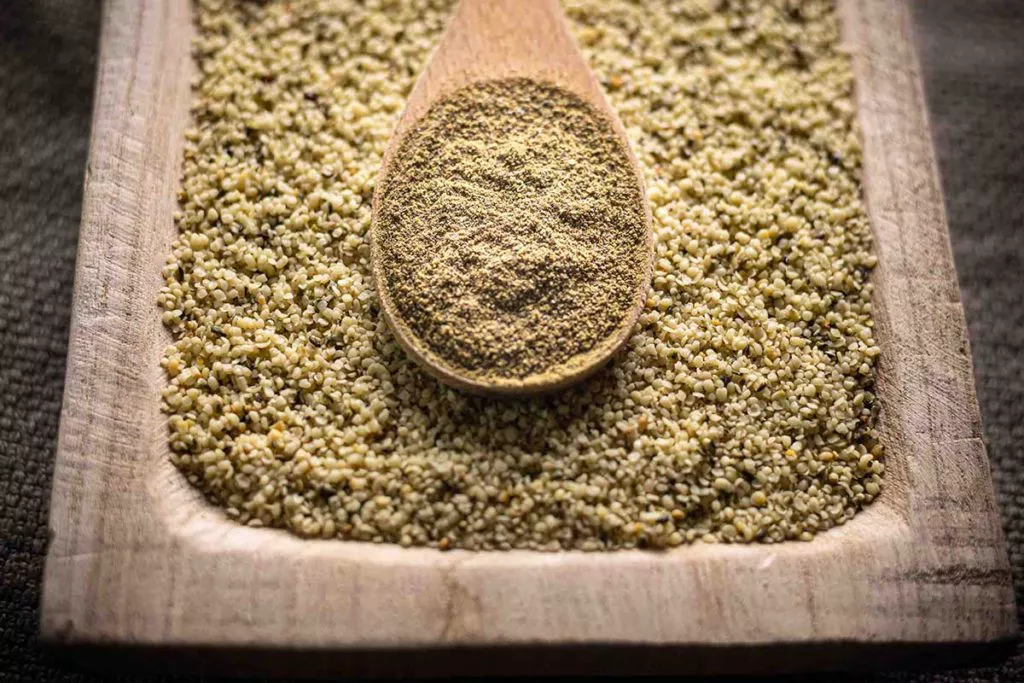
«Let’s start with the seed. Commercially available hemp flour is made from press cake, the residue left after oil has been extracted from the seeds. Wheat flour does not undergo this oil extraction stage because wheat grains do not contain oil», Carcea points out. As for nutritional properties, «If we compare the seeds, hemp has a fat content of thirty percent, compared with three percent in wheat. Protein content is also higher in hemp, exceeding twenty percent, while wheat reaches a maximum of fifteen percent», Carcea continues. «In terms of fibre, wheat contains up to nine percent, compared with as much as thirty percent in hemp. This is reflected in the carbohydrate content. In wheat, starch and carbohydrates account for the largest proportion, up to sixty percent, whereas in hemp the figure is around fifteen percent».
Flour made from hemp
Although hemp flour has a higher protein concentration, it does not contain gliadins and glutenins, the protein fractions that, when mixed with water, form a viscoelastic, spongy mass known as gluten, which allows dough to develop. Hemp is naturally gluten-free, and its flour alone cannot be used to make baked goods such as bread or pizza, or products such as pasta. «For this reason, hemp flour cannot be used above a certain percentage, which varies according to the type of dough, and must be combined with other flours. Hemp flour cannot replace wheat flour, but it can supplement and complement it. This makes it possible to obtain a flour blend suitable for dough preparation, with a higher concentration of fibre and protein. A complete flour».
In bakeries that use it, hemp flour often plays a supporting role. A proportion of between ten and fifteen percent in the blend enriches the dough with fibre and protein without compromising its elasticity. The dough becomes darker and more aromatic, while the bread retains its familiar character with a slightly different flavour profile. Beyond this threshold, the dough tends to become denser, requiring more experienced handling and higher hydration.

The Italian food-grade hemp supply chain
Italy’s food-grade hemp supply chain remains limited, although it is more clearly established than it was a few years ago. Some cooperatives and small processing facilities have developed established pressing and dehulling procedures, while continuing to source part of their supplies from abroad. The selection of suitable Italian seeds remains an ongoing process that requires time. Italian varieties suitable for food processing are still being consolidated: some breeding and adaptation programmes have already produced results, but availability remains uneven across the country. For this reason, some producers continue to source seeds from French and German markets, while others are experimenting with selected Italian varieties. In Molise, hemp seeds have been cultivated, processed and turned into flour since 2016. Canaperia Italiana emerged from the development of Sativa Molise, a regional association. «We started growing hemp for food production with fifty-four hectares cultivated by three or four farmers», recalls Rosario Scotto, president of Canaperia Italiana, now a cooperative bringing together around forty agricultural businesses across Italy.
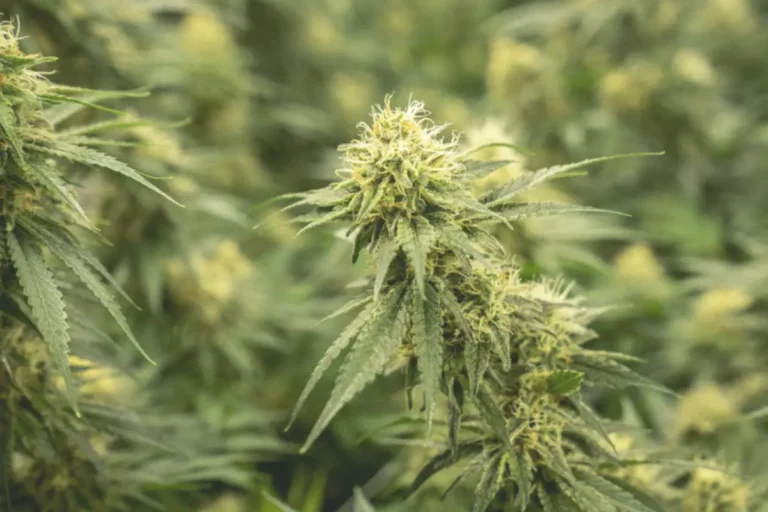
«We source our seeds from the French-German market, which holds an almost monopolistic position in European food-grade hemp. The seeds are of higher quality», Scotto explains. «The fields follow a crop rotation system. Sowing and harvesting times depend on the plant variety. Sowing can begin in late March, with harvesting taking place from August until late September or October. Early sowing, in April and May, is specifically intended for seed production. Late varieties, which remain in the field for up to one hundred and eighty days, are more suitable for fibre production. An early variety rarely exceeds two metres in height, while a late variety can reach five metres. At that height, the plants can no longer be harvested mechanically for flour production, and seed harvesting becomes unmanageable. I use early-maturing, monoecious plants, specifically the USO 31 and FINOLA varieties. Herbicides are not used because hemp outgrows all other weeds during vegetative growth». Alongside USO 31 and FINOLA, Futura 75, Fedora 17 and several recently selected Italian varieties are now also cultivated, chosen for their yields, seed size and stability of THC content.
When hemp is grown for seed production, it is sown at high density, approximately fifty kilograms per hectare, encouraging the plants to compete for height and preventing branching. «If the stem exceeds one centimetre in diameter, it becomes too resistant. It turns into a woody, lignified stalk with a high silica content. This damages the combine harvester blades because it is like cutting glass», Scotto points out.

Hemp flour processing
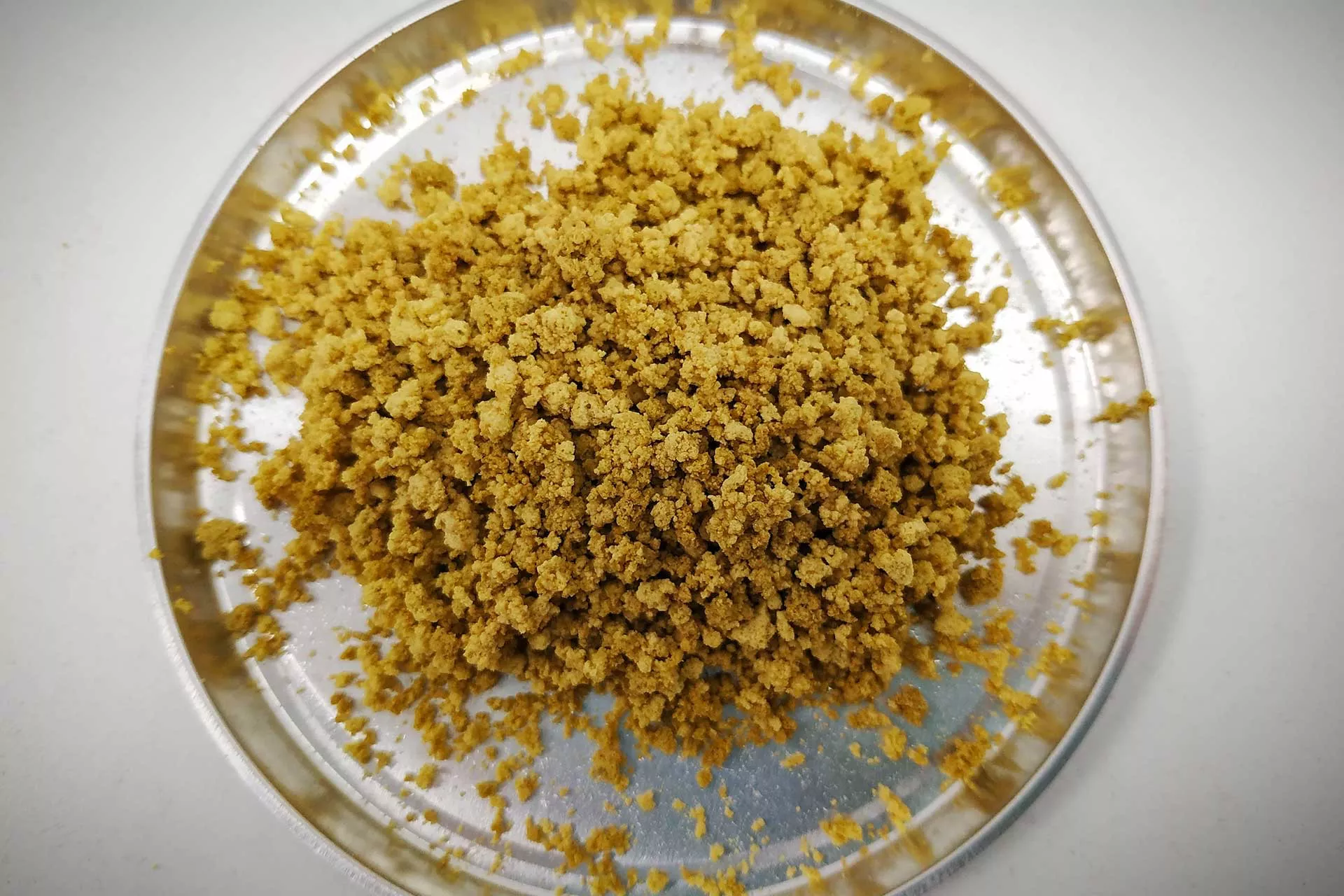
Harvesting is carried out mechanically, as with wheat. Drying the seeds is essential and must take place within four hours of harvesting to prevent mould or bacterial growth. The next challenge is pressing, since the seeds cannot be exposed to high temperatures during this stage. «Pressing must be carried out cold. Hemp seeds are sensitive to heat and have a smoke point of around eighty degrees Celsius. After three attempts, we found a machine that was suitable and capable of withstanding the stresses caused by the seeds. Hemp is tough and difficult to press. This is the eighth year we have used the machine, which has a capacity of three hundred kilograms per hour. We press hemp seeds exclusively». At a temperature that must never exceed fifty degrees Celsius, ideally remaining around thirty degrees, the seeds are pressed and filtered through a screening machine. Another machine then extracts the oil and separates it from the residual material, the protein-rich press cake, which will subsequently become hemp flour. The oil is left to settle for several days before being drawn off, while the remaining hemp material is taken to the mill. «There is very little waste from pressing. One hundred kilograms of seeds yield thirty litres of oil, approximately sixty-eight kilograms of protein cake, from which fifty kilograms of flour can be obtained after removing the bran, and two to three kilograms of dust and sediment lost during processing», Scotto explains.
The moisture content of hemp flour provides an indication of its quality and shelf life. If the flour is moist, this means it still contains some oil. «Hemp flour is characterised above all by its high protein content, polyunsaturated fats (Omega-3 and Omega-6) and vitamin E. It is naturally gluten-free and has a low glycaemic index», Di Maio points out.
Regarding THC levels, the current reference is Regulation (EU) 2023/915, which establishes a limit of 3.0 mg/kg of total THC for flour and other hemp seed derivatives, and 7.5 mg/kg for oils obtained from hemp seeds.
Once dried and analysed, the material must be milled. For hemp grown in Molise, Canaperia Italiana relies on the expertise of miller Cofelice. The mill has been operating since 1910 and passed into the hands of the Cofelice family in 1958. «Initially, our mill worked with local farmers, using millstones to grind wheat, corn and other cereals», recalls miller Dionisio Cofelice. In the 1970s, the mill was modernised and converted to a roller milling system, which remained in use until the early 2000s. Realising that competing with large industrial mills was no longer feasible, Cofelice reconsidered the ancient grain varieties of his region and the stone milling techniques used by his father. The mill consequently returned to traditional processing methods, working exclusively with small local producers.
Hemp in Matrice, Campobasso
«In this area, in Matrice, in the province of Campobasso, there are farmers whose fields are measured in tomoli, a pre-Napoleonic unit of land measurement smaller than a hectare. Precisely because of their small size, these areas have high biodiversity, which has also allowed forgotten cereal varieties such as Senatore Cappelli wheat, Solina and Saragolla to be cultivated», Cofelice explains. «Farmers ask me to do different things, to experiment. I am always open to innovation, even though I remain attached to the past. Milling is not simply about crushing grain. It means understanding the product you are working with, touching it and rubbing it between your hands. It is more an emotional matter than a technical one, although working with a stone mill requires using a chisel to achieve the necessary roughness. When I first saw hemp, I wondered what could be made from it, but then we started processing it. Hemp flour has distinctive sensory characteristics. It is different from other flours. It is highly aromatic, still soft because of the oil, and has an intense green colour. I call it the devil’s flour because it is dark, although in reality it has a great many positive qualities».
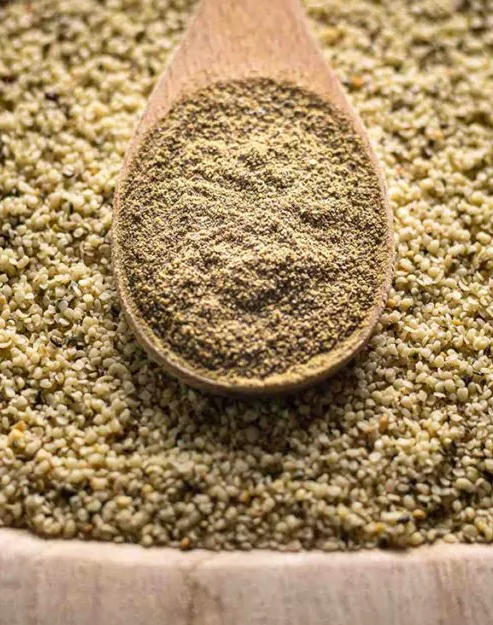
Hemp flour
Hemp flour can be refined by removing the outer part of the seed, which gives it a bitter taste, or blended with other flours. Its presence in dough can also be detected through tasting: it has a subtle aftertaste reminiscent of hazelnuts.
Mariavittoria Zaglio