Motors, fish and minor disasters: Yuko Mohri scales technology
From feather dusters to magnetic fields, Yuko Mohri rewires everyday objects into unstable systems where error generates knowledge and technology returns to human scale
Embodied technology and opaque systems: Yuko Mohri on motors, scale and human limits
Yuko Mohri: I once tried to engage with big data and complex computer systems, but I need something physical. With small materials and motors, I try to wrestle with them —like a form of miniature wrestling. I test their limits. A small motor can move one hundred kilos; a larger one can handle more. Through that, I measure my own body. Five hundred tons are beyond my scale. Beyond the body. Working at a size I can physically grasp creates a balance between body and matter. It stays tangible.
In Japan, large systems — big data, nuclear plants, vast infrastructures — operate far outside daily experience. I prefer to stay close. I work with energy I can touch. In my installations, technology becomes a way to establish physical equilibrium. Materials are not passive. They answer back. There is a conversation.
The earthquake shifted my view. When the infrastructure collapsed, technology stopped being abstract. It raised basic questions: how much energy do we need, and how safe are the systems we depend on? Large-scale networks can feel distant and opaque. I bring them back to human scale. I combine technology with familiar materials, so the installation becomes a collaboration between energy, objects, and myself. I ask whether I can position myself as the smallest link in that chain. The mechanisms are simple. The results are not.
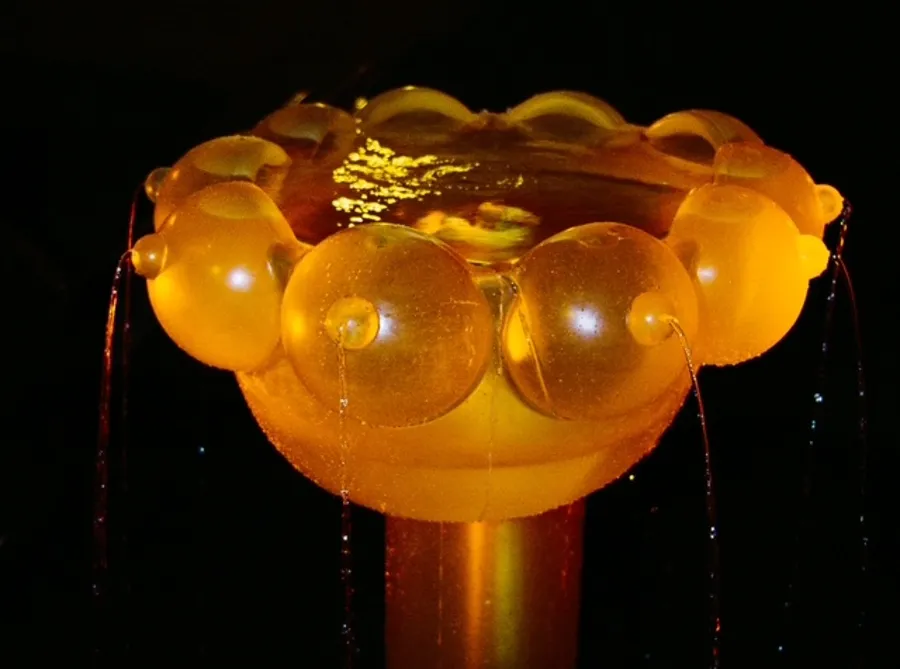
In Flutter (2018–2025), sensors track the movement of fish. Their behavior cannot be fully predicted. They respond to forces we do not see, such as magnetism. The system is basic — on and off — yet it reacts to real movement and translates it into action. It may appear high-tech, though structurally it is open and exposed, almost like a raw input–output exchange. I do not hide the mechanism. I want the audience to sense what is happening, to feel the transfer of energy between bodies, water, sensors, and sound.
The framework is simple. What it reveals is not. Unstable currents, invisible forces, small fluctuations — these shape the environment constantly. My installations convert existing energy into tangible experiences. They make something latent perceptible. The system remains minimal. The interaction remains real.
Yuko Mohri on sound art: speakers, magnets and devices as co-participants
MF: Sound, materials, and devices become co-participants.
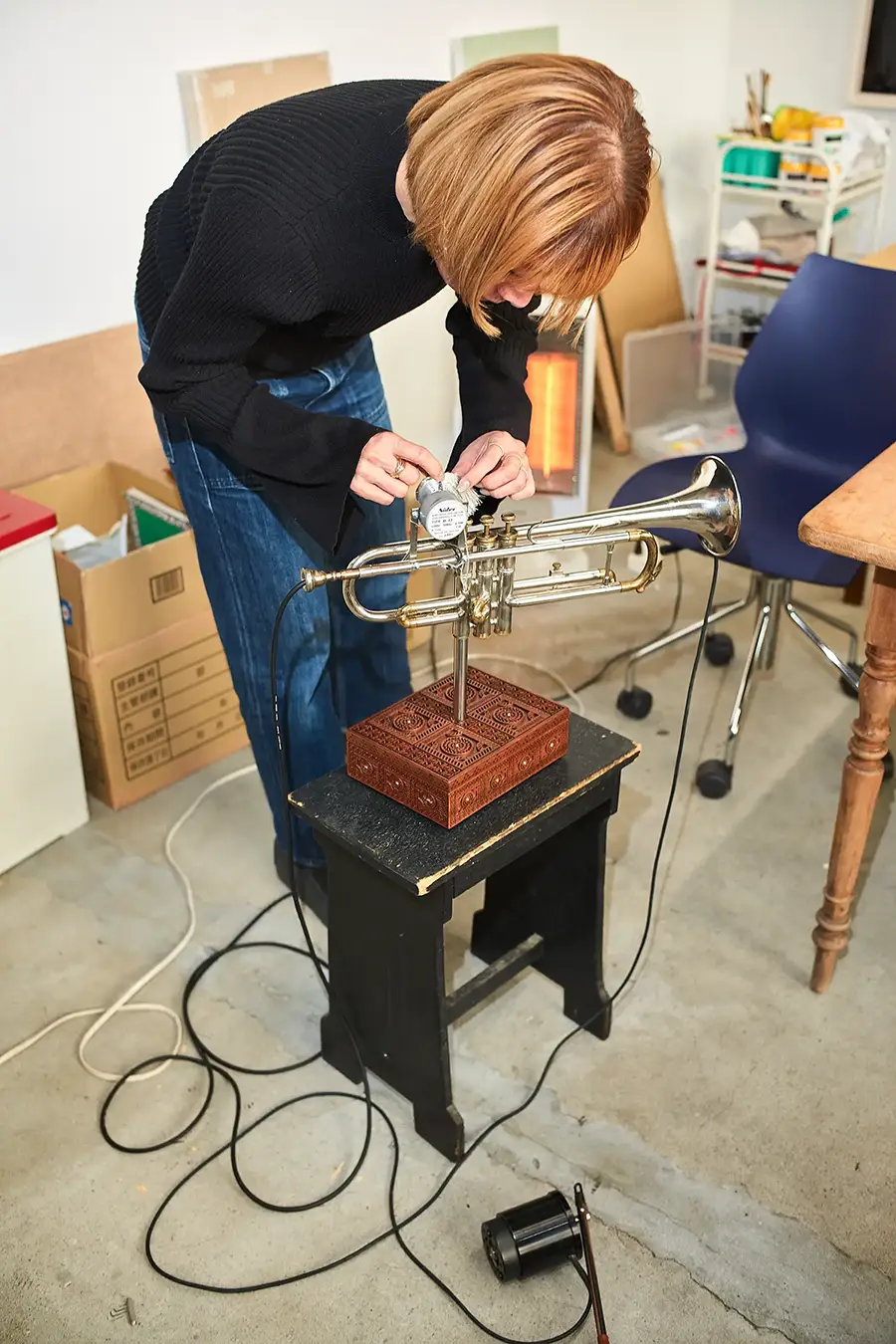
Yuko Mohri: I grew up shaped by visual art and music. I’ve always played instruments and attended performances. For a time, I considered dedicating myself entirely to music and the performing arts. I realized it wasn’t for me. Performing live is demanding, and I’m shy. I prefer being in the audience. About twenty years ago, I played in experimental bands. That position—observing rather than performing—stayed with me. It led me toward interactive works. When I build kinetic sculptures in my studio, I am the first spectator, standing in front of the piece as it moves. I like to “play” with materials and test their limits. It is similar to performance art and experimental music: trial, reaction, adjustment.
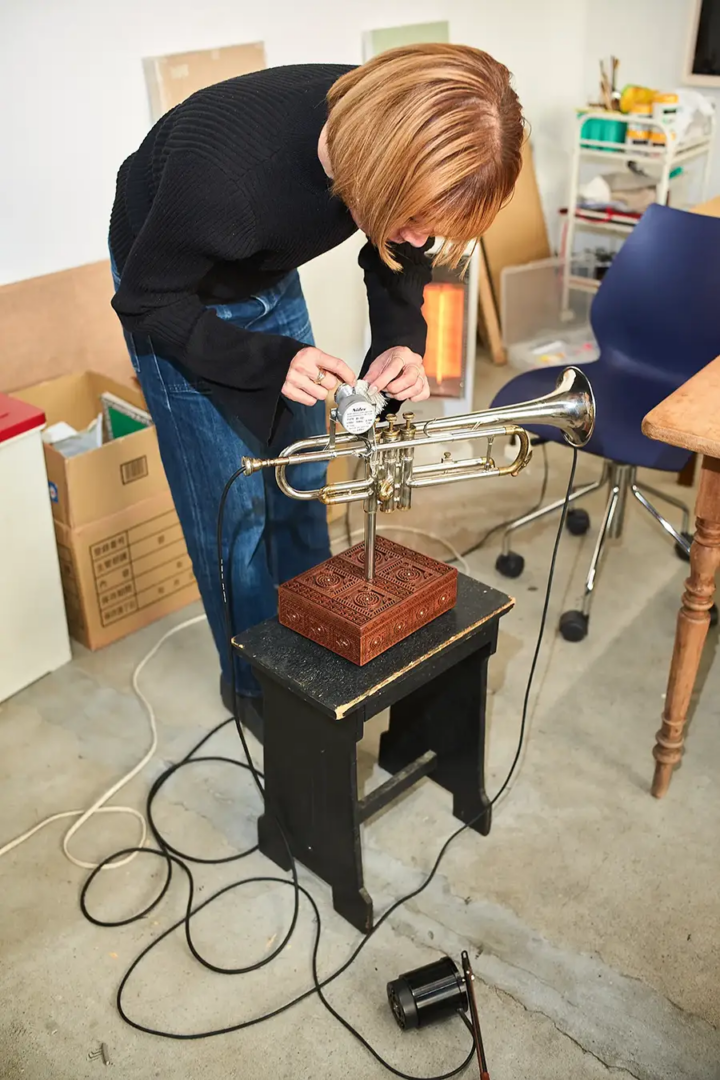
I’m drawn to audio devices—speakers, amplifiers, cables—because sound shifts depending on how they are combined. Sometimes, I’ll open up an amplifier or a loudspeaker to see how the sound is produced. The principles are simple: a coil, a magnetic field, an electrical circuit. Yet a small change—replacing a single capacitor—can alter everything. Working with these devices feels like a negotiation with the material and its potential. Sound is unstable. It changes through experimentation. Magnetic Organ (2004–ongoing), one of my earliest works, is built on the same principle as a loudspeaker, but I altered its form. The sound was “erased,” exposing the magnetic force and mechanism usually hidden from view.
Error is part of the process. When you work this way, results are never immediate. You experiment, you miscalculate, you repeat. It can be tense. I don’t treat error as failure. It’s a dialogue with devices that resist quick answers. Error generates knowledge. It opens other routes, other solutions. The same applies to human relationships. There is no single answer. Communication is uneven, full of gaps and misunderstandings. That friction is not an obstacle. It is part of the exchange.
Sound as translation in Yuko Mohri’s practice: perception, ambient noise and the unseen
MF: Sound emerges as a way to translate natural phenomena into visual and auditory experiences.
Yuko Mohri: I’ve been trying to open my ears and listen more carefully to what surrounds me. There are sounds everywhere—on a train, in a restaurant—yet we move through them without noticing. Most of the time, we privilege sight. Even in front of a meal, our attention is almost entirely visual. Sound offers another entry point: the clatter from the kitchen, the low hum of conversation—if we decide to listen.
The urge to be present through listening intensified during the COVID-19 period. I felt a stronger need to perceive through sound. Our lives are saturated with it. Even in the countryside, in spaces that appear empty, silence does not exist. Birds, distant engines, wind, echoes—sound continues. We live at speed. Beneath that surface runs a deeper sonic layer. Sound has a particular status: we can attend to it consciously, yet we also absorb it unconsciously. We suppress it, overloaded by information and speech. Still, ambient noise carries data. It reveals spatial dimensions, social dynamics, and the character of a place. Sometimes you recognize where you are by sound alone.
Energy, movement and frequencies: how Yuko Mohri turns space into a living system
It’s not about sound in a conventional sense. It’s about energy and movement. Waves and frequencies are everywhere. Light, LED panels, any form of illumination carries energy. Sound is simply one wave we can perceive, like air in motion or wind passing through a space.
Kinetic movement operates like a low-frequency wave. Light—whether from a spotlight or embedded in an installation—belongs to higher frequencies. These layers coexist in the same exhibition space. Some are perceptible, others exceed or fall below our sensory threshold. Often it is their interaction that produces a new perception. We are able to register much more than we can articulate. I try to protect this richness of perception that comes from direct experience. We spend a large part of our lives online. Social networks have reorganized how we process reality. Relying only on digital streams reduces experience to a single, pre-structured viewpoint. In daily life—walking through my neighborhood, sitting in my studio—I’m reminded of how stratified and unstable information is. I try to carry that density into my installations. They are not conceived as images for Instagram. They function as physical situations. They change, they unfold, they never repeat in the same way. The viewer has to remain present, attentive, inside the space.
Shared presence and collective attention: Yuko Mohri’s installations beyond the screen
MF: The way audiences interact with your work feels different from what we usually see. People stay. They watch, talk, laugh. They are not absorbed by their phones. Visitors of different ages and backgrounds seem to share the same sense of surprise, almost like children discovering something together.
Yuko Mohri: Children are more direct. Their perception is open and less conditioned. They don’t need art, historical knowledge or contextual frameworks to relate to an installation. In that sense, my work is not only about art. It concerns how we inhabit and perceive everyday life. Adults can recover that openness, but only if they suspend assumptions, even briefly.
I live in Japan, yet I travel both domestically and abroad. I walk. Whether in my own neighborhood or in Italy, Spain, or Indonesia, I keep the same habit: walking, observing, staying close to ordinary routines. That proximity to daily life is where new insights appear. Many of them emerge from common objects. A milk carton, for example, differs between Europe and Japan. The variation reflects infrastructure, logistics, distribution systems. Everyday objects carry those structures within them. That is why I speak about infrastructures. They are largely invisible, yet they shape how we live. You can study them theoretically, but the objects we handle each day are the most immediate interface with those systems.
Everyday objects as infrastructure: Yuko Mohri on touch, displacement and material research
MF: Your practice is grounded in direct engagement with materials.
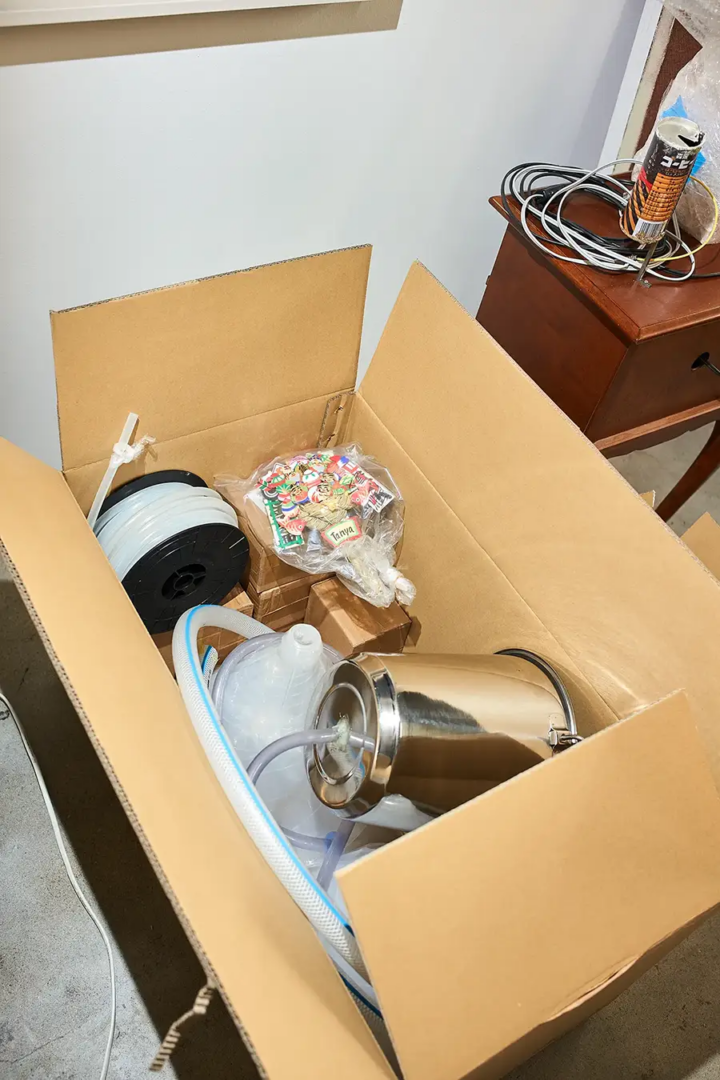
Yuko Mohri: My research is physical before it is conceptual. I prefer going to places rather than reading about them. I touch materials, collect them, carry them back. The collecting phase is essential, almost like drawing or sketching. My studio is chaotic. That is where the work starts.
Sometimes I gather objects in Europe and bring them to Japan. Once displaced, they carry a different charge. There is distance, tension. At times I hesitate to alter them because they already contain another context. That friction often marks the beginning of a project. Everyday objects function as interfaces. Paper, aquariums, kitchen tools – materials people recognize. Not everyone connects to the same item, and that difference is productive. It creates multiple points of access. Even in complex installations, simple materials keep the experience direct. I have felt this myself when encountering a familiar object in an unfamiliar environment — it creates an instant connection. I try to preserve that mechanism.
These objects also clarify what is happening within the space. If everything followed a neutral, standardized aesthetic, perception would flatten. Texture matters. Handling materials is a way of exposing the infrastructure of the work—what operates behind the surface. People recognize the components at once. At the same time, they sense that something exceeds them. Beneath these objects lies a system—sometimes ecological, sometimes infrastructural—not immediately visible. Familiarity becomes a threshold. Through it, viewers begin to detect structures that would otherwise remain concealed.
I play with objects and whatever materials I find around me. The process almost always makes me laugh. It feels like a small joke I can stage each time. I might run a tap into a cup, then stack that cup on top of another and see what happens. If it holds, an upside-down tower appears. It’s fun. I’m never completely sure whether it’s strange or not. That is how I work. I do not ask whether it is art. It’s closer to how children play.
Duchamp, irony and error: Yuko Mohri’s playful dialogue between materials and systems
Yuko Mohri: I first encountered Duchamp in art textbooks as a teenager. His work shifted the way conceptual art was understood. From Japan, far from Europe or America, his pieces felt almost out of reach. When I visited the Philadelphia Museum and saw them in person, I was struck by how direct and funny they were. Duchamp played with everyday objects and irony. I do something similar in my studio. Materials that seem insignificant — sometimes even what others call trash — become triggers for unexpected combinations.
I could relate to Duchamp’s attitude. It gave me confidence. My path diverges, though. He did not work with movement or sound. I use motors, loudspeakers, computers — common technologies he could not have imagined. These are my raw materials. I combine them according to what is available, shaped by context. In Tokyo, motorized loudspeakers are easy to find second-hand. Almost anything can be ordered online. Practice is like a form of prayer. It’s about catching coincidences and following small, playful sparks until they turn into movement.
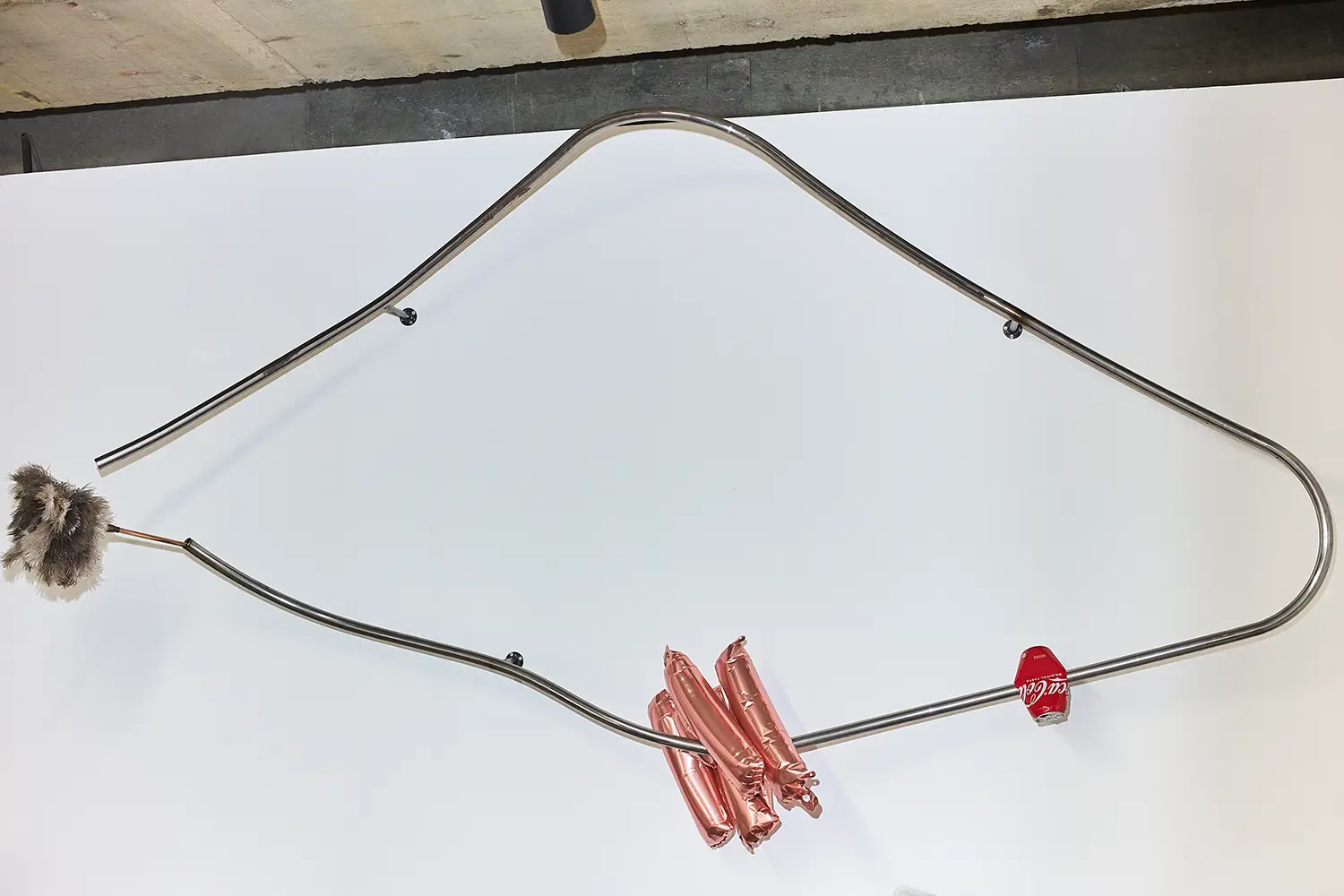
I treat simple objects the same way. The feather dusters in I/O (2011–ongoing) are one example. They were originally produced in Austria to clean Buddha statues. In Japan they became ordinary household tools. I was drawn to that shift: a ritual object reduced to something banal. My studio in eastern Tokyo is surrounded by temples and small shops that sell them. They are part of the everyday landscape. I picked one up, attached it to a motor. The result was random and slightly absurd. There is no complex programming — just on and off. Physics takes over. The movement becomes unstable, unpredictable. It was an accident, but I laughed. That reaction told me I was on the right track.
Yuko Mohri and kinetic installations: ordinary objects as embodied open systems
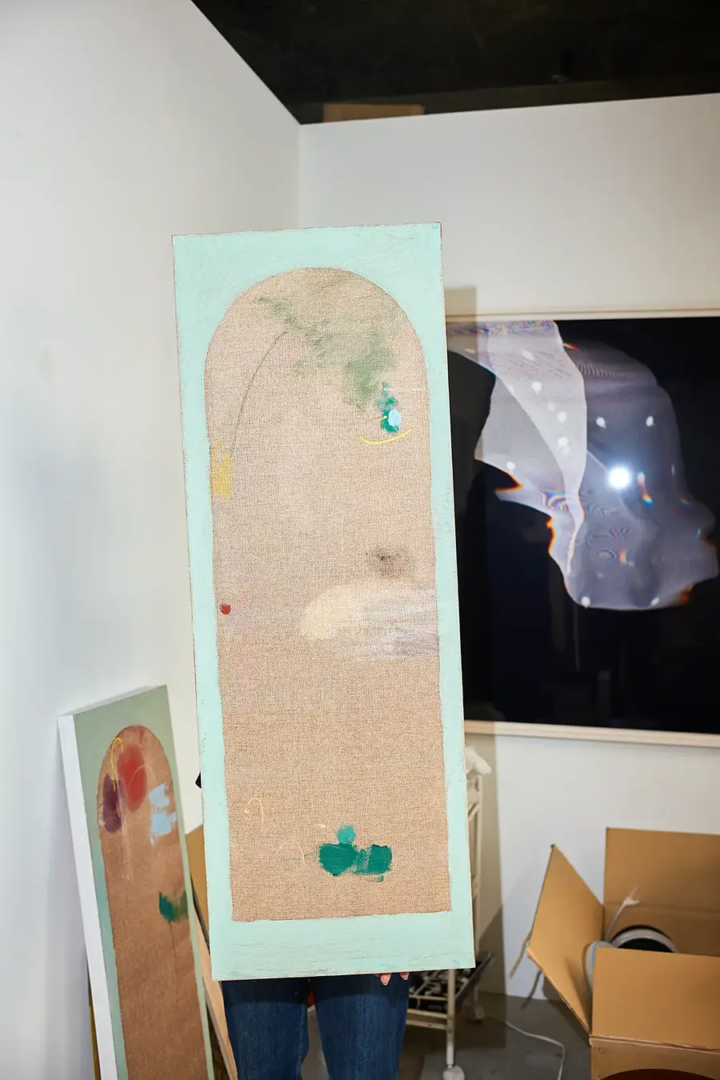
Yuko Mohri (Kanagawa, 1980; living and working in Tokyo) creates kinetic installations that turn ordinary objects into living, responsive systems. Working with salvaged materials, altered musical instruments, motors, and simple electronics, she orchestrates interactions with subtle, often invisible forces, such as gravity, magnetism, heat, air currents, and dust.
Micaela Flenda
Photography Federico Radaelli