From aero politics to salt architecture: Tomás Saraceno
In Salinas Grandes, El Santuario del Agua by Tomás Saraceno reimagines land art as a community-owned project rooted in water, salt, and Indigenous knowledge
Toward El Santuario del Agua: a community-owned work against extractivism
Tomás Saraceno (b. 1973), the Argentina-born, Berlin-based artist. At the end of October 2026, El Santuario del Agua will open in Salinas Grandes, northern Argentina: a project conceived together with, and belonging in its entirety to, the eleven Indigenous communities of the territory, and perhaps the most concrete expression of that statement to date.
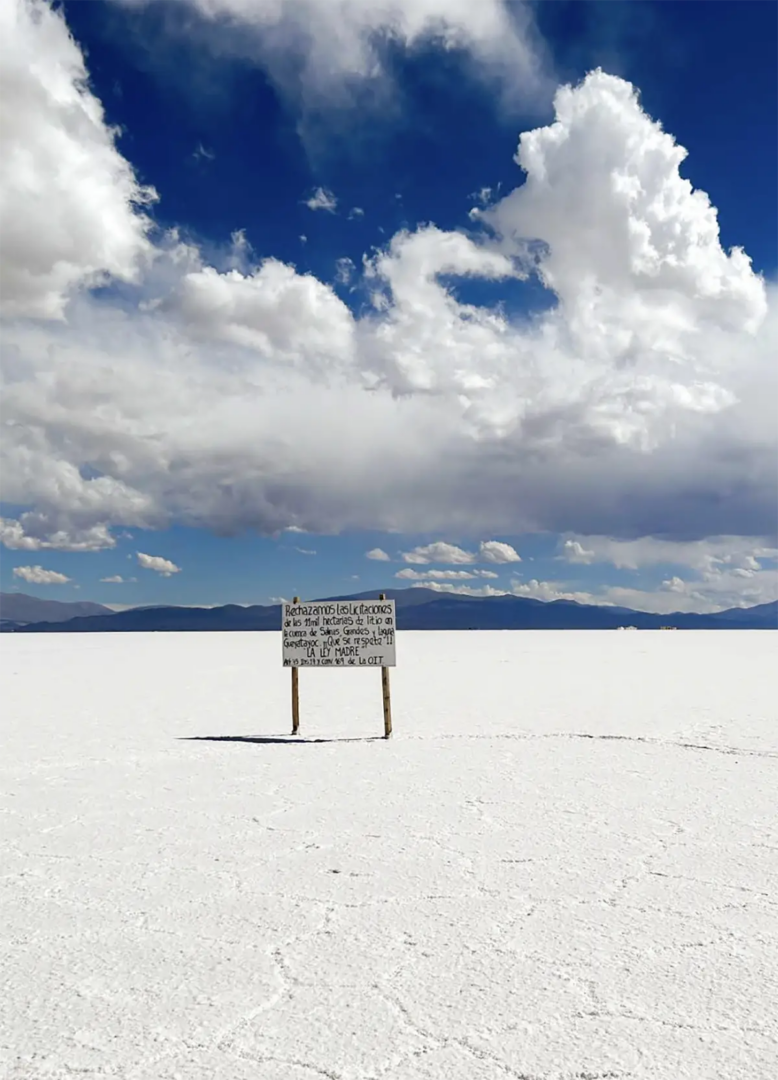
The project has grown out of more than a decade of encounters, conversations, and shared learning with the Indigenous communities of the Salinas salt plains. Part architecture, part sculpture, part monument, part land art, El Santuario del Agua is envisioned as an artwork made in collaboration with the Red Atacama Indigenous communities, as well as a replicable model of community-led, low-impact tourism capable of generating stable local income while directly confronting extra activism. Located within an endorheic basin, where water never reaches the sea but is endlessly transformed through slow and ancient processes of crystallization, the project is grounded in a cosmology in which water is not a resource to be exploited, but a living being: a spiritual, cultural, social, economic, and political force, a source of life and connection with the cosmos.
In a 2023 interview with The New York Times, he said: «Part of my work is always trying to ensure that I do not extract that knowledge for my own benefit. Every time a work is done in collaboration with the communities, one-third of the income is donated to them. We have to think about less extractive ways of exhibiting or displaying knowledge that others have, and to extend economic compensation to them, not be naïve about that.»
Arachnophilia, Aerocene, and the will to turn poetic speculation into action
This is not an exception in Saraceno’s practice, but its latest and perhaps most radical consequence. When he says he is «fascinated by, or more accurately, creatively obsessed by, airborne movement of all kinds,» he does not mean that, like any other artist, he will merely produce poetic, hermetic installations alluding to floating. Or rather, not only that. His works have filled museums across the world, from solo exhibitions at the Serpentine Galleries, Palais de Tokyo, the Metropolitan Museum of Art, and Hamburger Bahnhof to major appearances at the 17th Venice Architecture Biennale and the 53rd and 58th Venice Biennales. He has also staged artistic interventions at COP20, COP21, COP26, and the World Economic Forum in Davos, and has been commissioned for twenty-one permanent large-scale installations across four continents. Yet unlike most of his peers, Saraceno does not stop at implication, metaphor, or inspiration. He insists on turning aspiration into practice.
He does so by studying, with scientists and researchers in collaboration with institutions including the Max Planck Institute, TU Darmstadt, and the Museum für Naturkunde Berlin, the kiting spiders that travel through the air on gossamer silk, and by advancing long-term inquiries into spider-web architectures, biotremology, and interspecies communication through Arachnophilia (2018-). He has done so by creating environments in which spiders could proliferate, as at Palais de Tokyo in 2018, by developing the Spider Web Scan, by helping form the world’s largest distributed archive of three-dimensional spider webs, by supporting the web portal Nggamdu.org as initiated by the spider diviners of Somié, Cameroon, and even by having a newly identified species named after him (Heteropoda saracenoi, named by arachnologist Peter Jäger).
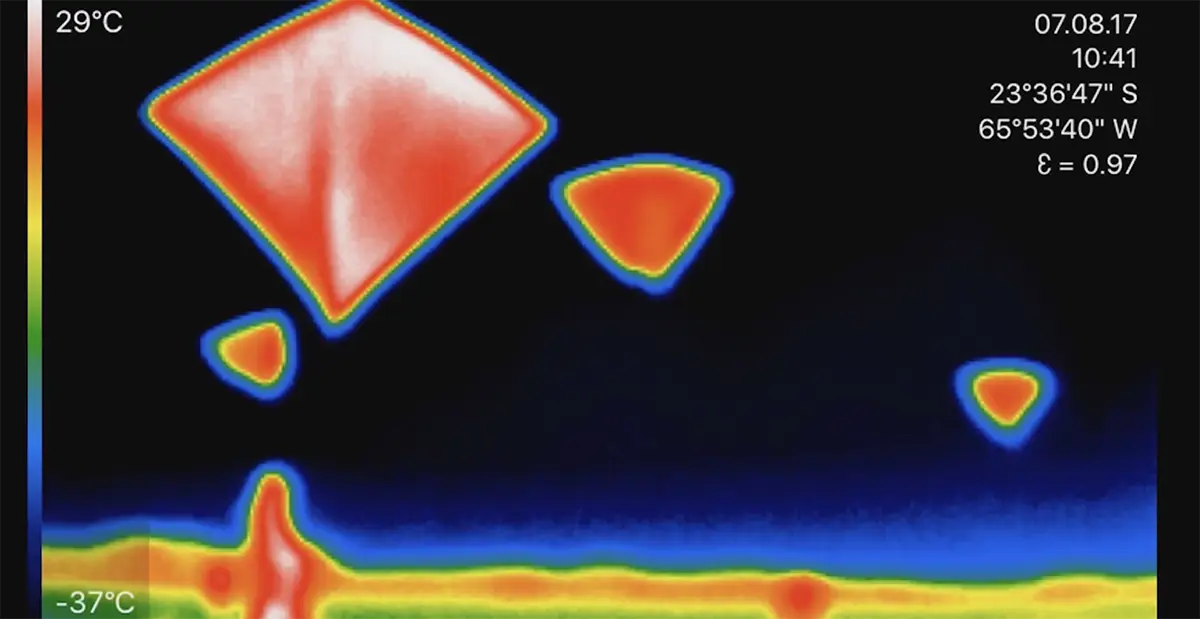
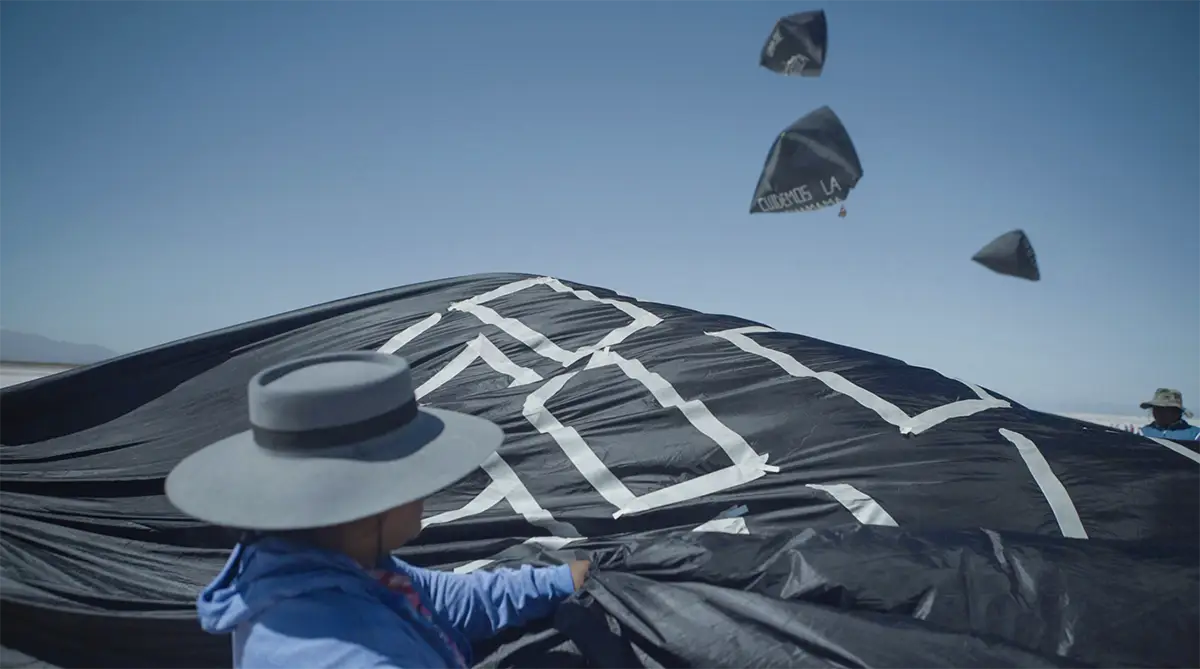
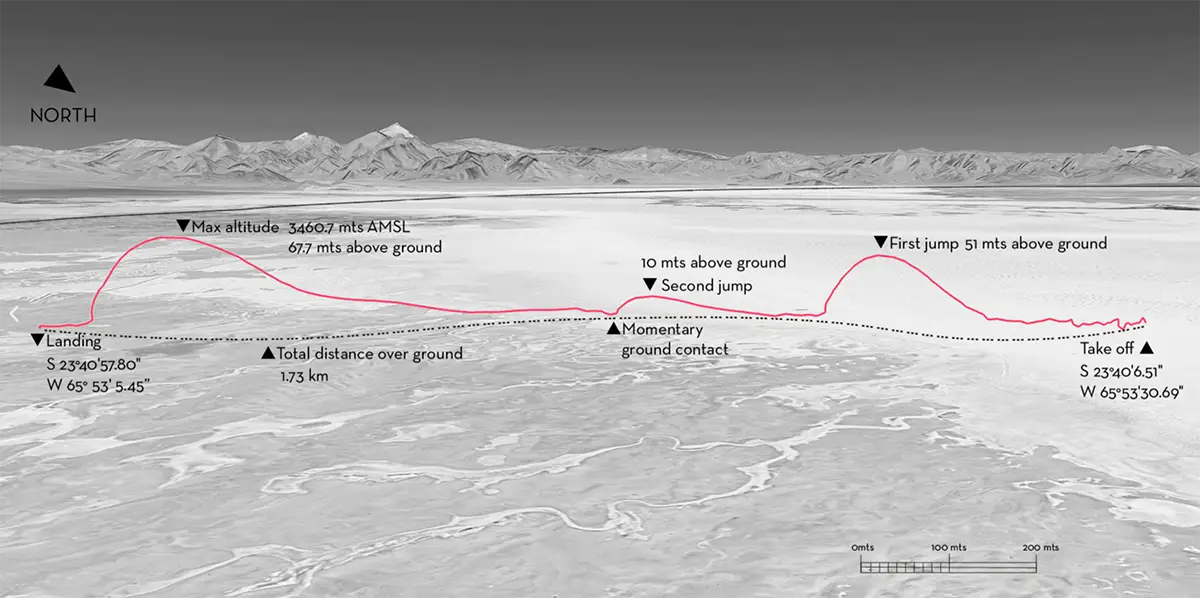
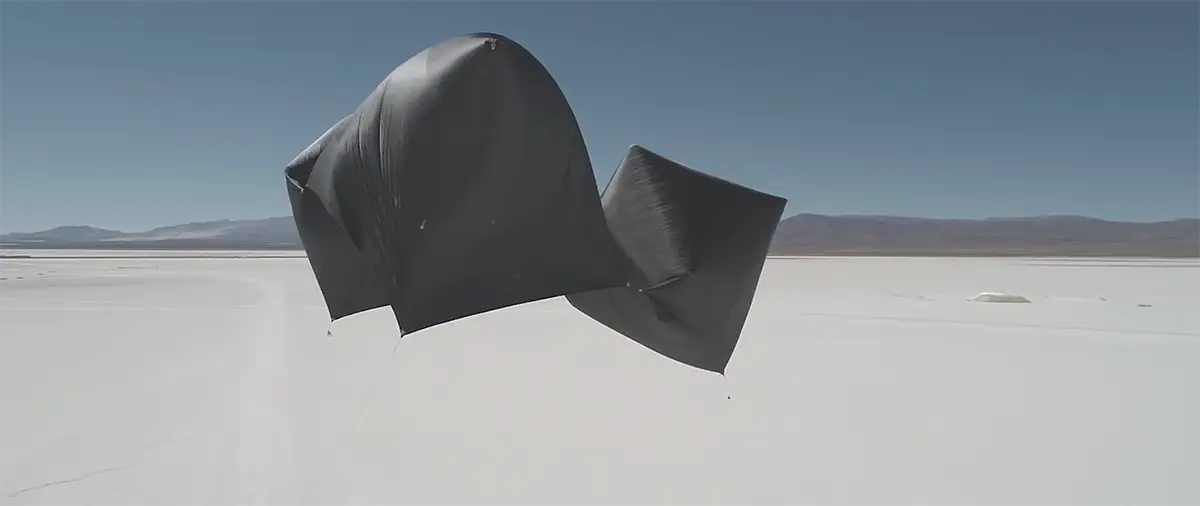
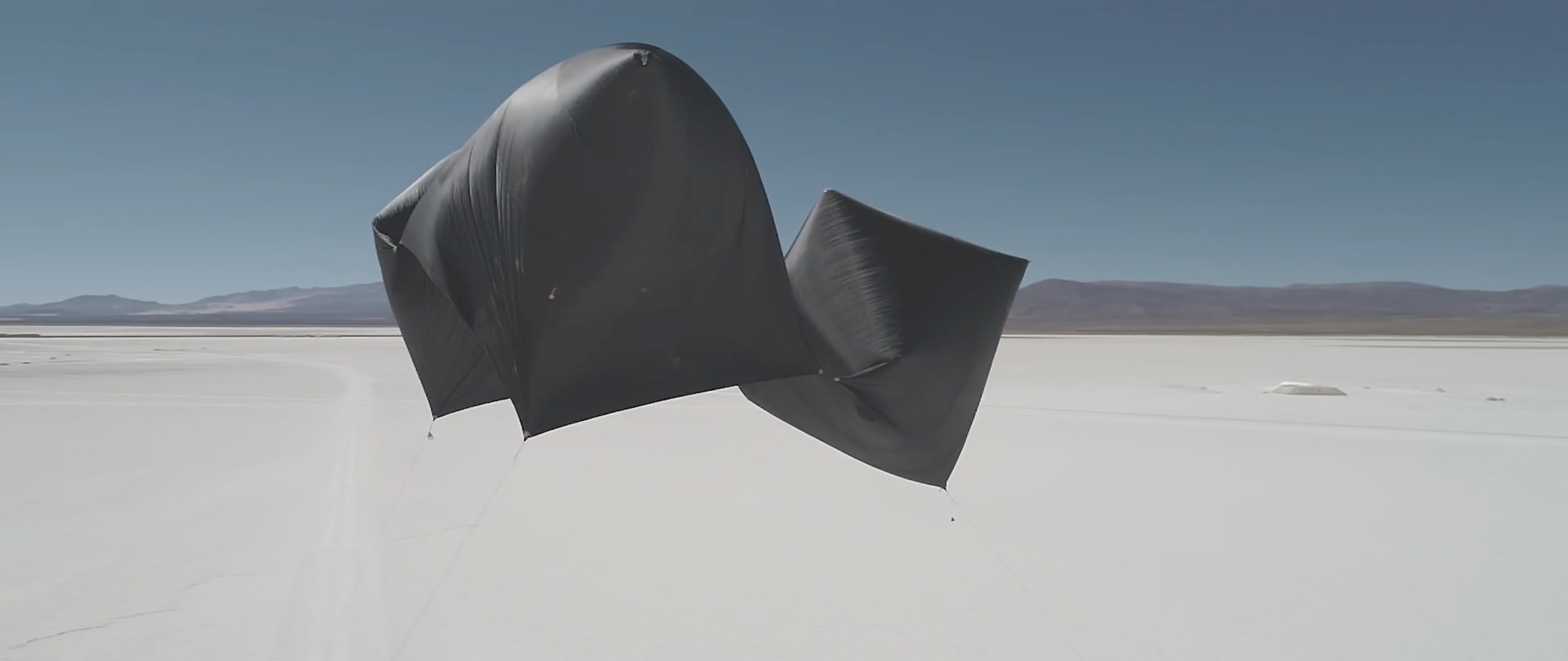
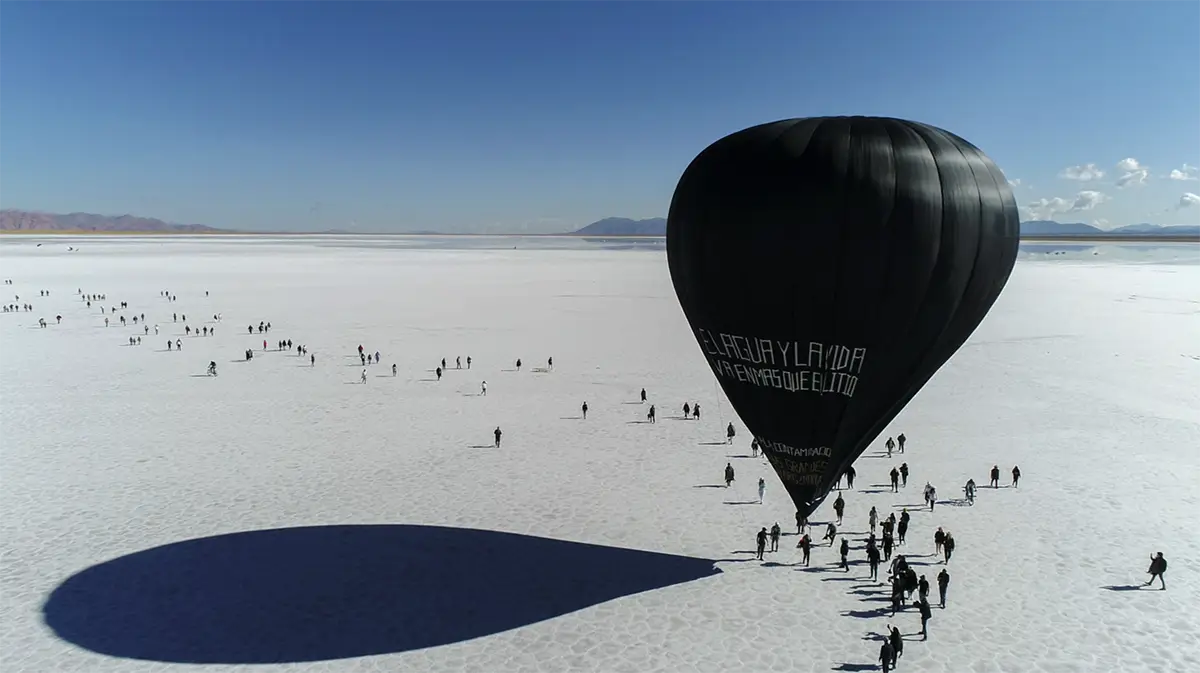
He has done so, too, by imagining and realizing a way of flying without emissions through Aerocene, culminating in the 2020 flight of Aerocene Pacha, «the most sustainable flight in human history», which set 32 world records recognized by the Fédération Aéronautique Internationale while carrying the message «Water and Life are Worth More than Lithium.»
He has done so by designing a floating backpack balloon and developing open-source devices to monitor air quality in the lower stratosphere: the Aerocene Backpack, as he describes it, is a portable floating kit that enables anyone to launch their own aerosolar sculpture, hack the device pack, create lightweight sensors, and lift them into the air, while sharing the collected data through Aerocene’s open-source online community. He has done so by inviting anyone to build aerosolar sculptures out of plastic bags through downloadable instructions, as in Museo Aero Solar, whose displaced open-source community has collected more than 20,000 plastic bags across Argentina, Colombia, Cuba, Germany, Italy, Palestine, Switzerland, the United Arab Emirates, the United States, and elsewhere. In doing so, Saraceno has brought together representatives of the Salinas Grandes’ native communities with multidisciplinary, transnational bodies spanning art, science, anthropology, ballooning, and engineering, from the EAPS (Earth, Atmospheric and Planetary Sciences) lab at MIT to CNES (Centre Nationale d’Études Spatiales)’s MIR (Montgolfière Infrarouge) solar balloon research, involving in the process 126 cities, 43 countries, and 6 continents.
Why Saraceno’s language of eco-social justice does not remain at the level of rhetoric
What might sound, in another artist’s mouth, like inflated rhetoric or utopian vagueness does not, in Saraceno’s case, feel like empty art-speak, but like a real ethical and political commitment, and not merely one of good intentions, but of actual transformative potential. That is why, when he uses expressions such as «planetary thinking,» «eco-social justice,» and «ethical re-alliance with the Earth,» when he describes Aerocene as «an era-in-the-making,» or speaks of moving beyond arachnophobia and the Capitalocene towards an «epoch of planetary solidarity,» it does not sound like decorative theory. Nor does it when he says, in much simpler and more grounded terms, that «in the end we understood that the best thing is to do things the way grandparents and great-grandparents did, following the seasons, following natural bioindicators, the same ones spoken of in proverbs across cultures all over the world.»
Even when he engages a notion such as Boris Groys’s «cosmic anxiety,» defined as the «specifically modern anxiety» produced by «humankind’s dependence on cosmic events that are uncontrollable and even unknown,» Saraceno does not use it as a pretext for self-contained works, but as a life mission. His language emerges from an effort to challenge institutional inertia, disciplinary comfort zones, and the normalized geopolitical logic that prevents meaningful change. As he himself explains, «we are introducing aeropolitics to challenge the naturalness of assumptions about power» and to confront the «institutional inertia that blocks our abilities to tackle the contemporary crises.» Behind the pure beauty of lightness lies a subversive force: «The core strengths of Aeropolis are its horizontality and indivisibility. It is the political imaginary we desperately need. […] Political ecology requires destabilisation of the geopolitical focus. Unchallenged domination of geopolitical imaginary is harmful, if not fatal.» For Saraceno, «Science is not able to communicate or to explain or be emphatic enough to really make a change. Politicians are not making it. Artists are not making it. Unless we leave our comfort zone of saying, “I’m an artist alone” or “I’m a scientist alone”, unless we engage with politics, with social sciences, with philosophy and really try to collaborate, then the world will keep going as it is.»
From dream to construction: exhibitions as steps toward El Santuario del Agua
Art, of course, should make us dream, and Saraceno’s work does so like very few others; but like no one else he strives so persistently, and so often successfully, to make those dreams real. Whether imagining «nomadic socio-political structures that may emerge if we could navigate the rivers of the atmosphere,» in order to move «from Homo economicus to Homo flotantis,» or creating new sources of income and new structures of governance for communities resisting extraction, as in the work-in-progress El Santuario del Agua, Saraceno’s work is always moving in that direction. Each exhibition, therefore, is not a re-presentation of what he has already done, nor a celebration of an established oeuvre, but a further step forward.
This is how both his 2025 exhibition tomás saracenoi at neugerriemschneider in Berlin, and the major exhibition that will open at Haus der Kunst in Munich on July 16, 2026, should be understood: not as self-contained events, but as stages on the way toward El Santuario del Agua. The Berlin exhibition, whose title borrows the name of the spider newly named after the artist, already centers on cycles of water as both material and metaphor, even including, provocatively, at the center of the gallery, a closed-loop toilet system already in use in Saraceno’s Berlin studio, where sink water is directly reused for flushing, saving around 14,000 litres of water per year. This is not merely a new ethical take on the lineage of the toilet in art after Duchamp, Levine, and Cattelan, but part of a coherent and expanding vision.
It is precisely from this perspective, and toward the Fitzcarraldo-like undertaking of building the sanctuary, that I spoke with him.
Art beyond its boundaries: collaboration, curiosity, and the refusal of fixed disciplines
Tomás Saraceno: Are you Italian?
LA: Yes.
Tomás Saraceno: Possiamo parlare italiano, allora [We can talk in Italian, then]. No, better in English for the interview.
LA: Non me l’aspettavo [I didn’t expect that]. Okay, as you prefer. How come you know Italian?
Tomás Saraceno: I’ve been in Italy for twelve years.
LA: I didn’t know that. Okay, first of all, congratulations on having a spider named after you. I imagine you’re proud of it. How did it happen?
Tomás Saraceno: I’m happy, yes. I always said to Peter Jäger, the arachnologist from the Senckenberg Museum, who named it, that a very important way of naming species today would be to ask, as much as possible, the local people who live in the area what names they give them. Sometimes there is no specific local name for that type of spider, but nevertheless, at least we could begin from the names of spiders in the region. I’m very much in favor of trying to acknowledge that wisdom and to calibrate different forms of traditional ecological knowledge, TEK, and try to find a balance. Science has been very colonial and extractivist, right? Nevertheless, I’m happy. I’m happy because I can also talk about this, and maybe it is a chance that in the future Peter can keep the discussion open and find a way. But yes, I’m happy that my body may metamorphose, you know, into something more-than-human.
LA: In an interview you said that you are «very happy when they try to redefine me by saying that what I do is something that art isn’t yet, or could be». So how would you define yourself, then?
Tomás Saraceno: Art is also something that keeps shifting. There is not one fixed type of it. That is why I consider myself an artist, and I have so much faith in the realm of art. But there is always a tendency to feel comfortable, you know, to say art starts here and ends here, like any other discipline. You try to work within the boundary limits of the discipline, whereas today we should collaborate more, because what is science without politics? What is politics without faith? All these things tend to be separated, and there is no chance that they work separately. Every art is political. For me, art is a space where there may always be room to move the edges and rethink what we are doing, how we are doing it, who we are doing it with, and why we are doing it. As many questions as possible.
LA: And how did you arrive at the multidisciplinarity of your work today? Would you have imagined it becoming like this when you started?
Tomás Saraceno: No. And I don’t think of it as finished, either. If I were to say I’m already established, that would be the end of it. Every time I go to a museum and they ask, “Are you a student?”, I say “yes!” Curiosity should not stop at a certain age. There was a nice article in The New Yorker about how, in the West, once people retire, instead of entering a stage associated in other cultures with wisdom and celebration, they become part of a discarded society, something we have to deal with. Look at the way we fabricate our reality, right? It is a continuous learning process. Fernando Pessoa said that life is a long process of unlearning what we have learned. I enjoy it very much when know-how, knowledge, and sensitivities from different disciplines are shared. And sometimes it happens without forced collaboration, not because people feel they have to be interdisciplinary. There are moments of awareness, or meditation, that can be shared. There are also moments when I like to work alone. I need my own space and time. Finding different rooms is very important.
LA: I believe you said that your work sets itself in motion through conversations and relationships, and that you don’t like the idea of the lonely artist who has an enlightenment in the studio by themselves.
Tomás Saraceno: As I just said before, sometimes I do need to be alone. But this also means not necessarily playing all the cards all the time. A seed that you plant, even if it is good, can last five hundred years before it sprouts. It can live in latency, in this state of waiting. Many artists play with the idea that the times are not ready to understand what they are doing, right? To a certain extent, though, I feel there is a terrible urgency. We need to find ways to build resistance against how a very small minority of society wants us to believe there is only one way of living, that we need to keep consuming, and that there is a lifestyle we must maintain. There are other ways to be and to live. So yes, I think collaboration matters, and asking ourselves what each of us has to share. Especially with the current political situation, I find it urgent to draw solidarities across people, across humans, across places, across human and non-human beings, across weather and whatever.
LA: It’s a vision that is unusual in the realm of visual arts.
Tomás Saraceno: Well, yes. Look, yesterday I had dinner with Laura Poitras, the one who made Citizenfour, the one who made the film on Nan Goldin.
LA: Oh, yes, All the Beauty and the Bloodshed.
Tomás Saraceno: And I clearly admire her. She is doing such great work. She is also very generous with other artists and with causes, like Nan Goldin’s activism around Big Pharma. There are great artists out there, and I feel they are often quite generous in giving their time to important causes and making works with great sensitivity.
LA: Right. I wanted to ask if there are artists or collectives that you feel are your partners in this fight.
Tomás Saraceno: There are many artists whose work is not so visibly political. Maybe what appears in the media is only one image, but behind it they also do a lot of activism, a lot of other work on the side. Maybe they don’t like to talk about it, but it’s great. I’m also a great friend of Olafur Eliasson, and there is often a commitment there that may not be immediately evident, but he is a great person, with a big curiosity and a big generosity on many fronts. If you look more closely, there is political engagement at a different level. Another great institution is Spore Initiative in Berlin. The director Antonia Alampi, my partner, is doing amazing work there, on many fronts.
LA: Through your books published by Studio Tomás Saraceno, teaching, open websites like Fairclouds and Arachnomancy, and also the Aerocene Newspaper, it seems that communication to a broad audience is important to your work.
Tomás Saraceno: Absolutely. Sometimes what I appreciate in a great artwork, or a great social work, is when it really reaches people. One great example for me was when we were at the Palais de Tokyo. There were, I don’t know, hundreds of thousands of visitors visiting the show, and arachnologists thought it would make it very rare for spiders to have offspring. But the spiders were reproducing during the show, they had spider babies. People had said, “Oh, there will be too much noise, too many visitors, there won’t be enough space for the spiders to feel comfortable.” And yet the humans were behaving in a way that made it happen. It means there was a reciprocity, a communication. That, for me, is also a broad audience. And now, because I have just become a father recently, being able to talk with many, many people, and for each person to engage with the work in their own way, is a pleasure. I love when kids come to my installations and love them. I love when scientists love them, when politicians love them, when activists love them, when hackers love them, whatever. It is an attempt to put many things together.
LA: In the past, you created installations for COP20, COP21 and COP26, and for the World Economic Forum in Davos. What possibilities and what limits did you encounter? Why did you believe in the opportunity of creating art on those occasions?
Tomás Saraceno: There was a moment when I thought the COPs were a space where there could be a fruitful and honest dialogue. Then they were colonized by petro-capitalist lobbies, and I stopped being interested. Davos also. One of the last times, I was in conversation with the director of Greenpeace, moderated by Al Gore, and I was also in dialogue with the Potsdam Institute, which is one of the institutions producing climate reports on climate change. Receiving that invitation, I thought, wow, maybe there could be some leverage there, a chance for a conversation with a different kind of audience. But slowly, as we said before, I decided that maybe there are other places where other things could be more interesting. I was tempted to go to Brazil for the last COP. Prices were astronomically high. Nevertheless, I took part in preparations by invitation of the Brazilian Minister of Culture, after Gilberto Gil, who is also a great singer and an amazing person. It was about how art and culture could begin to play a much bigger role in political discussion. It was a beautiful meeting, and we had a great time.
Water, redistribution, and the Red Atacama communities of Salinas Grandes
LA: To move on to the Salinas Grandes communities: you once said that «We have to think about less extractive ways of exhibiting or displaying knowledge that others have, and to extend economic compensation to them – not be naïve about that». Is El Santuario del Agua the result of that thinking?
Tomás Saraceno: That is exactly what you are saying. Sometimes, for example, in the way galleries and the art market function, you produce an artwork and 50% of the revenue goes to the gallery, 50% goes to the artist, minus the production costs. So the revenue is split fifty-fifty. Then I started to think: okay, but if I make a film, a portrait, and all the people in it are from these communities, and then I exhibit this film in different places, it is fantastic that many people in many countries can see that reality. But why shouldn’t those people also get a fair share from the exhibition of that work? Of course, many times films are very expensive, with royalties, crews, and so on, and often you barely make it. It is hard for many artists to live in this world. But sometimes, from the other side of the spectrum, artists become very, very famous and forget. They keep accumulating. We criticize those who have too much, but somehow we too can also have too much. So I pushed the gallery and said: if we have the possibility, if we show this artwork, or if we sell this artwork, 30% of all the revenue goes to the communities. It was a growing relationship, and there was also an interest in showing the film because they knew that economic redistribution would happen differently than if that money never arrived. Today, with technology, it is not so complicated to trace and track that economy. Luckily, I have had a certain economic stability that has allowed me, to some extent, to rethink these things. Now, with El Santuario del Agua, it comes after ten, twelve, maybe more years of relationship. It is an answer to something they themselves requested. They said, “Tomás, why don’t you try to build something here that stays here, that we can control, that we can benefit from?” Then I met Andrea Lissoni from Haus der Kunst, whom I have known since I exhibited at HangarBicocca in Milan, and I said, “Andrea, what if we really make a sculpture in this land, in this area?” He was very enthusiastic, and part of the budget that he was able to finance helped make this Sanctuary of Water possible. Now we are in the middle of it. When I talked with Laura Poitras, she said, “Do like Nan Goldin did: make an edition, sell it for 250 euros each, make it broad so many people can contribute.” Now we are trying to find ways of making that happen, because the bar is high. I’m putting in all my time and investment, but it is still very expensive. Still, in about a week we will start harvesting the salt. It is happening.
LA: In the presentation of the project there is an invitation to «join the cycle». So how is that search going, and is this interview also a way to find someone?
Tomás Saraceno: Yes, of course. At the moment, we have received support from people buying an edition, and that directly helps the construction. That is the most urgent thing now: paying for the construction. Then later there will be many other needs, including documentation of the whole process. If you are a photographer or a filmmaker, if you are in the area and you have the time and means to support yourself, we would be very happy if people could come and record this moment of construction. But there is no budget for most of that. In the future there will also be many things related to promoting the site and maintaining it. There is a lot of work to be done, and the communities are very helpful. I mean, it is their work. I never thought water would become so important in my life. That really came from them, because even when we made Fly with Pacha, or the newspaper issue, it was about lithium, air quality, particulate matter, pollution. But they always came back to water. Water, water, water. Until, in the end, this work emerged, trying to celebrate the care and the aliveness they attribute to water. I really hope it resonates with people who visit the space.
LA: The Red Atacama communities say that water is not a resource but a living being. Could it be thought of as a collaborator, like spiders are in your work?
Tomás Saraceno: Absolutely. But what I tend to be very careful about saying is: we can collaborate with water, or I can collaborate with spiders, only because there are cultures that do not treat spiders with arachnophobia, fear, or demonization, as happens so often in the West. In many countries, there is this cultural construction of spiders as evil, something to… schiacciare sotto la ciabatta [crush under a slipper], or something your house must be cleaned of if you want to maintain a certain way of living. So for me the important thing is to take care of those who have taken care of them in the first place, because they are the ones whose territories have been able to keep the water there, and keep it circulating, not only for themselves but for many others. Sometimes when countries try to preserve a site, they declare it a national park, and the first thing they do is kick out all the people who were living there. As if nature must be without humans. But what is understood today is that Indigenous and First Nations peoples make up about 5% of the world’s population, and yet the territories they inhabit preserve around 80% of the planet’s biodiversity. So this idea of nature without humans is a Western perspective. The other perspective is what you said: water is life, water is a sister, a brother, Mother Earth, Pachamama. The cosmology embraces a wider understanding of what family is.
Salt architecture, ethical land art, and the future of El Santuario del Agua
LA: You mentioned your upcoming show at Haus der Kunst in Munich. Will there be any previews of Santuario del Agua there? And how is the project coming along?
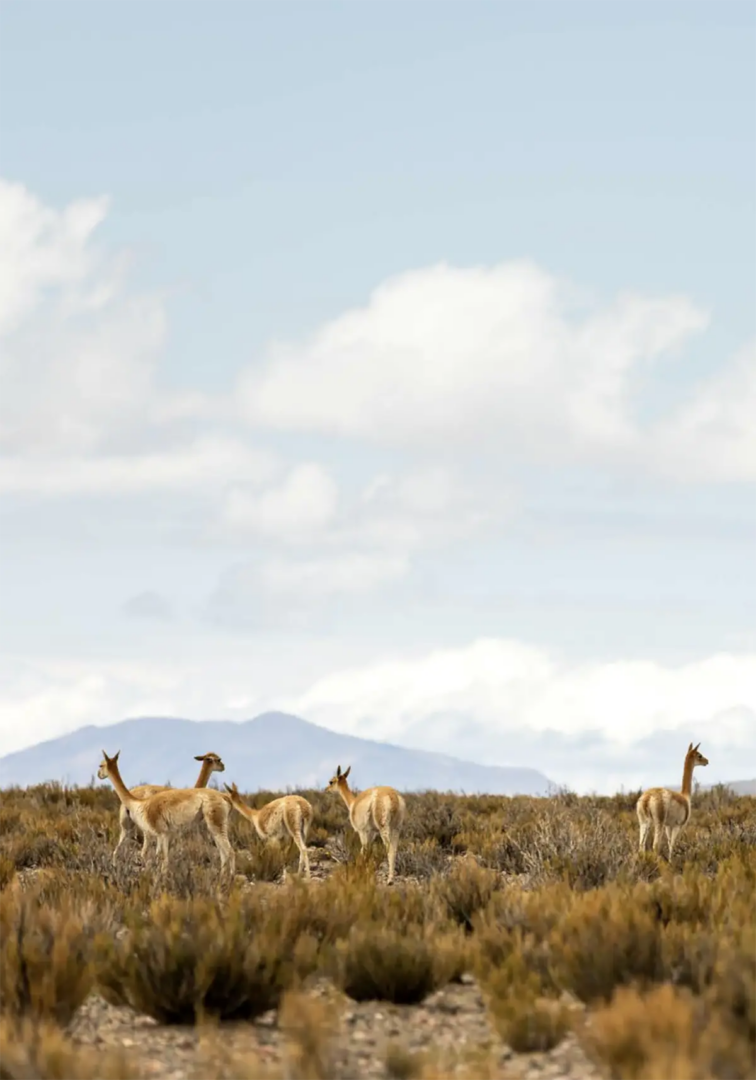
Tomás Saraceno: We are crossing all our fingers that both things will develop in parallel. The exhibition will have two unfoldings. One will begin in July at Haus der Kunst, and then the opening of the Sanctuary of Water, we hope, will be on October 31 or November 1. It would be lovely to pin down the date and mark the calendar. The communities are very interested in forms of tourism that could make a difference compared to global mass tourism, which today is so pernicious, especially for the people who live there. You see manifestations in places like Spain against gentrification, because huge corporations transform territories at the expense of local populations. But this is the diametrical opposite: the people there are managing and promoting an artwork. It is also very different from what the history of land art has often done before. James Turrell, Walter De Maria, Spiral Jetty, you name it. There may be something that comes from that tradition, but now maybe it contributes another stone, or grain of sand, or salt in this case, to think that the benefit and origin of the work belong to the community that lives there, and to the ecosystem that lives there too, with plants, vicuñas, whatever.
LA: So you feel that Santuario del Agua is in dialogue with the history of land art, maybe as a kind of contemporary, more ethical evolution.
Tomás Saraceno: Yes, why not? Absolutely. It has always been a great inspiration. Maybe this project comes a little closer to architecture, because of the scale, and because I studied architecture, I also feel comfortable dealing with that. But it shifts the context and gives it another meaning.
LA: From a structural point of view, how are the domes made?
Tomás Saraceno: They are made as massive salt mountains, rigid and basic. Look. [Tomás lifts a large, stratified block of salt from his desk and holds it up to the camera.] It is not like an igloo or a shell that is empty inside. Everything is made of salt. In the future there will also be some steps built from bricks of salt cut directly from the crust. And maybe later, with more time and budget, one of these domes could also be hollow inside, so that it can provide shade. But it is a process, step by step.
LA: In the project you also mention the idea of replication, that this design could become a kind of blueprint for future interventions.
Tomás Saraceno: This also comes out of collaboration. We are all trying to think through this together. Besides the fact that I believe every artwork is very specific to its context and region, there may nevertheless be something, if we manage to succeed, that can diversify for whom we work, and maybe give museums a little courage to do something beyond their own walls. Museums often expose other realities, but maybe they can engage with them more directly. Exhibitions have a set timeframe, but this is a legacy that remains permanently in the land, in the place. It is another way of thinking. Institutions have their own rhythm of consumption and promotion, also in terms of tourism, but maybe they can engage in other dialogues, other constructions in space and time, and allow their own practices to shift a little. It is a learning process for all of us. We are all trying to imagine how we continue afterward. I have received great feedback from many artist friends who come to Munich or come to Argentina and are very curious. That makes me happy, because artists are often very honest, and it gives me more hope.
LA: How does this very practical economic intervention speak with the more utopian dimension of Aerocene?
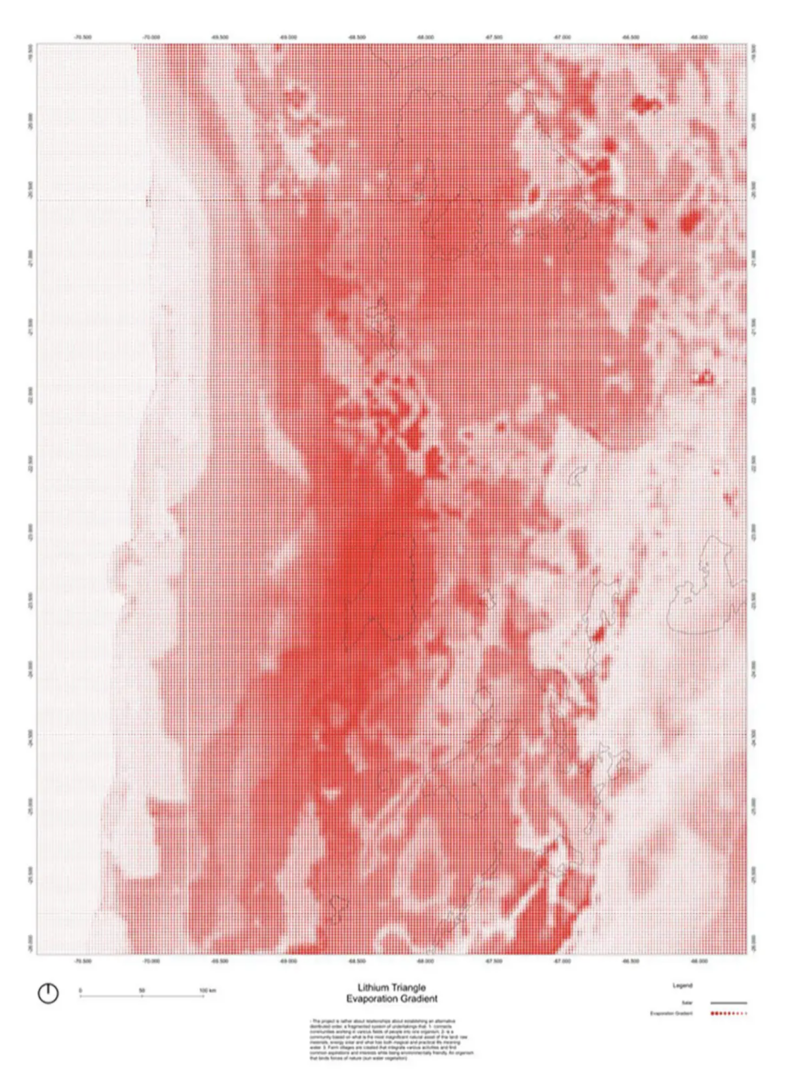
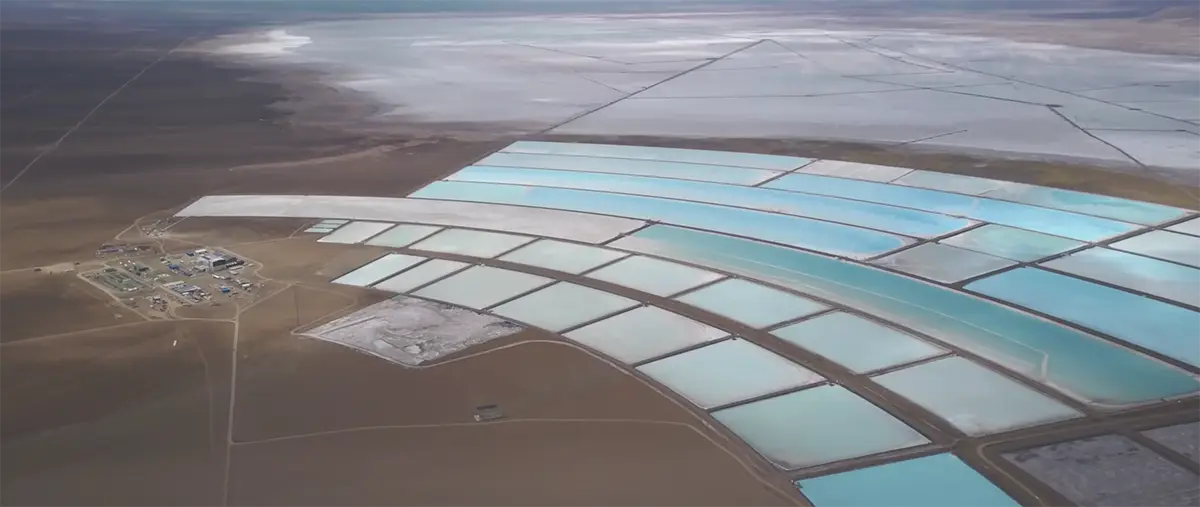
Tomás Saraceno: If you think about where we are building the sculpture, and how contested that territory is today, if I tell you that it is like going into land rich in oil or gas, or in this case lithium, and every one of those lands is worth a hell of a lot of money because there is a hell of a lot of money under the ground, and then you arrive there and say: “Well, I’m going to build a sculpture here, and I’m not going to let you pump out the oil or take out the lithium here.” That is a challenge. We do not know what will happen. It could be that big bulldozers come and destroy everything before it even opens. But we have faith. The communities have been resisting very, very strongly in defense of their territory. Some of the salt lakes around the region are already affected. We have interviewed many people together with the communities about the damage that these extraction methods are producing, how they dry out the land, reduce water, dry the rivers, and contaminate the lives of people living nearby. Around salt and lithium extraction, you can no longer drink the water, and so on. So yes, building the sanctuary is utopian. Maybe we don’t speak too publicly about everything because we want to make it happen before it is threatened. But it is their land. The government and the state may recognize their rights to a point, but when it comes to what is under the ground, it does not belong to them. But where is the water? In all these states, in the latency between solid and liquid. For them, water connects the three worlds: Kay Pacha, Hanaq Pacha, and Uku Pacha, the world of the stars, the world of the here and now, and the underworld. Water teaches and connects all these worlds. It is where spirits, ghosts, and lives move. What they are saying is: you are not only taking lithium from underground, you are taking the water. To extract one ton of lithium, you need two millions of liters of water. Water does not know the geopolitical divisions we impose. To interrupt that flow is something that the geopolitics of today are not prepared to understand. Some understand it, but other interests prevail, and they neglect the real needs of life on this planet. For many, this will be the end. A few may be able to go to another planet, but for the great majority, the people who actually know how to live on this planet, we need to resist and produce a shift that is beneficial for the majority.
Aerocene, other forms of knowledge, and the politics of beauty
LA: On the Aerocene website, it is noted that during your residency at MIT you «discussed everything from nanoengineered materials to solar energy, weather patterns, and even the origins of the universe» with architects, engineers, and scientists. What was it like to work with these figures? Were they immediately receptive to your perspective, or did it take time?
Tomás Saraceno: With some of them it went very quickly. You meet many people, and with some of them, boom, it’s like: okay, we do this and this, and they are very practical and things move forward. With others, there was a frequency of resonance, but we did not fully match. Maybe in the future, who knows. With EAPS, Earth, Atmospheric and Planetary Sciences, Lodovica Illari was great. With Markus Buehler at MIT, it was also great, and we did a lot of work with spiders and spiderwebs. Sometimes things can go quite fast because the interests align. But as a university, everything also needs some kind of process. Sometimes we have an idea and then say: okay, we will connect it to the academic year, maybe a PhD or a student can apply to work on it. So yes, you also have to learn how to work within those structures. But we did it, and it was great. And with Markus one of the later interactions, a couple of years ago, was me saying: “Markus, why don’t you ask a question to the spider diviner in Cameroon?” So that the MIT scientist could also be advised by another form of knowing, right? And the spider replied to Markus: “You are not formulating the question correctly. Ask it again.”
LA: Was it the same with the Red Atacama communities? Did things click immediately when you started collaborating?
Tomás Saraceno: Yes, some things are immediate. It’s like: yes, we want it. Yes, we like it. Yes, we believe in it. There was never any doubt about committing to something beneficial for the way they have been protecting their territory. For me it was also inspirational to see how they mark territory and pay respect to Mother Earth through the construction of apachetas. Apachetas are like little mountains made of stones. You say thank you to Mother Earth through them. There are different apachetas for different rituals, different times of year, different moments. They are a way to mark presence, a path, a road, even a spiritual path. So when we started discussing this, I felt the salt construction could work in a similar way. Because with apachetas, if one stone falls, the next person who comes, who wants to say thank you to the Earth, puts the stone back in place. There is this communitarian construction. It is like Museo Aero Solar, where each individual plastic bag contributes to the whole. There is a rituality in the making that I thought was very interesting. In this case, also, the shape can only be completed thanks to water, which allows it to reflect its other half. Now that it comes to the actual moment of construction, it is also a learning process for me. At first I wanted one company to build everything, because contractually it makes life easier. One big company gives you guarantees and a timeframe, and when you have museums and donors involved, and you yourself are constantly moving between places, that can feel reassuring. But then we were not able to find all the money that company was asking for. And the community really loves the way we are doing it now, bit by bit, with their participation. What is incredible for me is how organized they are. For example, if we need a prototype, we say, okay, who builds the prototype? We need one mason from each community. They all come through a whole system they already have for organizing themselves, dividing labor, working through their assemblies, which they hold monthly and write down in books. It is very egalitarian and very responsible. Even now, when we get different quotes for different tasks, they say: no, no, for the salt construction we will not just hire one company. We will hire one machine from each different company. At first for me it was crazy. But at the end they really take care of everything. They always say to me: “Listen to us. If one becomes richer than the others, nobody benefits. That is when trouble starts, because jealousy starts. Why you? Why you? Why you? All should benefit equally and all resources should be redistributed fairly”. And they are very consequential. It is not just a nice philosophy in theory. When the moment comes, they follow through. For me too, it is a test, let’s see how it goes, but so far it has always worked. You have to be ready to do it in their time, because it takes longer. But the construction itself is beautiful not only formally, but also in how it has been built. It has strengthened and solidified their own way of building things. That makes a difference.
LA: On the occasion of Oceans of Air at Mona in Tasmania, the founder David Walsh described you as «the artist most likely to change the world». How do you take that?
Tomás Saraceno: I don’t want to change the world. What I can maybe do is help change part of the people who live in a certain world. But first of all, what I try to recognize is that the people who live there, in those places, why should we want to change them? We don’t want to change them. We want to learn from them. There is this attitude that makes it seem as if we are all equally guilty, equally responsible, equally implicated. Actually, it is a minority that has fucked up the world. Climate change is a global phenomenon, yes, but some people have fucked up the world and others are suffering the consequences of that way of living. So I’m happy that David puts so much faith in me, but we still have to ask: who changes, where, when, and toward what?
LA: David Walsh also said that despite your effort to actively intervene in the world, you make beautiful things. So what role does beauty have in your work?
Tomás Saraceno: It goes back to what we were discussing before. We can speak about the beauty behind the scenes, how we are building something, what economic model is behind it. Beauty does not only need to please the eyes or the ears. It is a complex construction, multifaceted. Sometimes we buy something very beautiful, but then we know what is behind it. There is a growing consciousness in some people and communities, and we are also maintaining certain kinds of beauty. Sometimes, when I spend time in the Salinas Grandes, I find beauty in austerity. It is so hard to live there. It is 3,000 – 4,000 meters high, it is hard to breathe, rain is scarce, everything requires effort, and yet you find another beauty in the way things are done. The canons of beauty are always being rediscovered, day by day, year by year. They do not need to be standardized.
Luca Avigo