Fashion is just about a sense of Community: why Stone Island proves it better than the others
Community is a testing ground: how Stone Island’s garments have been managing to evolve through real-world use across subcultures and shared environments
Stone Island: Community as process over structure
Community is an over circulated word. It now appears early, often too early, in a brand’s language. Community becomes the slogan way before anything has had time to accumulate. The word itself implies closeness and participation; it creates a shared code that brings people together. This was community in its original sense, before it turned into a strategy. Today, it’s a structure imposed in advance. It’s organized, anticipated, managed. There is no time for community to form now; it’s something that is immediately declared. So are the concepts that derive directly from it. Belonging is framed before it exists; identity is confirmed before it’s even tested. What we have now is an inverted process where the narrative precedes the reality.
Most brands declare community now, but Stone Island sits outside of it. Community drove the brand through decades, but it did so through an unspoken, organic process that emerged as a result rather than intention. It was a result of the consistent research that didn’t end at production, but extended to circulation, which the brand didn’t have full control of. It’s at this stage that a less stable and less visible process began. Something else took shape, and it was neither a following nor a community in their current state. The Stone Island process formed a network of use that included specific environments and groups of people. Wearing a Stone Island gradually created a narrative that they wanted to belong to. This was community in its original sense.
Stone Island’s material innovation: A continuous process of research
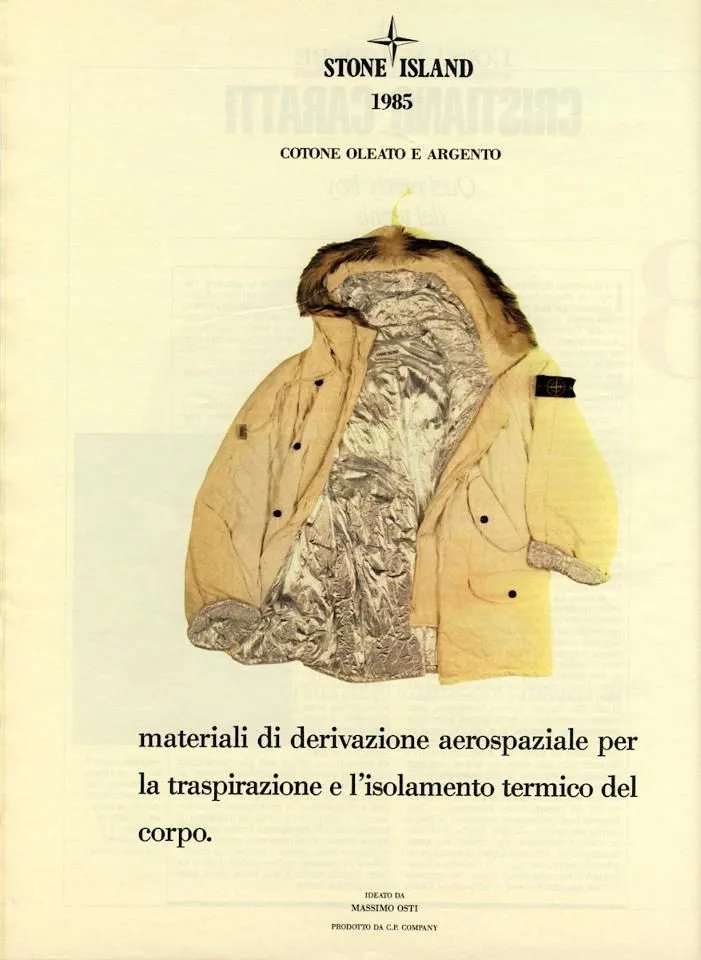
Stone Island is not technical wear or streetwear, but it sits between the two, defined less by category and more by process. Continuous research and material innovation have structured the brand since 1982, when Massimo Osti founded the brand.
Experimentation became Osti’s area of expertise before Stone Island existed. He entered the industry by presenting his innovative take on the simplest fashion item, the T-shirt, using serigraphy and four-color printing methods, tried only on paper before. Through his C.P. Company, Osti kept experimenting with materials and creating cutting-edge pieces up until the introduction of a completely new material.
In 1982, Massimo Osti introduced Tela Stella, dense, double-faced cotton inspired by military truck tarpaulins. The material ended up being too technical for C.P. Company. This led Osti to create a new brand around Tela Stella; Stone Island emerged as a response to material constraint. It began from a fabric rather than a concept. The name referenced novelist Joseph Conrad, whose works inspired Osti’s passion for boats and the sea. With seven pieces in the first collection, the brand was received well, quickly redefining male fashion through performance over formality.
After Osti’s departure, Paul Harvey continued material experimentation, extending into areas considered technically unfeasible. Under Harvey, the brand dyed Kevlar, a fiber developed for military use and previously regarded as non-reactive to color. Garments like the Pure Metal Shell, constructed from nylon coated in stainless steel mesh, further pushed the relationship between fabric and function. Continuous research and testing in the laboratory led the brand to develop such fabrics as Nylon Metal and Tank Shield.
From labs to the streets: The initial circulation of Stone Island garments
Through the years, something larger than a single audience emerged around Stone Island. It was a variety of different overlapping environments where the same garment gained different meanings. In Italy, the brand started to circulate among young, middle-class individuals who associated with the balance of Stone Island between visibility and restraint. The garments messaged status without display, with a cultural inclination toward subtle distinction, something the aspirational youth associated with.
In the UK, the environment around the brand was different; it was embedded within football culture. In this context, identity was collective and territorial. Football fans wore Stone Island as a form of discretion and anonymity, often concealing club colors to avoid confrontation in public. These different environments used the brand to create a shared code and a sense of belonging.
From football terraces, the brand extended into adjacent subcultures. It was adopted within the British indie and rock scenes, worn by groups such as The Farm and Happy Mondays. Later, it was associated with figures like Liam Gallagher, becoming part of a recognizable, almost uniform aesthetic. The garment shifted across contexts without losing coherence. It maintained its identity while adapting to different cultural frameworks.
Moving from subcultures to the global scene: Stone Island in contemporary pop culture
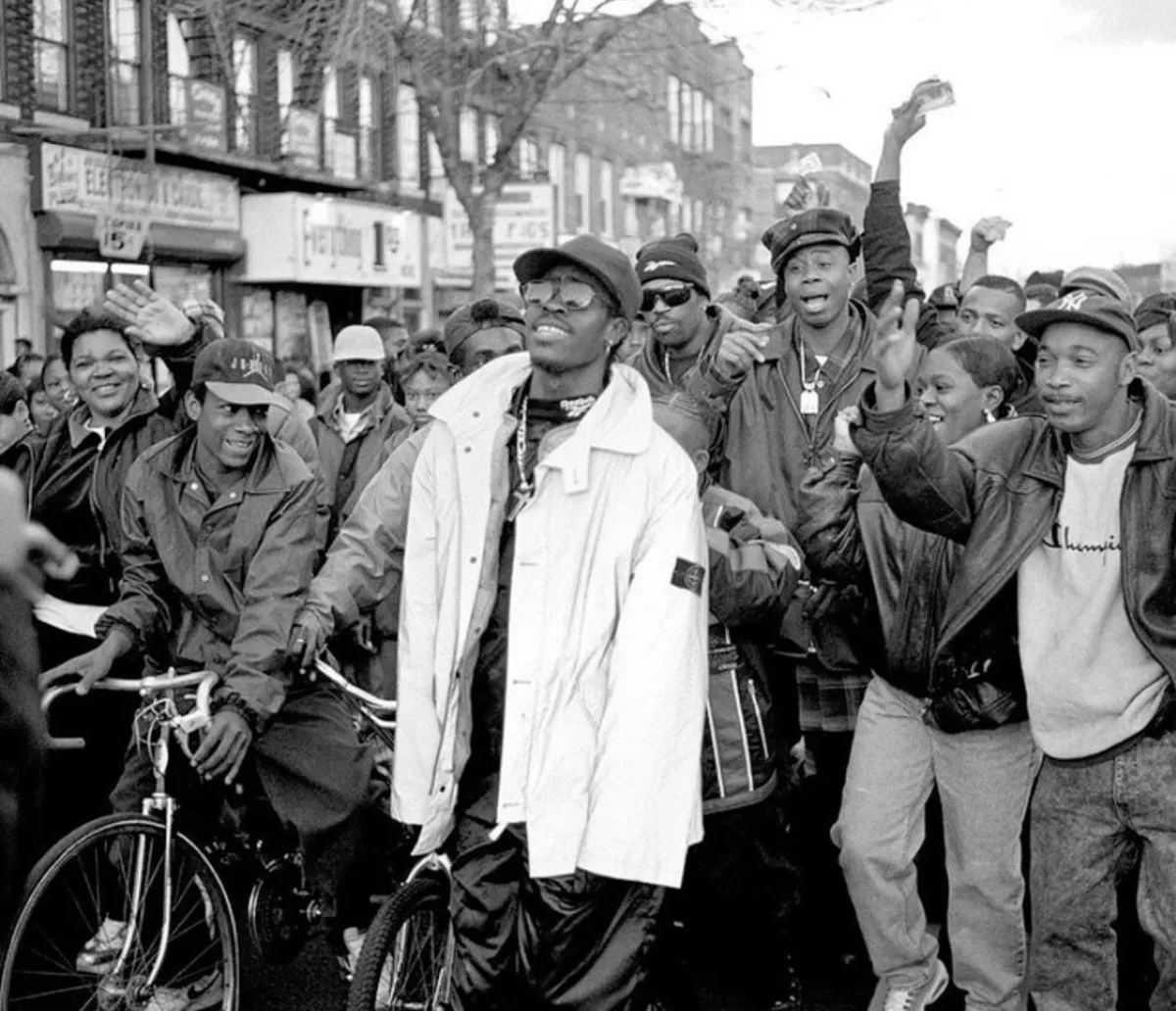
By the early 2000s, Stone Island had entered another layer of circulation through grime — a genre rooted in urban Britain that merged rap, electronic music, and bass-driven production. Artists like Dizzee Rascal helped define an aesthetic that combined functional clothing with a direct, unfiltered expression of environment and identity. Hoodies, tracksuits, technical outerwear became part of a shared visual language: clothing was less about styling and more about belonging.
Circulation continued into global visibility through figures like Skepta and Stormzy. They maintained the connection between the brand and its original contexts while introducing it to wider audiences. At the same time, international artists such as Drake brought Stone Island into the scenes of global pop culture, where its presence shifted again. Stone Island went from a subcultural marker to a widely recognized symbol. Adoption by artists like Kendrick Lamar and Jay-Z further extended its reach, embedding it within multiple layers of contemporary music culture.
The brand started to exist across different geographies and identities simultaneously. What connects these instances is the shared mechanism of recognition. The Stone Island piece creates a connection between individuals who don’t necessarily belong to the same scene but understand the same visual and cultural cues. This is community in its traditional form — a series of networks that emerge where the product is adopted and interpreted. It acted as a process of continuous exchange rather than a fixed group.
Stone Island: Community as a Form of Research
Stone Island’s research and testing start in the labs, but they finish in the streets, where Stone Island circulates. The laboratory defines the initial parameters, but the behavior of the garment is visible outside, where it’s no longer contained within controlled conditions. Climate, repetition, movement, social context — all these external factors are part of the research. Garments are tested in real time through continuous use across different contexts. Each environment has its own constraints and interpretations, producing variations impossible to be anticipated in advance. Between design and use is where the garment takes its real shape.
The brand has been explicit about this with its recent direction, introducing the Spring Summer 2026 collection, titled Community as a Form of Research. This further formalized the process that had always been present implicitly. From musicians to professional athletes, from Joe James and Mike Skinner to Paolo Maldini and Chito Vera, the brand highlighted the diversity of its community. These repeated interactions contributed to a shared understanding of the product, communicating its relevance through practice rather than presentation.
Archiving a process in motion: Stone Island Storia
In 2020, Stone Island: Storia was published by Rizzoli International Publications. A chronological account of the Italian brand, the book uncovers its materials, experiments, and evolution — a traditional archive of garments, technical innovations, and treatments. But rather than being a static record, it shows the progression of the brand, with no final solutions but stages of ongoing processes.
The book shows innovation in a different light, as part of a sequence rather than a single achievement. Whether it’s Tela Stella or Nylon Metal, each creation presents itself as a result of continuous adjustment. It isolates the controlled phase of the brand and translates it into a readable form. The book records the laboratory and the process of development, but not its continuation. The community where the garment takes its final form is implied, but it remains beyond the page.
The result is an archive that records the internal evolution of the garment, but leaves open its external journey. The street, the subcultures, the different social environments are not fully documented. This is not strategic, simply because the external process is not fixed or centralized; it can’t be easily archived.
Between organic formation and design: Community in its contemporary sense
Community still exists, even more actively than before, but it does so within a different framework. It’s actively pursued and structured in advance. The past decade has shifted community from outcome to a method, closely integrating it into branding strategies and marketing plans. Searching “how to build a community” brings up outline stages and performance measurements. The language includes engagement, retention, conversion, sales. It’s now quantified through metrics that predict sales and visibility.
The dynamic is different from what it used to be. Quantifying community changes its nature. What was once organically emergent is now predefined. Influencers are now community leaders, something that was not inherent to community in its organic form.
For a brand like Stone Island, community formed gradually, through circulation, through repeated use across uncoordinated environments. There was no central figure organizing it or a designated framework to sustain it. The difference is in how it’s positioned. What was once discovered in practice is now established in advance and then activated.
Is research through community still viable today?
Research through community — what Stone Island incorporated into its process — becomes harder to isolate once the community itself is predefined. When participation is structured in advance, when environments are curated and interactions anticipated, the conditions of use are no longer entirely spontaneous.
Testing through community risks losing friction. The garment is still worn, but within a system that is already aligned with the brand’s expectations. Feedback is visible, immediate, often amplified, yet it is filtered through systems designed to produce engagement rather than unpredictability.
If community becomes organized, the shift in its function is unavoidable. It no longer operates as an open field of observation, but as a controlled environment. The question is not whether research can still take place, but whether the outcomes remain as unmediated.