Amalia Ulman: humor as revenge, cinema as class warfare
From Web 1.0 irony to noir-inflected filmmaking, Amalia Ulman rejects poverty porn, questions AI hysteria, and defends humor as a survival tool
Her website has not been updated in some time. The last post, tagged with a blinking “New!” animation, dates back to January 2023. The Web 1.0 layout reinforces a sense of suspension. As you scroll, the site moves from a standard CV section for the Spanish Argentine filmmaker to an eccentric “Click here to see my Aura Report,” followed by a detailed psychological profile derived from her handwriting. It feels neglected. It also feels precise. The page mirrors its author: self-aware, ironic, slightly confrontational.
“Yes, I haven’t updated it in a while,” Ulman says on the phone from New York. “Then again, I’m not sure it makes much sense to talk about my films on that site, right?” She has just returned to the United States, where she has lived for years, after spending time in Europe for work. “I’m in pre-production on my next film, and we’ll start shooting soon.” The project will be her third feature, following El Planeta and Magic Farm. It is based on a short story she wrote, titled The German Teacher.
“In Spain there’s something called ‘El Cobrador del Frac,’ a well-dressed debt collector,” says the filmmaker, who grew up in Gijón. “It’s a private company you can hire if someone owes you money. They follow that person around and publicly shame them. The film centers on the first girl who takes that job. The first man she has to follow is her former high school German teacher; someone she had an affair with. It doesn’t end well. It turns into a heist story. At its core, it’s about trauma and memory, and how she has to hit bottom before she can move forward and start over.”
From Instagram fiction to feature films: the evolution of Amalia Ulman
Whether the story carries autobiographical traces is unclear. What is evident is the strain of grotesque humor that has become Ulman’s signature. Irreverent from the start, she became an internet phenomenon with Excellences & Perfections in 2014. It was not a film. It was a performance staged on her Instagram account. Over four months, divided into three acts, she introduced her followers to fictional personas. The work, now widely regarded as ahead of its time, set out to demonstrate how easily identities could be fabricated online. Today, with AI systems and automated bots shaping digital presence at scale, that premise feels routine.
“People are more aware now of fiction on social media,” she reflects. “Back then, there was a kind of built-in naivety in how people perceived fiction online. Part of that had to do with the range of content available. Now everything is curated in a way that didn’t exist before. The piece would not function the same way today. In 2014 there was a linear progression that allowed me to tell a story. Now the algorithm sends everything into strange loops, and it’s hard to know what people are receiving on the other end.”
Like many others, Ulman has grown tired of life online. Most of her professional focus is now directed toward filmmaking. She describes the process as stressful, labor-intensive, demanding. It is also the only thing she wants to do. “It was my main goal from the beginning, even if I didn’t realize it,” she says, with characteristic directness. “I never had directors from my social class or my gender as references. I never thought it was something possible for someone like me. That’s why I started in fine arts.”
Outsider in cinema: class, migration, and the DIY method
Born a woman and into economic precarity, she explains, the film industry felt like a distant mirage. “My mother loves cinema and I grew up going to film festivals,” she says. “You have to understand that making a feature requires not only a lot of money but also access. Especially in Spain, and I suspect in Italy as well, it can feel like a closed system run by a few people.”
Add another layer: she is also an Argentine immigrant. “Thinking about making films felt unthinkable.” Fine arts became a practical entry point. It was something she could pursue independently, using her own resources. Even the color palettes of Magic Farm reveal the imprint of her visual arts training. The chromatic control, the staging: the composition operates with the discipline of an artist trained in image-making before narrative convention. Her characters carry a presence that exceeds classical beauty and imposed aesthetics. They move outside gender norms and ableist standards without turning that position into a slogan.
That critical formation as a conceptual artist has also insulated her from dominant cinematic tropes. “Coming from fine arts, I know how to do things on my own. I produced my first film entirely by myself. That’s rare in cinema, partly because people around you keep telling you it’s impossible. What makes me happiest is coming from a field where everything is possible. You can do whatever you want.” Having fewer resources in the art world expanded her imaginative freedom. The DIY ethos became structural rather than stylistic.
Humor as craft: between Argentina, Spain, and the Anglo-American tradition
Moving from Latin America to Spain exposed her, firsthand, to cultural differences—especially around humor. “In the U.S. and in the U.K., there’s still a strong appreciation for humor, and it’s taken seriously,” she says. “In the United States, you have people doing new and ambitious work in comedy and film, like Connor O’Malley or Tim Robinson. What they do is sophisticated, and it’s recognized as such because comedy is extremely hard. There’s also a major tradition that comes out of Jewish humor—someone like Larry David. It’s that lineage combined with a broader Anglo-Saxon respect for humor.”
Her assessment of Southern Europe is more critical. “In Spain and in Italy, humor is often trivialized. It’s not treated with respect. That’s unfortunate, because comedy is the hardest thing you can attempt.” She traces part of her sensibility back to Argentina. “A lot of it has to do with my Argentine background. Argentines can be very funny in a more sophisticated way.”
Noir comedy and class critique in Amalia Ulman’s new film
Her next project moves closer to the tonal register of El Planeta: a noir-inflected comedy embedded in drama. “Serious themes with touches of comedy, always grounded in realism. That’s what interests me,” she says, laughing. “Making a straight drama would be too easy.”
Choosing the difficult route has been consistent across her career. “It doesn’t make sense for me to make a drama without trying to introduce humor. Many of the darker themes in my films come from things I’ve lived through. I had to develop a sense of humor to survive. In European cinema, there’s a lot of poverty porn made by people from privileged backgrounds. It has to be dark and heavy with guilt, so the viewer can feel absolved just for watching it.”
Working-class audiences rarely see themselves in that framework. “They’re plumbers. They’re practical. The difference in my tone is that I’ve experienced many of those situations myself. When you face them firsthand, you develop a sense of humor.”
In Magic Farm, she stages that tension directly. A group of upper-class Americans travel to South America to shoot a documentary. The setup suggests authority and distance. The twist is grotesque: they realize they are in the wrong country.
That narrative reversal carries an undercurrent of retaliation, even if she resists framing it in simplistic terms. “It’s not black and white. Some of them are meant to be upper-class Americans. I’m interested in those kinds of misunderstandings and circumstances. I always choose the harder path. It’s a flaw of mine. So far, I haven’t given up.” Her determination surfaces even in casual conversation, including when the topic shifts to her hobbies.
Water sommelier, AI, and the politics of privilege
Before this interview, a friend of mine—an admirer—mentioned that Ulman is a certified water sommelier. “That’s true,” she says, laughing. “I have a diploma.” She explains that New York’s water is strong at the source; the issue lies in the underground pipes. Her preferred bottled option is Evian. In Venice, she tasted Kaiser Wasser, which she describes as unforgettable. What she looks for is precision: lightness, clarity, a clean mineral profile.
The certification was not a stunt. “I’ve hated how, in the art world, people pick up a casual hobby and turn it into a performance without any real training. I didn’t want to pretend to be a water sommelier, the way many artists have pretended to be nutritionists, personal trainers, or even wine sommeliers. I wanted to learn what it is. So yes, I studied it and I earned a diploma.” She even wrote about a water sommelier convention for The Paris Review. The piece circulates online.
The conversation then shifts from water to the internet. The connection is structural. Data centers—especially those powering AI systems—require vast cooling infrastructures. Tens of millions of cubic meters of water are consumed to sustain server farms that support daily digital habits, including trivial requests typed into language models.
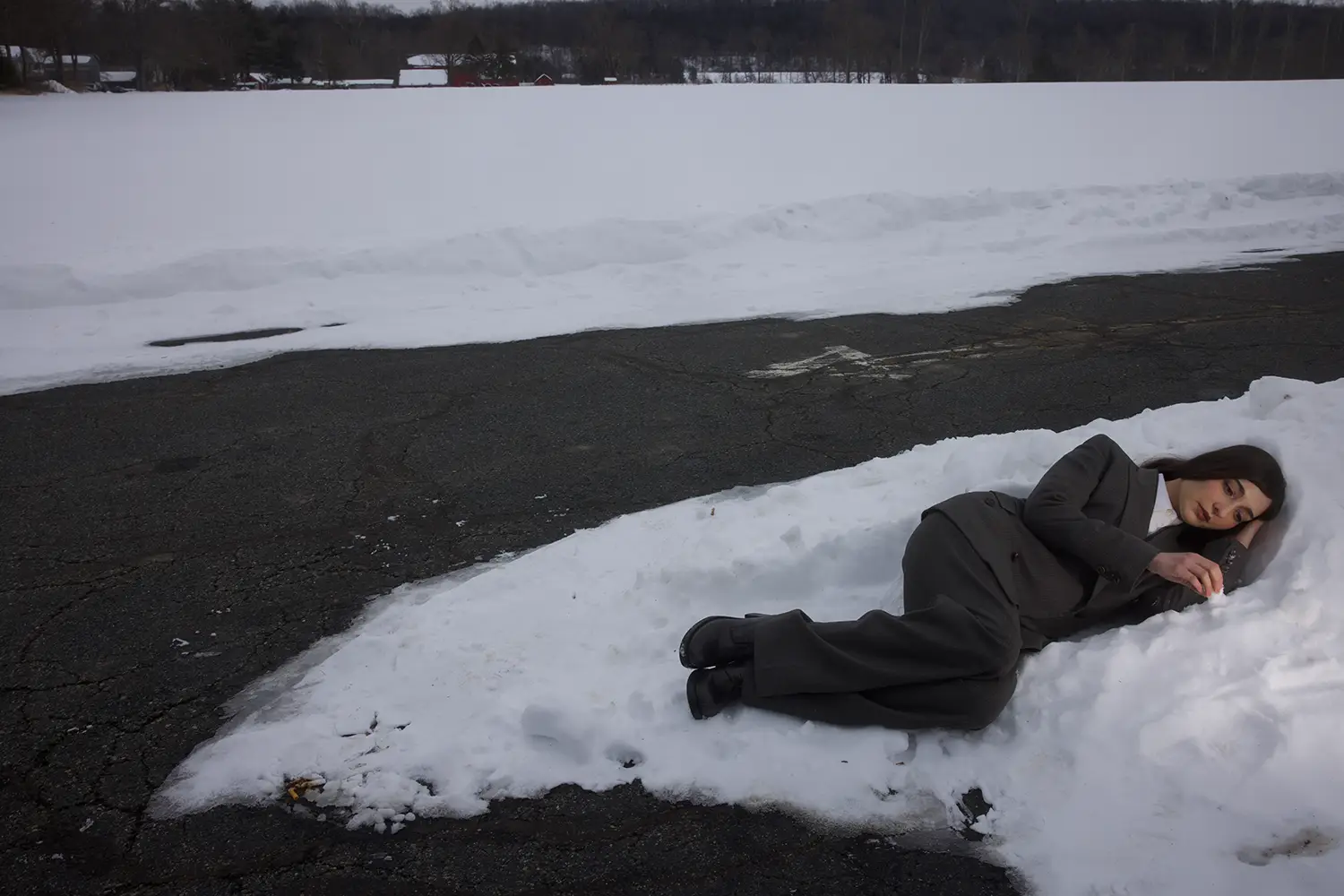
Amalia Ulman’s position on artificial intelligence is less categorical than expected
“I’m not enthusiastic about it,” she says. “It’s not my crusade to be against it either. These things happen. Photography is also polluting. Shooting on film is environmentally damaging, and nobody talks about that anymore. The most sustainable option would be to shoot digitally and abandon film, yet people are precious about celluloid. With AI, yes, it’s terrible. It’s also not going anywhere.”
Her skepticism is technical rather than moral. “Large language models will hit a wall. That’s not how human intelligence develops. Too much money has been invested in language-based research alone, and intelligence doesn’t function that way.”
At the same time, she acknowledges a social dimension often overlooked. “The people who’ve used AI most positively tend to be from lower social classes. It helps close gaps in legal language, for instance, for immigrants with limited English. You can correct your writing and appear more professional in bureaucratic contexts. It would be wrong for me to say AI is bad just because I have the privilege of relying on traditional methods.”
Internet, AI, and immigration: access, survival, and power
For those without access to legal counsel or bureaucratic support, artificial intelligence is filling gaps that, until recently, were structural and vast.
“It reminds me of when people opposed the internet in the mid-1990s and said online friends weren’t real friends because they didn’t exist in real life. That wasn’t true,” she says. “I’ve met many people online. For me, the internet helped bridge the gap between living in the middle of nowhere and becoming an artist. Without it, I would have stayed in my hometown. I’m not the only one.”
As an immigrant, she frames technology as infrastructure rather than convenience. “I’ve lived without it. It was painful. You can’t communicate with your family – you don’t see them. You rely on letters, and phone calls were incredibly expensive. I experienced that. It was hard. Once we had video calls, that suffering eased. You see your family. You hear them.”
In that context, debates about attention spans or AI ethics can appear secondary—issues one has the luxury to prioritize when survival is not at stake. Access to fast connectivity and automated tools becomes another axis of privilege.
The political climate in the United States sharpens the stakes. She refers to immigration enforcement practices that operate with broad discretionary power across the country. “The situation in the U.S. is heartbreaking, especially as a Latina. There’s a sense of ingratitude toward the people who do the hardest jobs in America. We’re treated as if we’re a threatening minority, and we’re not. Many states are Spanish-speaking. It’s a terrible feeling to be framed that way. Despots don’t seem to realize that they are the minority.”
Claudio Biazzetti
Team
photography Chessa Subbiondo
styling assistant Silvia Lee
fashion full look Prada
makeup Yunqi Ying
hair Takayuki Umeda
photography assistant Payton Kuhn