CAN Art Fair Madrid at ten: from urban art to a broader contemporary field
At Matadero, over 50 galleries and new sections such as CAN Design marked a shift from street-rooted practices toward a cross-disciplinary programme spanning art, design, and architecture
CAN Art Fair
In 2016, Sergio Sancho was working in advertising and spending his spare time in galleries. Not Spanish galleries, mostly. He was tracking what was moving through New York, Seoul, Paris, and Tokyo: a generation of artists whose work had roots in graffiti and street practice but had moved into institutional contexts, attracting collectors and curators without losing the visual directness of its origins. No fair in Spain was paying attention. Sancho decided to build one.
He called it Urvanity. The name announced the premise plainly. The first edition launched with seventeen galleries at the Palacio de Neptuno in central Madrid, during the city’s Art Week. It was small, specific, and unusual by the standards of what Spain’s art fair landscape offered at the time. It found its audience fast.
Two more editions followed at a second venue, the headquarters of the Official College of Architects of Madrid, before the fair relocated to Matadero Madrid, the former municipal slaughterhouse in the Legazpi district, where it has remained. The name changed twice along the way: from Urvanity to UVNT, and then, at the tenth edition, to CAN, standing for Contemporary Art Now. In 2022, Sancho launched a sister fair in Ibiza, invitation-only and curated by Saša Bogojev, which drew galleries from all six continents and established itself as a summer fixture on the international circuit. The 2026 rebrand aligned both events under a single identity.
«In almost a decade of history, the fair has evolved naturally and has moved away from those urban languages that defined us at the beginning. CAN, Contemporary Art Now, more faithfully represents the fair we are today».
Matadero and the Green Ring: A Fair in the Middle of a City Replanting Itself
The complex that hosts the fair was designed in the early twentieth century by Luis Bellido, the municipal architect of Madrid, and operated as a slaughterhouse and livestock market until its closure in the 1990s. The buildings are brick-and-iron industrial pavilions organized around a central axis: wide spans, high ceilings, loading docks, drainage channels set into stone floors. The scale was not designed for art; it was designed for cattle.
The city began converting Matadero into a center for contemporary creation in 2007. The conversion is ongoing and partial: some pavilions host residencies, film production, and theatre; others are used as event spaces. The central nave, the one CAN Art Fair Madrid occupies, offers close to 4,000 square meters of floor space with ceiling heights of up to ten meters. It can hold large-scale installations and sponsored structures that conventional halls cannot.
Legazpi carries residual traces of the industrial history that Matadero concentrates. The Mahou brewery operated in the district before relocating. The street grid and the scale of the blocks still reflect a neighborhood built around logistics and production. In recent decades, residential development, the Arganzuela park, and the cultural uses of Matadero have shifted Legazpi’s character. It is now a district at the southern edge of the city’s cultural geography, dense with new residents and with public spaces that were once inaccessible.
The Arganzuela district is also the starting point for the Bosque Metropolitano, a 75-kilometer green ring of indigenous trees being planted around Madrid’s perimeter to counter the urban heat island effect. The project places Matadero, and the fair it hosts, inside a wider municipal effort to restore ecological infrastructure at the city’s edge.
When Jadot’s furniture built from reclaimed timber sits on those stone floors, or when Moreno Pinart’s textile structures in natural fibers are suspended in air that Bellido originally designed for cattle, the contrast between the building’s origin and its current content is present in the room. The fair does not stage that contrast. The building produces it.
The New Section That Asked: What Is an Object Worth Collecting?
The most discussed addition to the tenth edition was CAN Design, a new programme bringing together around ten practitioners whose work sits between art, design, architecture, and craft. The section had its first outing at CAN Art Fair Ibiza the previous summer. Its Madrid debut carried the title Mix Max: a reference, in curator Marisa Santamaría’s framing, to the combining impulse that organizes contemporary design practice. The question underneath the title is less decorative: what separates a designed object from an art object, and does that distinction matter to the collector who lives with both?
Art fairs run on the logic of singular authorship. A work is made by a named artist, presented by a gallery, and acquired as an object whose cultural value is determined by that chain of attribution. Collectible design does not fit neatly into that logic. A table built by an architect, a textile assembled by a craftsperson from paper thread and natural fibers, a plaster form produced by a designer who thinks about translucency and mass: these objects move between categories that the fair’s standard infrastructure was not built to handle. CAN Design creates a dedicated space for that movement.
«The line between art and design is sometimes blurred. There are designers who speak in a language close to art, artists who create pieces with a functional purpose, craftsmen whose work ends up in galleries. At CAN we wanted to shine a light on this phenomenon».
Marisa Santamaría: The Curator Who Works at the Edges of Disciplines
Santamaría is a curator and researcher who has spent her career at the intersection of design, social analysis, and trends forecasting. She teaches at Politecnico di Milano, at IE University, and at the School of Architecture of Madrid. For four years she has served as Talents and Trends Forecaster for Maison & Objet Paris. Her practice moves between academic work, institutional consulting, and curatorial projects, a position that places her professionally in the same cross-disciplinary territory CAN Design asks its participants to occupy.
«The aim of the proposal is to explore the widest possible range of existing creative possibilities, encourage innovative diversity and the cross-pollination of singular visions and perspectives. With this section, we want artists, gallerists, designers, architects, artisans to connect with one another and explore new horizons».
Objects That Age: Craft, Reclaimed Materials, and the Lifecycle of a Thing
Among the artisans in Mix Max, Lionel Jadot builds furniture from industrial offcuts, reclaimed wood, and salt-based composites. The wood in his pieces carries evidence of prior use: nails, cuts, surface wear. He does not conceal these marks; they are part of the object’s biography. The salt composites harden further with age and handling: a piece acquired in 2026 will be denser, its surface altered, in 2036. The object is not finished when it leaves the studio. It continues to be made by the conditions it inhabits.
Luz Moreno Pinart works in textile structures assembled from paper thread and natural fibers. Paper thread holds tension but responds to air and moisture; her structures shift with the environment. Gaspard Fleury-Dugy works in ceramics and surface treatment, producing objects between vessel, sculpture, and furniture. Loumi Le Floc’h works in natural fibers that reference both textile tradition and spatial installation.
What these four practices share is a relationship to material that accepts change as part of the object’s existence. They are built to last, but to last in a way that includes the accumulation of time, handling, and context. This is a different proposition from the conventional collectible, whose value depends on the object remaining as close as possible to its original state.

Terry Craven: When Urban Detritus Becomes Geological Time
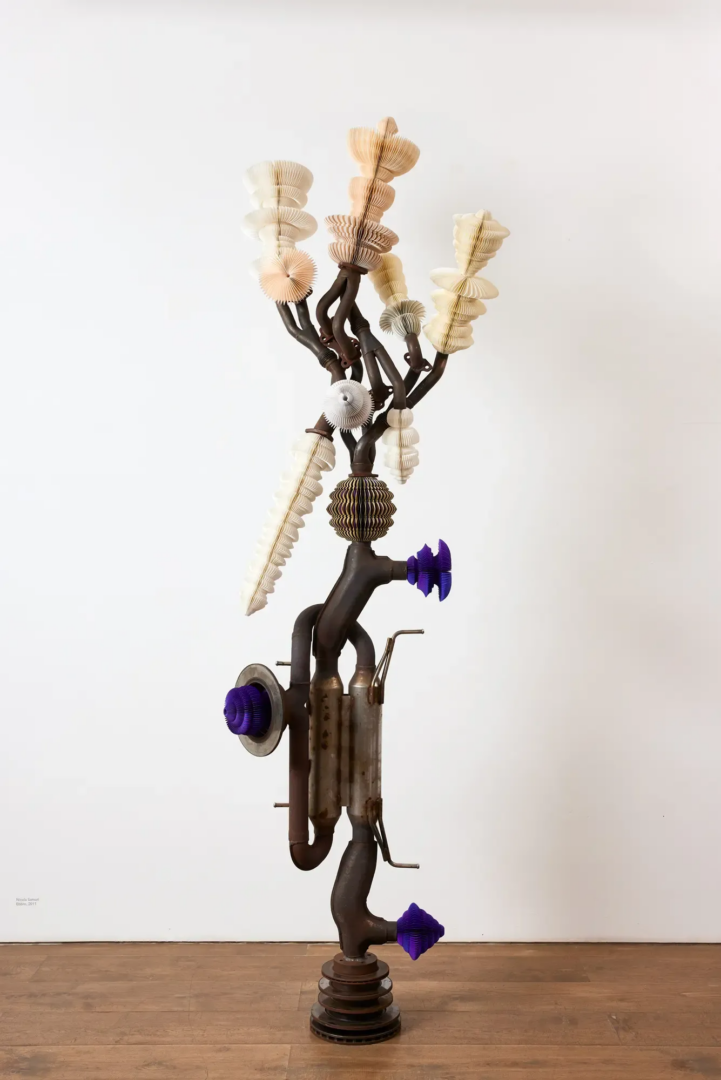
A parallel logic runs through the work of Terry Craven, shown at the fair by gallery Arniches 26. Craven builds from urban detritus — bricks, tiles, and iron elements recovered from semi-rural and peri-urban sites. The material carries visible traces of prior use, which he preserves rather than conceals.
His practice focuses on how these materials accumulate time, slowing down the viewer’s reading of the object. As he describes it, these works engage with «non-human temporalities», pointing to the gap between the speed of the fair and the slower transformations embedded in the materials themselves.
Plaster, Stone, Steel: Where Industrial Process Meets Formal Inquiry
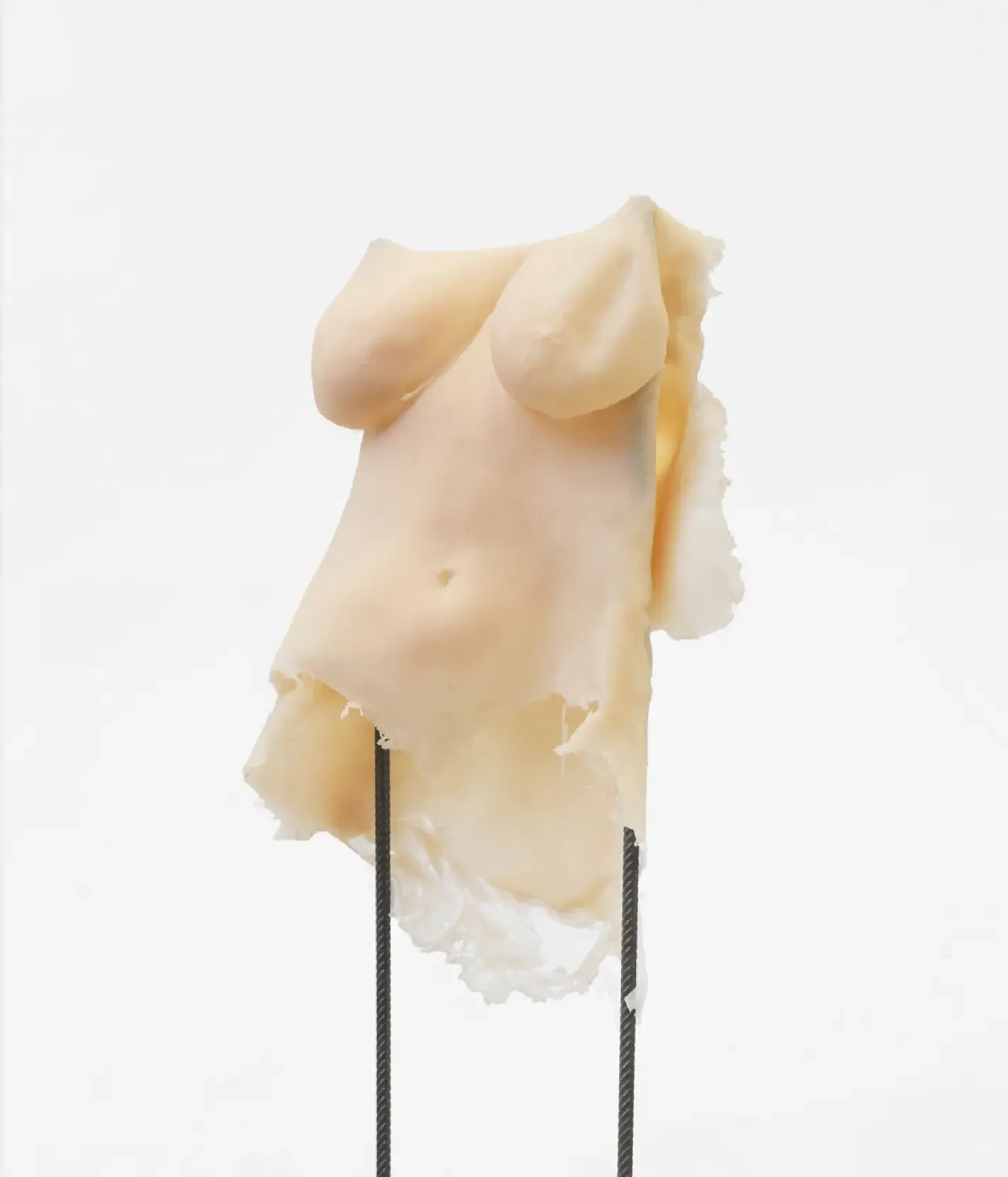
The industrial designers in Mix Max work in materials that require manufacturing processes as much as craft ones. Birgitte Due Madsen, based in Denmark, works in plaster, resin, and CNC-milled stone, testing the point at which translucency becomes opacity, or lightness becomes mass. Her pieces accumulate across a series: each object extends a formal logic established by the previous one, producing work that is as much about sequence as about any individual form.
Raffaella Mangiarotti and Lee Sisan work in combinations of steel and wood, materials that reference furniture-making, sculpture, and industrial production simultaneously. A collector who acquires one of their pieces is not acquiring a chair or a sculpture, but an object that holds both categories without resolving into either. Mix Max is organized precisely around objects like these: things that refuse the categories the market uses to price them.
When Architects Enter the Fair and What They Bring With Them
The architects in Mix Max work in a different register again. Belén Moneo and Andrés Jaque both practice at the intersection of architecture and cultural inquiry. Jaque’s office, the Office for Political Innovation, has been exhibited at MoMA and at architecture biennials across Europe and the Americas. His work moves between the built environment, performance, and political analysis. His presence in a collectible design section says something about where the gallery and the design fair are converging.
The objects Moneo, Jaque, Kresta Design, and Lluis Aleixandre contributed translate what Santamaría calls the grammar of urban infrastructure to domestic scale: structural joints, thresholds, load-bearing logic rendered at the size of a table or a shelf. The city’s organizing principles, reduced to something a person can live alongside.
Alicia Framis, the section’s one participant from fine art rather than design or architecture, has spent three decades producing work across installation, performance, and social practice. Her objects, furniture, clothing, signage, carry a conceptual charge that operates independently of their function. She does not move from fine art toward design; she produces art that has always worked functionally. Her presence frames CAN Design’s proposition from the opposite direction.
New Surrealisms: Foco LATAM and Latin American Art in the Programme
Foco LATAM returned to the fair for its second year, organized by curator Christian Viveros-Fauné around the concept of New Surrealisms. Six galleries participated, from Santiago de Chile, San José, Santo Domingo, Havana, Buenos Aires, and New York. The curatorial logic connects surrealism not to a historical movement but to a recurring condition: the moment when social conventions reveal themselves as constructions.
«We want to talk about the surreal as those moments when the mask of normality falls, revealing a somewhat stranger and less predictable nature».
The strand holds a structural position in the programme. Galleries and artists from Latin American cities, cities that do not regularly appear on the European art fair circuit, carry a recurring, defined presence. Foco LATAM is not a themed showcase. It has its own curatorial identity, its own hotel partner, and its own year-on-year logic. Two editions in, it is a fixture.
Al-Tiba9 and the Galleries That Make Room for Invisible Narratives
Among the galleries new to the 2026 edition, Al-Tiba9, based in Barcelona, operates as an international platform supporting artists working across disciplines and cultural contexts. Its programme brings forward practices that are often underrepresented within the primary market, with a focus on material experimentation and diverse perspectives.
Its presence within both the Young Galleries programme and the wider fair reflects CAN’s effort to integrate emerging and non-European voices into the core structure of the event, rather than isolating them as a separate category.
Young Galleries, Solo/Duo Projects, and the Architecture of Access
For the tenth edition, the Young Galleries programme doubled from five to ten spaces: art spaces with fewer than three years of activity, drawn from Barcelona, New York, Montreal, Seville, Madrid, Cannes, Porto, Havana, and Berlin. Ten spaces constitute a visible autonomous strand, not a gesture.
The Solo/Duo Projects section, new this edition, reserved space for first-time participants presenting a monographic proposal: a single booth dedicated to one or two artists only. Five galleries participated, from Oslo, Madrid, Amsterdam, Hamburg, and Madrid. The constraint is curatorial. It produces a different quality of attention than a mixed booth, and for a gallery making its first appearance, it sets the work apart from the general programme in a way that a standard format cannot.
Counterflow, the third new section curated by Saša Bogojev, who also curates CAN Art Fair Ibiza, brought together five galleries from Tokyo, Paris, Palma de Mallorca, London, and Madrid whose programmes move against the market’s prevailing tendencies. A fair large enough to have a dominant current is also large enough to name and hold space for what resists it.
CAN Art Fair Madrid
(formerly Urvanity, then UVNT) is a contemporary art fair founded by Sergio Sancho in 2016, held annually during Madrid Art Week at Matadero Madrid, Plaza de Legazpi 8. The tenth edition ran from March 5 to 8, 2026, with fifty-three galleries from over twenty countries and more than 12,000 visitors. CAN Art Fair Ibiza, an invitation-only sister event, launched in 2022 and holds its fifth edition in late June 2026.
Melis Özek