Lorenza Longhi at Centro Pecci: Villa Delizia, fabric, display and error
Lorenza Longhi’s first institutional solo show in Italy: ten canvases in Prato district fabric, screenprinting and flocking, the museum’s sofas dressed and the solar tubes reopened
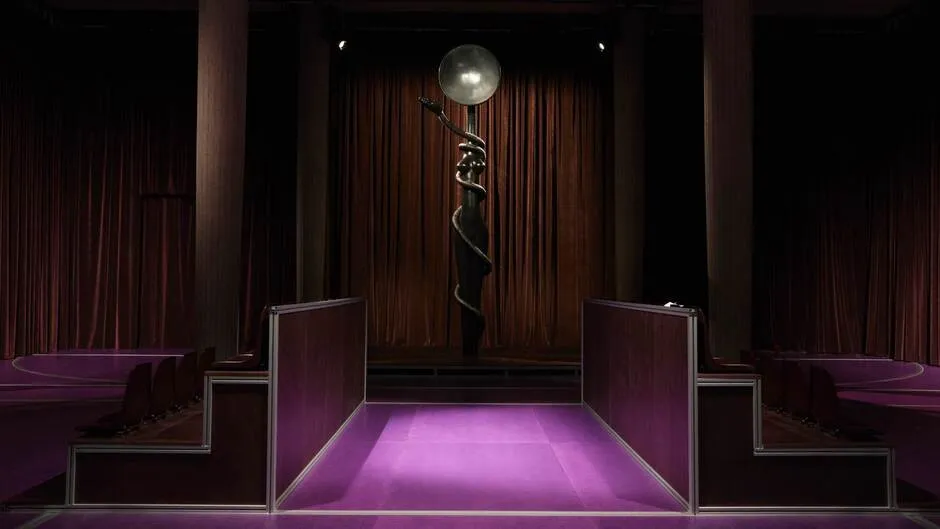
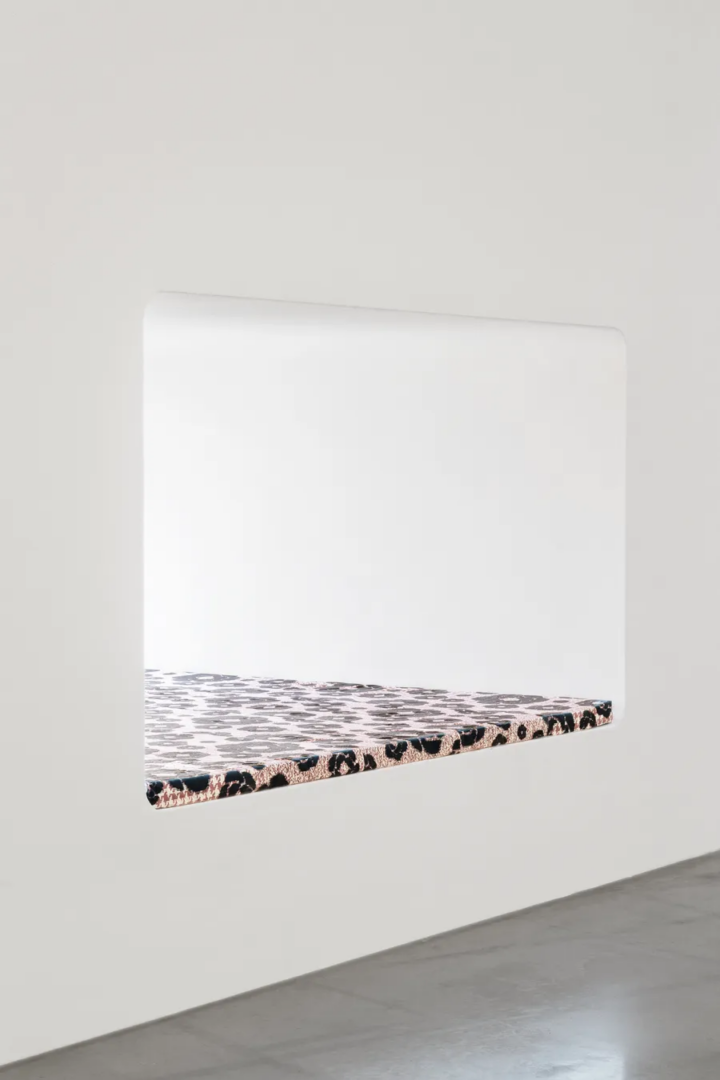
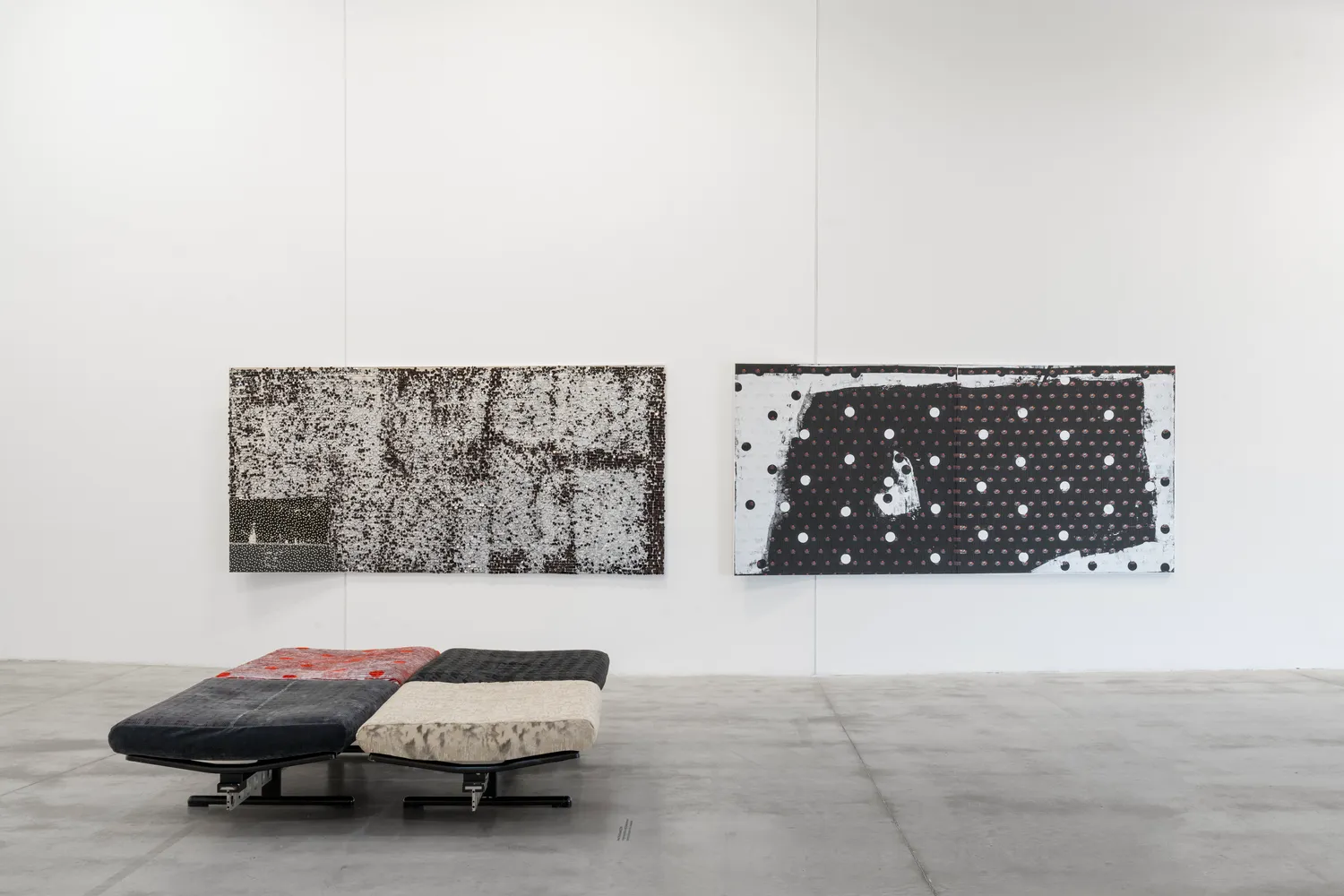
The artist Lorenza Longhi has dressed the Centro Pecci’s old sofas. A museum sofa is meant to almost vanish, part of the infrastructure along with the labels, the doors and the light. Here it is back in view. In the Ala Nio the same happens to the circular windows in the ceiling: trimmings, cushions, a portal and window films enter the architecture, while ten large canvases made for the show set fabric from the Prato textile district against screenprinting and flocking. Villa Delizia, Longhi’s first institutional solo show in Italy, curated by Michele Bertolino, starts from what an exhibition uses to present the work and then asks you to forget.
Villa Delizia at Centro Pecci: ten canvases in Prato district fabric
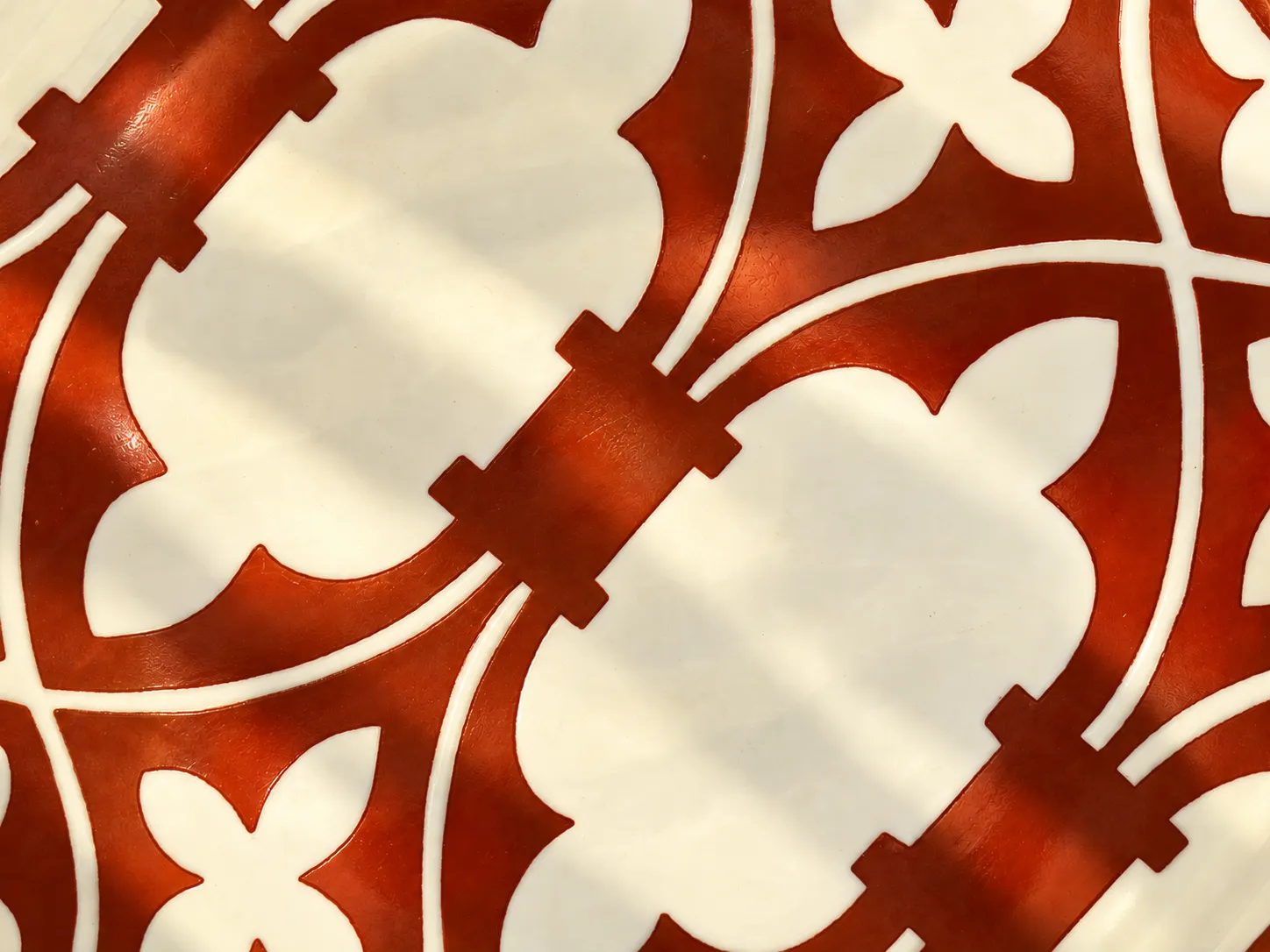
Prudenza e demenza domestica sets a dusty pink against wide black marks; lower down, a small, precisely drawn building is besieged by red roses. In Rammendo Sentimentale a grey-blue fabric run through with small plant motifs reaches a curved black band and a white-and-silver zone that keeps its scrapes and streaks. Villa Delizia puts a burgundy damask beside a pale field dotted with large irregular black circles; a floral motif thickens into dark pink over a blue ground, and another pale fabric carries blue arabesques in relief. Patterns that could have lived on a curtain, a seat or a dress become painting.
Lorenza Longhi and display: making a space awkward
Longhi works in the gap between the object and the conditions through which the object is recognized. Display, in her practice, helps build the work. In 2023 she described wanting to “make a space awkward.” She is drawn to lobbies, reception areas and cafés, the transit zones she called a “lobby syndrome,” spaces the institution needs and visitors read as intervals between the things that supposedly matter.
At the Pecci the principle shifts a few degrees. “For Villa Delizia I tried to ‘delight’ the space,” she says in conversation with Lampoon, “adding elements here and there to domesticate the Pecci’s rooms, and so to act on how their temporary inhabitants feel as they move through them.” She speaks of a “mutual predisposition to vulnerability” between her intervention and the institution: the museum lets the show change its behavior, and the show depends on what the building allows.
Centro Pecci in Prato: Gamberini’s factory of culture and Nio’s Sensing the Waves
The Pecci opened in 1988 in a building by the architect Italo Gamberini modeled on Prato’s factories, a “factory of culture” that the Dutch architect Maurice Nio reworked and enlarged with Sensing the Waves (2016), wrapping a new circuit around the original structure. The old museum had a circulation problem: a linear route forced the visitor back along the same line at the end. Nio redesigned the movement inside.
Fabric had already entered the Ala Nio. For Eccentrica, the permanent collection display opened in 2023, Formafantasma refused the white cube with wide partitions in recycled wool from the Prato mill Manteco. Longhi takes up some of those solutions and adds a layer: Gamberini looks at Prato’s factories, Nio wraps Gamberini, Formafantasma brings industrial textile inside Nio, Villa Delizia takes that memory as available material.
Lorenza Longhi and error: Cangioli 1859, Tessilfibre, Floccatura Balmar
The textile firms Cangioli 1859, Tessilfibre and Floccatura Balmar enter at a point beyond production support. A textile company works so the material has controllable properties: color, hand, strength, continuity. Longhi moves that result into a system that assigns value to discontinuity — overlaps, worn-looking zones, mismatched patterns, edges that avoid a seamless fusion. The same cloth crosses two economies of the gaze: in the factory it has to guarantee reliable meters of material, in the museum it has to be recognizable as that piece and no other.
“As an artist I have the privilege of making as many mistakes as I want. Only up to a point, though, because I’m still a worker and I have to account for costs, time and results.” She recalls a conversation with one of the companies involved: “For them error is something to eliminate, an enemy that stops the objects from reaching perfection.” The exchange surfaced a closeness as well: “a manual skill, a gesture that stays human, and therefore warm.” Prato built part of its history perfecting techniques that turn fiber into repeatable surfaces; Longhi uses those surfaces to introduce difference.
Lorenza Longhi on set design: letting the Ala Nio light in
The Ala Nio sets conditions through its geometry and above all its light. Longhi opens the circular skylights in the ceiling, the solar tubes, left shut until now because they make a light effect that is hard to predict.
She rejects the word set design. “A set is a fiction that carries an effect on its back: the fiction builds a spectacular frame inside which other fictions happen. I wanted to let into the show something that escaped my control. It’s a dialogue, in the sense that I let the architecture act as it had to, and built the show around that too.” She builds devices, decides pairings, chooses materials, alters a room, then looks for the point where the system stops obeying: “I’m interested in exercising a certain control and then letting part of it slip.”
Display appears early in her practice. At Villa Vassilieff, in 2020, she placed a work behind a counter a sponsor had brought into the space and used the obstacle. The next year, for Minuet of Manners at Kunsthalle Zürich, the paintings hung from long metal rods based on the system the architect Gae Aulenti designed for the Musée d’Orsay in 1986, meant to make rehanging easier and then abandoned partly because the rods and holes were too present. The support disturbed the works; Longhi kept the disturbance.
A minuet asks bodies to know a sequence. An exhibition asks for a similar competence, absorbed until it is no longer felt: we enter, slow down, keep a distance, don’t touch, look for a label. A sofa promises rest and sets where the body may stop, the height it will look from, the direction it will take. Senza Titolo (Ai divani! 1) takes a piece of furniture meant to offer a pause from the work and gives it back the right to be looked at.
Gottfried Semper, Bekleidung and the textile origin of the wall
In 1860 the architect Gottfried Semper gave textile art a role that modern architecture would later shrink to ornament: weave, mat, curtain and light partition belong to the genealogy of the wall, and the principle of Bekleidung, cladding, lets a surface be thought of as something that builds space. Inside Villa Delizia the windows, the portal, the films and the seating change how the space is crossed and recognized.
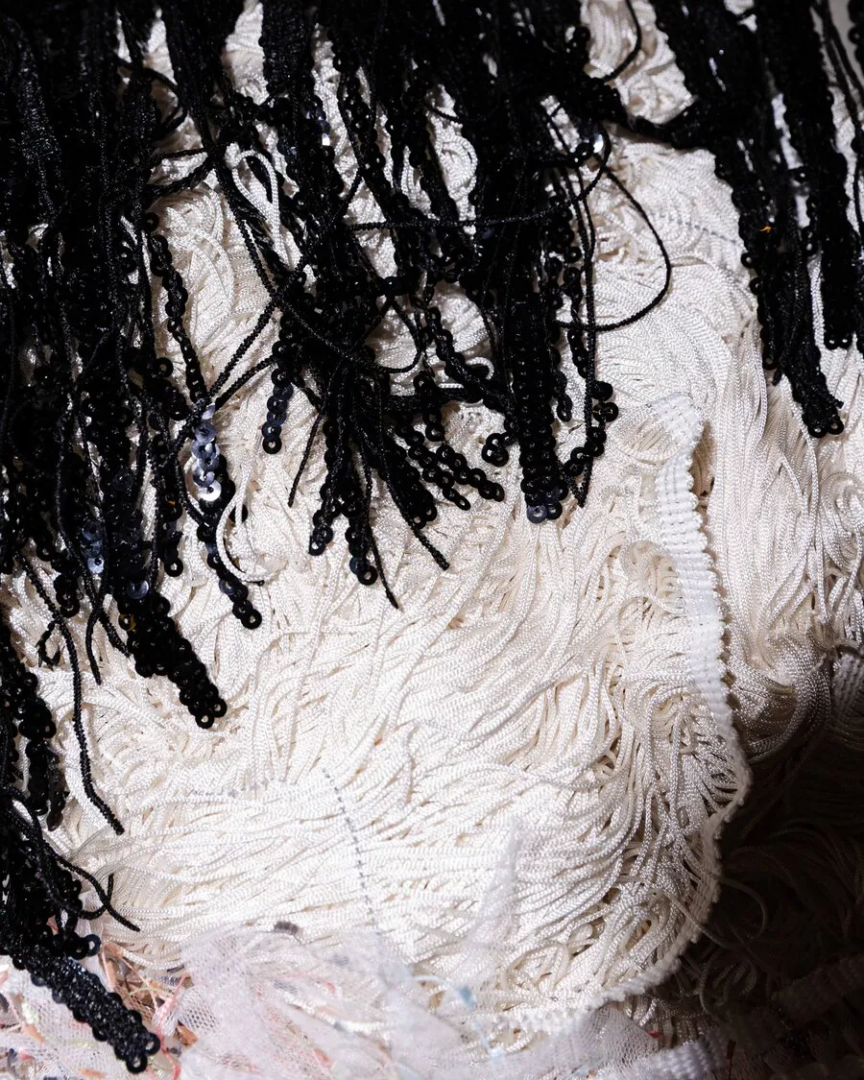
Flocking makes the problem physical. Short fibers are applied to a support until it turns velvety; the plane grows a pile, holds light differently, promises the fingers a quality the eye thinks it knows before contact. Touch is summoned into a space where touch is regulated. One fabric reads as expensive, another recalls a bedroom, a hotel, a boutique. The dusty pink of Prudenza e demenza domestica, the tartan half-covered by black marks, the irregular polka dots and the damask of Villa Delizia fire associations before any theory.
Damask, flocking and passementerie: taste as a social construction
The sociologist Pierre Bourdieu described taste as working when its rules have been absorbed deeply enough to feel immediate. Longhi brings the question to a tactile, almost domestic scale: how much must a surface shine before we call it vulgar, when does a damask look precious and when does it look aged, how much ornament can an interior bear and still read as sophisticated.
She asks the visitor for no correct decoding. “The works have multiple points of entry. It’s not for me to decide which is more or less valid.” Choosing the fabrics, she questioned her own reflexes, setting “current, almost of-the-moment motifs next to timeless patterns,” designs that could belong to different decades. The time gap between those surfaces interests her more than any prescribed reading: “Whoever catches the game between cheap and sophisticated sees one thing; whoever sees only an elegant damask sees another — and both stay legitimate.”
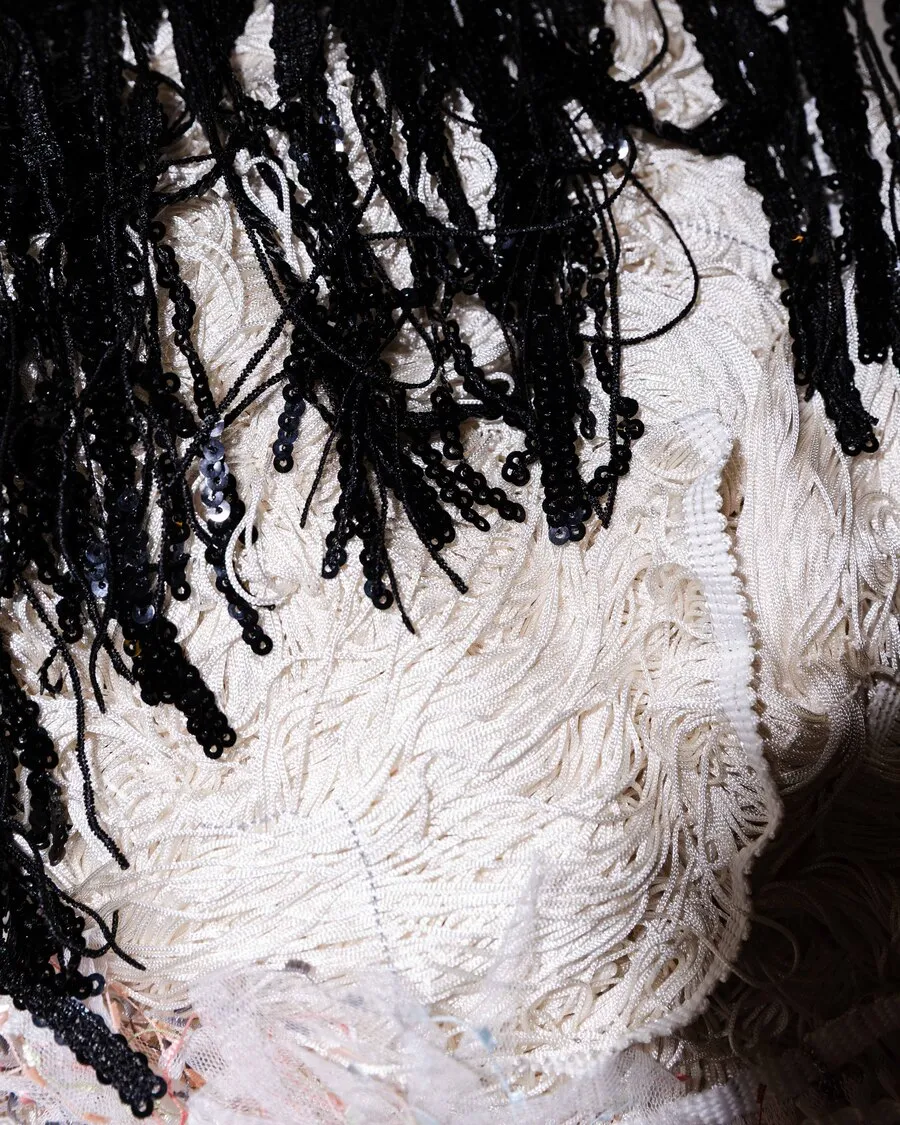
The architect Adolf Loos built one of modernism’s most aggressive attacks on decoration, and his own interiors show that removing ornament leaves prestige in place: marble, woods and grain speak at a high social volume. Luxury can go silent. A passementerie admits it is an addition; a sequin seeks the light; a border declares that someone chose to put it there. Longhi prefers materials that show their decorative intent.
Lorenza Longhi and screenprinting: a technique for repetition used to produce difference
Longhi traces her relationship with screenprinting to 2016 and a black stretch fabric already coated in silver: folded, the color cracks and lets out the process that was meant to stay hidden. The question turned technical — how to make images that hold traces, sediment and accidents. Screenprinting was born for reproduction. Longhi forces it the other way, applying stencils, stickers and fragments directly onto the surface, using techniques “the wrong way.”
The reference to Andy Warhol works inside that gap. In pop screenprinting, repetition could take on the condition of the commodity and the mass image; Longhi takes a technology still tied to seriality and makes it unreliable. With no stable matrix, differences appear between works; accidental marks are kept, or new elements added to mark each one.
The word imperfection is no longer enough: it is a tamed commercial language, new ceramics designed to look irregular, factory-aged woods, papers that fake a poor print, costly interiors staged to look casual. Longhi looks for the point where the accident brings a process back into view: the edge of an application, a surface that takes color unevenly, a zone that looks erased and keeps its earlier stages. In Rammendo Sentimentale the break between grey-blue fabric, black band and silver area keeps the surface from reading as whole.
Improved Accuracies, a series begun in 2019, cuts industrial fluorescent tubes and welds them back together. A standard object loses part of its efficiency and gains a joint: industry perfected it to be regular, and the work takes it further until it stops being so. The human coincides with the presence of a gesture.
World of Yum Yum and Dazzle Dazzle: Chanel camellias, sequins, the factory of desire
Longhi cites the artist Pati Hill for one word: “showy.” Hill spent decades using the photocopier, an office machine meant for reproduction, to turn ordinary objects into images. Longhi picks up that tension between the common and the displayable.
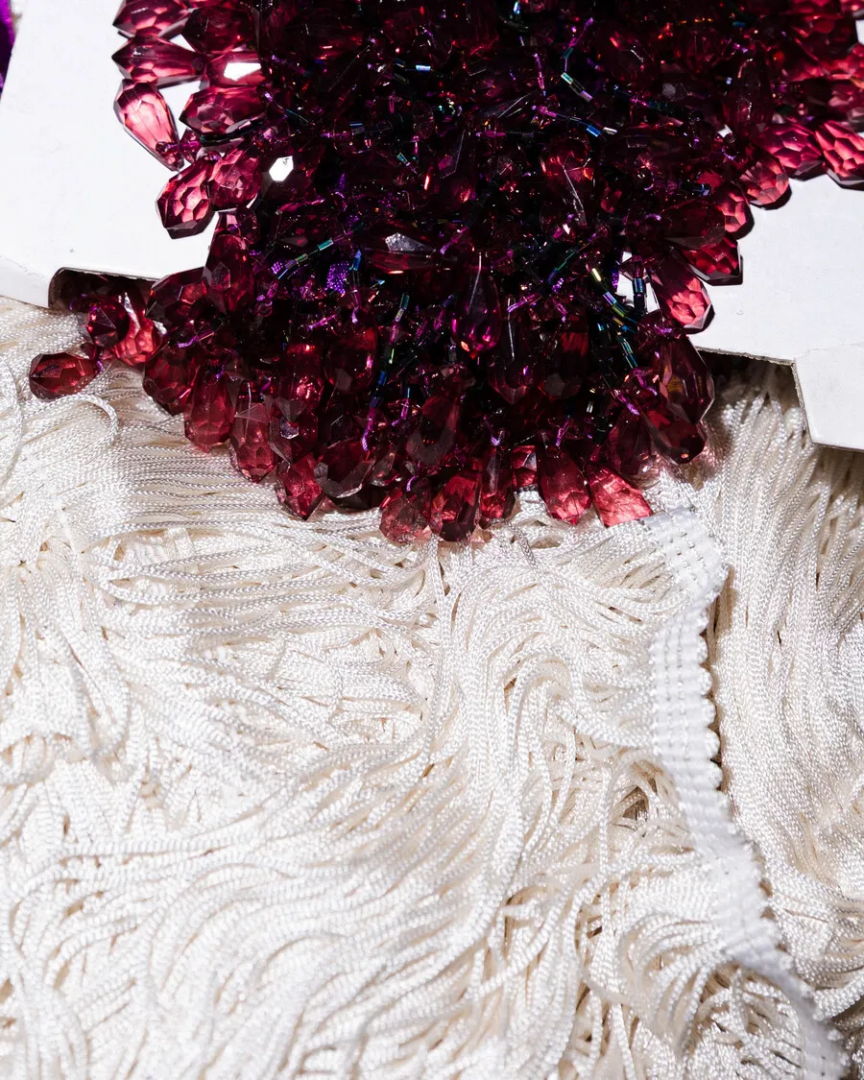
World of Yum Yum, at the Swiss Institute in New York in 2024, took the problem into retail. She built artificial camellias that recall the Chanel brooches, following YouTube tutorials and using fabric scraps, then photographed them, enlarged them and mounted them on mobile panels on tracks. Into some of the flowers she set working spy cameras, so the flower built to attract the gaze ends up with one of its own. The camera mics recorded the sound of department stores in Zurich and New York, played back through directional speakers in boxes lined with florist’s paper. A few sensory protocols stand in for the shop. The title comes from the writer Rhonda Lieberman on glamour and Chanel: the luxury commodity promises transformation and measures the distance between whoever desires it and whoever seems able to own it.
At Freiburg, in 2025, Dazzle Dazzle began when the party was already over. The floor of the Kunstverein was covered by a sixteen-meter intervention in screenprinted PVC, painted metallic grey and scattered with sequins; the source image was the asàrotos oikos, the unswept floor of ancient mosaic, where banquet scraps become decoration. The same show held damasks, bows, sequins and trimmings, and a column dressed in finishes from the charity shop where the artist’s mother volunteered. The reference was to Mainbocher’s dress aprons, decorative aprons that update a dress without replacing it.
The titles of the new works carry this economy into a domestic vocabulary: Prudenza e demenza domestica, Tipessa, Rammendo Sentimentale, Villa Delizia. You darn what has already had a life and that you choose to keep; the repair follows damage and carries a judgment, because someone decided the object deserved more time. A perfect darn disappears. Longhi keeps it legible. In Prato the word points further: the district’s history also runs through regenerating fibers, treating material that has already been used and returning it to a new cycle. A fabric carries a technology, a likely price, an intended use, an idea of the body or the room that might have received it.
Prudenza e demenza domestica holds the same friction. Prudence belongs to the managed house, where things last, get cleaned, match. The dementia starts when biography enters the interior: the inherited piece that no longer goes with anything, the curtain kept past its time, the object preserved against the scheme. A lived-in interior accumulates what the rendering removes, and the rendering can afford a calibrated mess — a throw falls in the right spot, a few books add culture, the chair is turned just enough.
Lorenza Longhi between museum and market: surface, desire, value
In her work the surface makes an object look cheap or precious, domestic or institutional, desirable or negligible. The body gets a dress, the furniture upholstery, the commodity packaging, the work a display, the building a skin.
A shop arranges objects to produce desirability, the museum to produce attention. Some tools coincide with a precision hard to ignore: light, distance, isolation, sequence, quality of materials, position of the body.
Then there is the market, where a critique of value produces more of it. A Longhi work is shown, sold, collected, desired, and can become an object of distinction itself. “My work isn’t separate from the systems it passes through, and I wouldn’t even know where it could stand to be outside them.” A work, she adds, produces value “commercial and economic, sure, but also cultural and sensible, and then a value that belongs to the language of the work itself.” “Maybe it isn’t something to resolve, but one of the places where the work keeps acting.”
Villa Delizia: Lorenza Longhi’s first institutional solo show in Italy
Villa Delizia enters a museum already built in layers: Gamberini looks at Prato’s workshops, Nio wraps the building and changes its circulation, Formafantasma brings in large textile walls. Longhi arrives in 2026, dresses the sofas, reopens the solar tubes, inserts a portal and works with the district’s fabrics.
The title could sit on a brass plate or in the brochure of a property. Delizia promises well-being and recalls a long history of residences for leisure and display, where pleasure, property and work shared one space.
Behind the fabrics are companies, technicians, samples and processes; the softness of the flocking is the result of a procedure. The museum takes these materials out of the supply chain and gives them another time: a cloth that could have been cut, sewn, sold and worn out is looked at instead. Longhi works at the moment the surface stops being innocent — a damask, a smudge, a sofa or a different light is enough to change what an object means.
Federico Jonathan Cusin