Indian cotton varieties: some seeds forgotten for 40 years
Aditi Mayer’s The Artisan Archive traces the revival of India’s indigenous cotton, from 40-year-old seeds to artisan livelihoods, organic farming, and a more resilient fashion supply chain
Indigenous cotton varieties: Kala Cotton and Desi Kapas explained
Indigenous cotton varieties such as kala cotton in Kutch and desi kapas in Punjab belong to genetic lineages that evolved within specific regional ecosystems. They are typically rain-fed, naturally resilient to pests, require fewer external inputs, and produce shorter staple fibers. Their qualities differ from the uniformity demanded by industrial manufacturing.
Industrial cotton follows a different model. In India, the widespread adoption of Bt cotton introduced hybrid seeds, chemical fertilizers, pesticides, irrigation-intensive farming, and production systems designed to maximize yields and support mechanized spinning. For many farmers, this has also meant growing dependence on purchased inputs and recurring cycles of debt.
«Heritage cotton asks us to value something different. These fibers may not always conform to industrial expectations of softness or uniformity, but they carry other forms of intelligence: drought adaptation, seed sovereignty, regional identity, and compatibility with handloom systems. They remind us that cotton is not a universal commodity. It is a crop with geography, memory, and culture embedded inside it».
Aditi Mayer, studying journalism
Rana Plaza, an eight-story garment factory complex outside Dhaka, collapsed in 2013, killing more than one thousand workers. Structural cracks had appeared the previous day, yet workers were ordered back inside.
At the time, Aditi Mayer was studying journalism. The disaster fundamentally changed her understanding of fashion. What she had viewed as a field of creativity, identity, and self-expression revealed its dependence on labor exploitation, environmental degradation, and global inequality.
«That was the first time fashion’s darker underbelly became impossible for me to ignore. Until then, I understood fashion as a space of creativity, identity, and self-expression. Rana Plaza forced me to understand it as a system shaped by labor exploitation, environmental harm, and global inequality».
After Rana Plaza, Mayer joined labor organizing efforts in Los Angeles’ garment district, working alongside garment workers advocating for fair wages. A reporting fellowship later brought her to India, where she began tracing fashion back to its origins, shifting attention from finished garments to the people and landscapes where fibers are produced.
The Artisan Archive and the forty-year-old Desi Kapas seeds
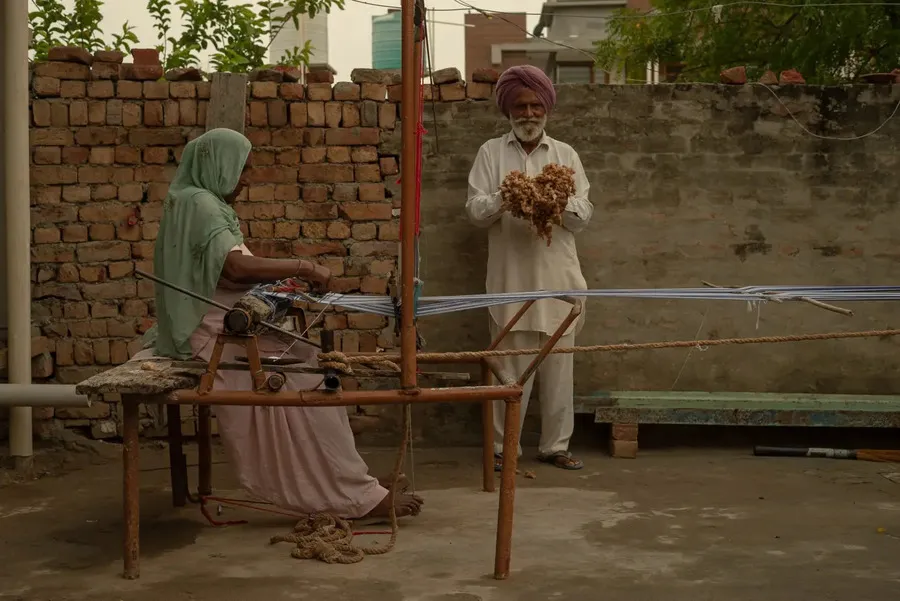
A moment came in Punjab’s Malwa region, historically the state’s cotton belt. Mayer was interviewing an elderly couple—a farmer and a weaver: indigenous Punjabi cotton replaced by Bt cotton, increasing dependence on pesticides, and the disappearance of local spinning and weaving traditions.
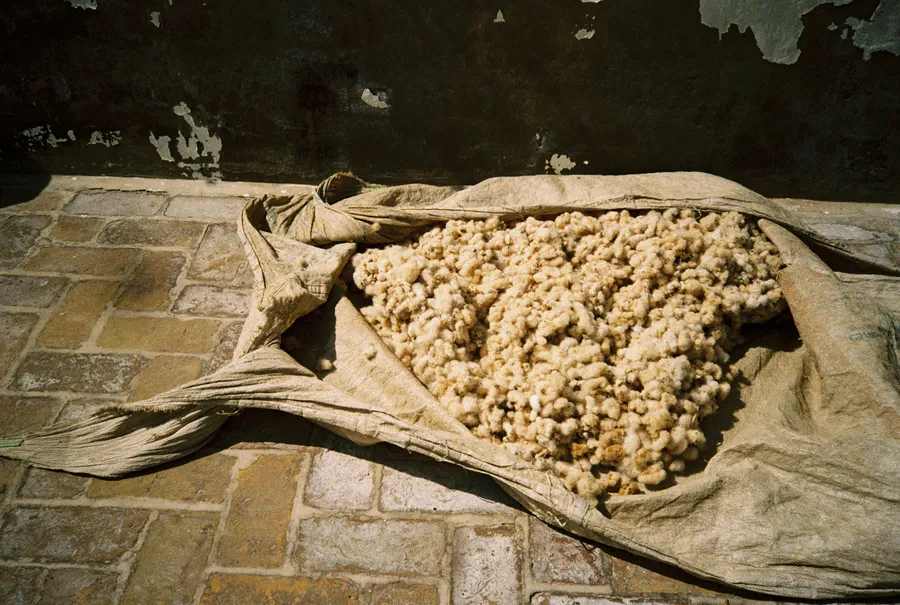
During the interview, the farmer disappeared into a storage shed before returning with a cloth bag. He emptied its contents onto a manja, the traditional woven cot: naturally brown indigenous cotton, its seeds still intact.
«Around forty years earlier, he had a feeling things were going to change. He sensed that future generations might not see this cotton again, so he saved it. Then, over time, he forgot about it».
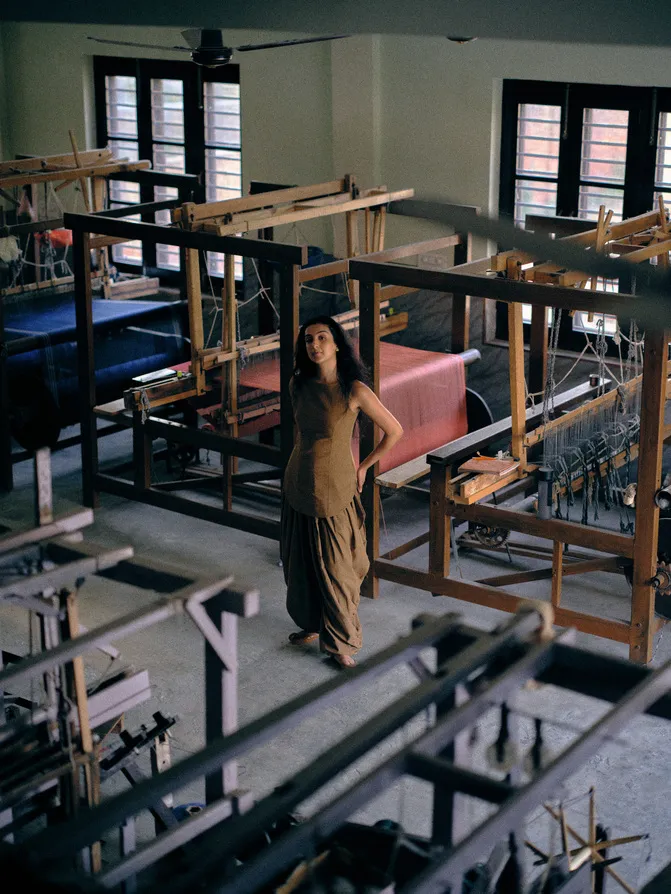
The seeds were still viable. Mayer partnered with Kheti Virasat Mission, an organization dedicated to organic farming and seed sovereignty, to germinate them and begin rebuilding a local textile ecosystem. That discovery became the foundation of The Artisan Archive, a platform where documentation is directly connected to economic participation rather than ending with storytelling alone.
The farmer had not preserved the seeds out of nostalgia, but because he anticipated their disappearance. For Mayer, that forgotten cloth bag became a symbol of resistance against the collective amnesia on which extractive systems depend: forgetting the farmer, the seed, the soil, the labor, and the knowledge behind every textile.
Why the Artisan Archive rejects craft as marketing
Fashion frequently invokes terms such as craftsmanship and heritage, yet Mayer questions how often those words become little more than marketing language. Handwoven textiles and portraits of artisans are easily transformed into brand assets without any structural commitment to the communities that produce them.
«The problem with words like sustainability and craftsmanship is that they are often used as aesthetic signals rather than structural commitments. Who owns the value? Who absorbs the risk? Who is being paid? Who holds the knowledge? Who has decision-making power?»
For Mayer, craft is not the final product of a supply chain but the outcome of an interconnected system involving farmers, seed savers, spinners, dyers, weavers, local organizations, generations of ecological knowledge, and the often invisible labor of women. Celebrating the finished textile while overlooking the conditions that made it possible remains another form of extraction.
This perspective informs every aspect of The Artisan Archive.
«The question is not simply, ‘Is this handmade?’ The question is: What kind of world does this way of making sustain?»
That question shapes decisions around sourcing, pricing, partnerships, and storytelling. A textile produced through debt, groundwater depletion, and precarious labor cannot be considered sustainable, regardless of how it is woven. One that supports seed sovereignty, dignified work, and ecological regeneration follows an entirely different logic.
Colonial history and the displacement of Indian cotton
Mayer situates the decline of indigenous cotton within a much longer historical process. Before British industrialization, India was one of the world’s leading textile producers, with sophisticated regional systems of farming, spinning, dyeing, printing, and weaving. Cotton was deeply embedded in local economies, domestic life, and cultural identity.
Colonial policies transformed that system. Rather than exporting finished textiles, India increasingly supplied raw cotton to British mills while becoming a market for industrially manufactured cloth. Local weaving economies declined as value shifted away from producing communities toward imperial industries and global trade.
The Green Revolution accelerated another transformation. Punjab, supported by fertile land and extensive irrigation, became central to agricultural modernization. Higher yields and food security came at the cost of monoculture, groundwater depletion, soil degradation, chemical dependency, and the erosion of agricultural biodiversity.
«The seed did not disappear because it lacked value. It was made illegible to systems that valued yield, uniformity, and profit over ecological relationship. That erasure tells us something essential about the empire: agriculture is never just agriculture. To control seeds, soil, fiber, and markets is to control entire ways of life».
Climate resilience and organic farming in Punjab after the 2025 floods
The floods that struck Punjab in 2025 damaged part of the cotton crop cultivated through The Artisan Archive, demonstrating that indigenous varieties are not immune to climate change.
The experience also highlighted differences in resilience. Farmers who had invested in soil health through organic agriculture recovered more quickly than those working on degraded land.
«Farmers who had been practicing organic agriculture and taking care of soil health were, in many cases, better situated than those working with more depleted soils. Healthy soil contains more organic matter, stronger microbial life, and better structure. That means it can absorb water in a more effective way, resist erosion in a stronger way, and recover with more resilience after shock».
The episode also exposed the limits of centralized supply chains. Standardized production systems depend on long-distance transport, concentrated manufacturing, and stable market conditions, making them particularly vulnerable to climate events and other disruptions. Localized production models allow communities to respond to changing environmental conditions while retaining economic value within the regions where fibers are grown and processed.