Can Italy return to linen? 100 hectares for the textile industry
Sustainable and traceable, can domestic linen production restore Italy’s former industrial strength? Linificio e Canapificio Nazionale has revived 100 hectares of linen cultivation in Italy
Italian linen – rebuilding the Italian supply chain in the name of sustainability
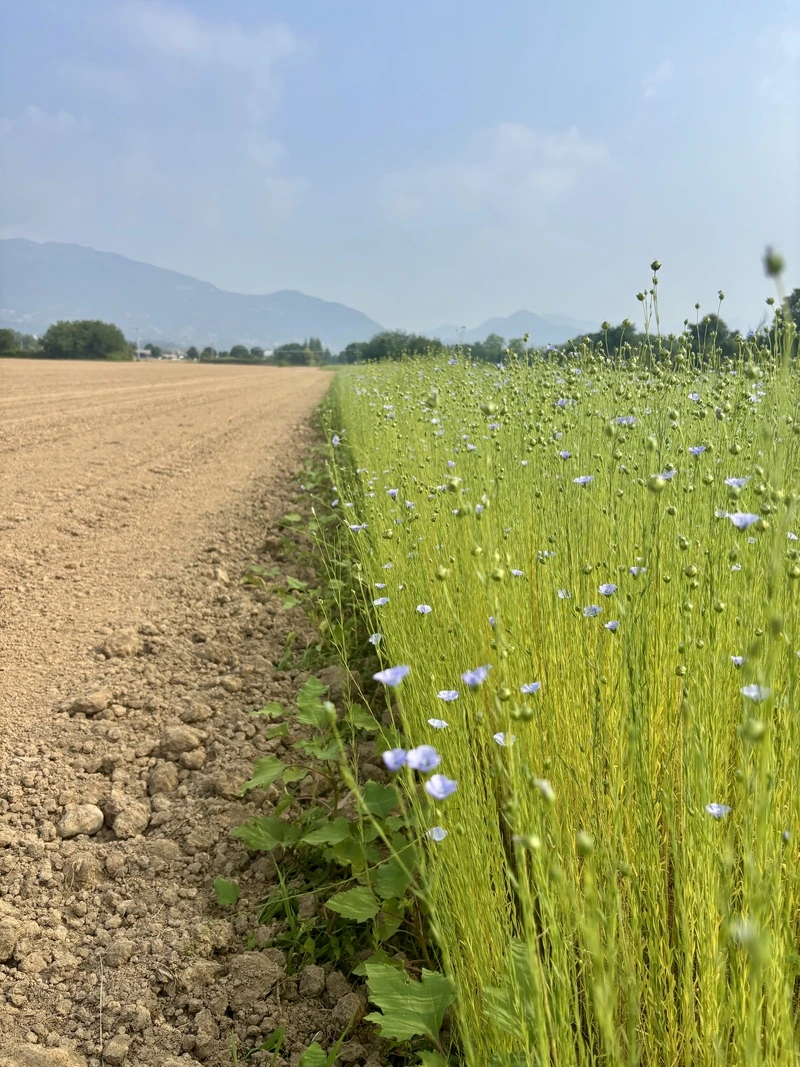
Near Bergamo, in Astino, one of the many green fields framing the provincial road out of the city center appears anonymous, yet tells the story of a glorious textile past and opens new possibilities for the future. Linen plants now grow there again, as they did centuries ago, replanted locally – not without difficulty – by Linificio e Canapificio Nazionale, which also processes them at its Villa d’Almè headquarters on the banks of the Brembo.
Inside, yarns are made for leading Made in Italy brands, valued around the world for their thermal-insulation properties: warm in winter and cool in summer. Linen is returning to attention at a time when sustainability has become a necessity rather than an option.
Growing linen requires few pesticides and less water than other crops, does not damage the soil, and all its waste can be reused, for example to develop biodegradable and compostable packaging.
Linificio e Canapificio Nazionale’s bet
Italian plants, Italian fibers, Italian clothes. It is a wager more courageous than nostalgic for those who would like to see the long-awaited return of a textile supply chain contained entirely within national borders. The economic approach is central to this attempt to regenerate linen production: growers are guaranteed profitability, while Linificio assumes the business risk. The philosophy behind the project matters just as much.
Blockchain is often discussed; here, the attempt is to create a system in which every stage of the production process can be known. From seed to fiber, from field to spinning mill, spool by spool. At least for linen: the hemp processed by Linificio, once central to Italian production, is far less significant than linen and comes from France and China, although the company is also seeking to open up to Belgian cultivation.
A millennia-old fiber – from Egypt to Italy, from sails to diapers
Linen, traces of which date back to 7000 BC, probably originated between Egypt and Mesopotamia, where it was also used to wrap mummies. The Phoenicians are thought to have brought it to what we now call Europe. We know that the Etruscans already used it, followed by the ancient Romans, who also cultivated it. Today we associate linen with clothing, but for millennia it was the main material used for fishing nets, ship sails, bed linen, napkins and handkerchiefs. In the past, babies were swaddled in linen: this is how the Italian word pannolino, meaning diaper, originated.
The rise and disappearance of linen in Italy
During the nineteenth century, as the Second Industrial Revolution accelerated, Italy was one of the leading producers of linen, alongside hemp. Both were cultivated and processed domestically. In the second half of the century, entrepreneur Andrea Ponti brought together small businesses in Lombardy: Ceriani & C. in Fara Gera d’Adda, where wet spinning was concentrated, and Battaglia & C. in Cassano d’Adda, later joined by Maggioni & C. Linificio e Canapificio Nazionale was founded on January 14, 1873, and only three years later became the third Italian company to be listed on the Milan Stock Exchange.
Everything collapsed after the Second World War, when cheaper new fibers – synthetic ones – replaced linen. While factories across Italy disappeared, Linificio e Canapificio Nazionale never closed. Now part of the Marzotto Group, it invests in advanced processing techniques. At Villa d’Almè, the world’s finest yarn is produced, with a metric count of 110. To give an idea, one of the company’s clients uses a metric-count 90 yarn for handkerchiefs made for the Japanese imperial family. Meanwhile, attempts continue to recover Italy’s now-defunct spinning tradition.
One hundred hectares of linen across Italy, from Bergamo to Prato, with seeds from Normandy
Linificio e Canapificio Nazionale started with three hectares and can now count on a total of 100 hectares of linen cultivation across Italy. Not only around Bergamo, but also near Padua and Prato. According to agronomist Clara Dughetti, the best fields at present are those in Tuscany, partly because of the climate and partly because of the region’s commitment to maintaining the reputation of the Prato textile district. Italian linen – formally Lino d’Italia, with a capital L to emphasize its sole parentage in Villa d’Almè – is, more precisely, actually Italian-French.
The seeds are supplied to Linificio by Terre de Lin, a Normandy cooperative with 20,000 hectares and 750 farmers. Together with a small number of other organizations, it dominates the sector: 90 percent of European production is concentrated between France – particularly Normandy – Belgium, with Flanders, and to a lesser extent the Netherlands. There are practical reasons for this. First, the oceanic climate: cool, humid and rainy summers rather than the 30–40 °C temperatures that can hit Bergamo. Then there is the soil, which contains the organic matter linen needs to grow well and has the right degree of compactness, allowing it both to retain water and support the roots.
Linen cultivation – sowing and flowering
Years of determined work have allowed Linificio to attempt to recreate a national linen crop. The project began toward the end of the last decade. The first harvests arrived during one of the worst periods Bergamo had experienced, during Covid-19. Experimentation continues: every year cultivation has to be recalibrated around rapid climate change, depending on when rain arrives and monitoring pollution. A crop rotation of four to seven years is followed, on land previously used for barley and sorghum, in line with regenerative-agriculture principles.
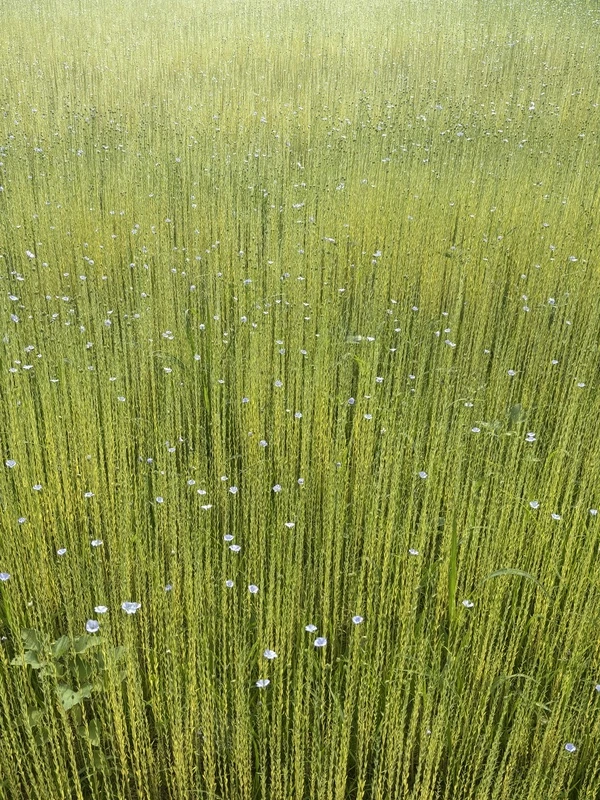
Sowing takes place shortly before spring arrives, generally during the first two weeks of March. Then it takes roughly 100 days to see the flowers. Around June, blue flowers appear on straight stems – only apparently fragile and thin – when the plant has reached around one and a half meters. They bloom in the morning and wither by midday. The speed of growth prevents high concentrations of substances such as cadmium, lithium and similar elements from accumulating.
From flowering to retting, from harvesting to scutching
After flowering, the groundwork for processing the plant begins. When the stems lose their leaves, it is time for pulling: around the first half of July, they are laid on the ground in windrows using a dedicated pulling machine. Retting then takes place on the ground, without water. The windrows remain there for around three weeks and are turned from side to side with a turning machine so that retting occurs evenly. When the fiber separates from the straw, harvesting can begin.
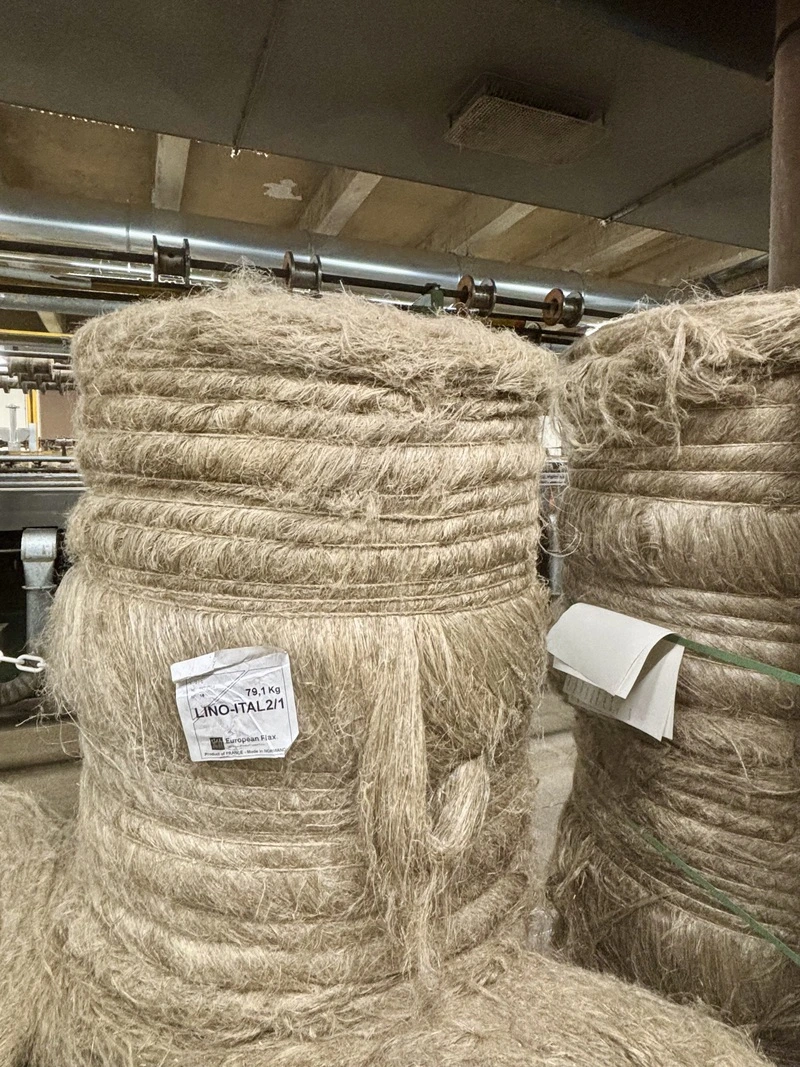
By this stage, the stem has changed from green to grey-brown. Round balers gather the bundles into bales, opening the way to scutching: inside the scutching machine, rollers and blades crush and beat the linen to promote decortication, separating the straw – the woody parts – from the fiber. This stage, however, takes place in France: Italy lacks scutching plants. The linen then returns to Italy for the final stages.
From classification to winding
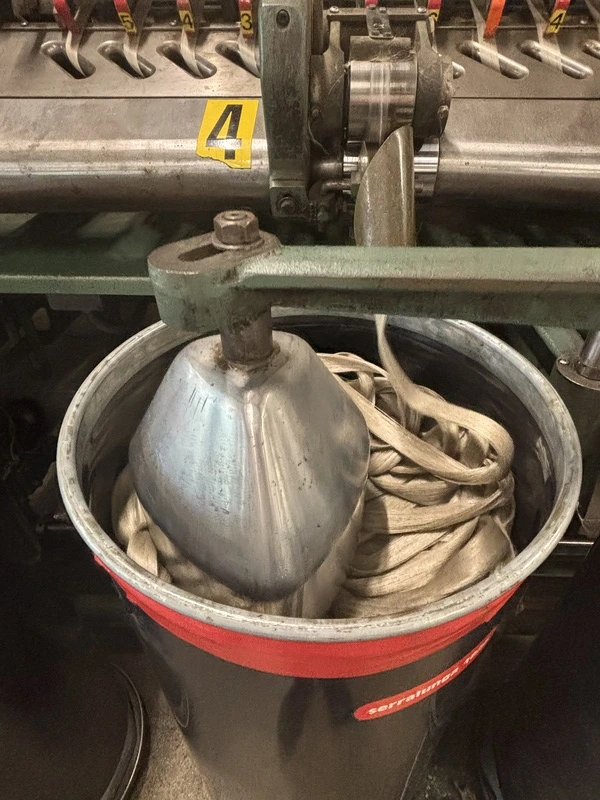
Not all linen is the same: much depends on the degree of retting. After decortication, the result is classified according to parameters such as fineness and strength. Round bales of scutched linen pass along a conveyor, where a field of combs – mounted on aprons rotating perpendicular to the fibers – aligns them, refining and overlapping them.
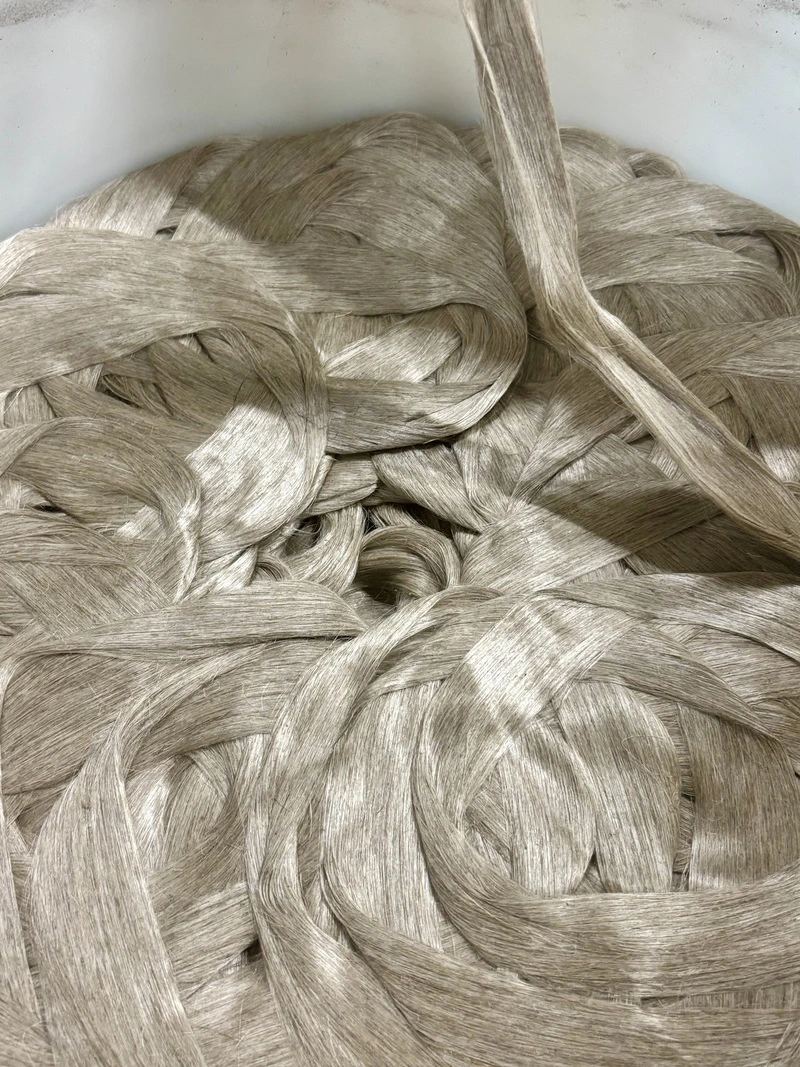
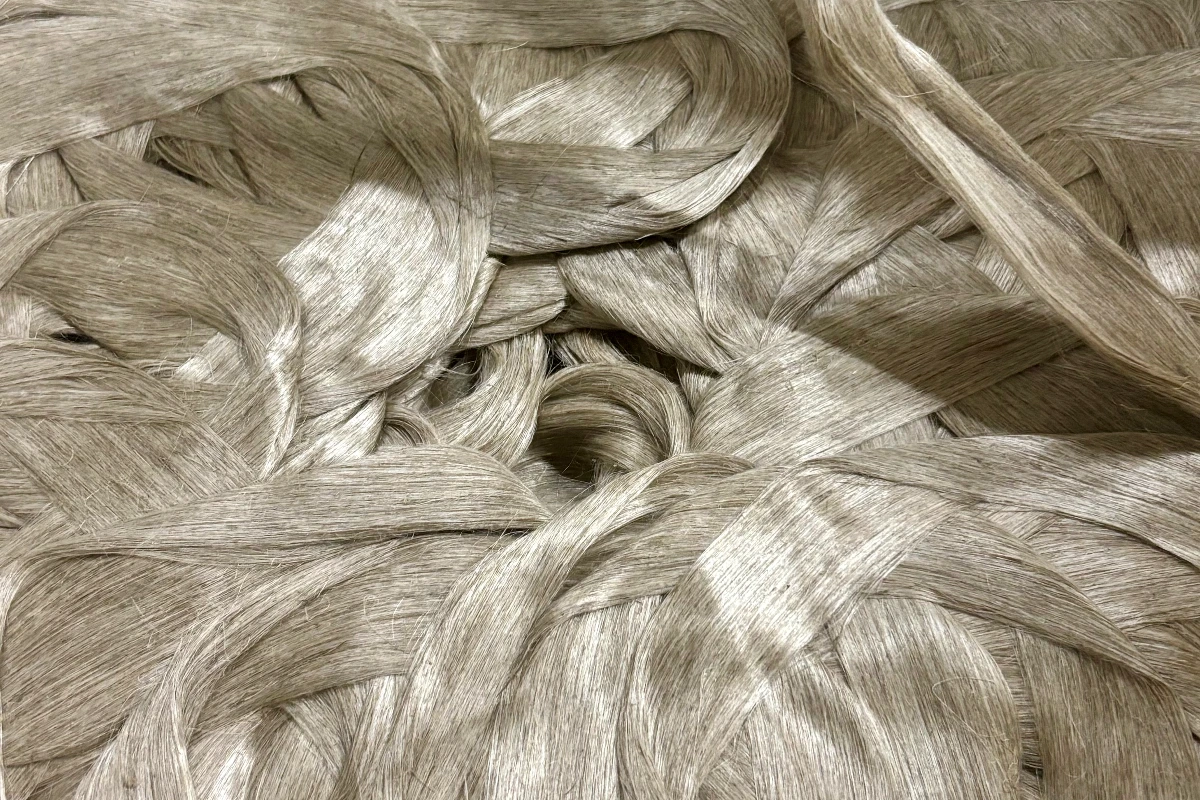
A continuous combed sliver is formed. The weaker fibers are collected for blending with other fibers or for use in dry spinning. The others can proceed to wet spinning. Before that comes bleaching, a whitening and boiling process in vats that improves spinnability. Once spinning is complete, the linen is dried using hot air or, alternatively, radio frequency.
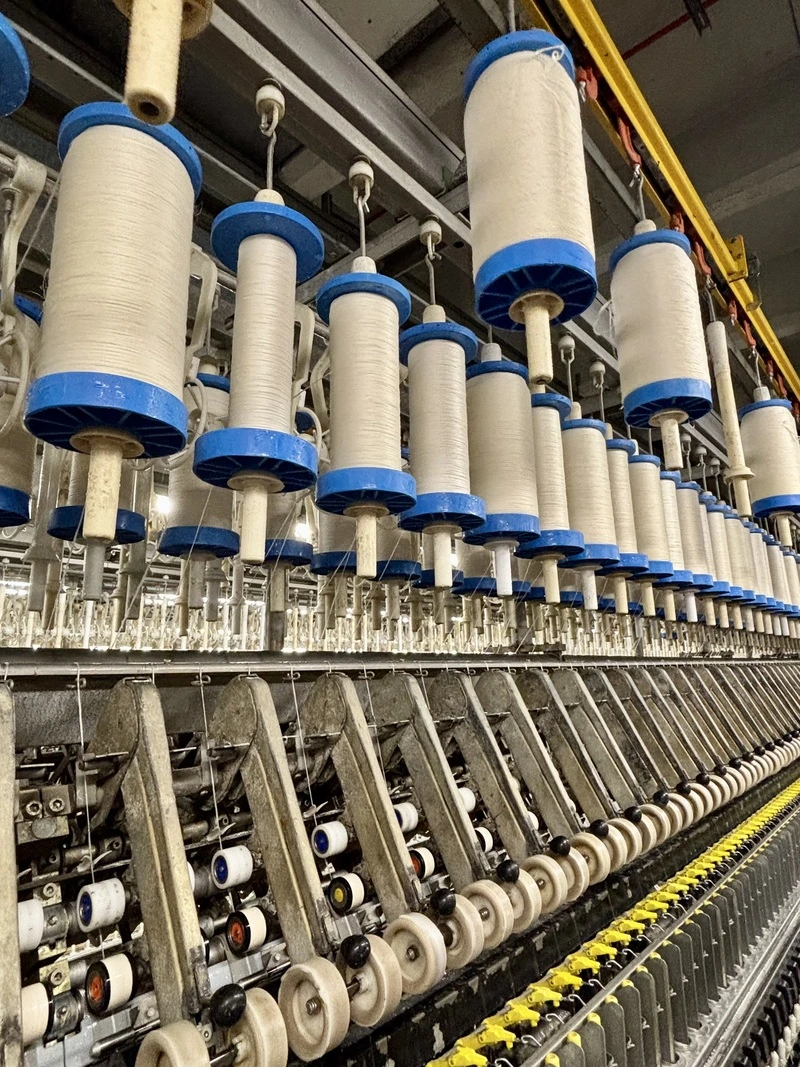
Only winding remains: the dry yarn is wound onto spinning tubes and monitored by optical electronic sensors which, when significant variations in diameter are detected, cut the yarn. This is how Lino d’Italia is made.
Linificio e Canapificio Nazionale
Founded on January 14, 1873, Linificio e Canapificio Nazionale spins linen and hemp for clothing, furnishing and home interiors. It is a benefit corporation and a B Corp.
Marzotto Lab
Linificio e Canapificio Nazionale is part of Marzotto Lab, a Marzotto Group company operating in the world of natural fibers, particularly wool, cotton and linen.
Giacomo Cadeddu