Kajal’s Dahab Absolu adds the flowers that Dahab left out
Patrick Müller of LUZI rebuilds the house’s floral-free bestseller around tropical fruit, a sulfur-bright green thread and a base where oakmoss and musk share one Italian word
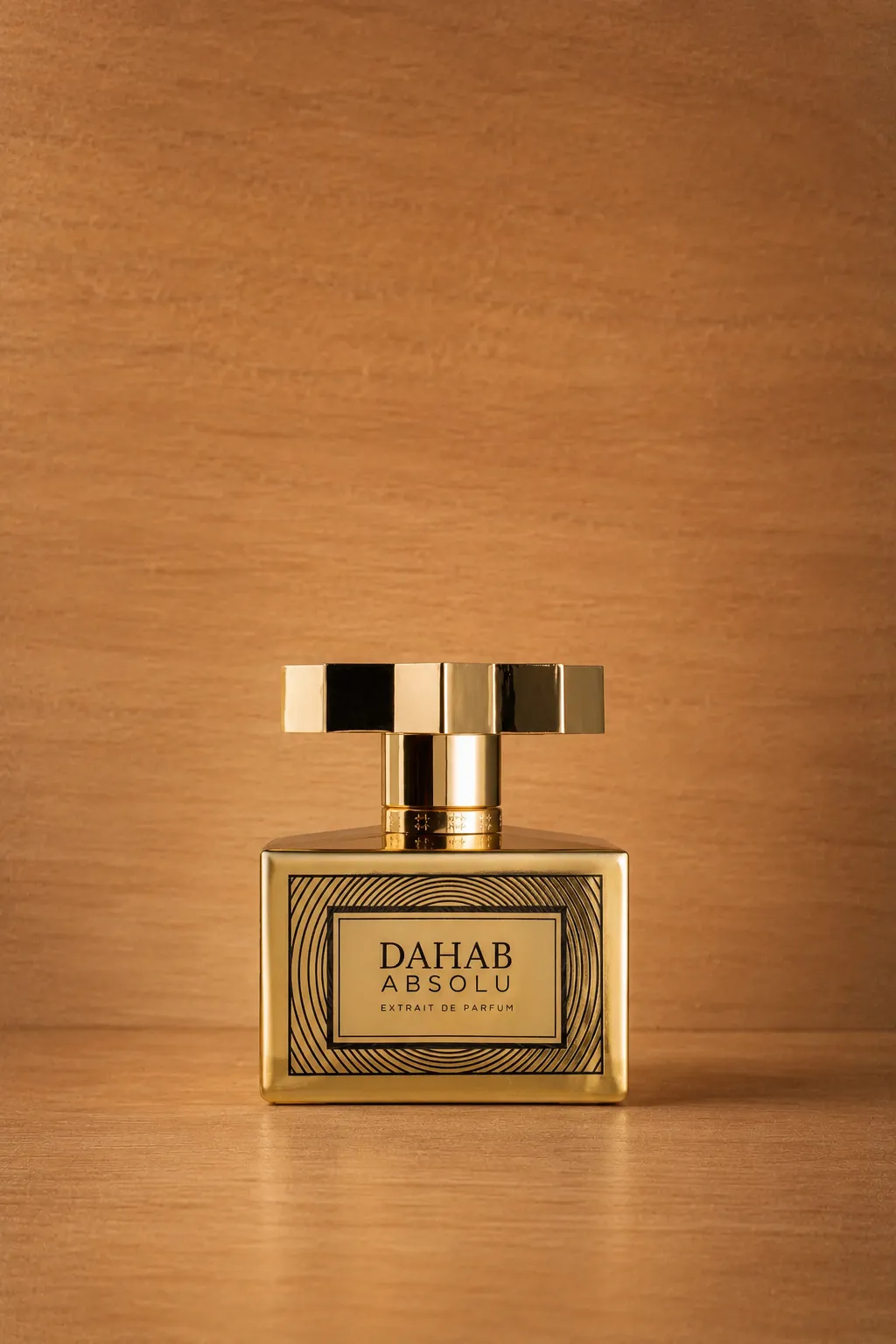
Dahab is Arabic for gold, and it is the name Kajal Perfumes Paris gave to the bestseller of its Gold Collection, a composition defined by what it lacked: no floral notes. Dahab Absolu, presented as a world preview at the Mandarin Oriental in Milan on 19 May 2026, reverses that decision. The new extrait keeps the name and adds a heart of jasmine, rose, geranium and lily of the valley. It joins Dahab, Lamar, Aican, Lamar Caviar and Lamar Noir in the collection, and it is signed by the Swiss perfumer Patrick Müller of LUZI.
The house describes the result as an “absolute gold”. In perfumery, absolute names a specific material: the alcohol-washed extract of a concrete. Here it is a title rather than a process. The note list is the more useful document, and read as a list of materials, it shows a composition in which several of the named notes cannot be extracted at all.
Citrus that comes from the peel, and fruit that comes from the lab
The opening pairs two kinds of material. Bergamot, grapefruit and orange are real extracts, cold-pressed from the rind. Bergamot is grown mostly on the Calabrian coast around Reggio Calabria, and its oil carries linalyl acetate and linalool, which give it the floral-tea register that separates it from other citrus. It also carries bergapten, a phototoxic furocoumarin, so fine fragrance generally uses furocoumarin-free grades. Sweet orange oil is largely limonene and is a by-product of the juice industry. Grapefruit owes its recognisable bitterness partly to nootkatone and partly to a sulfur molecule, 1-p-menthene-8-thiol, one of the most potent odorants known, perceptible at vanishingly small concentrations.
Passion fruit, mango, green apple and the generic “tropical fruits” have no commercial extract for perfumery. They are accords. Green apple is usually built from esters such as hexyl acetate with green alcohols to keep it crisp rather than sugary. Mango leans on terpenes, carene and terpinolene among them, softened by lactones. Passion fruit is the most technical of the group: its character depends on sulfur compounds, thiols and oxathianes, which smell tropical at trace doses and sweaty or catty above them. Dosing is the whole problem.
Blackcurrant leaves: the thread from top to heart
The house places blackcurrant leaves in the heart rather than the top, and the placement makes chemical sense. The blackcurrant materials used in perfumery, most famously bud absolute from Burgundy, owe their signature to a sulfur note of the same family that shapes passion fruit and grapefruit. The green, slightly animalic edge that makes blackcurrant read as blackcurrant is what links the tropical opening to the flowers that follow. The fruit does not stop when the heart begins; one of its facets is carried forward and turned green.
Four flowers, three different problems
Jasmine and rose arrive as naturals with established supply chains. Jasmine grandiflorum, grown in Egypt and India, is solvent-extracted into a concrete and then washed into an absolute; several hundred kilograms of flowers go into each kilogram of finished material. Its profile is benzyl acetate for fruit, indole for its animalic shadow, and methyl jasmonate for radiance, which perfumers often extend with its synthetic relative Hedione. Rose presents a choice between methods. Steam-distilled rose oil loses much of its phenylethyl alcohol, which is water-soluble and stays in the distillation water; solvent-extracted rose absolute keeps it and reads fuller and more honeyed. That rose also contains damascenone, the carotenoid-derived molecule that pushes rose towards cooked fruit, which suits a composition already saturated with it.
Geranium is a leaf oil, distilled from Pelargonium graveolens in Egypt, China and Réunion. Its citronellol and geraniol give it a rose profile with a minty, green edge, which is why perfumers use it to stretch rose and to give a floral heart some sharpness.
Lily of the valley is the flower that yields nothing. Muguet has always been an accord, and it has been rebuilt twice in recent years: Lyral was removed from EU-compliant formulas in 2021 and Lilial was banned in 2022. Contemporary muguet relies on replacements such as hydroxycitronellal, Florol and Mayol, which read cleaner and more transparent than the older accords.
Honey links the flowers to the base. It is typically rendered through beeswax absolute or through phenylacetate esters and phenylacetic acid, which smell of honey at low doses and of something far more animal at higher ones.
Muschio and muschio: oakmoss and musk
The Italian note list carries a small ambiguity worth untangling: muschio translates both musk and moss. The base names both, and they have nothing in common as materials.
Musk in contemporary perfumery is synthetic. Natural deer musk has been out of the palette for decades, and the house does not specify which of the macrocyclic or polycyclic families it uses. Oakmoss is a lichen, Evernia prunastri, harvested largely in the Balkans, and it is the backbone of the chypre structure. Since the EU banned atranol and chloroatranol, two of its allergenic constituents, only low-atranol grades can be used, often supported by Evernyl, the synthetic that reproduces the moss’s dry, inky facet. The inclusion of oakmoss places Dahab Absolu closer to a fruity chypre than its gourmand notes suggest.
Caramel, vanilla, and two woods that are not the same kind of wood
Caramel is built from the molecules produced when sugar browns: maltol and ethyl maltol for cotton candy, furaneol for jam, cyclotene for maple. Vanilla may be natural extract, vanillin, or both. Together they make a sweet register that the oakmoss is there to dry out.
Guaiac wood is a genuine distillate from Bulnesia sarmientoi, a tree of the Gran Chaco in Paraguay and Argentina. The oil is semi-solid at room temperature, smoky and faintly rosy, and the species has been listed in CITES Appendix II since 2010, which regulates its trade. Cashmere wood is not a tree. It is an accord built around Cashmeran, a molecule developed by IFF in the 1970s that smells musky, powdery and woody at once. Its presence explains the “velvety” trail the house describes: the texture comes from a synthetic, not from timber.
What the note list does not say
Kajal does not publish a formula, and the press materials do not include the ingredient declaration that EU labelling requires on the box. The notes describe perceived effects, and the proportions between naturals and accords are not disclosed. The concentration is extrait de parfum, at €240 for 100 ml. At that load, the slow materials such as guaiac, oakmoss, musk and Cashmeran occupy more of what reaches the nose over time, which is where a fruit-led opening either survives or dissolves.
Kajal Perfumes Paris
Kajal Perfumes Paris was founded in Paris in 2012 and combines Middle Eastern heritage with French perfumery. Its name comes from kohl, the mineral pigment used to line and protect the eyes. The house is distributed in more than 75 countries, with offices in Paris, Toronto, Dubai, London, Milan and Manila. Its bottles are recognizable by the eight-pointed star stopper, drawn from decorative geometry.