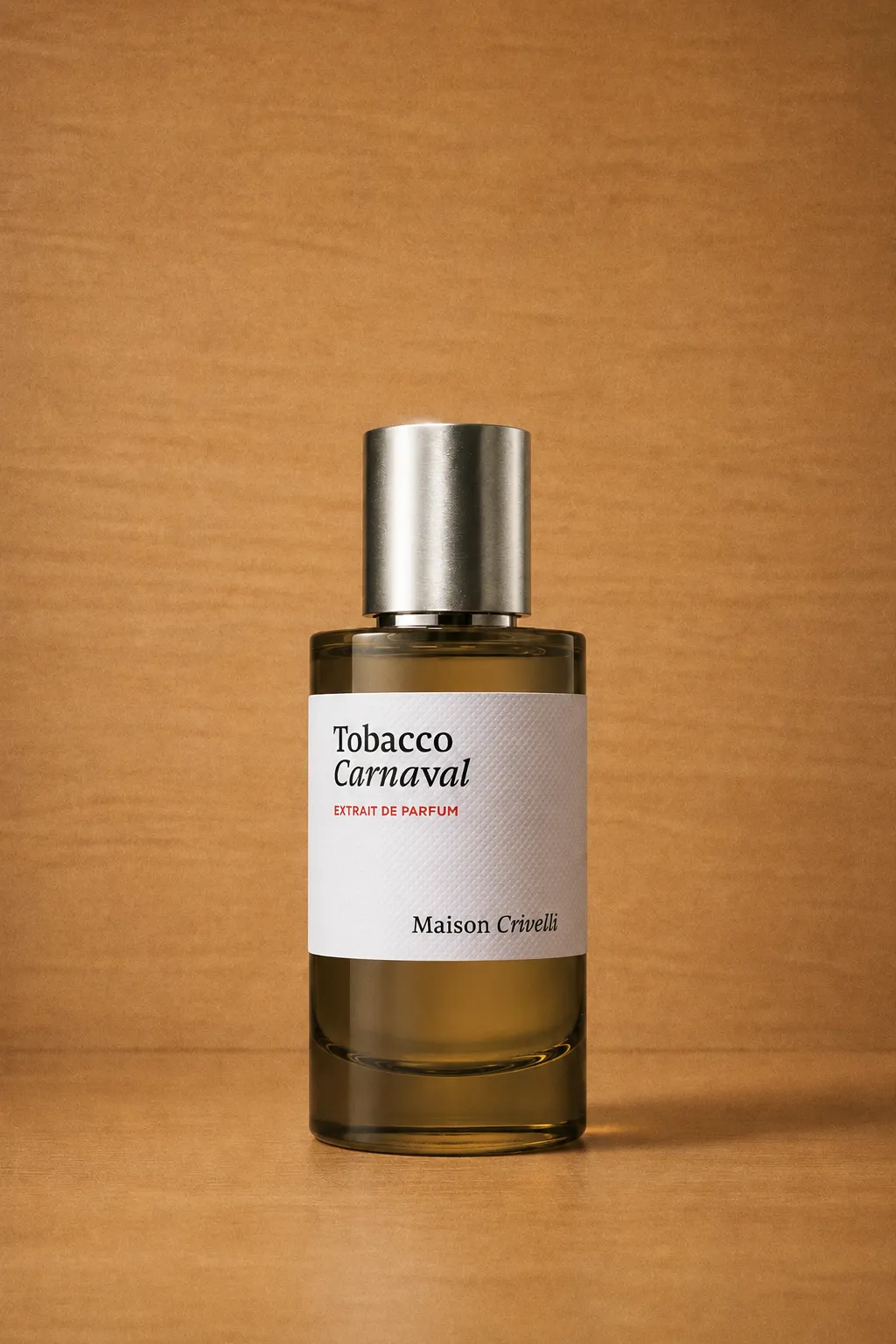
Maison Crivelli builds Tobacco Carnaval on a leaf that is cured
Thibaud Crivelli worked with Quentin Bisch on an extrait built around cured tobacco leaf and infused rum – the formula is withheld
Tobacco is the second material to be named by Maison Crivelli’s Olfactory Mysteries, a collection of extraits whose formulas are deliberately undisclosed: one key raw material is released, a few sensory facets, nothing else. For Tobacco Carnaval, launched worldwide on 3 September 2026, that material is the tobacco leaf.
It is one of the few perfumery materials whose smell does not exist at harvest. Nicotiana tabacum leaves come off the plant green and almost odourless in perfumery terms. What the industry calls tobacco is the product of curing: a controlled senescence in which chlorophyll breaks down, sugars and nitrogen compounds rebalance, and the volatile profile is effectively built.
The method determines the result. Virginia leaf is flue-cured in heated barns over roughly four to eight days; the heat caramelises the leaf’s own sugars without adding smoke, and the profile comes out honeyed, hay-like, blonde. Burley is air-cured over weeks in open barns, which oxidises most of the sugar and leaves a low sugar-to-nitrogen leaf – darker, more caramelic, cigar-box. Oriental varieties are sun-cured and read dry and herbaceous; Latakia is fire-cured, and the smoke is literal. Perfumery has historically drawn its extracts from Oriental and cigar-type leaf, though Virginia is also widely used; the choice is a compositional decision before it is an agricultural one.
The scale is worth stating. The global tobacco crop runs above six million tonnes a year. The fraction that reaches fine fragrance is marginal, and it is frequently made from leaf that failed to qualify for smoking products – an agricultural by-product routed into extraction rather than a dedicated crop.
Concrete, absolute, and the problem of nicotine
Cured and aged leaf is extracted with a non-polar solvent, usually hexane or petroleum ether. What comes off first is a concrete: a waxy, near-black mass carrying plant waxes alongside the odorous fraction. The concrete is washed with ethanol, chilled so the waxes precipitate, then filtered. The ethanol is removed, and what remains is tobacco absolute – a dark brown to black-brown viscous material, difficult on its own, closer to fermented hay and damp leather than to anything a perfumer would sell as tobacco.
Supercritical CO₂ extraction has entered the category more recently and yields a brighter, more faithful reading of the leaf; molecular distillation is used by some producers to isolate specific fractions.
Nicotine is largely handled by the chemistry rather than by an added step: it is water-soluble and therefore poorly carried by an oil-soluble extraction, and perfumery-grade material is denicotinised to trace levels. The absolute that arrives in a perfumer’s organ is not a smoking product and cannot behave as one.
It is also expensive in use and slow to move. Tobacco absolute functions as a base note and a fixative, typically handled at ten percent dilution in dipropylene glycol or triethyl citrate and dosed somewhere between half a percent and three percent of a formula. Its first significant appearance in fine fragrance is usually dated to 1919, in Caron’s Tabac Blond, composed by Ernest Daltroff. A century later the note is rarely a single material: houses build tobacco accords around the absolute using coumarin as a backbone, megastigmatrienone for the hay-tobacco effect, pyrazines for roasted nuance, and hay-type absolutes for depth.
Rum is an accord
The house describes the second axis of the composition as infused rum. In production terms, rum does not enter perfumery as rum. There is a natural rum extract obtained by concentrating distillate, but it is used almost entirely in flavour work rather than in fine fragrance.
What a perfumer builds instead is a construction. The boozy-ethereal core is usually acetaldehyde diethyl acetal, traded as rum ether, sharp and volatile enough that it is dosed at ultra-trace levels. Ethyl esters – butyrate, hexanoate, formate – supply the fruit; isoamyl acetate pushes towards overripe banana. Vanillin and ethyl vanillin carry barrel sweetness, cis- and trans-oak lactone carry the cooperage wood. A dark rum leans further on caramelised-sugar molecules: furfural, sotolon, hydroxymethylfurfural. Fragrance houses sell proprietary rum bases that pre-blend this architecture into a single specialty.
The distinction matters for a piece of copy like this one. Infusion here is a description of an effect, not of a process step: nothing is macerated in spirit. The liqueur reading is assembled, and then made to sit under the tobacco rather than beside it.
What the label declares when the formula does not
Maison Crivelli withholds the formula. European law does not permit it to withhold everything. The result is that the most informative published document about a secret formula is its ingredient list. For Tobacco Carnaval, after alcohol, parfum and water, the house declares tetramethyl acetyloctahydronaphthalenes – the diffusive woody-ambery material known commercially as Iso E Super – followed by patchouli oil, coumarin, alpha-isomethyl ionone, linalool, benzyl salicylate, eugenol, beta-caryophyllene, Atlas cedar, cinnamal, clove oil, pinene, sandalwood oil, santalol, eugenyl acetate, limonene, vanillin and rose ketones.
Read as material rather than as legal text, that is a spice register built on clove and cinnamic aldehyde, a woody spine of Atlas cedar and sandalwood extended by a synthetic diffuser, patchouli for earth and volume, and coumarin and vanillin doing the sweet, hay-adjacent work that tobacco accords have relied on since Daltroff.
The tobacco absolute and the rum architecture stay inside the word Parfum. The disclosure is real, and it is partial. That is precisely the space the collection is designed to occupy.
Carotenoids: why the tobacco reads as fruit
The one entry worth isolating is rose ketones – the damascones and damascenone. They are carotenoid degradation products, and so is megastigmatrienone, the molecule most responsible for the hay-tobacco character of cured leaf. Both arise from the same breakdown chemistry that curing sets in motion, which is why the fruit that early wearers report in Tobacco Carnaval – stewed apricot, plum, something between jam and liqueur – is not an interruption of the tobacco. It is a magnification of one of its own facets, pulled forward and given a spirit to sit in.
The concentration is stated: 32 percent, vegan, in the bronze semi-transparent glass the house has adopted for the collection, cased in moss green. It launched at €350 for 100 ml and €200 for 50 ml, distributed in Italy through Olfattorio Bar a Parfum. Extrait at that load is not a question of longevity alone; it changes which materials can be perceived at all, since the heavy, slow-diffusing end of the palette – absolutes, sandalwood, fixatives – occupies proportionally more of what reaches the nose.
Maison Crivelli
Maison Crivelli was founded in Paris in 2018 by Thibaud Crivelli, who spent a decade in Asia working with perfume houses and encountering raw materials in the fields and markets where they are grown. The house builds each fragrance from a documented personal experience, translated into moodboards of images, sound and texture before a perfumer is brought in – Quentin Bisch here, as on Ambre Chromatique. Sourcing commitments include patchouli through the Coeur de Forêt initiative in Indonesia, no artificial colourants in the formulas, and packaging in handmade Italian paper.