Eredi Zucca and the Genius Loci of Milan: Ultima Cena recalls Leonardo
Can the genius loci of Milan become a perfume? Ultima Cena is the point of departure for reading a perfume house that connects scent with the historical and material identity of the city
One phrase, applied to Eredi Zucca — the Milanese perfume and personal-care house founded in 2023 — takes on a particular meaning: Genius Loci. In Roman religion it was the guardian spirit of a place, a presence that kept its identity and accompanied its life. The grammarian Servius, in his commentary on Virgil’s Aeneid, wrote nullus locus sine genio: no place is without its genius. The idea was later taken up in architecture, philosophy and landscape studies to describe the features that make a place recognisable and unlike any other. In 1980 the Norwegian architect and theorist Christian Norberg-Schulz published Genius Loci: Towards a Phenomenology of Architecture, which helped bring the concept back to the centre of architectural debate: the spirit of a place is not only its buildings or its monuments, but the relations between people, the collective memory, the habits and the changes that set its identity.
Eredi Zucca offers a Milanese case of that idea in contemporary perfumery. The house builds its world through precise references to the city’s history, past a generic nod to its look. The relationship with Milan runs through the choice of address, the interior project, the professional tradition it claims, and the figures chosen for the bottles.
The history the brand evokes goes back to 1652, when Carlo Antonio Zucca opened a barbershop in Spanish-ruled Milan. The barber’s shop was then a place where grooming lived alongside medical practices and social life. That continuity belongs to the brand’s historical and genealogical account; the present company was founded in 2023, recovering the name and the imagery.
Eredi Zucca in Via Bigli 6, the Milan shop designed by John Whelan
Eredi Zucca boutique is at Via Bigli 6, steps from Via Montenapoleone, inside the Quadrilatero. The interiors, developed with John Whelan of The Guild of Saint Luke, build a route through different periods of Milanese decorative history. The entrance is screened by a linen curtain, with a brass medallion and a bell.
Inside, the walls are clad in black ebony boiserie, broken by columns with Corinthian capitals. The counters are green marble, the floors hand-laid mosaic, the decorated plaster ceilings carry references from neoclassical architecture and the Teatro alla Scala. Three private rooms hold shaving, hair care and facial treatments, where restored period chairs in green velvet sit with contemporary tools and adjustable lighting; in the cases, razors, brushes, containers and products are shown as a collection of decorative objects. Eighteenth-century libraries, historic pharmacies and neoclassical architecture meet in the same rooms, composing an image of old Milan out of materials, techniques and objects of different periods.
The Eredi Zucca perfumes and the cameos of Manzoni, Verdi, Marinetti and Einstein
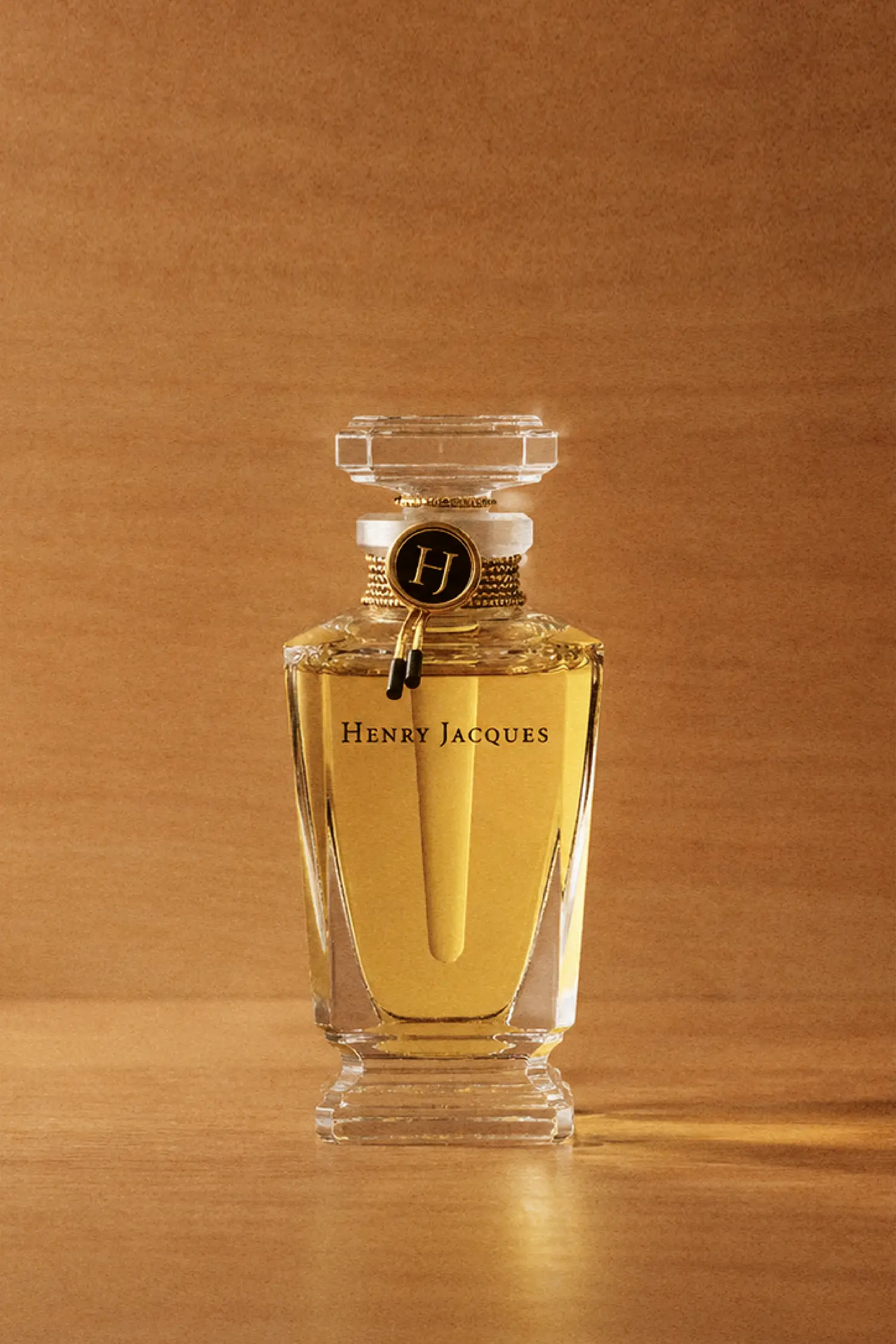
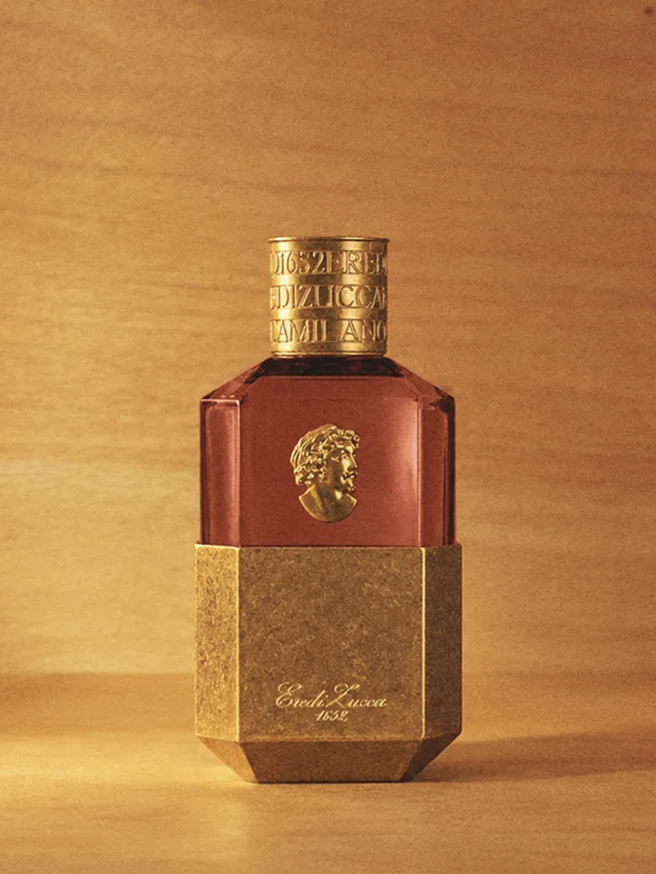
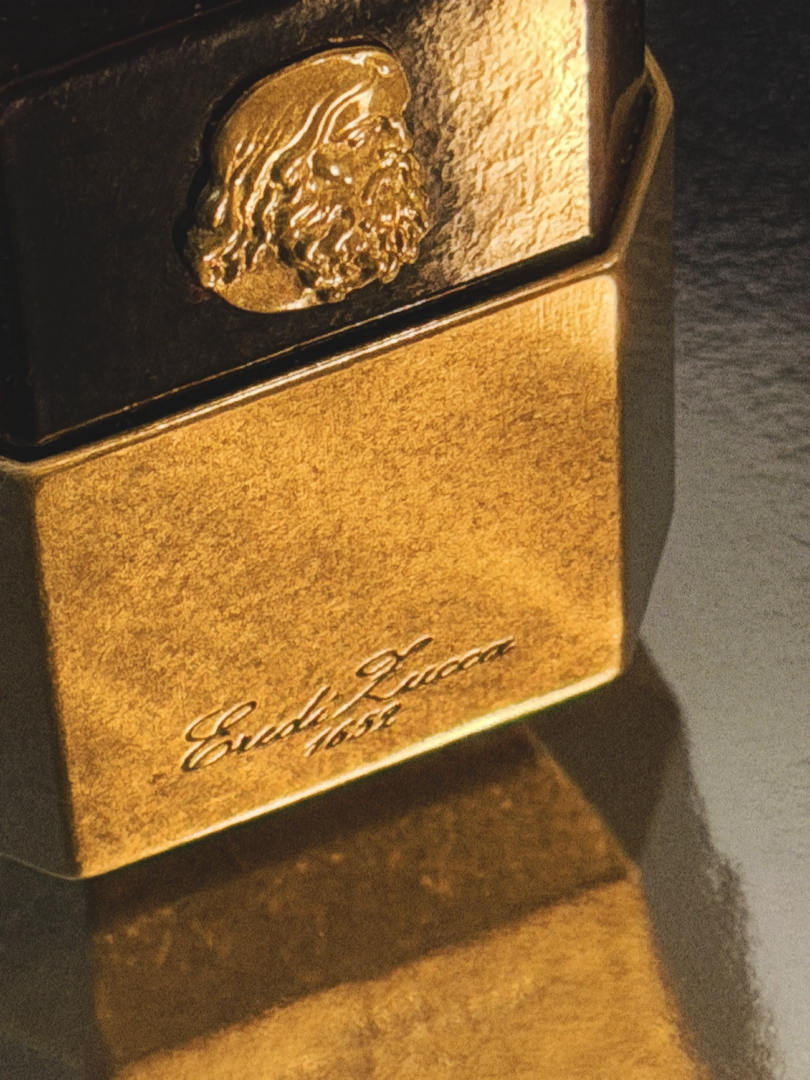
The bottles, in faceted glass with brass-finished metal, carry cameos of figures who shaped Milan’s cultural history and its international reach. Alessandro Manzoni appears on Veritas, Giuseppe Verdi on Cuoio, Filippo Tommaso Marinetti on Novecento, Albert Einstein on Ventuno, for the years of his youth spent partly in Milan. Some were born elsewhere, some worked in the city, others found there a decisive part of their training. Milan is represented through the figures and movements that passed through it and helped make it a centre of culture, art, science and innovation.
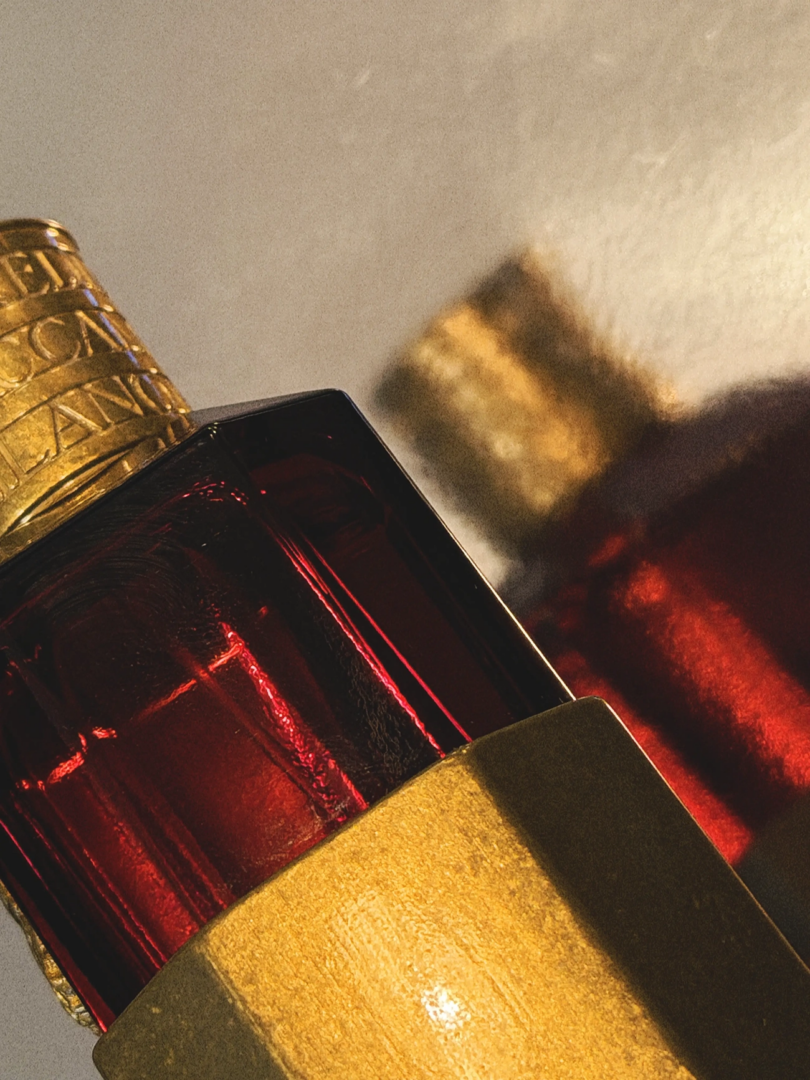
Ultima Cena by Eredi Zucca, the eau de parfum built on rose and patchouli
Of the fragrances in the collection, Lampoon has chosen Ultima Cena, the eau de parfum presented in 2025 and signed by the French perfumer Blaise Mautin. It belongs to the floral-spiced family and develops around the relation between rose and patchouli, with Egyptian geranium, pink pepper, incense and musk.
The choice is tied first to the character of the fragrance, which meets an editorial sensibility that resists a single register. Lampoon can be rough and elegant, rigorous and ironic; not romantic, not immediate. Ultima Cena carries a similar contradiction: the rose, tied by habit to a delicate floral imagery, is set against the earthiness of patchouli and the resinous notes of incense. The result looks past a conventional sweetness toward something more ambiguous, hard to file under a set category.
Then there is Leonardo da Vinci, a figure of one of Milan’s defining seasons. Born in Vinci in 1452, Leonardo reached Milan in 1482, entered the service of Ludovico Sforza and stayed at the Sforza court until 1499, working on painting, architecture, engineering, stage design and scientific study. Milan became a place of experiment, where he could take on technical problems, urban projects, artistic commissions and the study of how nature works.
Leonardo da Vinci in Milan and The Last Supper at Santa Maria delle Grazie
The Last Supper, painted between 1494 and early 1498 on the northern wall of the refectory of Santa Maria delle Grazie, is the best-known result of that period. It shows the moment Christ announces that one of the apostles will betray him, and Leonardo builds the scene through the reactions of twelve men, set in four groups of three, turning a Gospel episode into a study of human behaviour. The perspective leads to the central figure of Christ, while gesture, gaze and posture describe fear, disbelief, anger and loss — the moti dell’animo, one of the central themes of his painting.
The work also carries a technical experiment. Leonardo set aside the traditional fresco, which demands painting on still-damp plaster, and worked on a dry preparation. The method let him change the composition and layer glazes, and it compromised the stability of the materials: the surface began to deteriorate within the first decades. That fragility made the Cenacolo the object of a long conservation history, and the restoration completed in 1999, led by Pinin Brambilla Barcilon, removed many later overpaintings and recovered what remained of the original paint film.
Leonardo da Vinci in Milan today, from the Cenacolo Vinciano to the Navigli
In Milan Leonardo remains a daily presence, past cultural tourism. The Museo del Cenacolo Vinciano keeps The Last Supper in its original place, inside the Santa Maria delle Grazie complex, recognised by UNESCO as a World Heritage Site in 1980. The Museo Nazionale della Scienza e della Tecnologia carries his name and gives his research a large part of its display. The Leonardo3 Museum, at the entrance to the Galleria Vittorio Emanuele II from Piazza della Scala, shows digital reconstructions, working models and readings of his projects, and the Biblioteca Ambrosiana holds the Codex Atlanticus, one of the main collections of his drawings and notes.
His presence runs through questions that belong to more than art history, chief among them Milan’s relationship with water. At the Sforza court he studied the system of the Navigli and the problems of navigation, of differences in level and of regulating the water. The canal network existed before he arrived: his contribution lies in the study and the refinement of the hydraulic systems, among them the navigation locks. The Codex Atlanticus holds drawings and notes on that research, where one of the main questions was letting boats pass between stretches of canal at different heights.
Five centuries on, Milan still argues about its water system. The possibility of reopening parts of the historic Navigli network, covered over through the twentieth century, has returned more than once to public debate. In 2018 the city opened a discussion on a project to reconnect the Naviglio Martesana and the Darsena, with a first phase of about 2 kilometres of open canals and an underground connection of the waters. The project stopped over cost, feasibility and the impact on traffic. In 2026 the reopening returned among the proposals for Milan’s environmental and urban future, while associations and the administration weigh the options. The whole design of the Navigli belongs to others; Leonardo’s contribution sits inside a tradition of hydraulic research that still shapes the way the city reads its own territory.
His work treats painting, engineering, anatomy, architecture and the observation of nature as communicating disciplines, anticipating an interdisciplinary method now applied to design, scientific research and the development of technology.
Leonardo da Vinci and perfume, distillation and the exhibition at Clos Lucé
The link between Leonardo and the culture of scent is documented. His manuscripts carry notes on aromatic substances, on distillation and on methods to extract and keep perfumes. The Codex Atlanticus holds a process to transfer the smell of flowers to peeled almonds, using the ability of fatty materials to absorb aromatic substances, and Leonardo also looked at citrus peel and at the instruments of distillation.
In 2024 the Château du Clos Lucé at Amboise, where the artist spent his last years, devoted the exhibition Léonard de Vinci et les parfums à la Renaissance to the theme, curated by the historians Carlo Vecce and Pascal Brioist. It reconstructed the olfactory culture of the Renaissance through manuscripts, recipe books, instruments and sensory installations, among them a reconstruction of an alembic designed by Leonardo. The show looked at the use of aromatic substances in the courts of Florence, Milan and France, where perfume served the body, clothes and rooms, and belonged at the same time to medicine, to the making of remedies and to experiment on the properties of natural materials. At the Sforza court, scent was part of social display: essences, aromatic waters and perfumed objects marked the rank and the identity of whoever used them.
Ultima Cena notes, Egyptian geranium, pink pepper, incense and musk
The opening of Ultima Cena holds Egyptian geranium, rose and pink pepper; the heart is built around rose and patchouli; the base brings incense, patchouli and musk. Patchouli, from the leaves of Pogostemon cablin, a plant of the mint family, gives an earthy, woody, at times camphoraceous oil, with a persistence that suits the base. Rose carries a complex aromatic structure, with fresh, green, spiced and honeyed facets, and its pairing with patchouli produces the contrast between floral and earthy that forms the main axis. Egyptian geranium, used for its green and rosy notes, carries a continuity with the rose, while pink pepper adds a spiced, resinous edge. In the base, incense moves the composition toward a drier, balsamic register, with the softness of musk beside it.
Incense also brings an association with religious spaces, out of a cultural repertoire in which aromatic resins and sacred ritual are historically tied. The rose–patchouli pairing moves past the traditional split between men’s and women’s perfume: rose has often been tied to feminine perfumery and patchouli, in its more intense forms, to accords read as masculine, cultural conventions more than qualities of the ingredients, since both have long belonged to formulas for different audiences. In Ultima Cena the contrast holds both sides. The rose keeps its floral identity, the patchouli changes how it reads, bringing depth and persistence, and the incense sharpens that ambivalence, pulling the composition away from a romantic reading.