Satinine Galleria: Bulgarian rose, Italian sage and Indonesian nutmeg beneath Mengoni’s iron vault
The Milanese house names a composition after the Galleria Vittorio Emanuele II and builds it on three raw materials from three countries
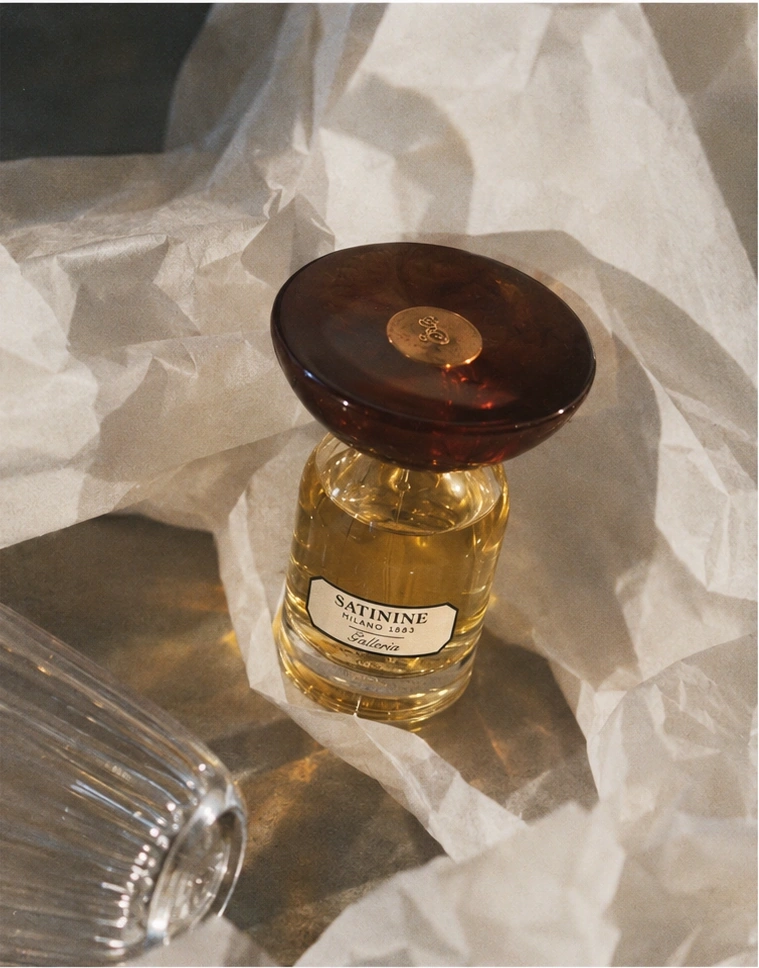
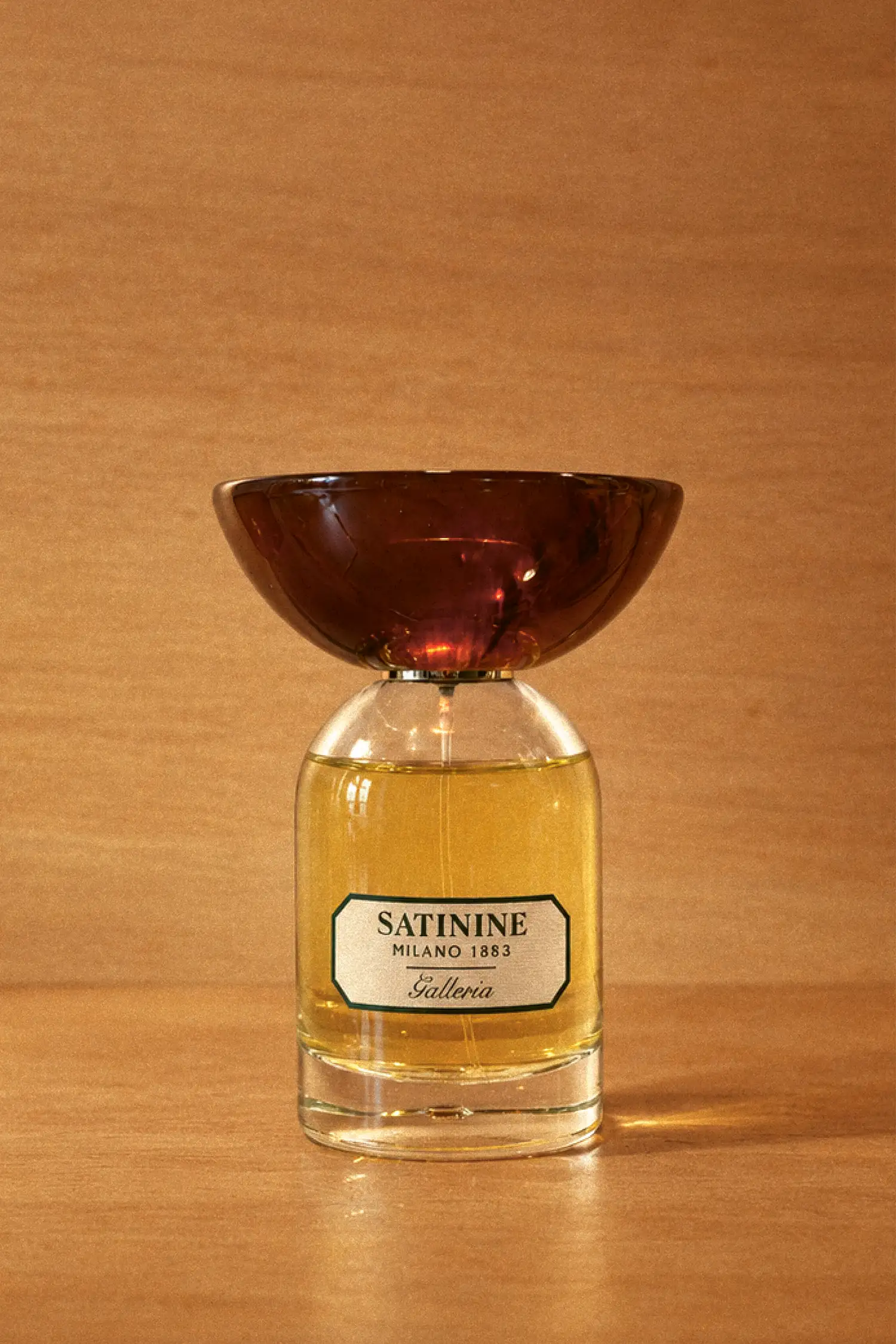
Galleria is a fragrance by Satinine, the Milanese house founded in 1883 by Lorenzo Usellini and relaunched in December 2025 after more than half a century of inactivity. It belongs to the collection of twenty-one fragrances presented at the reopening, developed and produced in the brand’s own laboratory in Milan. The house classifies it as fruttato, verde, talcato — fruity, green, powdery — and declares three ingredients: Bulgarian Rosa damascena absolute, Italian Salvia officinalis, and Indonesian nutmeg. Galleria is available at Officina Satinine, Via Giuseppe Mengoni 4, a short walk from Piazza del Duomo.
The press text describes the Galleria as a temple of Milanese elegance where gemstones from Africa, silks from Paris and teas from the East once mixed beneath iron vaults. It closes on the architect: Giuseppe Mengoni built it to last, and it has.
Galleria Vittorio Emanuele II and Giuseppe Mengoni: the reference behind the name
In 1860 the city of Milan launched a competition to redevelop the area between the cathedral and the opera house. The design of Giuseppe Mengoni, an architect from Fontanelice trained at the University of Bologna, was adopted in 1861. Mengoni had studied the covered arcades of Paris and proposed a glass-roofed passage linking Piazza del Duomo to Piazza della Scala. Victor Emmanuel II, the first king of unified Italy, laid the first stone on March 7, 1865.
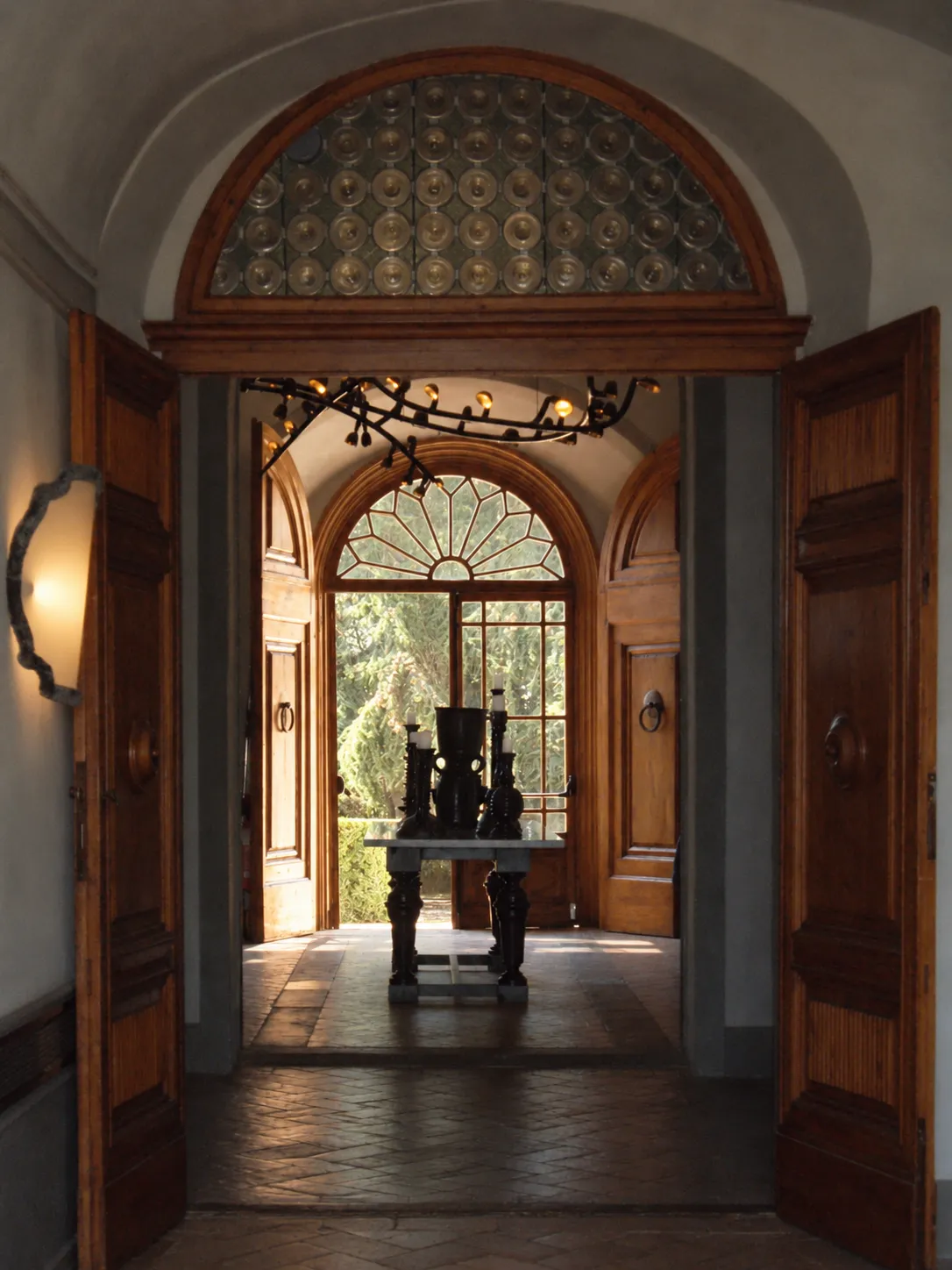
The structure consists of two glass-vaulted arcades crossing in an octagon beneath a central dome, roofed in cast iron and glass. The arcade opened in 1867; work on the triumphal entrance arch facing the Duomo continued for another decade. On December 30, 1877, the day before completion, Mengoni fell from the scaffolding during a final inspection. He was forty-eight. The Galleria remains Italy’s oldest active shopping arcade, and the Milanese call it il salotto di Milano, the city’s drawing room. Satinine’s boutique stands on Via Giuseppe Mengoni, the street named after the architect, a few steps from the arcade.
What is Bulgarian Rosa damascena absolute — and how is it made
Rosa × damascena is a cultivated plant with no known wild populations. Genetic analysis identifies it as a hybrid of Rosa moschata and Rosa gallica, crossed with the pollen of Rosa fedtschenkoana, pointing to an origin in Central Asia or Iran. Bulgaria, Turkey and Saudi Arabia account for over seventy percent of the rose oil market. Bulgarian production is concentrated in the Rose Valley near Kazanlak. Flowers are picked by hand in the early morning, before sunrise, and processed the same day.
The rose yields two different materials, depending on the method. Steam distillation in copper stills produces rose otto, an essential oil. Solvent extraction produces an absolute. In the second process, the petals are agitated in a vat with a solvent such as hexane, which draws out aroma compounds together with waxes and pigments. The solvent is removed under vacuum, leaving a waxy mass called a concrete. The concrete is then washed with alcohol, which dissolves the aromatic fraction and leaves the wax behind; the alcohol is evaporated at low pressure. The result is a deep reddish-brown liquid. Because the process runs at low temperature, the absolute tends to stay closer to the smell of the fresh flower than the distilled otto, where heat alters some compounds.
The chemical difference between the two is measurable. Bulgarian rose absolute consists of alcohol, in proportions that depend on the extraction conditions and the concentration of the ethanol used. Phenylethyl alcohol is water-soluble, so in distillation much of it passes into the rose water. Yields are low: depending on species and method, roughly three thousand parts of petals produce one part of oil.
Italian Salvia officinalis: the green and camphoraceous facet
Salvia officinalis, common or Dalmatian sage, is a different species from clary sage, Salvia sclarea, the variety more frequently cited in perfumery. In a study of Dalmatian sage, flowering parts contained more oil than leaves. Sage can also be solvent-extracted. Its essential oil is steam-distilled from the leaves and has a camphoraceous, herbaceous profile with a dry, woody undertone.
Indonesian nutmeg: Myristica fragrans and the Banda Islands
Myristica fragrans is an evergreen tree native to the Banda Islands in Indonesia’s Maluku archipelago, the historical Spice Islands. A single fruit gives two spices: nutmeg from the seed, and mace from the red aril that wraps it. In 1667, under the Treaty of Breda, the Dutch retained Run, a small nutmeg island in the Bandas, while the English kept Manhattan — an exchange that reflects the value of the spice under the Dutch East India Company’s monopoly.
Nutmeg oil is obtained by steam or steam-and-water distillation of the dried, crushed seeds. Reported oil yields from nutmeg kernels range from five to fifteen percent. The terpenes give a sharp, resinous, almost coniferous opening; myristicin contributes a dry, warm spiciness. Origin affects the balance: East Indian oils, from Indonesian and Indian sources, tend to be spicier and richer in myristicin, while West Indian oils from Grenada are milder, with more sabinene. Indonesia exports around 350 to 400 metric tons of nutmeg oil a year, about eighty percent of global production.
Satinine Galleria: fruity, green, powdery — how the three materials build the structure
Read against the chemistry of its declared materials, the classification follows a sequence. The fruity register belongs to the rose absolute, the fruit-like side of the flower. The green register comes from the sage: camphor, cineole and thujone bring an herbaceous, cooling edge to the opening. Nutmeg links the two, its terpenes adding lift at the top while myristicin supplies a warm, dry spice. As the volatile terpenes of sage and nutmeg evaporate, a softer, drier trace remains, the stage at which the powdery facet develops.
The remainder of the formula — the materials that fix the composition and shape its drydown — is not disclosed, which is standard practice in the industry. Two of the three declared ingredients come from outside Italy, the rose from Bulgaria and the nutmeg from Indonesia; the sage is the Italian component. The geography matches the brief: the press text describes the Galleria as a meeting point for goods from other continents, and the composition assembles materials from the Balkans, Italy and the Moluccas.
From Satinine Officina Odoraria to the relaunch: the history of the house
Lorenzo Usellini, originally from Arona on Lake Maggiore, founded Satinine in Milan in 1883 as a business importing and distributing toiletries. In 1910 he built a palazzo at Via Broggi 23 to house the laboratory, the shop and the family home. After the First World War the firm began composing its own fragrances under the name Satinine Officina Odoraria. In the 1930s Usellini and his son Carlo Antonio, a chemist, developed Orchidea Nera and Caccia alla Volpe, also sold abroad, in bottles made by Vetrerie Bormioli. During the Second World War, production moved to the family home in Arona.
Profumieri Milano, co-founded by Galletti and former Loewe president Ridgely Cinquegrana, reacquired the brand in 2024. The company owns the trademark and an archive of more than 150 items from the 1920s to the 1960s; the oldest is a pocket calendar from 1903. The relaunch draws on both archive documentation and reconstruction. Satinine ran chromatography on sealed 1930s bottles and used the results as a reference for the new formulas rather than as a replica.
Bottle, caps and the vuoto a rendere refill
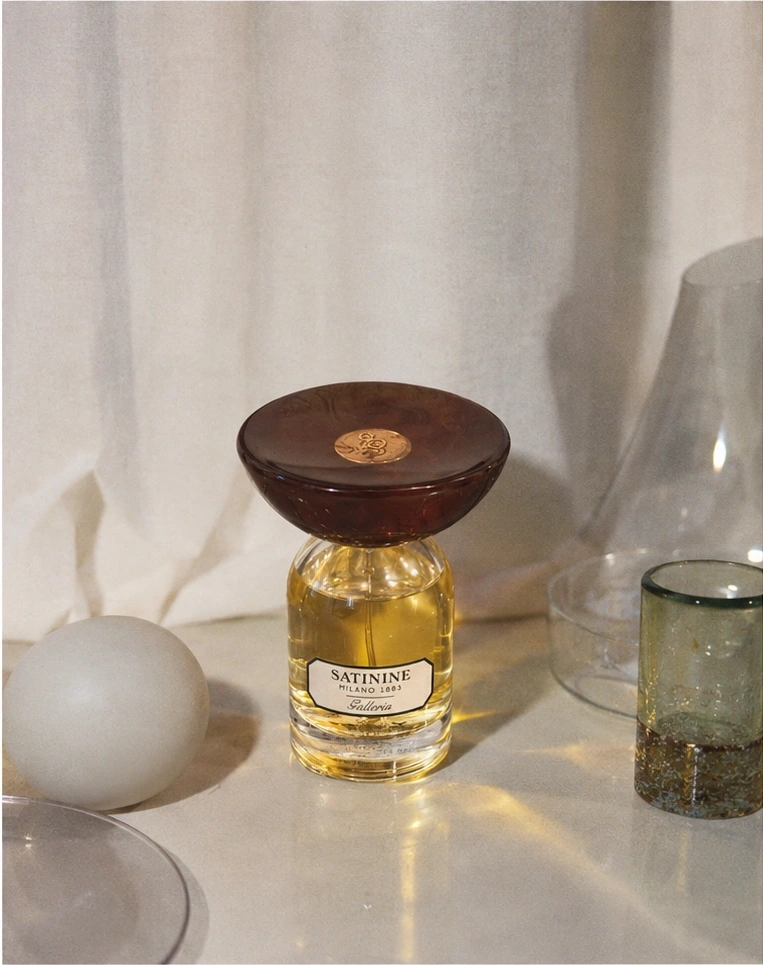
The flacon was designed by Milanese designer Franz Degano and draws on 1930s Art Deco. The cap is oversized: the standard version is bio-resin, the premium version marble. The refill system dates back to the brand’s wartime history. When raw materials ran short during the Second World War, Satinine bottles were marked vuoto a rendere, meaning the customer could bring back the empty bottle to be refilled. Today the house takes back empty bottles, cleans them, and returns them to circulation as refills.
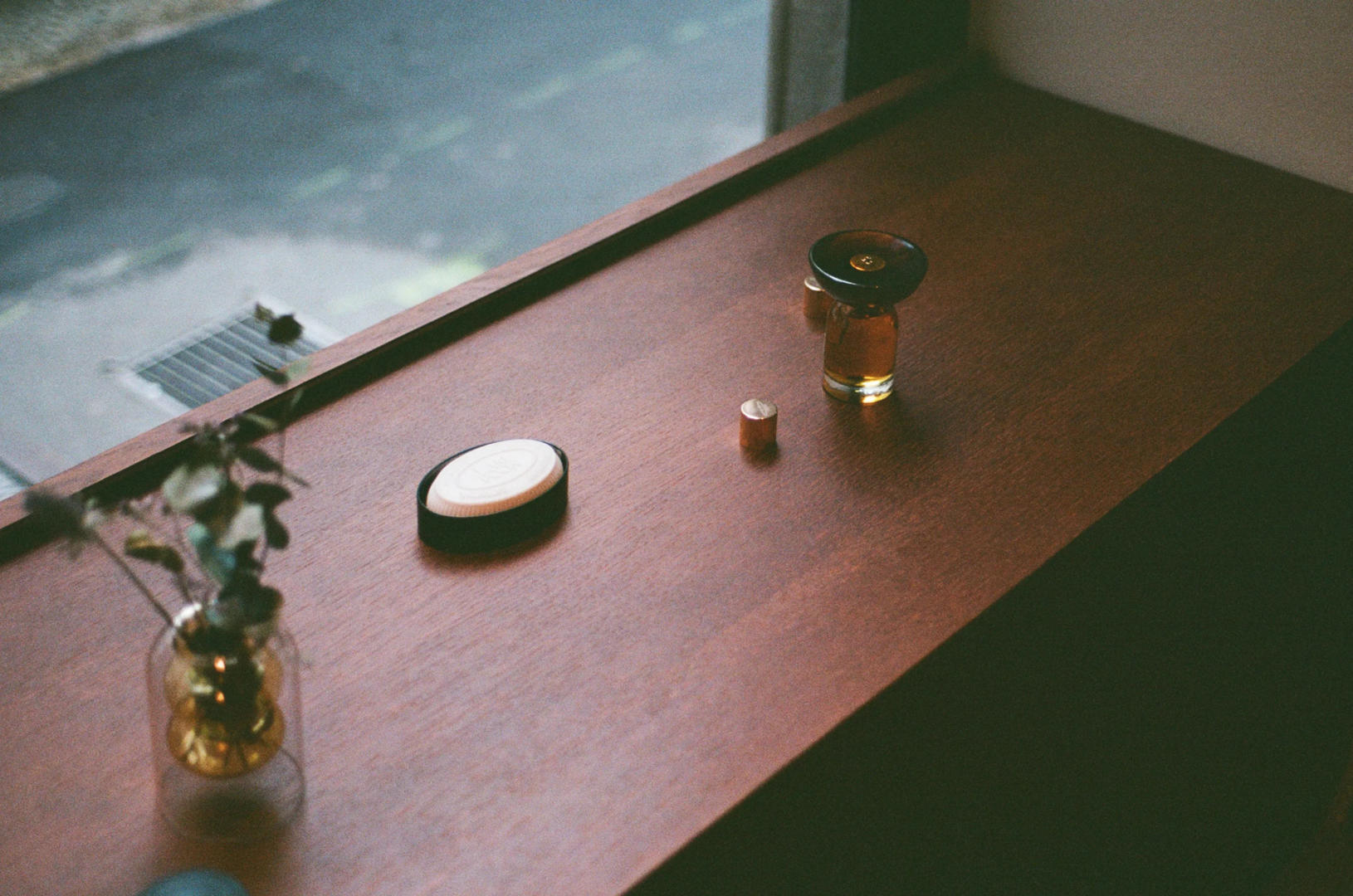
Satinine, in collaboration with Lampoon, presented a limited-edition soap to mark the launch of the Soap Issue.
Editorial Team