How Carthusia turned Capri into a fragrance identity
Inside the world of Fiori di Capri, and how Carthusia transformed Capri into a fragrance identity built on place, continuity and local production.
Fiori di Capri: Carthusia’s heritage in a bottle
Before Carthusia became a global fragrance name, and way before its laboratory became a must-stop between Via Camerelle and the Gardens of Augustus, there was Fiori di Capri. It wasn’t a seasonal release or a product created to respond to market demand. In 1948, Fiori di Capri was released as the official perfume of the house. This is precisely when Carthusia moved into formal production. It was an island legend then, and today, it has the same position. Today, Fiori di Capri is not in the brand’s archives; neither is it nostalgia. The fragrance continues to be at the center of Carthusia’s catalogue, sold from Capri, exported from the same place that gave it its name.
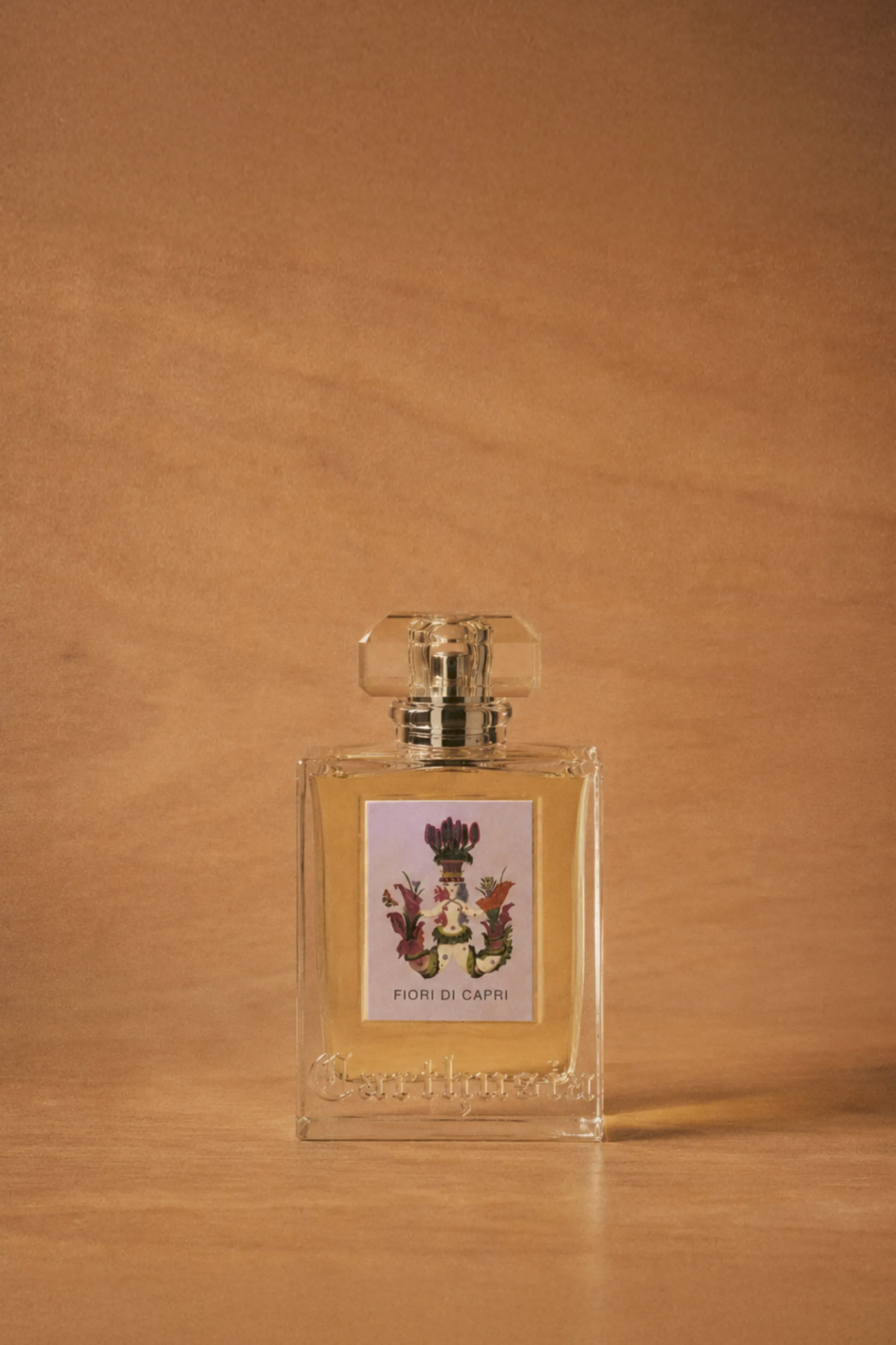
The fragrance remains; it has changed little from its original form. The silhouette is still the same clear apothecary one, now coming with a clear glass cap. It’s closer to pharmaceutical glass than contemporary luxury packaging. The same typography that has become synonymous with the house and its heritage is also preserved. In a sector that sees continuous rebranding of heritage, Fiori di Capri has remained materially stable. It’s still recognized, but it comes from repetition rather than reinvention. The bottle, the typography, the design remain close to the original because they do what they’re meant to do: identify the brand. The fragrance carries Capri in a glass.
Fiori di Capri: The floral opening and what comes after
The name performs similarly. “Flowers of Capri,” translated from Italian, is not a poetic description. The name of the fragrance is a territorial labeling, naming the place before it names a scent. Before learning about the scent and the composition, way before learning about concentration or olfactory family, the fragrance announces its belonging to an island. This is what became the foundation of Carthusia — a relationship between fragrance, geography, and origin. In a way, Fiori di Capri created Carthusia itself.
The name promises flowers, but the formula resists simplicity. The fragrance opens with citrus of tangerine, bergamot, and orange blossom. This Mediterranean vocabulary expected from a Caprese name doesn’t linger for long; white florals take over densely. Not delicately, as you would expect, but with weight in it. But the composition continues to shift. Beneath the floral opening, Fiori di Capri grows into a classic chypre structure — spiced, slightly powdered, built with the density of mid-century perfumery. And by the time the woody base of cedarwood, sandalwood, and patchouli settles into the base, the fragrance has left its floral identity altogether. It’s now dryer, structured, and more persistent. What remains is a scent that’s farther from the Capri sold in brochures, and much closer to the island that remains after the boats leave.
Capri before Carthusia: The inheritance of an already written landscape
Capri has long carried a closed aesthetic system, way before Carthusia was created. An island of over ten square kilometers, separated from the Bay of Naples by a small body of water, yet completely distinct in its own aesthetic appeal. For centuries, Capri has produced images way bigger than its size. From Roman villas, limestone cliffs, and monastic architecture to postwar cinema, foreign artists, and aristocratic tourism, geography on the island is anything but neutral. By the nineteenth century, Capri was already a destination for writers, artists, and collectors.
When Carthusia came in, rather than creating a mythology for Capri, the house inherited an island of rich narrative. Part of Carthusia’s history lives in it too. The origin began back in 1380, in the Certosa di San Giacomo. The Carthusian monastery was founded in the fourteenth century, right above Marina Piccola. The story began with the arrival of Queen Joan of Anjou at the monastery, where they had gathered Capri’s flowers in a basin of water as a ceremonial offering. The water where the flowers sat for three days had gained a specific fragrance. Later, the name was identified — Garofilum silvestre caprese, meaning the wild carnation of Capri. A fact or a legend, this shows that Capri’s first perfume was never an invention, but an accident of place.
Centuries later, old fragrance formulas were discovered and passed to a chemist from Piedmont, who established what the house calls “the smallest laboratory in the world.” The name Carthusia, meaning charterhouse in Latin, solidified this connection. Local mythology moved from oral history to an industrial language with a specific vocabulary: island, monastery, flowers, formula, bottle. This is how Fiori di Capri emerged, giving Capri a fragrance identity.
The making of Carthusia, from a local legend into a laboratory
Fiori di Capri’s production is anchored to the island. The laboratory is in Capri, far from its industrial area and closer to where tourism flows. Inside, the process is limited in scale; an intentional move by Carthusia to maintain a model of small production. Instead of automation, the creation and bottling are also kept manual or semi-manual. A way to control the origin by keeping it in close proximity to the place. Carthusia’s laboratory extends beyond the traditional format; it’s a point of workshop and verification, which defines every product it produces.
A fragrance that was made on an island where everything is translated into souvenirs carries the claim of origin as its primary identity marker into the global market. Craftsmanship is still important, but it’s not the priority; it’s the geography that becomes inseparable from the product.
The Carthusia Store: Embedded in Capri’s architecture
Carthusia doesn’t live in a single flagship; it’s spread all over Capri as a network, across the pedestrian locations with the same precision as the fragrances. The laboratory remains close to Parco Augusto, open year-round, but the brand extends outward through seasonal boutiques across Capri’s concentrated areas. Carthusia is on Via Fuorlovado, near Marina Grande, where visitors first arrive by ferry, and along Via Federico Serena, one of the island’s most trafficked commercial arteries. Each of the stores is inserted directly into Capri’s movement.
In 2023, the newest Carthusia boutique opened its doors inside Capri’s historic newsstand in the Piazzetta, one of the most visible public points on the island. The choice of location was more than expansion; it was a form of occupation of the former kiosk that used to serve as a local information point. Once a place for newspapers, it’s now become a space dedicated to scent. Inside, Fiori di Capri remains a point of orientation.
Capri is not a place built around retail. It has a dynamic of its own, and each of the Carthusia stores is embedded and adapted to it. Whitewashed façades, narrow limestone passages, shuttered windows, with terraces, staircases, and courtyards all around, Capri’s architecture dictates every commercial gesture here. Carthusia boutiques adopt that visual language, one that’s present in Fiori di Capri too: direct, legible, with no theatricality.
Continuity as a local structure of Carthusia
What Capri knows best is how to bring continuity. For centuries, the island has preserved its authentic character — same façades, same terraces, same names painted above hotel entrances long after the original owners are gone. Carthusia exists in continuity too, but it lies outside branding or campaigns. People behind it never really left, and that’s what contributed to the permanence of the house.
Carthusia continues to exist under the Ruocco family. One of Capri’s historic families, the Ruoccos have long been woven into the commercial and social scenery of the place. This is where the fragrance house enters a different category of luxury. Decisions are not made in Paris, London, or Milan, but in the same streets where the laboratory and the boutiques open every day. That close proximity to its place of origin is what ensures the maintenance of the company, which is far less romantic and more routine-based. The island that holds it all together, the family that manages it, the people who know the difference between a summer customer and a regular client who’s been buying Fiori di Capri for thirty years.
Inside the stores, faces repeat too. Sales assistants who have spent seasons in the boutiques. Lab workers who know the weight of the glass bottle before it’s filled. Store managers who recognize surnames and timing of returning visitors — Americans first, Milanese in August, northern Europeans in September. Memory has commercial value; this is why Fiori di Capri existed without reinvention. It was designed to outlast the season and linger in the memory.