Uzbekistan: some Soviet Modernism is leading creativity worldwide
From Timurid empires to Cold War metros, from mud-brick labyrinths to solar furnaces: how Uzbekistan is turning heritage, brutalism and contemporary art into a new geopolitical and aesthetic statement
Contemporary Uzbekistan: Bukhara Biennial
Uzbekistan, the most populous state in Central Asia, is currently shaped by an intense cultural dynamic intertwining its Bactrian roots — the ancient historical region between the Hindu Kush and the Amu Darya, largely corresponding to present-day northern Afghanistan — and the legacy of Tamerlane’s empire with a plural and experimental present. Its historical trajectory shifted during the Tsarist period, with the Romanov military occupation in 1865 and the subsequent Soviet rule from 1917 to 1991, which left structural marks on the country’s institutions and urban fabric.
The first Bukhara Biennial, inaugurated in early September 2025, marked a key moment in this cultural repositioning. Uzbekistan, historically a crossroads between East and West, is consolidating new institutional frameworks. The new National Museum of Uzbekistan, designed by Tadao Ando, is under construction in central Tashkent near the park dedicated to poet Alisher Navoiy. The 40,000-square-meter complex is structured around a monumental composition of triangle, circle and square. Opening is scheduled for 2028. On March 21, the CCA (Center for Contemporary Arts) opens. Studio KO transformed a 1912 diesel station and tram depot into a cultural hub including exhibition galleries, a research library and educational programs.
Bukhara revived this dialogue between contemporary practice and traditional know-how
The revival of local craftsmanship in dialogue with global contemporary art defined the mission of the first Bukhara Biennial, held from September to November under the artistic direction of Diana Campbell. Its title: Recipes for Broken Hearts. Uzbek artists participated alongside international figures such as Antony Gormley, who collaborated with restorer Temur Jumaev to construct a labyrinth of mud-brick bodies inside the Khoja Kalon Mosque (1598). Echoing the early model of the Venice Biennale — where avant-garde art intersected with artisanal expertise — Bukhara revived this dialogue between contemporary practice and traditional know-how.
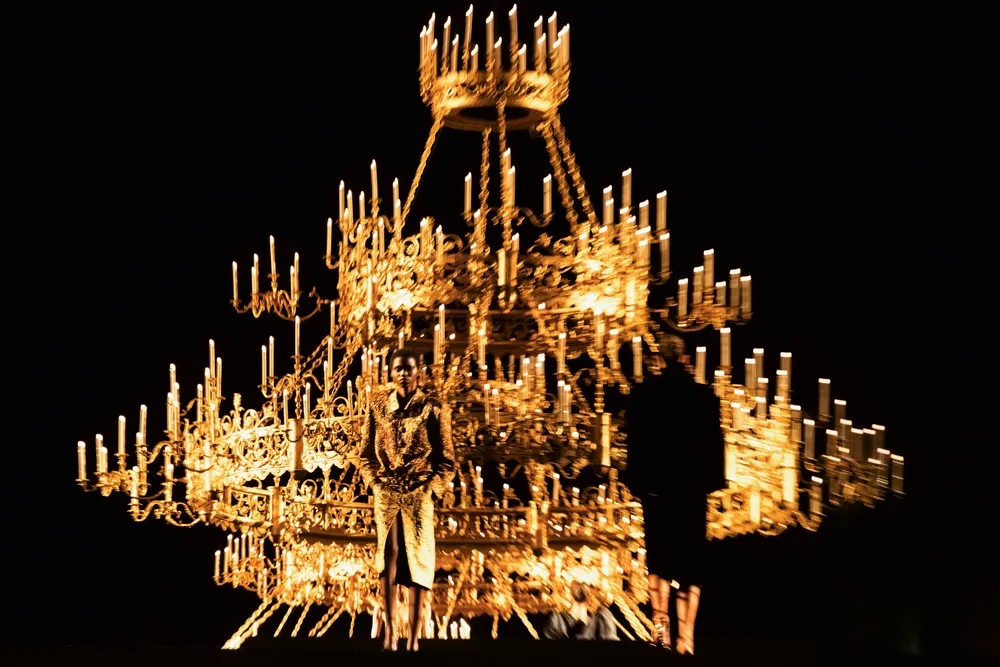
Among the highlights was Abdulvahid Bukhoriy’s Blue Room, an immersive ceramic installation inside the former prayer chamber of the Gavkushon Madrasa (1570). A continuous ishkor-glazed ceramic surface of octagonal tiles with floating inscriptions enveloped the space, accompanied by a metal chandelier created with coppersmith Jurabek Siddikov. The spatial perception dissolved under thousands of blue-toned tiles — peacock blue, turquoise, emerald, tourmaline — generating a chromatic field that redefined scale and morphology.
Tashkent, capital of Uzbekistan: Soviet modernism, brutalism and architectural memory after independence
Tashkent, capital of Uzbekistan, counts more than 2.5 million inhabitants. It is a city marked by contradictions and transformation. Soviet modernist architecture, including a distinct brutalist strain developed through successive phases and often expressed in monumental forms, underwent a form of erasure after independence in 1991. Many buildings constructed between the 1950s and the mid-1980s were demolished or left to decay, perceived as remnants of political and cultural domination. “Nobody remembers Yuri Gagarin, the first human to fly in space,” states Shahnoza Kamalova, entrepreneur and founder of an association defending Soviet architectural heritage, “nor has anyone protected the Tashkent house where he stayed after the Vostok 1 flight in 1961. We turned the page as if that past were only a burden, overlooking that Soviet rule also produced a shared cultural framework. Everyone knew Lev Tolstoy and his writings. The period was harsh. Yet there was a platform of common identity.”
While tourism gravitates toward Samarkand, Bukhara and Khiva, Tashkent represents the epicenter of Uzbekistan’s cultural redefinition. After the destruction caused by the 1966 earthquake, which erased much of the historic fabric, reconstruction intensified under Brezhnev. Soviet modernism in Tashkent developed a hybrid language: monumental public buildings incorporated ornamental motifs drawn from local tradition. Mosaics, reliefs and murals shaped façades and interiors, notably within the Tashkent Metro. Craft traditions — ceramics, metalwork, textiles, wood carving and enamel — were integrated into architectural expression, both in restoration campaigns in Samarkand and in new construction.
Tashkent is expanding, with uneven architectural results
The Uzbekistan Art and Culture Development Foundation, established by Gayane Umerova, advocates for the preservation of Soviet modernism amid accelerated development. International teams document and protect this architectural legacy. The same focus informed the Uzbekistan Pavilion at the 2025 Venice Architecture Biennale, curated by Ekaterina Golovatyuk and Giacomo Cantoni.
The project examined the Sun Institute heliocomplex, a solar furnace built in 1987, 45 km from Tashkent, designed to test materials under extreme temperatures. Conceived during the Cold War technological race, following a similar French facility inaugurated in 1969, the complex consists of 12,090 mirrors and a morphology reminiscent of Antonio Sant’Elia’s futurist projections. It stands as a suspended promise of technological progress, emblematic of an anticipated future repeatedly deferred.
The Tashkent Metro became a flagship project
After the 1966 earthquake, Tashkent proclaimed itself the “Moscow of the East,” drawing on its long history and Silk Road heritage. Modernist reconstruction incorporated ancestral materials and techniques, reinforcing national prestige. Late Soviet modernism sought a more open vocabulary, engaging with vernacular Islamic architecture and developing a layered interpretative language.
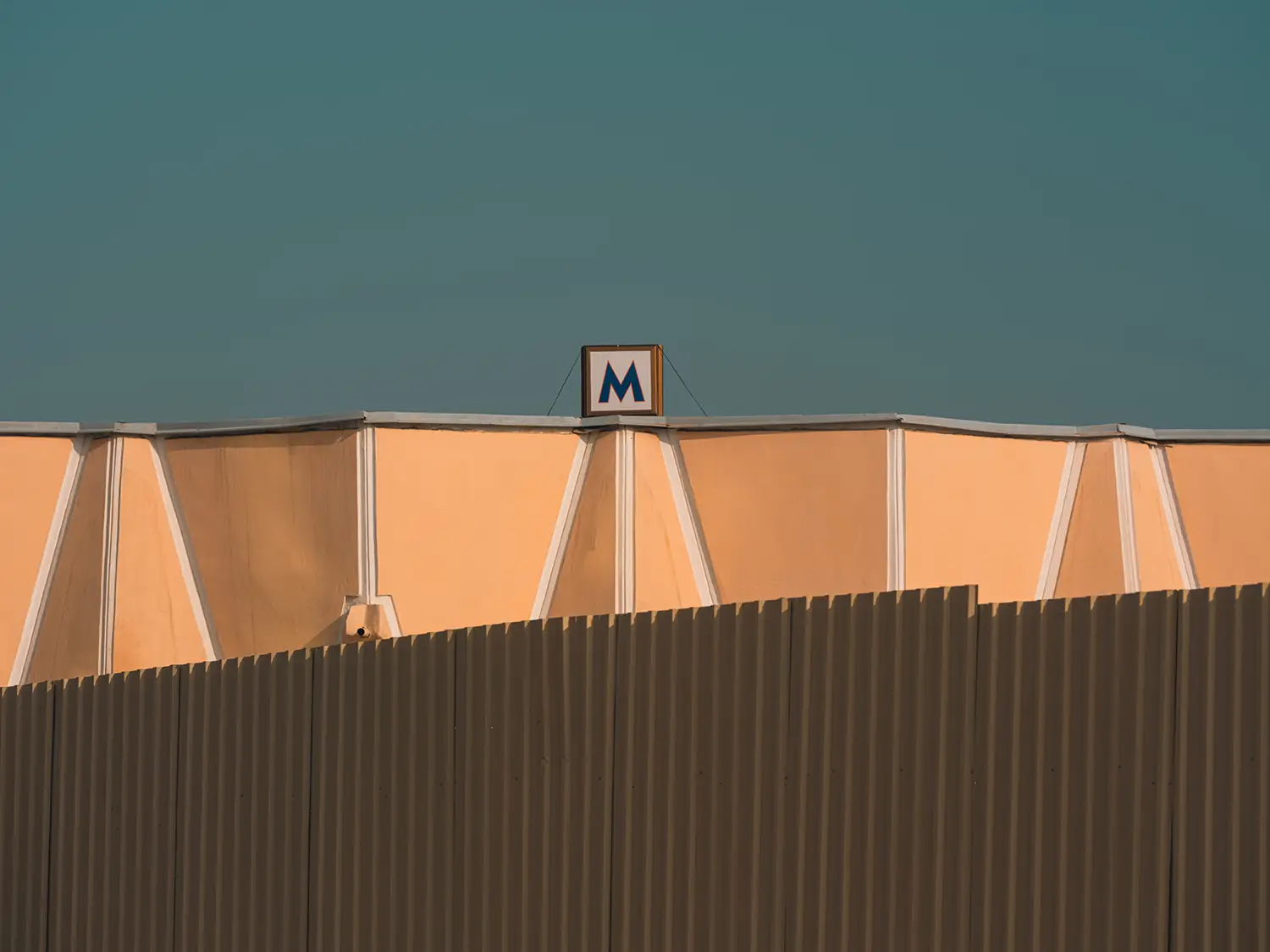
The first metro line, inaugurated on November 7, 1977, extended 10.5 kilometers with nine stations. Today, 29 stations form a symbolic pantheon of Uzbek writers, poets and scientists, while also referencing agricultural resources such as cotton and almonds. Conceived as a rival to the Moscow Metro, photography was prohibited for years. Each station integrates angular Soviet forms with local ornament. The Tashkent Metro became a flagship project: more than 58 kilometers of track, conceived as both infrastructure and cultural statement. Party leader Sharof Rashidov personally oversaw the selection of architects, artists and engineers, positioning the metro as a representation of Uzbek heritage.
Palace of Friendship of the Peoples and the National Museum of History
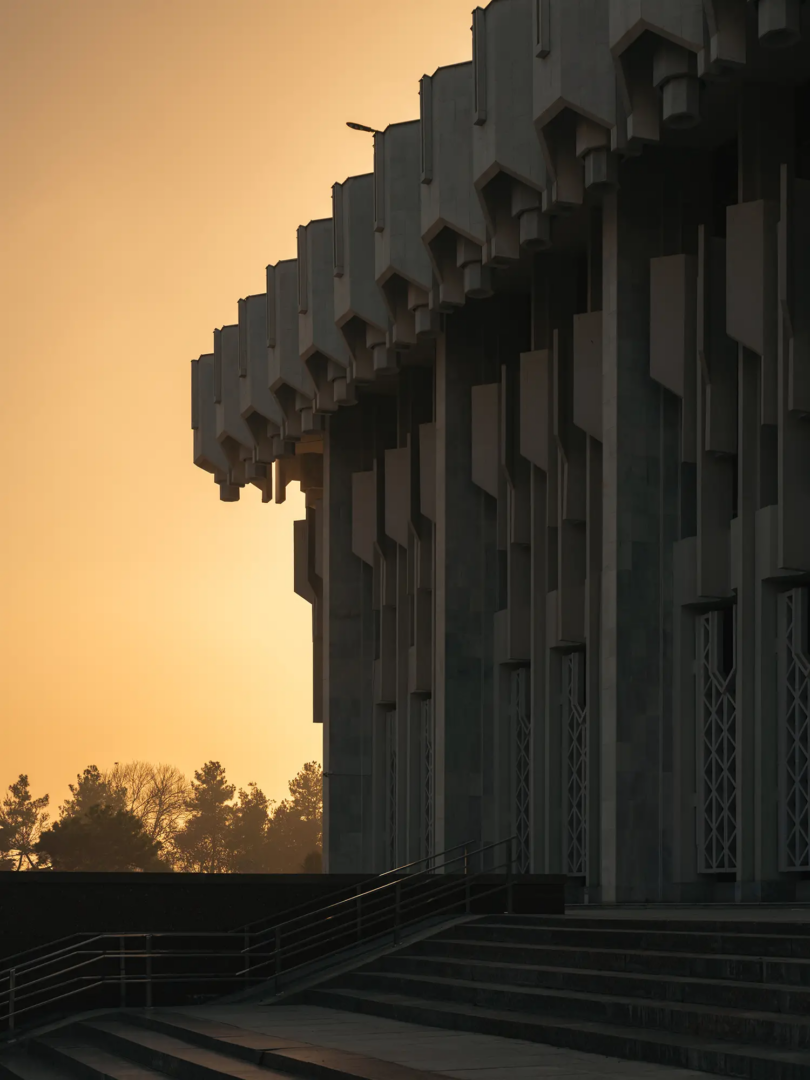
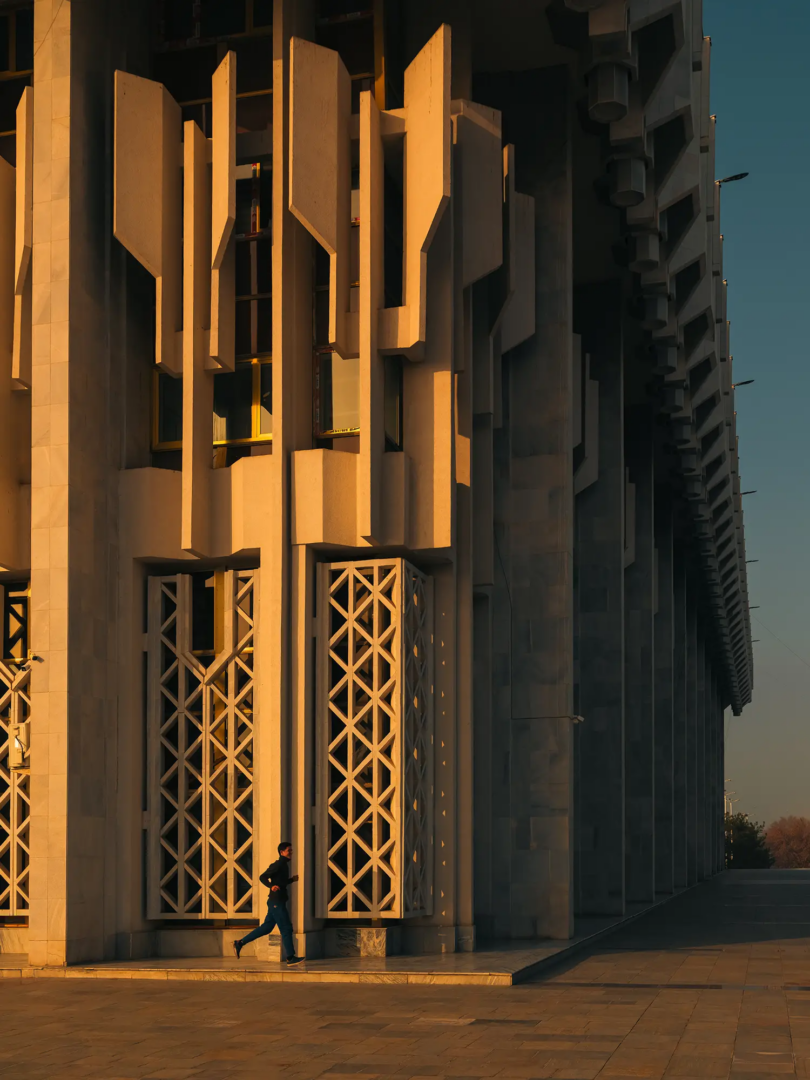
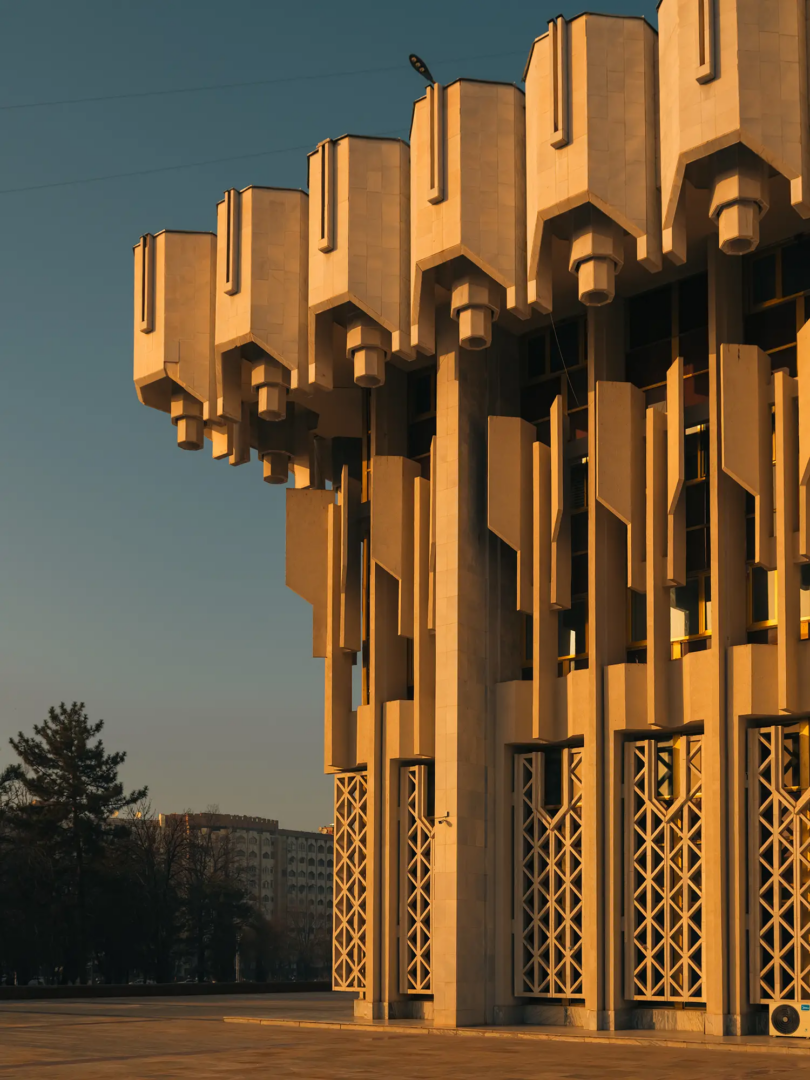
Built between 1980 and 1983 by Yevgeny Rozanov and Elena Sukhanova, the Palace of Friendship of the Peoples anchors the largest square envisioned in the Soviet urban plan. Its glass envelope is crowned by a reinforced-concrete grid resembling organ pipes, culminating in a figurative cornice. Gazgan and Nurata marble, granite, bronze and gold articulate a structure of pronounced ornamental emphasis. The monumental ceramic wall in blue and turquoise with gilded details was executed by Alexander Kedrin, who, after being expelled from the Academy for his expressive independence, found in ceramic a medium suited to large-scale architectural intervention.
The square plan integrates sci-fi references with Islamic formal vocabulary. Inside, a forum, concert hall and a solemn lobby with natural-stone mosaics by sculptor Bukharbaev define the spatial hierarchy. The amphitheater auditorium seats 4,100. Glass chandeliers, gilded accents and ceramic murals construct a continuous scenography narrative.
The National Museum of History was built between 1968 and 1970 by Yevgeny Rozanov and Vladimir Shestopalov
A decade earlier, that same ambition to formalize identity through architecture had taken a different form. Founded in 1876 and later renamed the Lenin Museum under Soviet rule, the National Museum of History was built between 1968 and 1970 by Yevgeny Rozanov and Vladimir Shestopalov. Currently under restoration (since June 2024), it remains one of the most refined examples of Soviet multicultural architecture in Central Asia.
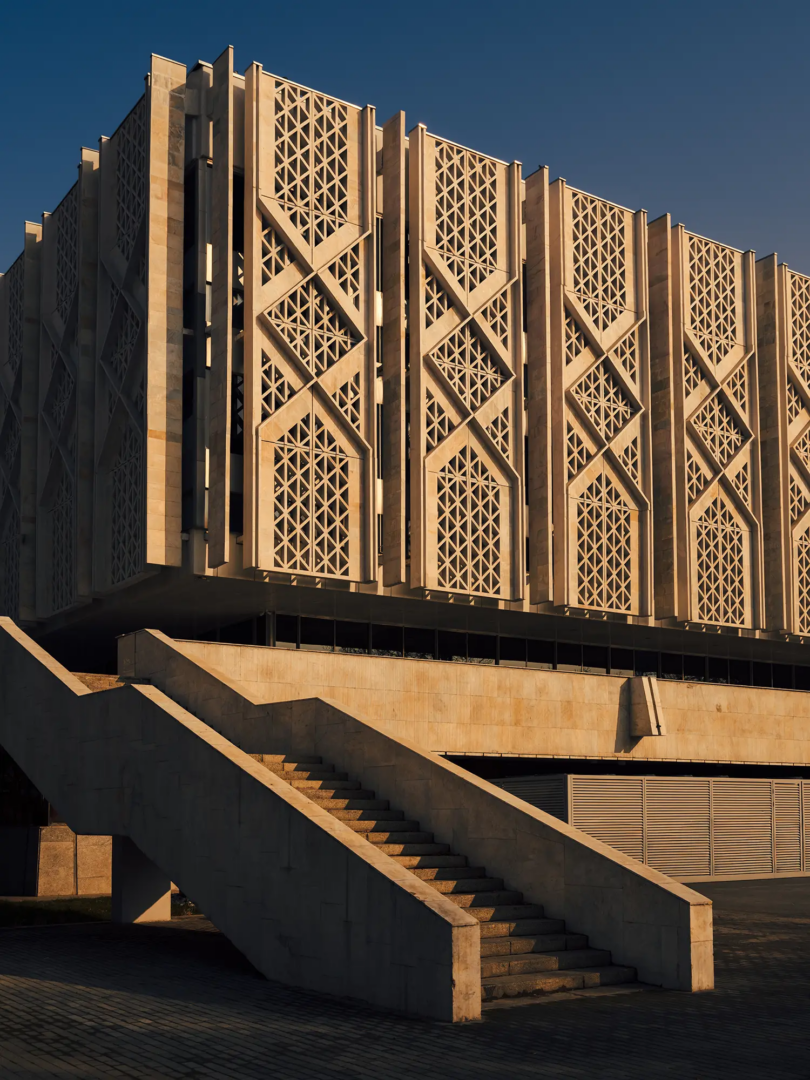
The parallelepiped volume, raised on pilotis and set on a podium, features light-colored concrete screens derived from the traditional Uzbek sun filter known as Panzhara. Reflecting pools amplify its theatrical presence. By the late 1960s, the Central Asian republics had become laboratories for a synthetic architectural language merging indigenous forms, materials and ornament within a stereometric modernist framework.
Cesare Cunaccia
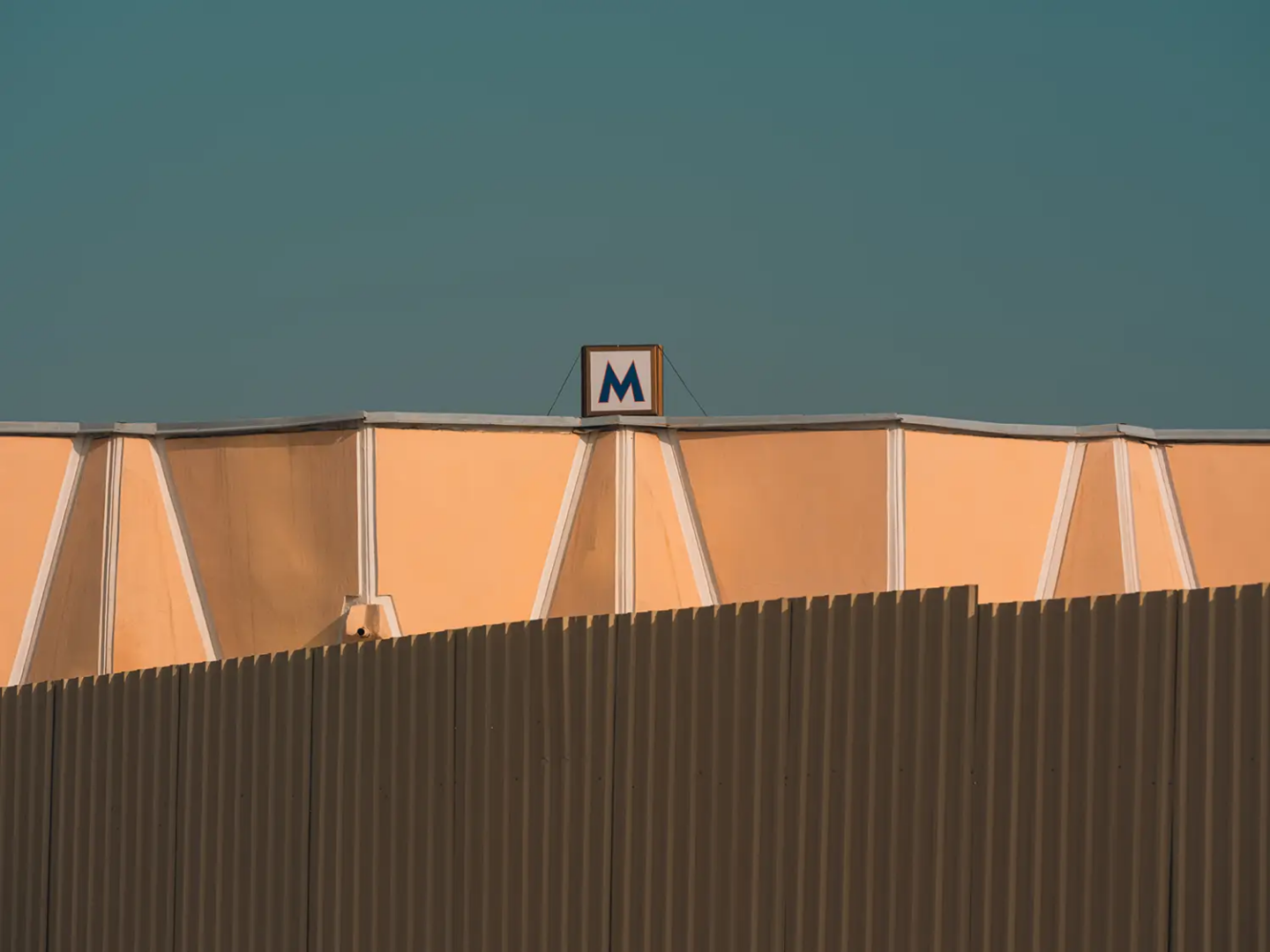
BUNYODKOR METRO STATION
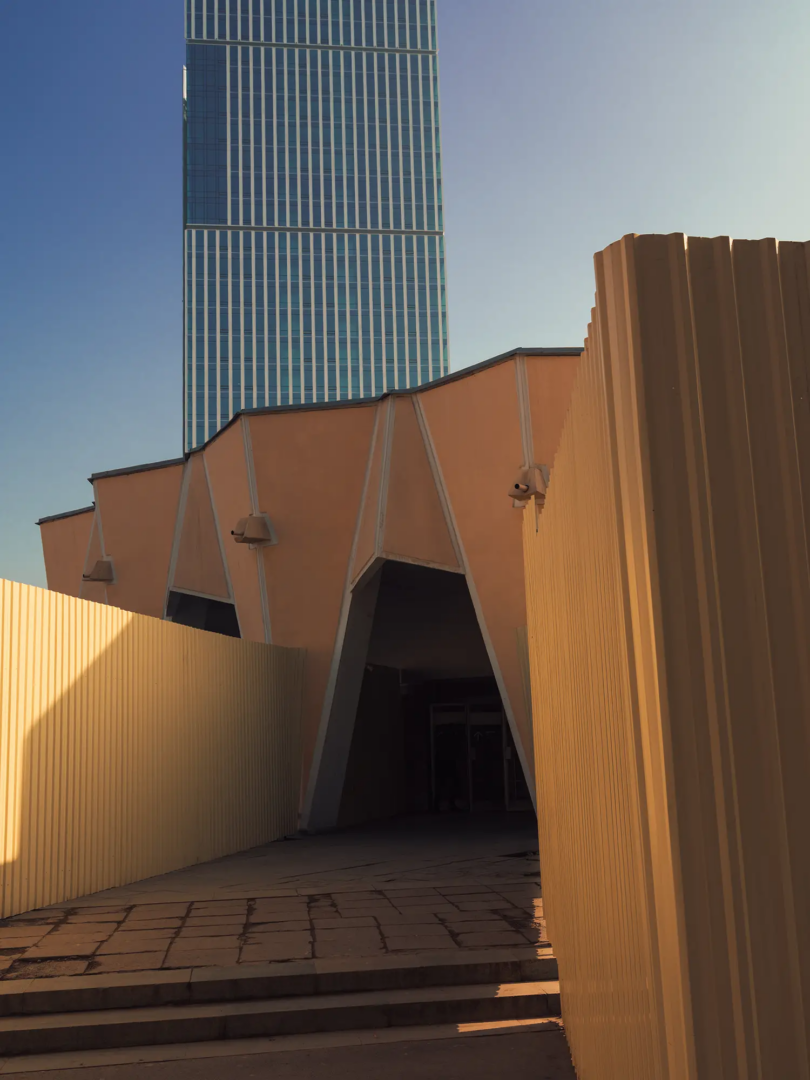
Opened in 1977, the station is a shallow, three-span column design with a central island platform and underground vestibules connected to surface entrances. The interior is clad in light-grey marble with grey and black granite flooring; the original wall emblems of the Soviet republics were later removed. The project is attributed to architect F. Tursunov and collaborators.
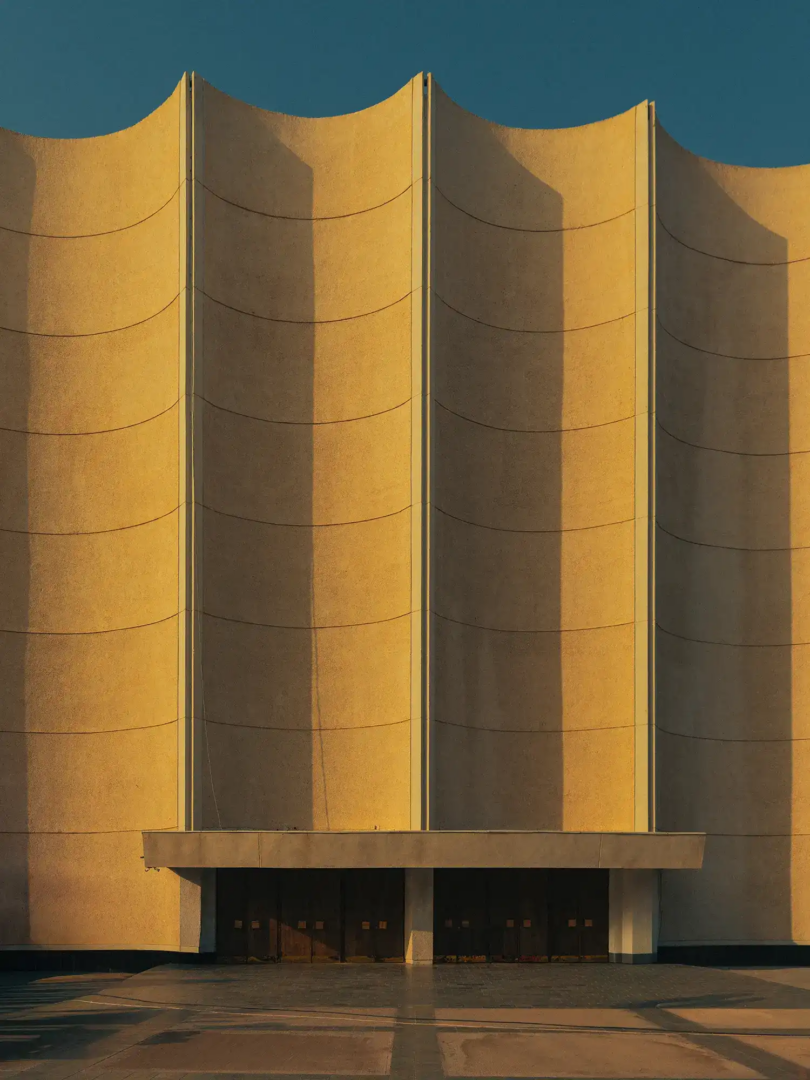
ALISHER NAVOI CINEMA PALACE
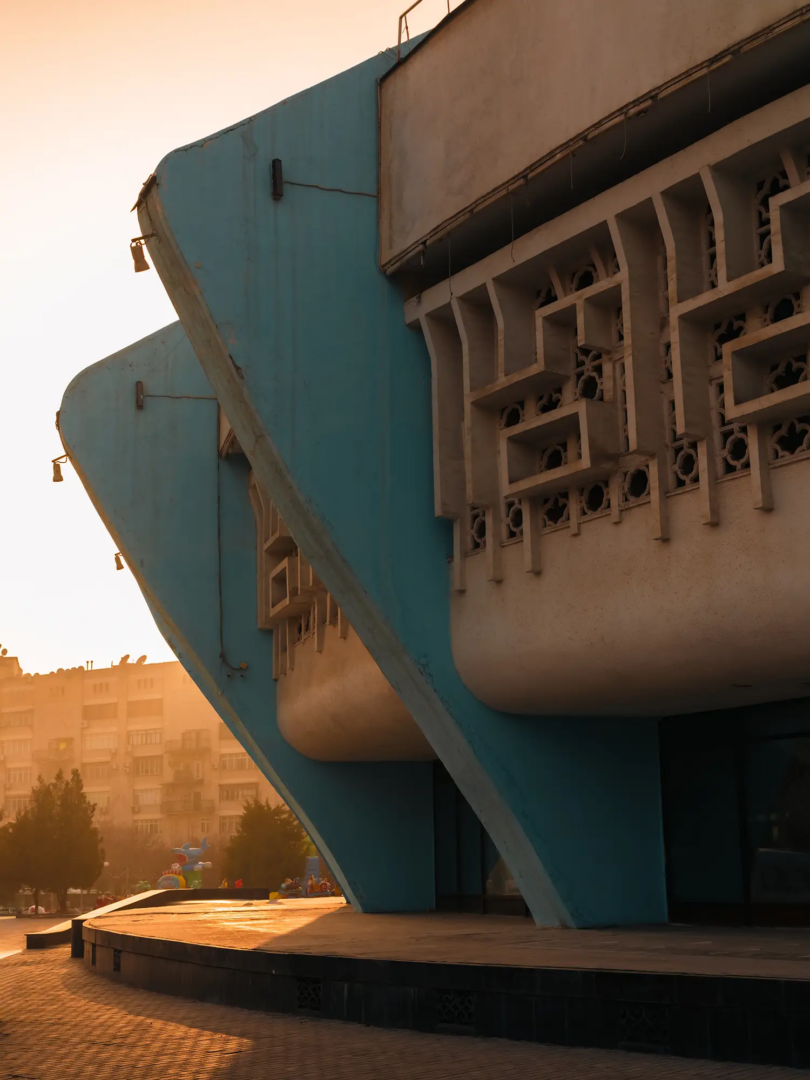
Named after the Timurid poet and statesman Alisher Navoi, regarded as the founder of classical Turkic literature. Completed in 1964 as the Palace of Arts, the complex hosted the Tashkent International Film Festival for Asian and African Countries. Its architecture is organized around a cylindrical auditorium composed of vertically stacked concrete rings, paired with a glazed foyer; a secondary pavilion was added in the mid-1970s under Sutyagin’s direction.
STATE CIRCUS
Inaugurated in 1976, it was designed by Genrikh Aleksandrovich and Gennady Masyagin. The building follows a circular plan with a reinforced concrete structural ring supporting a ribbed turquoise dome over the main arena, aligned with Soviet permanent circus typologies of the period. The foyer integrates gold-ground mosaics and carved gilded doors referencing regional decorative traditions.
HEADQUARTERS OF THE NATIONAL INFORMATION AGENCY OF UZBEKISTAN
Established in 1992 following a presidential decree and tracing its institutional origins to a ROSTA (Russian Telegraph Agency) office opened in 1918, UzA functions as the state news agency of Uzbekistan. From this building, it coordinates official communications and distributes multilingual news content across national and international media networks under the Agency of Information and Mass Communications.
BLUE DOMES CAFÉ
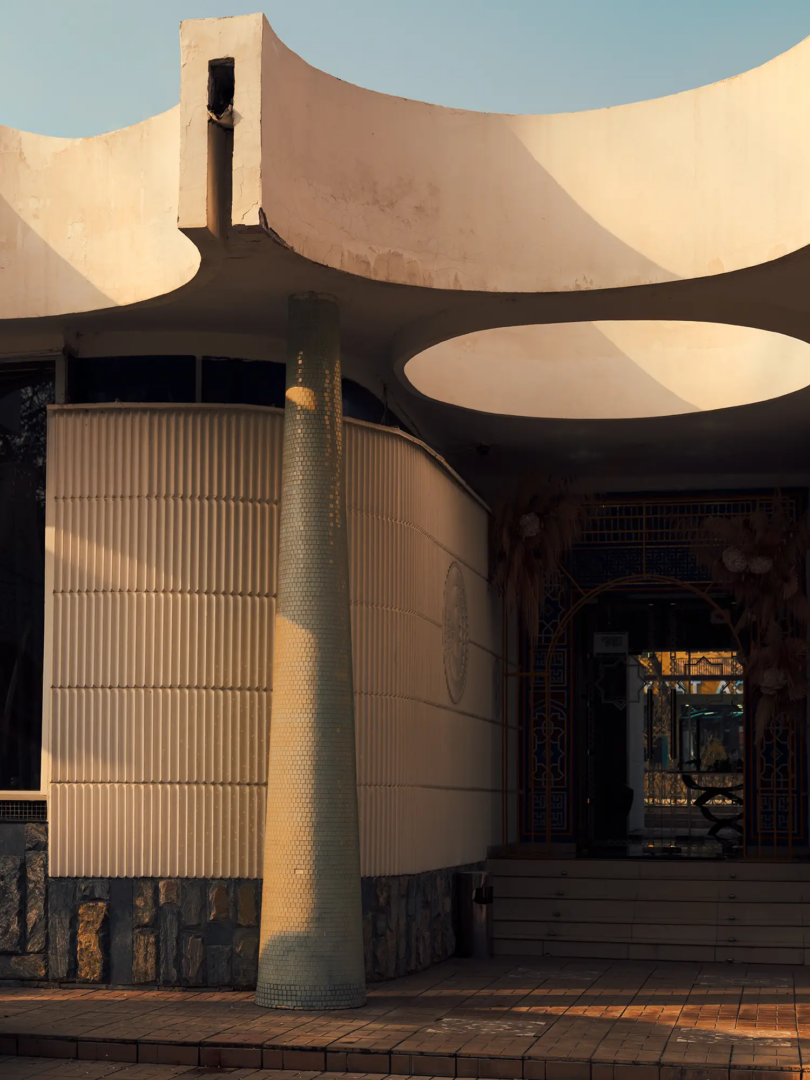
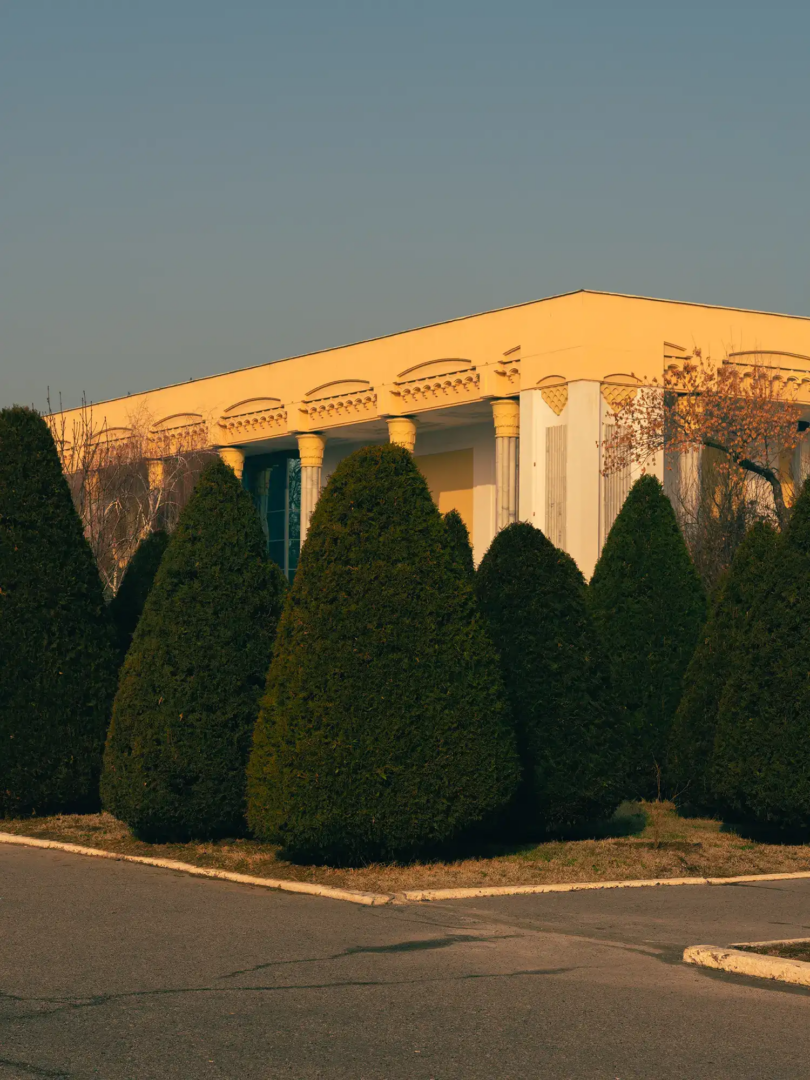
The pavilion was designed by architect Vili I. Muratov with engineer Ye. Platsman and artist A. Kedrin — opened in 1970. Conceived as a public catering venue within the Skver / boulevard system, it is organised around a domed winter hall with linked vestibules and service spaces, complemented by a summer hall-terrace. The structure is defined by dome volumes set on slender columns above a flat roof plane. Trading hall area of 225 m².
PEOPLES’ FRIENDSHIP PALACE
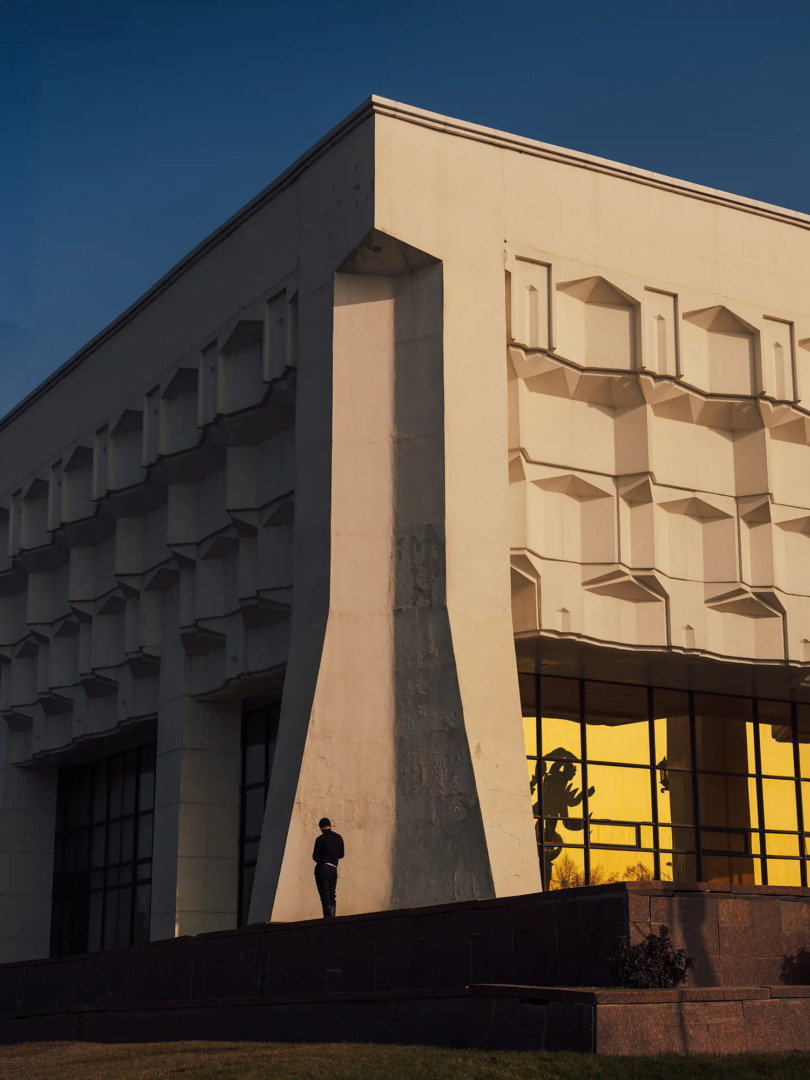
Opened in 1981 and attributed to Yevgeny Rozanov with collaborators, the Peoples’ Friendship Palace was built to honour post-earthquake solidarity and hosts cultural and state events. Interiors are finished with local marbles, including Gazgan and Nurata, with monumental decorative mosaics and panels; nearby, the square also includes the Shamakhmudov family memorial.
HOTEL UZBEKISTAN
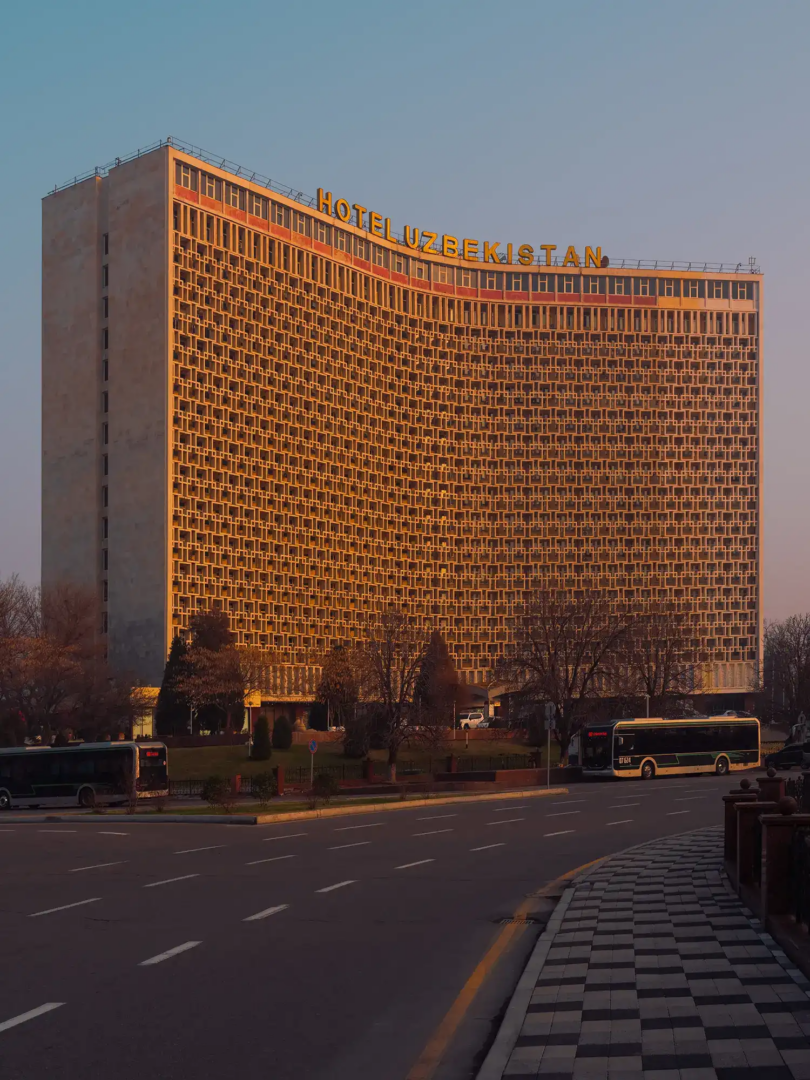
Completed in 1974, the 17-storey hotel was designed by Vyacheslav Rashchupkin and Ludmila Yershova under the direction of Ilya Merport. Two slightly diverging wings are structured on a steel seismic-resistant frame. The concrete façade is articulated by modular brise-soleil that regulate solar exposure and provide passive shading and ventilation. Renovated in the 1990s and again in 2010, the building retains interior mosaics, stained glass and sculptural elements.
FORMER HEADQUARTERS OF THE STATE DESIGN INSTITUTE
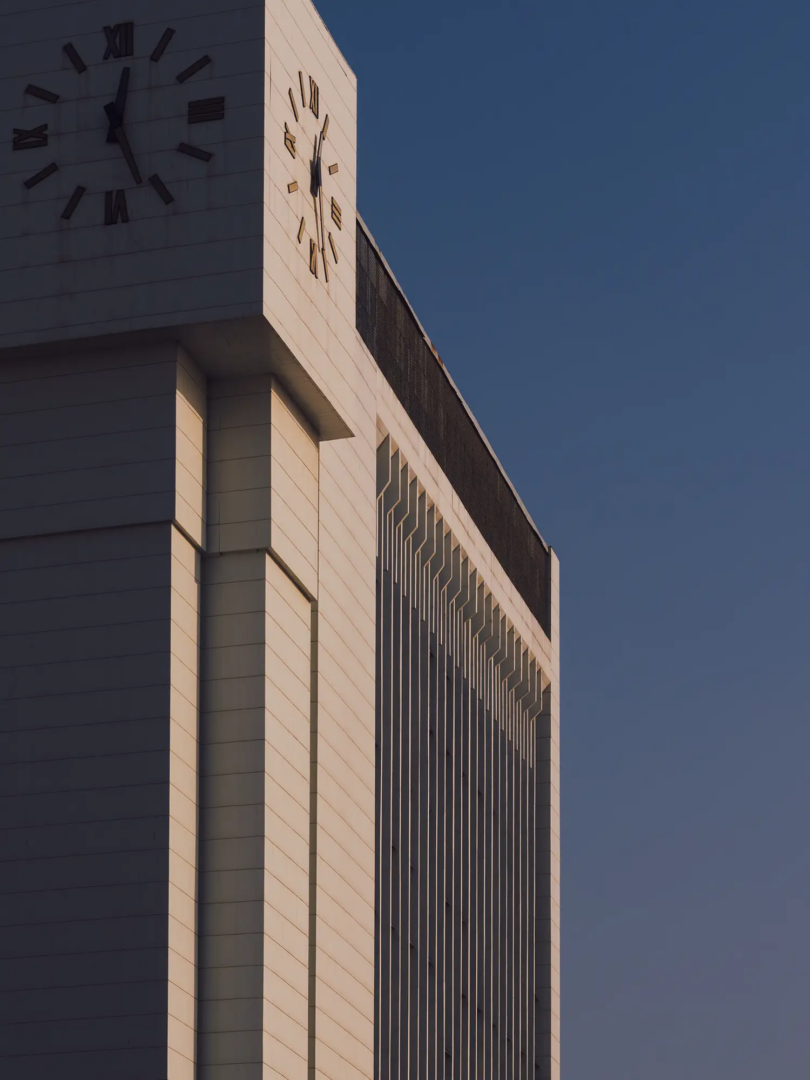
Built in early 1981, it is defined by metallic sun-shading panels, retained during the 2009–2010 reconstruction, when the original green façade was repainted white. Over four decades, the building has housed major telecommunications operators. In June 2025, Uzbekistan’s State Assets Management Agency announced the launch of a 100% privatisation process for Mobiuz (LLC Universal Mobile Systems), indicating a potential change in the site’s ownership.
INDEPENDENCE SQUARE
Laid out in the Soviet period as Lenin Square and renamed in 1992 after Uzbekistan’s independence, it extends over more than twelve hectares, framed by government buildings, colonnades and landscaped axes along a central ceremonial route. A stork atop the colonnade references peace and continuity in regional iconography, while the Monument to the Independence of Uzbekistan marks the post-1991 redefinition of the square with a metal sphere decorated with ornamental patterns and bearing the map of Uzbekistan.
THE STATE MUSEUM OF HISTORY OF UZBEKISTAN
Founded in 1876 and known in the Soviet period as the Lenin Museum, it occupies a purpose-built modernist building constructed in 1970, attributed to Yevgeny Rozanov and Vsevolod Shestopalov. The architecture is organised as a cubic volume with geometric sun-screen façades faced in pale pink marble, combining abstract form with ornamental pattern. The museum closed in June 2024 for renovation.
TURKISTON PALACE OF ARTS
Officially named “Turkiston” by a Cabinet of Ministers resolution on 30 March 1993, the venue stands near Independence Square and functions as a state stage for public events. The complex includes two main performance spaces — a Winter Hall and a Summer Amphitheater — and is the result of a long construction process; interiors feature ganch carving and kundal gilding, with iconography including the Humo, a mythic bird.
THE ART GALLERY OF UZBEKISTAN
Opened to visitors in August 2004, the public museum was initiated after 1994, when President Islam Karimov sought a permanent home for the fine art collection of the National Bank for Foreign Economic Activity. The building provides 15 rooms across 3,500 square metres, with a conference room, lecture hall, small cinema, library and studio for masterclasses, and hosts both international and local exhibitions alongside cultural events.