What is linoleum? Patented in 1863, it is returning to architecture and design projects
Linoleum is made from linseed oil, pine resin, wood flour and jute, and it takes oxygen and weeks of time to come into being. The “natural” label, however, is not enough to account for its impact
In the 1960s, ’70s and ’80s, linoleum covered schools, hospitals, offices and homes: seamless, washable, quiet, suited to large surfaces. The historic catalogues held at Cooper Hewitt, Smithsonian Design Museum document its origins as a material made to be designed, with their Art Nouveau patterns, faux parquet and geometrics.
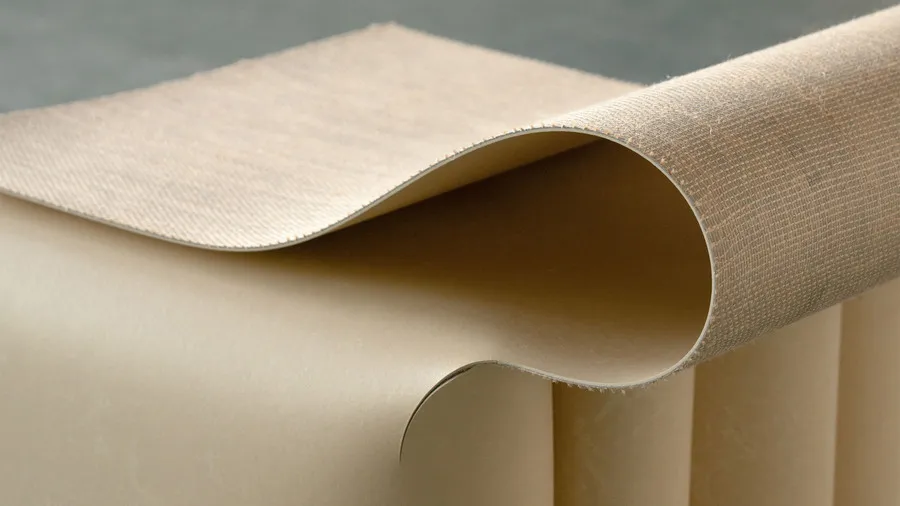
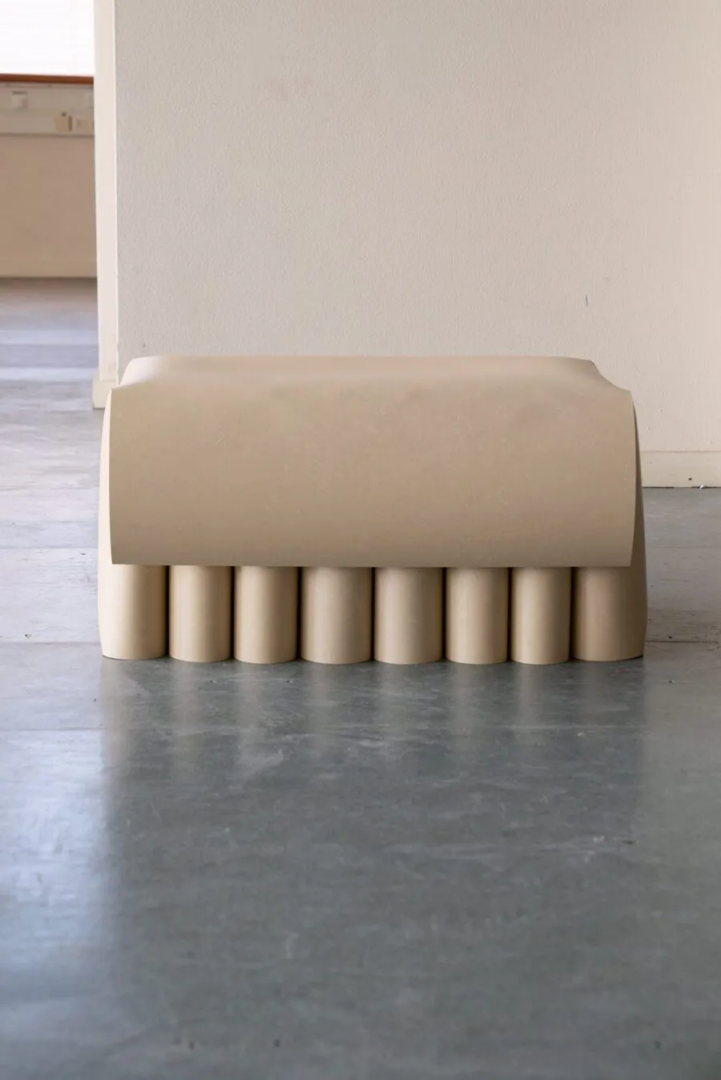
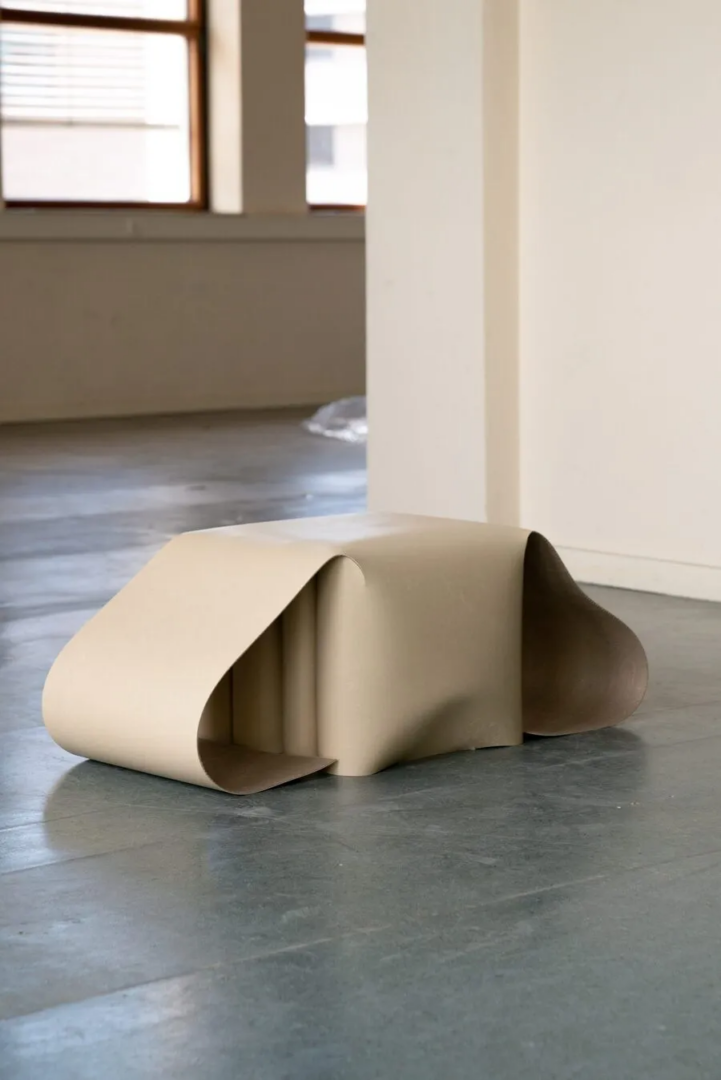
Furniture Linoleum is the same material in thinner gauges, glued onto wooden panels. It covers tables, desks, cupboard fronts and doors. To the touch it feels different from a plastic laminate. The finished object may contain adhesives, edging and synthetic finishes. So what are linoleum’s characteristics?
What linoleum is made of: linseed oil, limestone, wood flour and jute
Linoleum hardens like an oil painting. Linseed oil exposed to air reacts with oxygen: its molecules bond to one another and the liquid becomes a solid, elastic film. Frederick Walton patented the process in 1863 as a substitute for rubber, which was expensive at the time. The flooring itself has stayed the same. It is oxidised vegetable oil, kneaded with pine resin, wood flour and limestone, pressed onto a jute backing and left for weeks in a heated chamber for the reaction to finish.
A square metre of 2.5 mm linoleum weighs 2.9 kilos. A quarter of that weight is linseed oil; a fifth is ground limestone. Wood flour, jute, pine resin, pigments and recycled linoleum make up almost all the rest. The final 1% is plastic: an acrylic finish applied at the factory. In grams per square metre, that is just over 700 of oil pressed from flax seeds, 600 of limestone and around thirty of synthetic polymers.
Linoleum is an industrial composite. It combines an organic material obtained through a chemical reaction, powders of mineral and plant origin, colourants, a backing fabric and, almost always, a protective coating. Both its performance and its limitations stem from this combination.
Linoleum: the linseed oil that turns solid by reacting with air
Linseed oil is a drying oil, meaning an oil that dries in air until it hardens. Its molecules contain chemically unstable sites that react with oxygen: the chains break, link back up with one another and release volatile compounds. Once the reaction is complete, the liquid has become a solid, elastic network.
Linoleum production is chemistry from start to finish. Early twentieth-century industry called the oxidised oil linoxyn. Italy’s 1934 Enciclopedia Italiana described it as a rubbery substance, obtained through prolonged oxidation, to which resins were added to produce linoleum cement. The term has since fallen out of use.
The 1863 Walton patent: how linoleum came about
The name contains the recipe: linum, flax, and oleum, oil. The British patent bears the name of Frederick Walton. The most widely told version of the story has Walton noticing the elastic skin that had formed on the surface of a container of linseed oil left open to the air. In 1924 a technical account from the American Chemical Society credited him with grasping the properties of that skin: oxidised, tough, and elastic like rubber. Painters and varnish makers had known the phenomenon for centuries; Walton brought it into the factory.
The Victoria and Albert Museum notes that linoleum was patented as a hygienic floor covering and spread quickly across Europe. In 1875, twelve years after the patent, Morris & Co. was producing linoleum designed by William Morris. The Armstrong Cork Company entered the business in 1908. According to Cooper Hewitt’s account, by 1918 it was advertising 380 designs: florals, geometrics, faux parquet, faux marble, mosaics and tiles. Linoleum was laid in homes, in public buildings and on ships.
The way a floor was made changed too. It arrived from the factory in rolls, with its thickness, colour and performance already set. Before, floors had been assembled piece by piece on site in stone or wood.
The factories that make genuine linoleum in Europe
There are four main linoleum factories in Europe, owned by three industrial groups. Forbo, a Swiss-Dutch group, has two of them. The first is Assendelft, in the Netherlands, which turns out rolls, tiles and furniture linoleum sold under the Marmoleum brand. The second is Kirkcaldy, in Scotland, which specialises in modular formats and tiles. Tarkett, a French group, produces in Narni, in Umbria in central Italy, where linoleum has been made since 1898, and supplies the European and international markets from there. Gerflor, also French, produces DLW Linoleum in Delmenhorst, near Bremen. DLW is the heir to the Deutsche Linoleum Werke and one of the most widely used lines in schools, hospitals and public offices across Europe.
Worldwide there are four or five linoleum factories in all, with one further site in India. The material is still made where it was made a century ago, in plants that require curing rooms, calenders and long lead times.
How linoleum is made: calendering and twenty days of curing
Today’s production sequence follows the old one, with more control and more speed. Linseed oil and resin are mixed and oxidised by blowing air through them, producing the substance that will hold the floor together. Wood flour or cork, ground limestone, pigments and, in recent formulations, shredded linoleum scrap are then added. The result is a granular mix. The granules pass through the calender, a series of rollers that presses them onto the jute backing to form a compact sheet.
At this point a PVC floor would be finished. Linoleum sheets, by contrast, go into heated rooms where the reaction with oxygen continues. Production can take 20–30 days.
Once curing is complete, the finish is applied. At Forbo, two coats of lacquer are applied and cured under ultraviolet lamps. The first bonds to the linoleum; the second forms the surface that resists dirt, scratches and stains. The company describes the treatment, called Topshield Pro, as a double layer of acrylic polymers, partly water-based. Stain resistance, ease of cleaning, tolerance of disinfectants and resistance to light scratches depend largely on this coating, not on the linoleum beneath it.
Linoleum or vinyl: the ISO 24011 standard and through-body colour
The international standard ISO 24011, which defines the material, contains a caveat. The name linoleum is also misused for PVC or rubber floors, which fall outside the definition.
In use, linoleum and vinyl look alike. They come in the same formats, form the same seamless surfaces, are the same few millimetres thick and are equally easy to clean. The difference lies in how they take their colour. In vinyl, the pattern is printed on a dedicated layer protected by a thin transparent film, and it can imitate wood, stone or ceramic with photographic realism. In linoleum, the colour is mixed into the body and runs through the full thickness. When the surface wears, the same colour shows through, rather than a backing of a different colour.
Resilient floors: how much linoleum gives under a load
Linoleum is a resilient floor: it deforms under a load and returns to its original shape when the load is removed. It sits halfway between a tile, which stays rigid, and foam rubber, which gives a great deal. The test that measures this is called residual indentation. It records how much of the dent remains after the load is removed.
On a Tarkett range of 2–3.2 mm, between 0.07 and 0.10 mm remains, against a permitted limit of 0.15. Acoustic versions, built on a softer backing, reach 0.20–0.25 mm. Forbo reports, using an American test, a residual compression of about five hundredths of a millimetre under a pressure equivalent to a concentrated load. Both companies rate their commercial-grade products as suitable under the ISO 4918 test. That test runs an office chair on castors over the same spot thousands of times, then checks appearance, seams and the adhesion between layers.
Like every resilient floor, linoleum suffers under static, concentrated loads: feet that are too small, the wrong castors and heavy furniture all leave marks. Its flexibility also has a limit. The sheet can be rolled, can follow broad curves and can run up the wall if the right coving profiles are used. A sharp fold will crack it.
Installing linoleum: subfloor, adhesive and heat-welded seams
A sheet a few millimetres thick reproduces the surface it is laid on, so dips, cracks, grit and unevenness in the screed resurface. Sheet linoleum is glued down, and the adhesive remains part of the finished floor. It affects emissions, whether the covering can be lifted, and whether it can be recycled.
There are also click systems, laid without adhesive, in which the linoleum is bonded at the factory to a rigid board. They are a different product, with different weight, thickness, behaviour with water, acoustics and disposal.
In most cases, the seams between sheets are simply butted together, without welding. Heat welding, in which a melted bead closes the gap, is used where a continuous surface or hygiene requirements call for it. It seals the seam but leaves the body of the material as permeable as before.
Does linoleum absorb sound? Is it a thermal insulator? Is it water-resistant?
Solid linoleum does little to reduce noise. It lowers impact sound by 5–8 decibels, a modest figure. It becomes an acoustic insulator in versions bonded to a soft backing, with a layer of cork or polyolefin foam.
Thermally, it lets heat through, which is why it works well with underfloor heating. The limit to respect is surface temperature, generally around 27 °C. Linoleum’s binder is the product of an oxidation process, and sustained excessive heat damages the material along with the adhesive.
Linoleum with an intact finish withstands cleaning water and occasional spills. Still, a floor is only a covering: water can reach the subfloor through seams, edges, a hole or an installation error. Moisture trapped under the sheet ruins the adhesive, the jute backing and the integrity of the whole.
Fire and light: how linoleum behaves
Much of the material is organic, so linoleum burns. Standard products fall into European class Cfl-s1: limited flame spread, little smoke. Some formulations reach the higher class, Bfl-s1. A lit cigarette leaves a brown mark on the surface without damaging the body of the material.
The colour is stable, with one phenomenon specific to this material. During curing in the dark, the oxidising oil leaves a yellowish cast on the surface known as ambering. Light makes it disappear within a few days. A freshly unrolled sheet may therefore look a different colour from the one chosen in the catalogue. The same cast reappears under furniture left in one place for a long time.
Linoleum’s chemical resistance: the ASTM F925 test with acetone and bleach
What happens when a linoleum surface stays in contact with an aggressive substance for an hour? Acetic acid, acetone, ammonia, bleach, petrol, hydrochloric acid, isopropyl alcohol, phenol, caustic soda and dilute sulphuric acid have no effect. Iodine leaves a slight change in colour. The material gives way if contact with strongly alkaline substances is prolonged.
An hour on an intact finish is one thing; years of washing are another. A highly alkaline detergent used continuously wears away the surface treatment. Once it reaches the body of the floor, it attacks the oil-derived component.
For routine maintenance, neutral products are therefore recommended. For periodic professional cleaning, more aggressive machines and detergents are acceptable, provided the dirty water is vacuumed up and the floor is rinsed.
Is linoleum a natural material? How to read the percentages
For some of its ranges, Forbo states 97% natural raw materials and 72% rapidly renewable raw materials. Limestone is natural, but it re-forms over geological timescales: a flax field grows back every year, a quarry does not. The same goes for mineral pigments. The part that regrows quickly is the oil, resin, wood flour and jute. Other figures circulate for other lines: up to 98% natural raw materials for some Marmoleum collections, and between 93 and 96% for Tarkett ranges. These figures refer to individual products.
What holds the floor together is still the oxidised oil and resin. That 1% of acrylic coating means the product on the market cannot be described as made solely of natural ingredients. The precise definition is this: a resilient floor covering that is largely plant- and mineral-based, bound by oxidised natural oils, and almost always finished with a small share of synthetic material.
Linoleum has been studied through life-cycle assessment since the 1990s. This method adds up a product’s impacts from raw material to disposal. A 1995 study in the Journal of Cleaner Production compared it with a flexible vinyl and two carpets, and in the model adopted it had the best profile. A 1997 study in Building and Environment, set in Sweden, compared linoleum, vinyl and solid wood: wood came out on top, with linoleum narrowly ahead of vinyl. A 2002 analysis showed how much maintenance and pigments weigh on the result. A 2020 study returned to pigments and tested bio-based ones. Energy sources, formulations and calculation methods have changed in the meantime.
The 14% recycled content declared by Forbo comes from factory waste and removed flooring. The company describes a plant that grinds this material and feeds it back into the mix. It also runs a collection scheme for installation offcuts and, in some markets, for sheets taken up from old floors.
In terms of composition, linoleum can be recovered. Whether it is actually recycled depends on a supply chain that brings it back to the factory. An installed floor is a system: sheet, adhesive, levelling compound, screed residue, twenty years of dirt. Separating those layers is far harder than recovering the clean scrap that comes off the calendar.