Milk can become textile: what a dairy does with a milk it cannot sell
Don’t cry over spilled milk. The story behind the idea of transforming food waste into fabric.
Milk protein fiber: extraction from a dairy by-product
Milk that goes unsold has three destinations. Biofuel, livestock feed, landfill. Mi Terro, founded in Los Angeles, proposed a fourth: extract the casein and spin it. Casein is the protein carrying most of the solids in cow milk. Cheesemakers separate it from whey daily. Carried further, the same separation yields a fiber.
The Food and Agriculture Organization puts dairy surplus at a fifth of output. The European Commission records eighty-eight million tons of food waste across the EU, against costs near one hundred forty-three billion euros. The World Resources Institute defines the category as food discarded through negligence or decision.
Lanital, 1935: milk protein fiber under Italian autarky
Dairy carries biological oxygen demand. In a watercourse it feeds bacteria, which strip dissolved oxygen as they break it down. Fish and invertebrates lose it. Regulators in dairy regions log spilled milk as a pollution event.
Milk protein fiber is not new. It belongs to the azlon group, the regenerated protein fibers. Antonio Ferretti patented it in Italy in 1935 and sold it as Lanital. The setting was the autarky drive, which sought domestic substitutes for imported wool, and it followed the commercial record of rayon. Later trade names ran to Fibrolane in Britain and Aralac in the United States.
The fiber held a market through the nineteen thirties and forties. Nylon and polyester took it. The synthetics cost less, held strength when wet, and carried no agricultural input. What returned casein to the laboratory was not performance. It was disposal at the other end of the dairy chain.
Interwar extraction hardened the fiber with formaldehyde. Current work is defined by what it strips from that sequence.
Turning food waste into fabrics: Mi Terro case
Mi Terro, a company that aims to turn food waste into fabrics, has aimed to tackle this issue head on. Food waste is food that is left uneaten, unused or discarded; The World Resources Institute describes it as «the result of negligence or a conscious decision to throw food away». This wastage can happen at various stages of food production – from picking to consumption. It is attributed to over-production and low demand. The Food and Agriculture Organisation (FAO) estimates that 415 million tons of food are thrown away before distribution. According to The European Commission, the EU generates eighty-eight million tons of this, which has associated costs of around €143 billion.
With large amounts of waste, comes environmental costs from production, harvesting, transportation and packaging. It is appraised that this throwaway culture generates 3.3 billion tons of greenhouse gas, approximately six percent of total global emissions; three times more than emissions from aviation. In their attempts to combat this problem, the Mi Terro team addressed the waste that occurs in dairy production. Robert Luo, the CEO of Mi Terro described how his realization «began when I was visiting my Uncle’s dairy farm in China in 2018, and I saw buckets and buckets of spoiled milk. That was my first exposure to the milk waste that we have in the world». And this wastage was not specific to his uncle’s farm; according to the Food Agricultural Organisation (FAO), 20% of dairy products are surplus and get discarded. And with the global pandemic of COVID-19, this problem has been exacerbated.
«Every day in the US, 2.3 million tonnes of milk are discarded. This is because farmers do not have anywhere to sell this milk as it is usually sold to schools and restaurants which are all closed down. However, cows keep on producing milk even though there isn’t anywhere for it to go». Whilst milk is a natural product, when thrown away, it has the potential to damage the environment as «it can clump together once it dries out. If it falls into a water stream, there is potential that it can sit there and block out the oxygen in the water which causes eutrophication. This will then have a major impact on marine life».
Lampoon review: creating fabrics from spoiled milk
«There are a few avenues that can deal with the waste; to burn it as biofuel or dried to feed livestock but there is over-supply, and neither of these are beneficial for the environment». The options did not seem feasible for Luo’s uncle who asked him to find a solution to distribute the quantities of milk waste. «He wanted to make money from selling spoiled milk. We undertook research to understand what parts of the milk we could isolate and utilize to help alleviate this problem, and to create something out of it». Robert’s background is in business, and his co-founder Daniel Zhuang has a chemistry and material science background.
They combined skills and began testing, consulting with an array of experts to understand ways to utilize this spoiled milk. «At every step we came across difficulties. From the technology side we had to work out how we could transform milk into a material that we could use. We then had to work out how we could spin it – to make the fibers into yarn and then fabric, and then into a t-shirt». Currently, their fabric is made from around 15-20% of spoiled milk, with one glass of milk making up five T-shirts. Initially, their production relied on using the milk from Robert’s uncle’s farm, yet, as demand increased, they found that they needed to find other avenues to source their spoiled milk. To increase their reach, they began cold calling and sending emails, hoping that other farmers faced the same issue. Through their exposure, they have found that farmers have «reached out to us on the back of publications that we have featured in», giving them the opportunity to bring awareness and support to other farmers struggling with over-supply.
The process of converting milk amino acids into yarn
After collecting excess milk from a variety of sources, their patented process involves three steps to convert the milk amino acids (particularly casein) into a yarn. Their first step, Pro-Act (Protein Activation) is a technology which extracts casein molecules from the ‘bad’ milk, after the protein has been extracted, it is purified using Sea-Re (Self-assembly Purification) to turn it into a usable molecule in preparation for spinning using a process called Dynamic Flow Shear Spinning (DFS) which turns the protein into sustainable fibers. Over the past two years, Robert and his team have developed and tested yarn prototypes made from spoiled milk.
The first version of their milk-to-clothing process took two months to complete and the team have been working to improve their fabric ever since. They have been developing a second fibre which is «blended with viscose which has its own natural properties that will help it to boost the performance of our fibre and make it cheaper than organic cotton or modal». Despite viscose having potential drawbacks with respect to the chemicals used in its processing techniques, Robert believes that its benefits outweigh its potential costs «unfortunately there is no 100% eco-friendly fibre out there, every fibre requires a different chemical process in its production. There are many viscose producers in the world, and each has a different processing technique. We typically use Lenzing viscose, which is considered to be more sustainable than other types of viscose». Lenzing’s aim is to recycle the majority of the chemicals used in production of the fibre so that they do not end up leaching into the environment.
Keeping their use of viscose in mind, the development of their process, and their movement from their first fibre to their second, Mi Terro has tried to keep environmental impacts to a minimum, «production requires 60% less water than the process for organic cotton. Our fibre is 100% biodegradable and we do not use any petroleum which benefits the environment. We reduce the amount of energy and water required to produce our textile. Saving food waste from landfill reduces the amount of CO2 produced in the world. If we can do less fracking, or extraction of fossil fuel from the ground, then we are making major steps. Fashion is the second most polluting industry in the world, so if we can solve a problem for them, that is a big step for the industry». And these environmentally aware steps can seem even more important with
Beneficial properties of the yarn from spoiled milk on the skin
The material that they have created is not just beneficial for the environment but has properties that make it usable. «Unlike other protein-based materials, we have found that casein produces a soft fibre which is perfect for people who have skin allergies. On top of this it is moisture wicking and has antibacterial properties which is great for outdoor or casual wear». Their product has been well received, and Mi Terro have experienced support which has helped them to remain focussed and positive about their goals to reduce food waste. With their reach extending to 40 countries, they have begun to focus on meeting the demand of larger companies «so that they can incorporate our material into their supply chain, to provide to their customer».
Through this collaboration, they are seeing how their product can be used in wider markets. Mi Terro’s goal is to move beyond dairy, and look at ways to harness other food waste. «We have plans to use other protein-based food wastes to create these into fibers; we would like to find a way to replace plastic. The idea is to create a circular economy in which food waste can be re-engineered to produce a material that is recyclable or biodegradable and is able to replace petroleum chemicals. We’re having a triple impact – with the packaging industry, the fashion industry and the food-waste industry». With their aims on creating a lasting impression on these three areas, Robert sees an opportunity to redefine the circular economy.
«It goes back to consolidating the supply chain. Food waste happens at either the retail or consumer levels. It is hard to collect food waste from the consumer, so we began to understand, and collaborate with food-processing centers and retail stores, to collect their waste. We found that they could provide larger volumes of waste in a cost-efficient way. We then translate this communication and collaboration to work with businesses who want to buy our fibre, and want to make a change in their supply chain». With this reimagining comes the opportunity to benefit multiple parties in the supply chain. «Not only are we solving a problem for food processors, saving them cost from disposing of this food waste, we are also providing a solution. We try to make everything easier to streamline our process». And these benefits are seen by farmers and consumers, processors and textile companies. However, most of all the environment is able to reap benefits.
Mi Terro’s fabric is their starting point, as they attempt to make changes within the packaging, fashion and food-waste industries. Robert sees the work that they are doing as pivotal; opening up an industry to «educate people on this problem that we’re trying to solve». Whilst they have come against adversity from those who «do not understand what we are doing and who have never heard of anything like this before», it becomes more important to them to not let those doubts change their course.
QMilk: casein extraction without the interwar chemistry
The German case runs longer. Ms. Domaske trained in microbiology at Göttingen and holds the garment label Mademoiselle Chi Chi in Hanover. In 2011 she introduced QMilch, a casein fiber produced without the chemical steps the interwar route required. Reporting has named her the inventor of milk fiber. She is not, and has corrected it. What she holds is the extraction route.
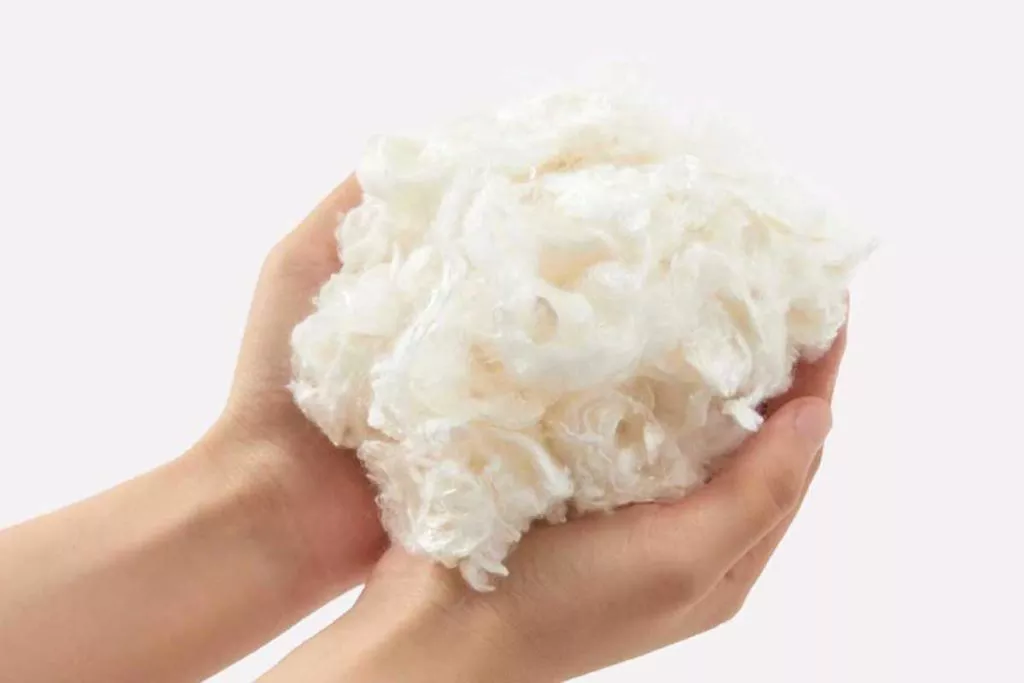
Casein comes from milk unfit for human consumption. It is dried, mixed with water, kneaded, drawn into strands, spun. Ms. Domaske puts the input near six liters of milk per dress, priced in the first years between one hundred fifty and two hundred euros. Casein carries eighteen amino acids, which she credits for the antibacterial behavior.
QMilk has since moved past garments into technical fiber, wipes and tissues, and medical and automotive work.
D-Leite: milk protein fiber on a Galician handloom
The third route runs smallest. Ms. Rodríguez holds RiR & Co, a textile workshop in Allariz, Ourense. She left a post at the Spanish tax agency to open it. The workshop weaves on a handloom: blankets, cushions, scarves, tapestries.
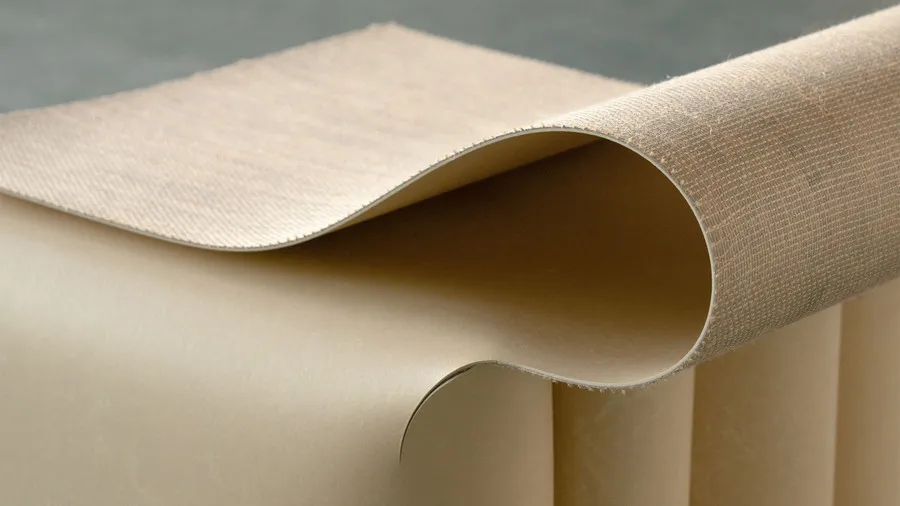
D-Leite is a baby blanket in milk protein fiber and merino wool, without dyes or additives. It took the Premio Nacional de Artesanía in the Product category, the Spanish national craft award run by Fundesarte, after reaching the final in 2023. The jury cited hand-weaving technique set against material research. Ms. Rodríguez states the fiber is hypoallergenic.
The workshop registers its research. Vagalume, a fabric woven with optical fiber carrying programmable light between wool threads, holds an industrial design registration. Of D-Leite, Ms. Rodríguez has said she wanted to show a firm of her size could carry out material research.
Three routes out of one dairy by-product
The cases divide by volume. Mi Terro went for industrial scale and found it outside textile, in film. QMilk holds the middle: fiber, paper, technical product, out of Hanover. RiR & Co works at one loom in a Galician town, where milk protein fiber is a component of a numbered object rather than a commodity input.
What holds them together is where casein sits in the chain. Nobody farms it. It arrives as residue of a dairy sector producing a fifth beyond what it sells, and its value as fiber is bounded by what that residue costs to collect. Ferretti spun casein in 1935 because Italy could not import wool. It is spun now because the milk has nowhere else to go.
Mi Terro
Mi Terro is the world’s first biotechnology company that creates ocean degradable and home compostable flexible packaging materials made from agricultural waste.
Editorial Team