What remains of a chair: Martino Gamper and the design of waste
From Martino Gamper to Markus Friedrich Staab, chairs built from recovered materials reveal the labor, the limits and the contradictions hidden behind the unique piece
Martino Gamper, 100 Chairs in 100 Days: from the street to the Nilufar collection and the museum
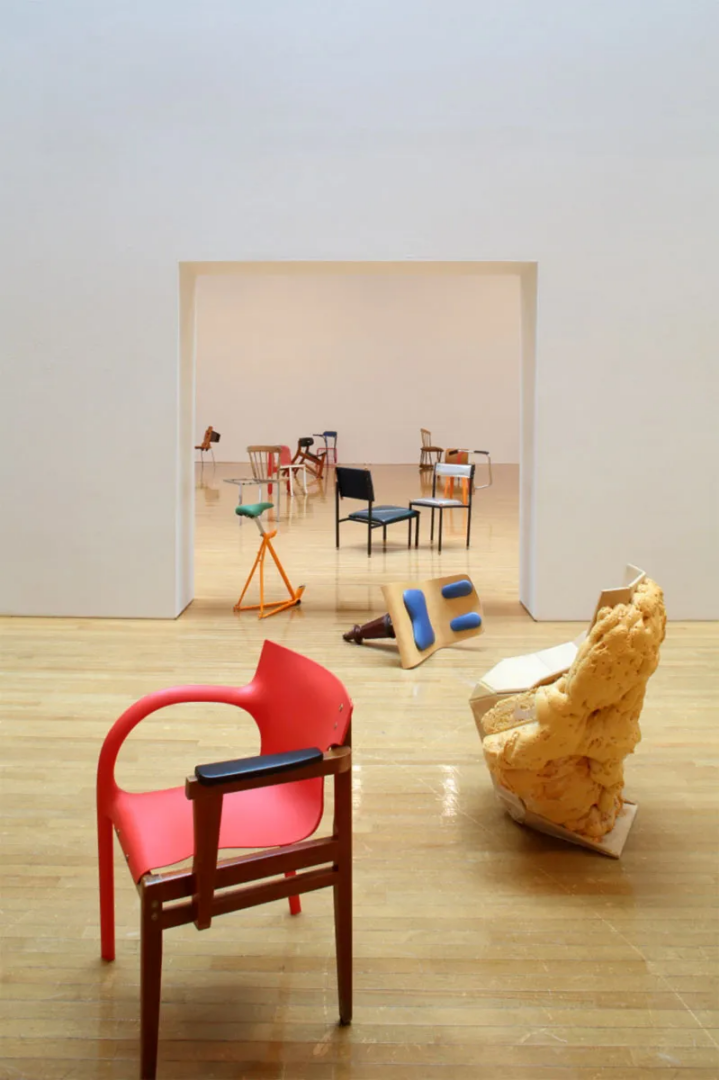
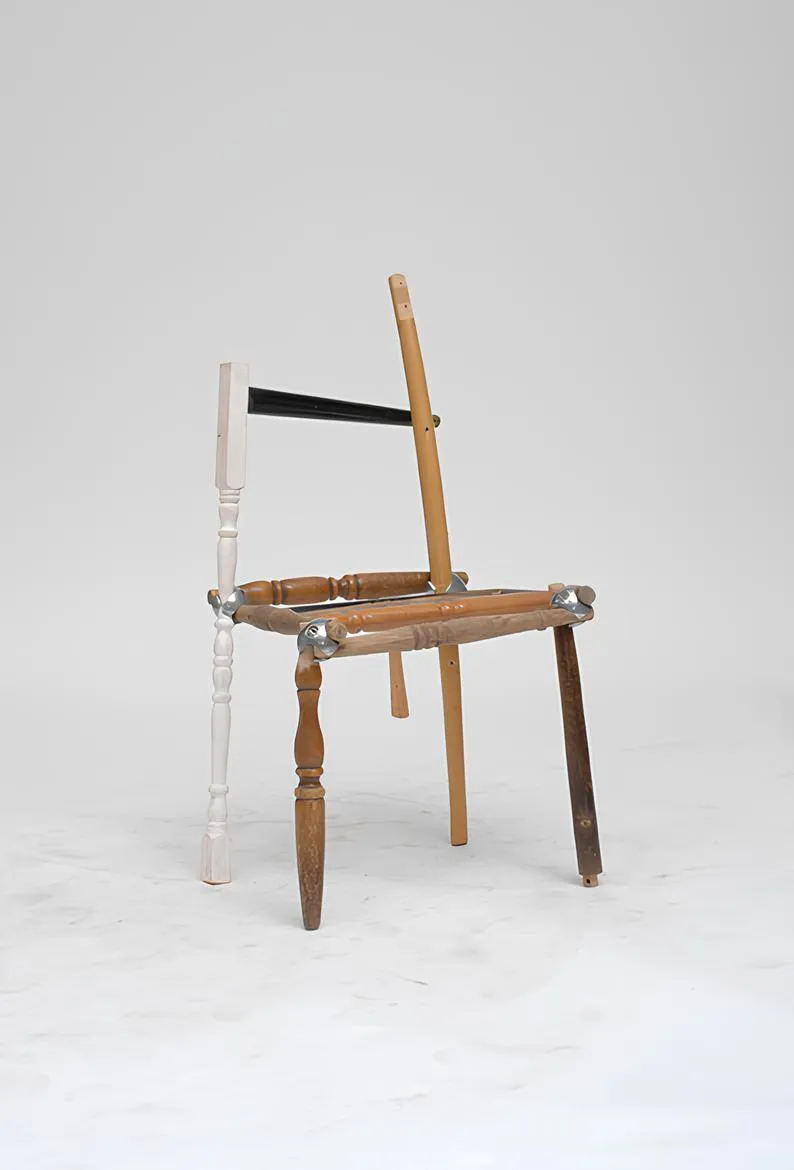
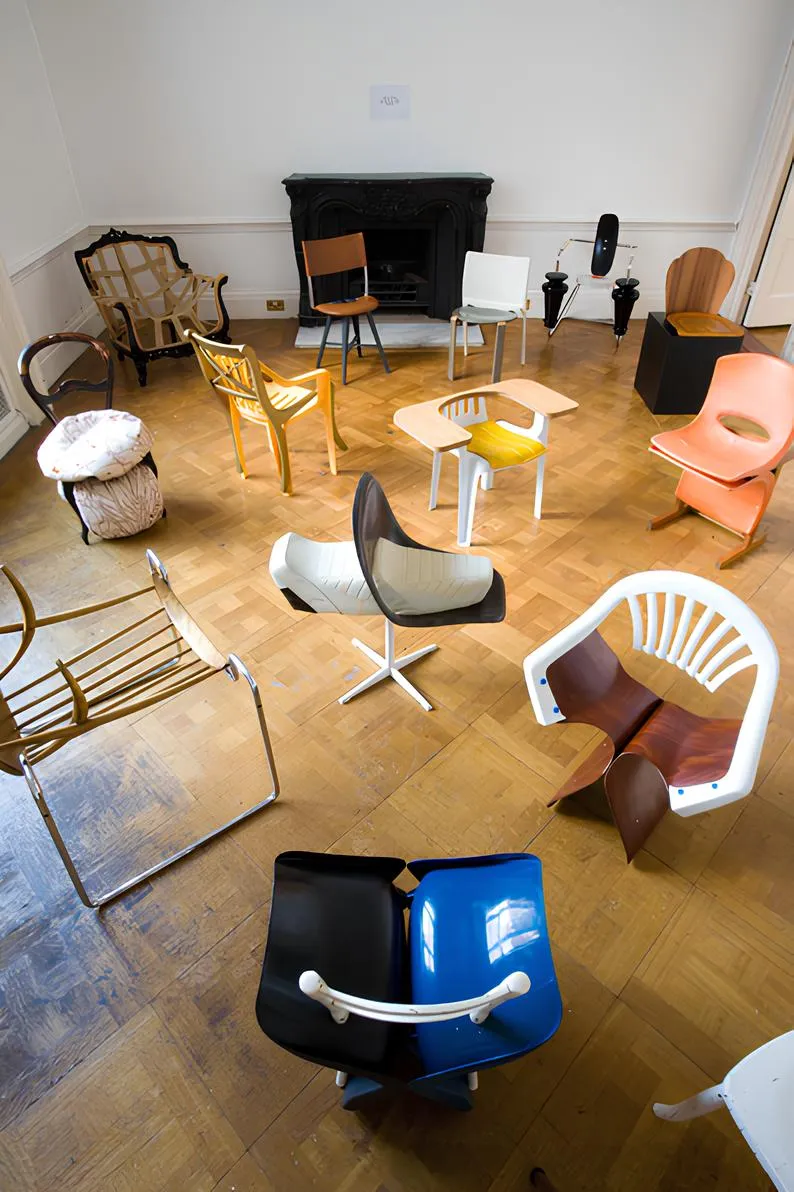
A chair abandoned on the sidewalk has lost its owner, its price and, at least temporarily, its function. What remains is the material, the form, and the marks left by the bodies that used it. It was from these residues that, in 2007, Martino Gamper began producing 100 Chairs in 100 Days. For about two years he collected chairs from the streets of London and from friends’ homes; then, for a hundred consecutive days, he built a new one each day, disassembling and recombining what he had found.
Gamper was not looking for the definitive chair. As he explained, the process had produced «something similar to a sketchbook, a collection of possibilities»: a hundred hypotheses generated by the available materials, by inherited forms, and by the limit of a single day. Some results appear plausible, others clumsy or structurally uneasy. Their meaning lies not in perfection, but in the sheer quantity of hypotheses extracted from objects that seemed to have reached the end of their life.
After nearly twenty years in the Nilufar collection, the entire series has been acquired by a major international museum institution, whose name has not yet been announced. The journey has come full circle: from the street to the studio, from the studio to the gallery, from the gallery to the museum. Objects initially devoid of economic value become heritage. The material has been saved; the function, perhaps, has not.
Recycling and reuse in design: Markus Friedrich Staab, from second authorship to secondary material
To talk about chairs made from waste, one must first distinguish recycling from reuse. Gamper, like Markus Friedrich Staab, does not transform furniture into a new material: he preserves legs, seats and backrests, modifies them and recomposes them. The identity of the previous objects remains at least partly visible.
These practices can be arranged along a spectrum. At one extreme, the old chair remains recognizable and receives a second form or a second signature. Moving forward, what is recovered is first broken down into its components, then reduced to an accumulation or an archive of fragments; further still, it is shredded, melted or bound with resins, until it becomes a relatively uniform secondary material. At the other extreme the waste is no longer recognizable and can re-enter serial production.
It is not a moral scale. Preserving an object’s identity is not automatically more circular than transforming it into raw material, just as standardization is not necessarily a surrender to industry. The more the previous life of the waste remains legible, the more the process tends to be slow, variable and difficult to repeat. The more homogeneous the waste becomes, the easier it is to control and produce in series, but its history is erased.
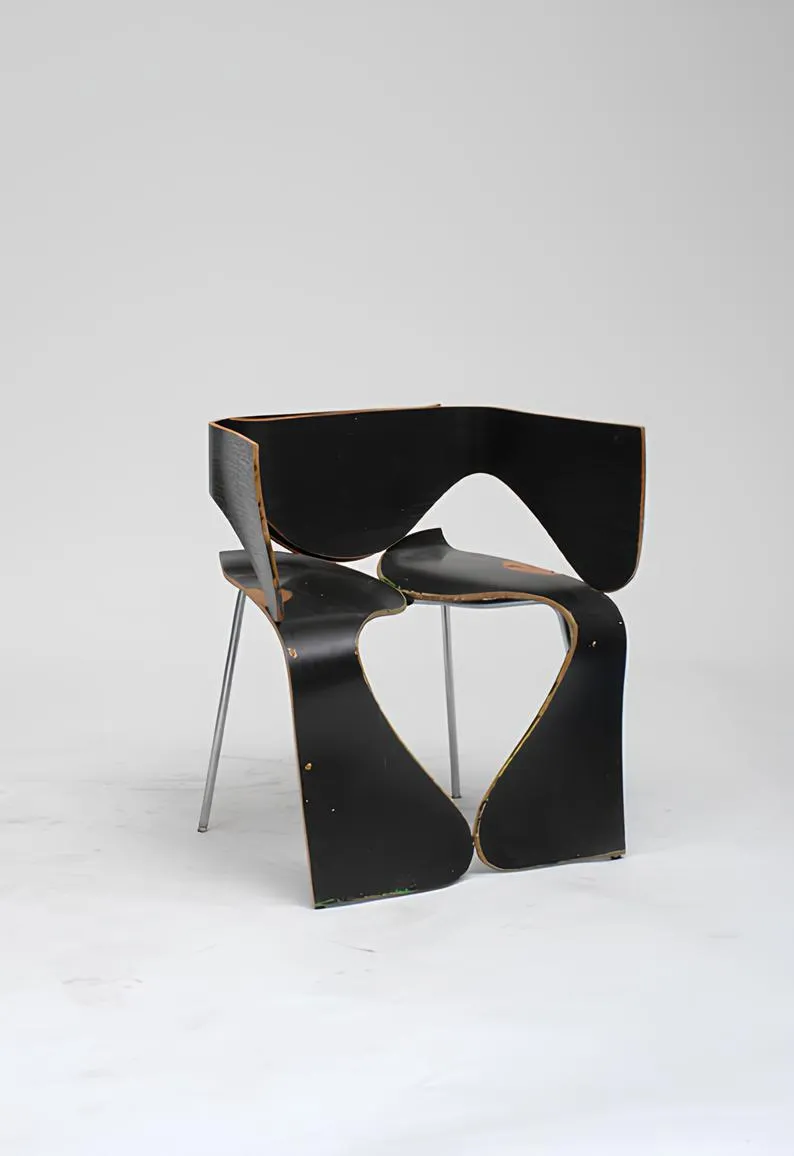
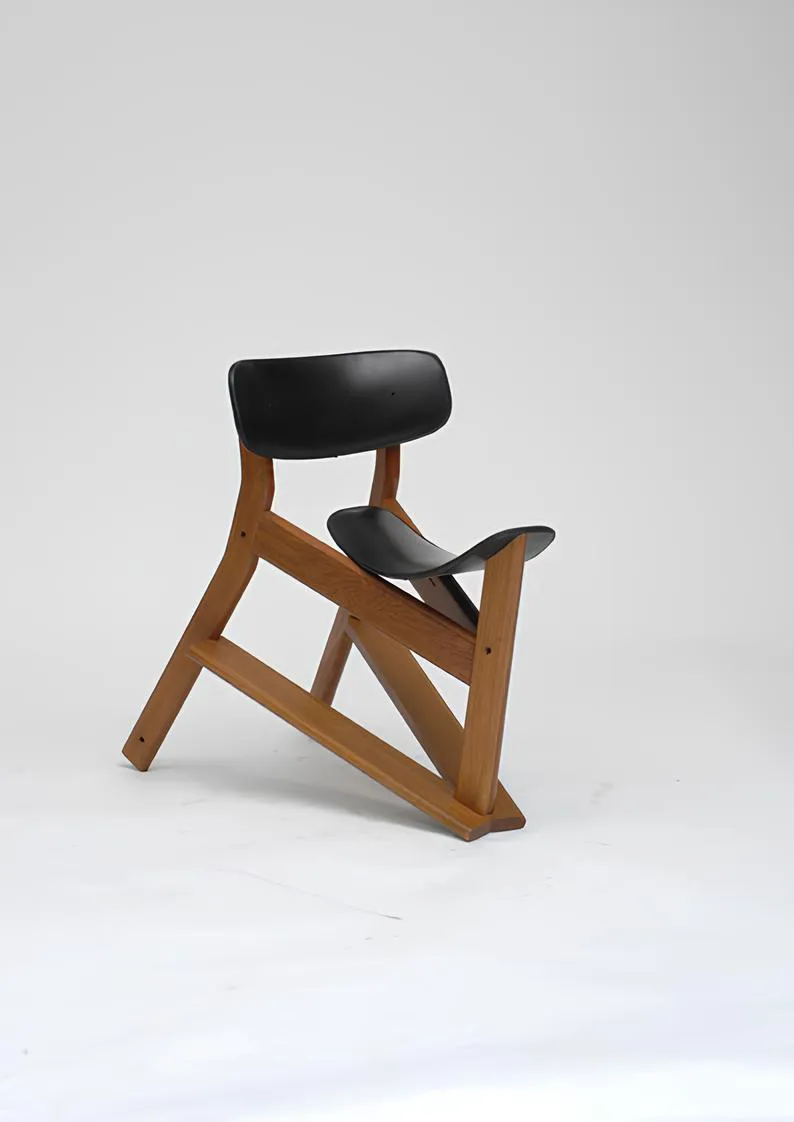
Staab works close to the first extreme, like Gamper. But unlike him, he starts from vintage, vernacular chairs or ones belonging to design history, and treats them as still-open structures: he cuts, replaces, adds, paints. In his works, rural Austrian furniture, work seating and models by designers such as Wim Rietveld, Ilmari Tapiovaara or Yngve Ekström can reappear. The past is subjected to another intention. Staab too initially collected chairs from the street, but later turned toward furniture selected at markets and auction houses, destined for the collectible design circuit. In an earlier interview with Lampoon, Staab also acknowledged that paints and lacquers prevent his work from being considered fully circular. The chairs remain usable, but around their usability an ambivalence forms: one can sit on them, yet their economic and artistic status suggests caution.
Ron Arad, Yinka Ilori and Maarten Baas: the recovered chair as identity and signature, and the cost of recycled material
The second authorship exercised on an existing chair has precedents. In 1981 Ron Arad mounted a seat recovered from a scrapped Rover onto a structure of industrial pipes and joints, producing the Rover Chair. The designer has recounted that, after dragging the seat out of a scrapyard, years later he could not touch his own chair in a museum without wearing white gloves. Recovery had not merely extended the object’s life: it had overturned its status.
Yinka Ilori shifts reuse onto the terrain of cultural identity. In If Chairs Could Talk, abandoned chairs and secondhand furniture become portraits of people known during childhood: colors, patterns and structural modifications weave their stories together with Nigerian parables and the author’s British-Nigerian experience. Onto the object’s biography a personal, diasporic memory is thus superimposed. Maarten Baas, instead, chars design classics and coats them in resin, pushing second authorship as far as controlled destruction. In all these cases, within a transformed chair coexist the original designer, the manufacturer, whoever owned and used it, whoever found it, whoever modified it, the gallery that constructs its provenance, and finally the museum that historicizes it. Authorship becomes a form of montage.
These works make visible an aspect that the narrative of circularity often leaves in the background: discarded material can be free, but its recovery is not. It must be sought out, transported, cleaned, sorted, assessed for condition, with unusable parts discarded and a solution invented for what remains. The real cost of waste is labor.
The aesthetics of scarcity in Piet Hein Eek and the Campana brothers’ Favela; the fragment archives of Tejo Remy, Tobias Juretzek and Jay Sae Jung Oh
Piet Hein Eek has turned this labor into a language. Recovered boards and fragments are selected and arranged until they form surfaces resembling an irregular marquetry. The waste loses the look of a heap and gains discipline: the furniture type can repeat itself, while the arrangement of the boards remains unrepeatable. The uniqueness is serial, but it requires an amount of manual labor incompatible with the supposed “zero cost” of the raw material.
The Campana brothers’ Favela makes the transformation of scarcity into luxury even more explicit. The chair is built by manually nailing together numerous wooden strips in a variable composition. Edra states that each piece takes about a week of work and uses pine or teak, meaning not necessarily recovered wood. What is recovered here is, above all, an image of scarcity. A technique associated with self-building, necessity and lack of resources is reproduced using new materials and highly specialized labor for the luxury market. Material poverty, real or evoked, becomes an aesthetic that can be purchased only by those who do not suffer it.
Moving further along the spectrum, the chair becomes an archive of materials. In Tejo Remy’s Rag Chair, used clothes are compressed by metal bands. Each piece contains an anonymous population of previous bodies: recovering the material here means preserving, at least symbolically, the biographies embedded in the clothing. In Tobias Juretzek’s Rememberme, instead, clothes from customers or recycling companies are bound together with a plant-based resin. The chair maintains a repeatable form, while the color and material memory remain individual. In Jay Sae Jung Oh’s Salvage series, toys, bottles, musical instruments and furniture parts are assembled into a structure and then wrapped in rope or leather, in a long, elaborate process that both reveals and conceals the waste.

From object to controllable material: Alicja Kwade, the RCP2 Chair, the Cabbage Chair and James Shaw between resins, waste and a third life
In Alicja Kwade’s work the spectrum folds back on itself. In Achairisatreeisachair the chair emerges from the trunk without fully separating from the tree; in Fahrrad a bicycle is shredded and recompressed into the mold of a chair. In the first case the natural material still contains the object; in the second, the object loses its own form and survives only as material and narrative.
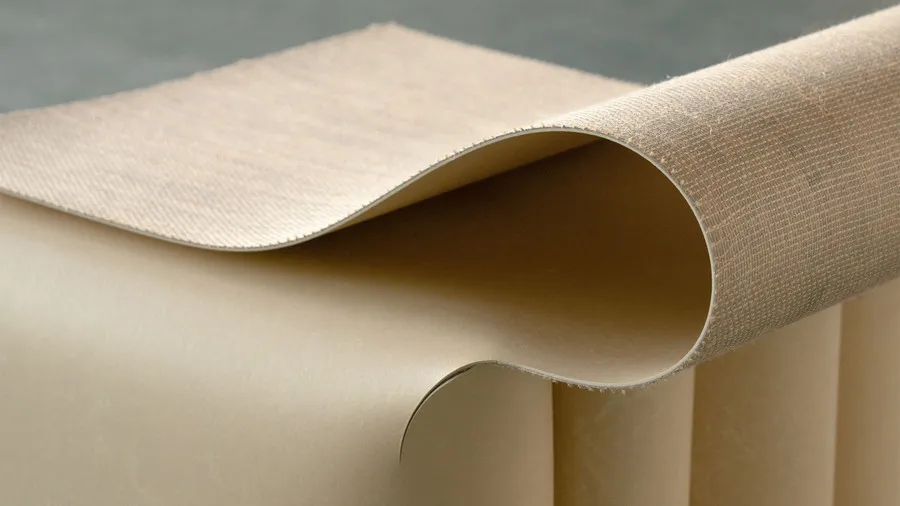
Fahrrad does not propose an ecological solution for bicycle recycling. It is, rather, an experiment on material continuity: how much of an object remains once its form has been eliminated? The same question runs through many recycled chairs. Jane Atfield’s RCP2 Chair transforms post-consumer polyethylene containers into panels that can be cut and screwed together. Here the transformation of waste into panels allows the structure to be repeated, while color variations make each piece slightly different. In nendo’s Cabbage Chair, instead, the form is obtained by peeling back a roll of pleated paper discarded during Issey Miyake’s textile production. No frame, nails or screws are needed; the resin already present in the paper contributes to its strength. The chair seems discovered within the waste rather than imposed upon it.
James Shaw works recycled plastic with a handmade extrusion gun. The chairs of Plastic Baroque show drips, accumulations and variations that turn an industrial material into a gestural practice. In the Well Proven Chair, developed with Marjan van Aubel, wood shavings and residues react with a bio-resin forming an expanded mass manually applied to the structure. Waste no longer necessarily determines a different structure for each piece: it can become a relatively controllable material.
Recovered provenance, however, does not guarantee the circularity of the result. Glues, resins, lacquers and reinforcements can make materials that could previously be repaired or recycled independently, now inseparable. An irregular surface can make the recovery immediately visible while, at the same time, concealing an object destined to become composite waste. A second life does not necessarily imply the possibility of a third.
The test of the body: safety, the EN 12520 standard and manufacturer liability
While a sculpture only needs to support itself, and a piece of artisanal furniture the weight of objects placed on it, the chair poses specific and particularly demanding challenges, because it must support a body. In industrial production, the density, thickness, strength and behavior of materials are known in advance. In a recovered chair, by contrast, every part can hide defects.
Seating intended for the market is subjected to load, impact, durability and stability tests, described by standards such as EN 12520 for domestic seating. In a uniform series, a representative sample can be tested. If each piece has different woods, joints and geometries, the performance of one chair does not guarantee that of the next. Individually verifying a unique piece through fatigue testing can be costly and can itself stress the very object meant to be sold or preserved.
The problem is not only technical. The European General Product Safety Regulation establishes that whoever substantially modifies a product in a way capable of affecting its safety can assume the responsibilities of the manufacturer. Transforming an old chair, therefore, does not mean simply signing it: it can mean answering for the new stability of the whole.
From here arises the ambiguity of functional art. The object still has legs, a seat and a backrest, but its price, fragility or placement in a gallery discourage its use.
From the Endless Chair to the Sea Chair and Ore Streams: uniqueness between machine, sea and electronic waste
Being made one at a time does not necessarily mean that chairs are all structurally different. Piet Hein Eek repeats a typology while letting the composition of wood fragments vary; the Campana brothers apply the same construction process to every piece of Favela. Uniqueness can also be produced by a machine: Dirk van der Kooij uses a robotic arm to deposit recycled plastic according to a programmed geometry. Variations in material, color and layering nonetheless make each Endless Chair slightly different from the others.
With Sea Chair, Studio Swine instead envisioned a microfactory connected directly to the collection site. Plastic recovered from the sea by fishermen is transformed into stools aboard the boats. Formafantasma’s Ore Streams, finally, shifts attention from the object to the system. The research into global flows of electronic waste includes furniture built with recovered metals and computer components, functioning above all as tools for making visible the obsolescence and circulation of materials. The designer does not merely transform waste: he investigates why that waste exists and which infrastructures determine its fate.
The political limit of the unique piece, from the street to the museum, against the serial production of Jasper Morrison’s Alfi Chair
The unique piece thus reveals its own political limit. It can save one chair from the landfill, but it cannot absorb the volume of furniture discarded by mass consumption. Its slowness creates attention and cultural value; it also creates scarcity. In the passage from street to studio, waste acquires a signature. In the gallery, unrepeatability becomes price. In the museum, finally, preservation extends its existence, but suspends its use.
At the opposite extreme of the spectrum sits the Alfi Chair, designed by Jasper Morrison for Emeco. Seat and backrest are made from a compound of recycled polypropylene and wood fibers from post-industrial waste. The previous material is no longer recognizable and does not generate unique collectible pieces: it is absorbed into an ordinary, durable, repeatable chair. It does not possess the narrative density of Gamper or Staab, but it can circulate as a product without depending on the exceptionality of each individual piece.
What remains of a recycled chair: memory, function and circularity
The spectrum of recycled chairs can thus intersect with sustainability, but it is not its true focus. It describes, rather, what we are willing to lose in order to save something: the object’s memory or the series’ uniformity, the time of manual labor or the possibility of large-scale production, the reparability of the present against the simplicity of future recycling.
Gamper and Staab make visible how much interpretation is needed for a chair not to become waste. But they also show recovery’s final paradox: the attribution of value can protect the object from destruction and, in the same gesture, deny it its purpose. The most precious recovered chair may become the one on which no one sits anymore; the most circular, perhaps, the one in which no one can recognize the waste any longer.
Luca Avigo