What you want from your body? Antony Gormley, iron and crawling
An interview with Antony Gormley. In What Holds Us, he stages a physical encounter with sculpture: “to become whole we have to be held. A tree has to be held in the ground in order for it to grow”
An interview with Antony Gormley on What Holds Us, on view at Galleria Continua, San Gimignano
“What is sculpture good for? That’s a question I ask myself every day, if not every hour,” says Antony Gormley. “Sculpture is a tool to probe the world with. Sculpture is not about making a picture of the world, but about changing it. The biggest shift in my work is that, originally, I wanted to contain space, whereas now I want to invite people into it.”
The solo exhibition at Galleria Continua in San Gimignano, What Holds Us, on view from 9 May to 13 September 2026, unfolds across the gallery’s historic spaces.
Antony Gormley explains the meaning of the title of the exhibition What Holds Us
Antony Gormley The word “hold” has a peculiar resonance for me. In the hold of a ship, it refers to a place where cargo is stored — a holding position that supports and protects. In my mind, there is a connection between “whole” and “hold” that is not simply alliterative and suggests that to become whole we have to be held. A tree has to be held in the ground in order to grow, a foetus has to be held in the womb in order to flourish, a mind has to be held in a body before it can develop.
In broad terms, the show is about what sustains our lives. This notion of sustenance has shifted from food for the body to information for the mind. Perhaps we are now beginning to feel and understand that information is not enough. In the exhibition, I try to bring together materials that evoke a sense of situated identity, alongside others that are perishable, conveying a sense of precarity and impermanence.
A former cinema-theatre rewired: Gormley on breaking spectatorship. From seated absorption to bodily interaction
FJC The main space of Galleria Continua in San Gimignano is a former cinema-theatre, built for seated spectatorship and a frontal gaze.
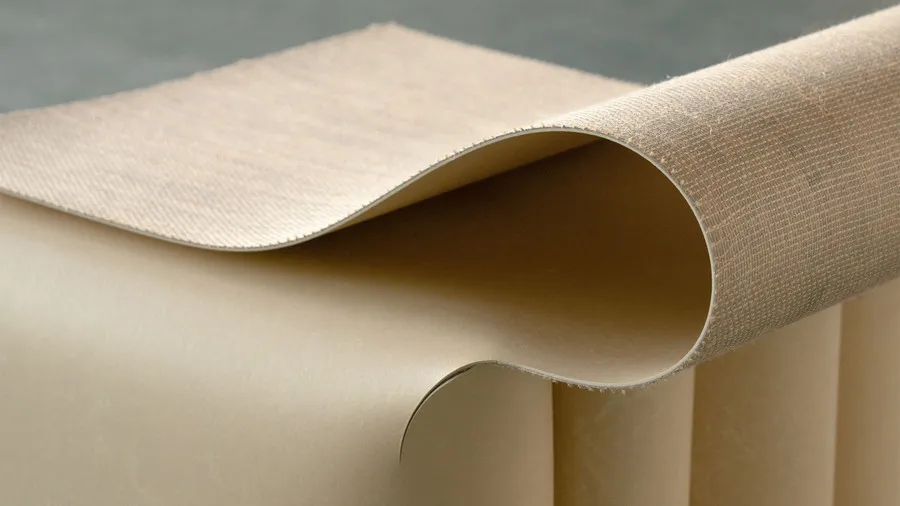
Antony Gormley I want to transform the sedentary space of static absorption into one of dynamic interaction. To use the entire architecture as a place where the viewer becomes part of the viewed, where the stalls become a kind of labyrinth in which inside and outside mix, and you are invited to traverse a landscape of massive bodies made from cardboard – a material that has become ubiquitous in the age of online shopping. I want people to get on their hands and knees and explore the interior spaces of these cardboard bodies that are also buildings: containers as well as displacers of space. I’m also aware of the installation as a total work that invites passage through as well as between the bodies. The missing panels at the top and sides of the sculptures allow people to look into the interiors, whether walking through the field or looking down from the balconies above.
FJC You’ve said: “I hope this exhibition stops people in their tracks and gets them down on their knees, crawling like a baby.” What does that lowered horizon make possible that standing height cannot?
Antony Gormley Once we get close to the ground, everything that rises above it becomes much more present. We are the most vertical animal constantly looking to the horizon. Our limbic system reinforces surveying from afar. The minute you are on four legs, you become an animal and become identified with the ground rather than the horizon. The fight or flight instincts are replaced by something closer to food attention or the kind of examination that we reserve for handwork. The withdrawal from the horizon reinforces intimacy.
Matter as behaviour: Gormley on mass, void, affordance. Stone, clay, concrete, iron, cardboard
FJC You write: «As a sculptor, I speak in the language of stuff: matter, in the belief that all matter has meaning». When you choose stone, clay, concrete, iron are you selecting a behaviour rather than an appearance?
Antony Gormley Every material has a ‘feel’, a character determined by its palpability. I want to be mindful of both character and affordance. Most of the singular sculptures in this show have a lot of mass, and I want that mass to count: fired clay and smelted iron are in dialogue with voided masses made of cast concrete and cardboard. I’m hoping that the voided works make one more aware of the massive works. The exhibition allows me to show two new ‘Double Slabworks’ made of iron, which will be seen outside against the Tuscan landscape. In these works, walls become slabs that are liberated from their function of protection and become independent, playfully containing and releasing space.
FJC What is your relationship to error—do you protect a margin of deviation where the human can appear as trace, rather than as a perfected automaton?
Antony Gormley There are no errors! The work tries to be true to itself and to its material. There are cracks and corners missing in the clay works, ripples in the tape that connects the cardboard, gas holes and dross in the composition of the iron. All of these express the character of the material and method of the work.
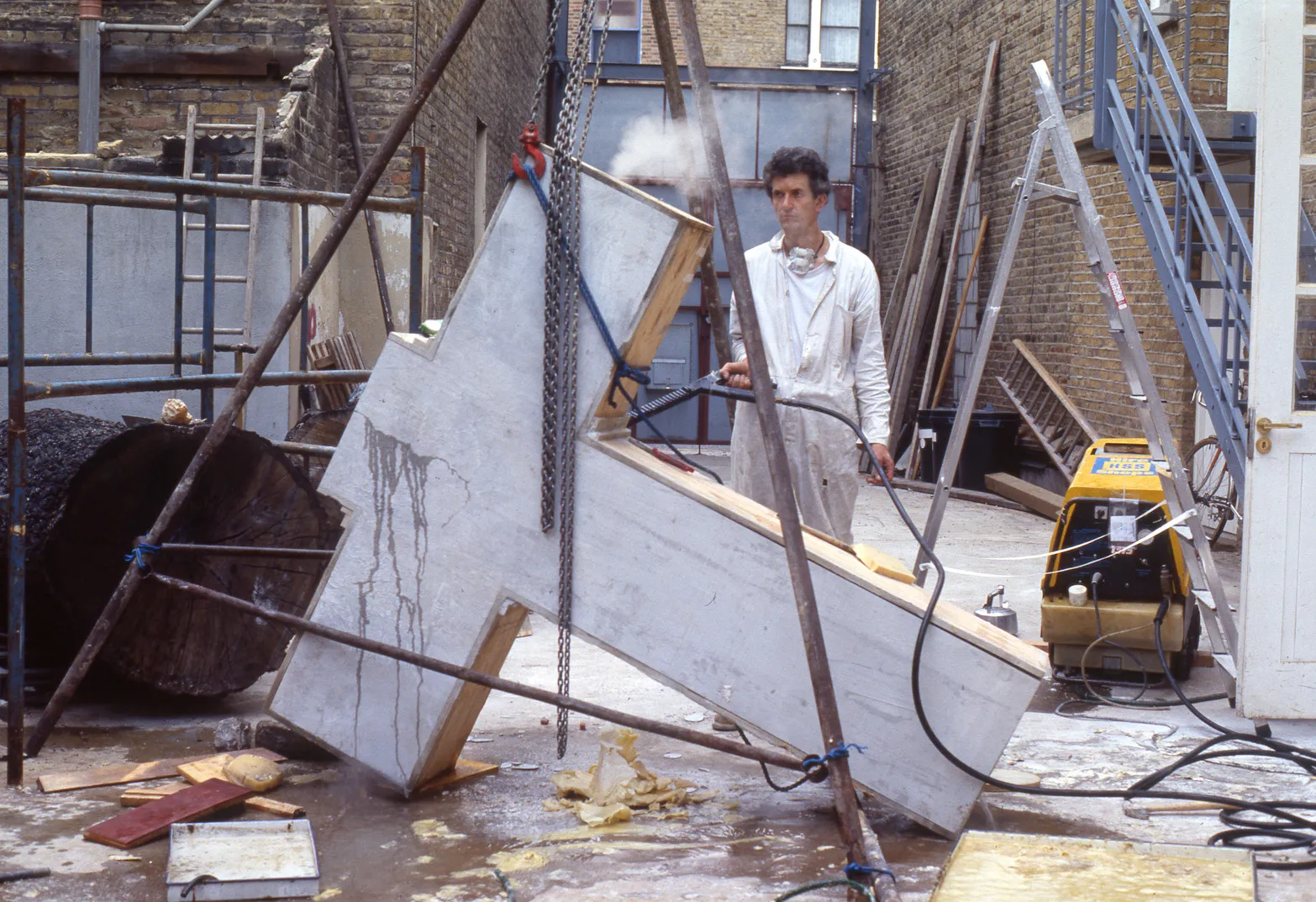
A theatre as acoustic instrument: Antony Gormley on sound and embodiment
FJC A theatre is also an acoustic instrument. Do you consider sound part of embodiment especially when people are moving rather than sitting?
Antony Gormley The acoustic environment is absolutely part of the work. In Ground, my recent collaboration with Tadao Ando at Museum SAN in South Korea, the acoustic reverberation of people moving through the cave-like space is very much part of the piece. I’m interested to see what acoustic effect the installation at Galleria Continua might have.
Antony Gormley in Tuscany: from Poggibonsi to What Holds Usin San Gimignano
Antony Gormley’s sculpture begins where the monument runs out of arguments. It drops the plinth, the heroic anecdote, the public as celebration, and replaces them with a stricter premise: the body as measure—gravity, balance, distance, threshold. Achille Bonito Oliva framed this shift with blunt clarity: “Gormley undermines the rhetorical, triumphalist sense of traditional sculpture from on top of a plinth.” What follows is not a portrait of power, but a method for testing how space holds a body—and how a body, in turn, holds space.
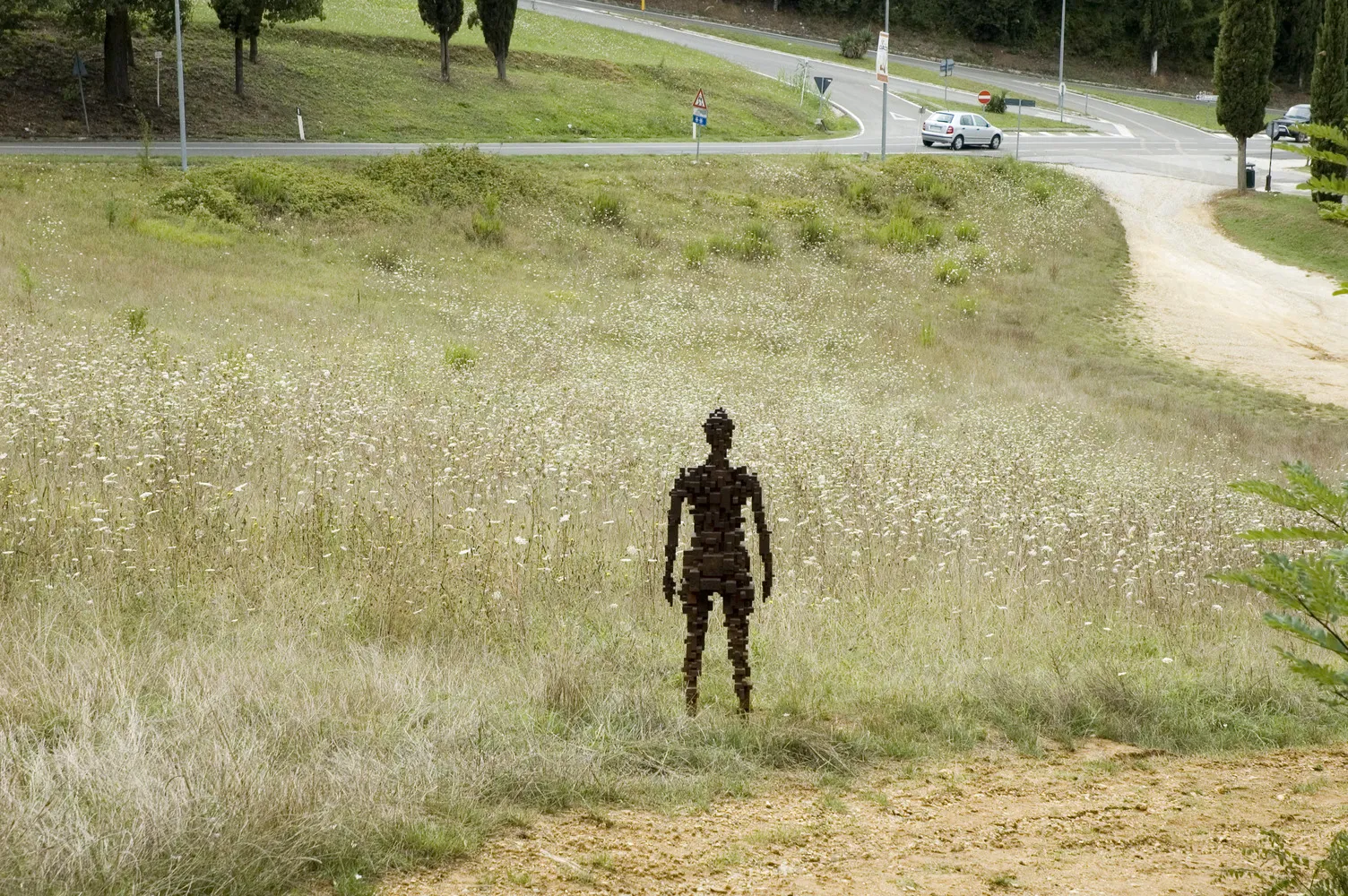
Tuscany is a sustained site in that enquiry. In 2004, in Poggibonsi, Fai Spazio, Prendi Posto / Making Space, Taking Place translated seven residents into cast-iron body-forms dispersed through the town: civic space treated as a field of encounter rather than a stage set for commemoration. The thread returns to San Gimignano across successive chapters at Galleria Continua—Vessel (2012), Co-ordinate (2017), Body Space Time (2022)—each time re-stating the same problem in different terms: how a figure becomes a unit, how a unit becomes a grammar, how a grammar re-educates attention.
Florence sharpens that same question within an institutional frame. At the Uffizi, Antony Gormley. Essere (2019) placed the body “in” space and “as” space, staging a productive friction between enclosure and traversal. In the catalogue text, Luca Massimo Barbero writes: «Space explodes inside and outside us […] a total break of the imposed boundaries between outer and inner, skin and limit, space and time». The line is decisive because it names the real stakes: Gormley’s work is not an image to decipher, but a boundary to cross—sometimes literally, always bodily.
This matters for What Holds Us at Galleria Continua, San Gimignano, where the main venue inhabits a former cinema—the classic architecture of disciplined spectatorship, frontal vision, synchronized attention—re-used as a site to be learnt again through movement. Here, mechanics is literal: constraints, pacing, acoustic feedback, friction; material understood as behaviour rather than look; “error” as the trace of making; responsibility as part of form—how a show is produced, moved, assembled, recycled, and given an afterlife.
Antony Gormley
Antony Gormley (b. 1950, London) has been exhibited throughout the UK and internationally with exhibitions at Museum SAN, Wonju (2025); Musée Rodin, Paris (2023); TAG Art Museum, Qingdao (2023); Lehmbruck Museum, Duisburg (2022); Museum Voorlinden, Wassenaar (2022); National Gallery Singapore, Singapore (2021); Schauwerk Sindelfingen, Germany (2021); Royal Academy of Arts, London (2019); Delos, Greece (2019); Uffizi Gallery, Florence (2019); Philadelphia Museum of Art, USA (2019); Long Museum, Shanghai (2017); National Portrait Gallery, London (2016); Forte di Belvedere, Florence (2015); Zentrum Paul Klee, Bern (2014); Centro Cultural Banco do Brasil, São Paulo, Rio de Janeiro and Brasília (2012); Deichtorhallen, Hamburg (2012); The State Hermitage Museum, St. Petersburg (2011); Kunsthaus Bregenz, Austria (2010); Hayward Gallery, London (2007); Malmö Konsthall, Sweden (1993); and Louisiana Museum of Modern Art, Humlebæk (1989). Permanent public works include Angel of the North (Gateshead, England), Another Place (Crosby Beach, England), Inside Australia (Lake Ballard, Western Australia), Exposure (Lelystad, the Netherlands), Chord (MIT – Massachusetts Institute of Technology, Cambridge, MA, USA) and Alert (Imperial College London, England).
Gormley was awarded the Turner Prize (1994), the South Bank Prize for Visual Art (1999), the Bernhard Heiliger Award for Sculpture (2007), the Obayashi Prize (2012) and the Praemium Imperiale (2013). In 1997 he was made an Officer of the British Empire; he was knighted in the 2014 New Year’s Honours list and appointed a Companion of Honour in the 2025 King’s Birthday Honours list. He is an Honorary Fellow of the Royal Institute of British Architects, an Honorary Doctor of the University of Cambridge and a Fellow of Trinity and Jesus Colleges, Cambridge. Gormley has been a Royal Academician since 2003.
What Holds Us: Antony Gormley at Galleria Continua, San Gimignano
What Holds Us is on view at Galleria Continua, San Gimignano, from 9 May to 13 September 2026, presenting Antony Gormley’s new solo exhibition across the gallery’s spaces.
Federico Jonathan Cusin