Cruise collections: political ideology and the American visibility machine
As Cruise collections migrate toward American cities, the original logic of seasonal escape gives way to something harder to name
When Cruise collections peaked in fashion, they were an invitation to escape. Suspended between seasons, they moved toward summer and everything it promised — ease, distance, leisure. They belonged to the fantasy of elsewhere, where clothing was about atmosphere rather than immediacy, where luxury briefly loosened its ties to the present. That picture no longer holds. The idea of elsewhere doesn’t frame the Cruise anymore. Neither does the romanticism of travel.
In November 2016, weeks after Trump’s election, Sophie Theallet — who had dressed Michelle Obama for eight years — published an open letter calling on the entire industry to refuse to dress the incoming First Lady, citing the “rhetoric of racism, sexism and xenophobia” of Trump’s campaign. Marc Jacobs declared he had “no interest whatsoever” in dressing Melania Trump, stating he’d rather direct his energy toward those who would be hurt by Trump’s policies. Tom Ford, a self-described Democrat who had voted for Hillary Clinton, declined as well. The message from fashion was loud and consistent: this administration is not our administration.
Two months later, on January 18, 2017 — the eve of Trump’s inauguration — Demna showed his AW17 menswear collection for Balenciaga in Paris, with a logo visually modeled on Bernie Sanders’ campaign graphic printed across coats, jackets, and scarves. Demna later clarified that the collection was primarily a commentary on corporate culture rather than a direct political endorsement, though he acknowledged the Sanders reference was fully intentional. The timing made the reading unavoidable. Sanders himself, asked about it on CNN, responded with laughter — noting that being a fashion icon was not among his many attributes. Now Demna is at Gucci, and the Gucci Cruise 2027 just took over Times Square.
Three of the five major Cruise 2027 shows were staged in the United States
Three of the five major Cruise 2027 shows were staged in the United States: Dior in Los Angeles, Gucci and Louis Vuitton both in New York. European houses, many of whose creative directors have been openly critical of Trump’s political climate, continue to invest in American soil as their primary stage for the most orchestrated, most visible expressions of luxury. The political language and the geography of the shows follow entirely separate logics, and nobody seems compelled to explain why.
Part of the answer is economic. As Walter Van Beirendonck stated bluntly in January 2025, the European fashion world was “afraid” of Trump — not ideologically, but commercially. LVMH and Kering, the conglomerates that control Dior, Gucci, Louis Vuitton, and most of the houses that staged Cruise shows in America this season, were acutely aware of what US tariffs on European luxury goods could mean for their bottom line. Bernard Arnault attended Trump’s inauguration in person alongside his daughter Delphine, CEO of Dior, and his son Alexandre — the family positioned in the front rows, just behind the former presidents. The political gestures on the runway and the political gestures in the room tell different stories.
The other part of the answer is structural. The United States remains the most powerful image-production environment in the world. Fashion follows that, regardless of who’s in the White House.
From seasonal escape to global visibility
Gabrielle Chanel saw the rise of leisure in high society and moved quickly to meet it. When clients began travelling to the seaside in winter to escape colder climates, the boutiques still sold wool and cashmere. In 1919, Chanel produced a small collection for clients heading to Biarritz — light dresses, transitional knitwear, pieces suited to the in-between coastal season. It was not a summer collection. It was a practical answer to where her clients actually were.
By mid-century, interseasonal Cruise collections had become a marker of sophistication, anticipated events in high society. By the 1990s, houses like Dior, Chanel, and Louis Vuitton had turned them into formal presentations. By the end of the century, Cruise was a fixed point on the fashion calendar, generating profit and sustaining relevance between the main seasons.
What it has become since is something else entirely. Leisure, travel, and escape survive in the name only. In a system dependent on digital circulation, the Cruise has become a mechanism for global visibility — a tool for narrative control and image production in the gap between seasons. Location is no longer selected for harmony with the collection or the spirit of escape. It’s selected for the intensity of attention it can generate. On those terms, the United States is the obvious choice.
America as amplifier
The United States is saturated with its own images and accustomed to turning itself into a narrative. It is hyper-visible and deeply fractured at the same time — a contradiction of political realities, cultural identities, and competing ideologies, each insisting on its own legitimacy. That tension, and the media infrastructure built around it, produces a level of visibility unlike anywhere else. Cities like New York, Los Angeles, and Miami are where this is most concentrated: instantly legible, globally consumed, continuously reproduced.
This is what the Cruise season is buying when it lands in America. Not geography. Not cultural alignment. Amplification.
The political instability and the visibility are not separate conditions — they feed each other. The more contested the environment, the more charged every image that moves through it becomes. Fashion enters that space knowing full well what it does to a collection’s circulation. The runway stops functioning as a boundary between fiction and environment. The city is no longer a backdrop. The contradiction between what these houses say politically and where they choose to show is part of the image, whether they acknowledge it or not.
Dior Cruise 2027: Hollywood as an environment
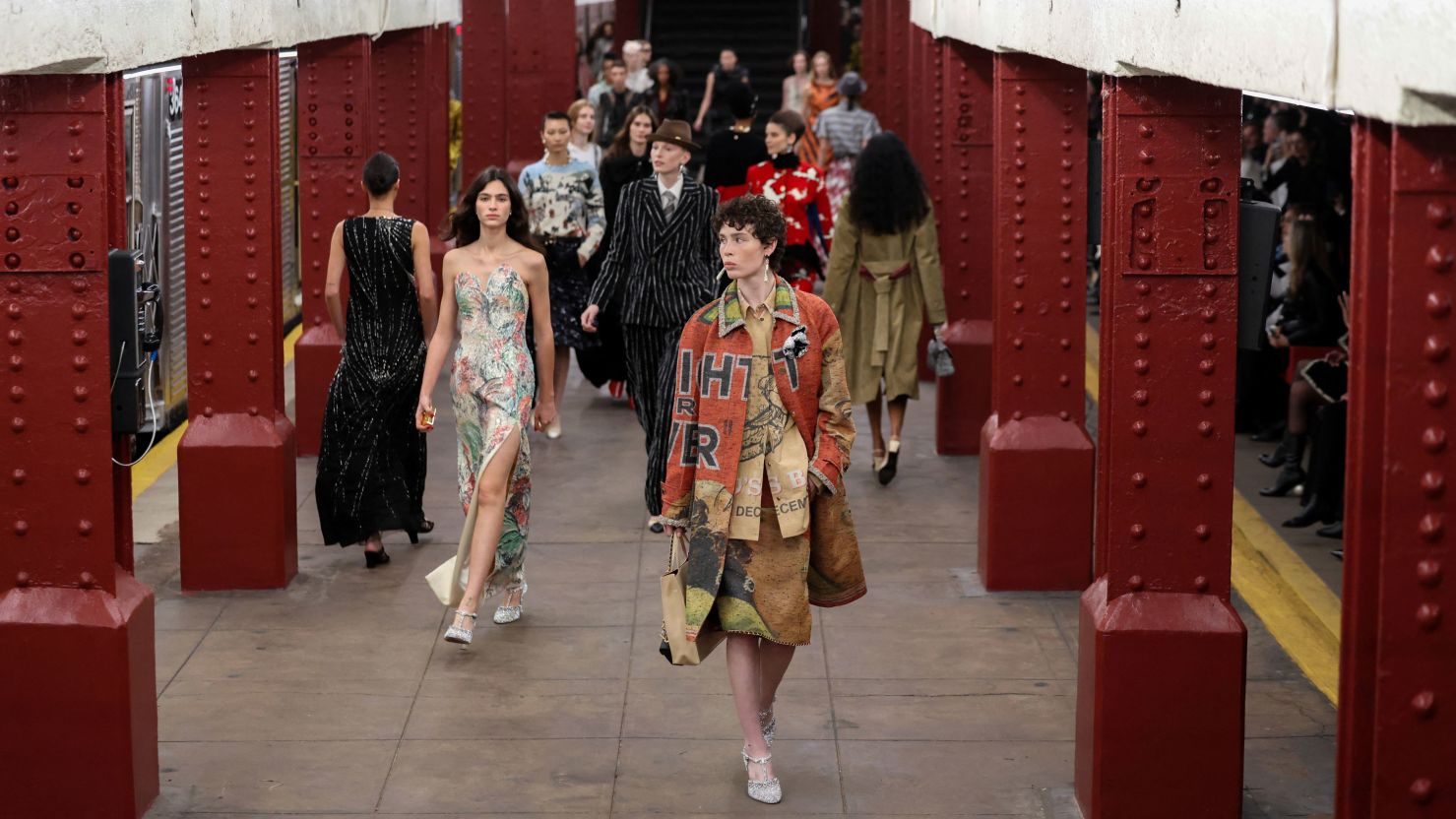
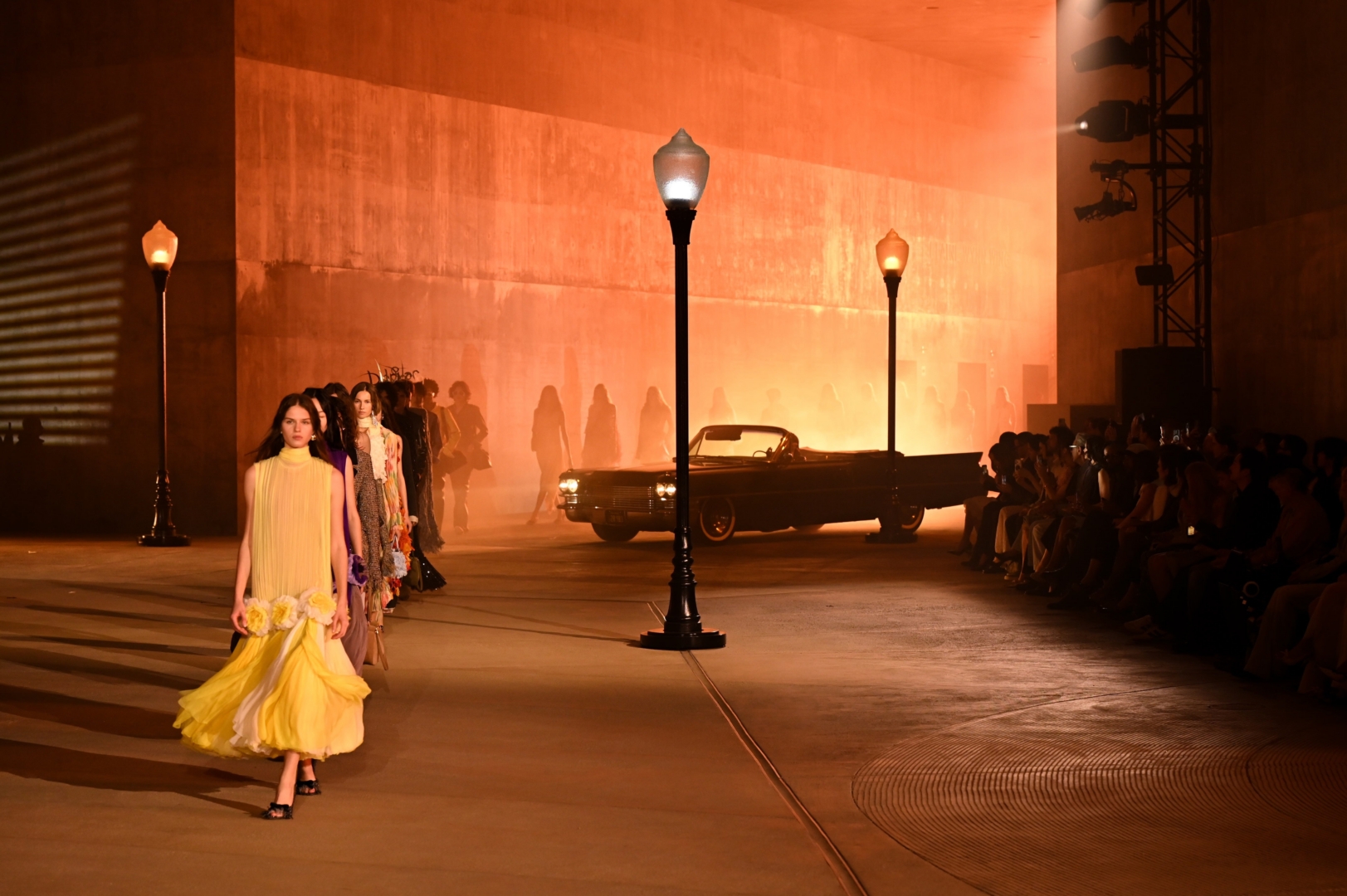
Dior opened the Cruise season on May 13, 2026 at the newly opened David Geffen Galleries at LACMA in Los Angeles. The first Cruise show under Jonathan Anderson brought womenswear and menswear together for the first time in a Dior Cruise presentation, drawing directly from Hollywood’s visual language and Dior’s longstanding relationship with film costuming.
Los Angeles doesn’t need fashion to introduce spectacle. It is already built on competing layers of fiction, memory, and performance. Anderson’s collection entered that environment rather than staging against it — Parisian savoir-faire moving through a city that already understands image-making as a primary language. The references to Hollywood glamour and vintage cinema positioned the show within a space already structured around visual production, where every gesture is immediately fluent in the codes of representation.
Gucci Cruise 2027: saturation at Times Square
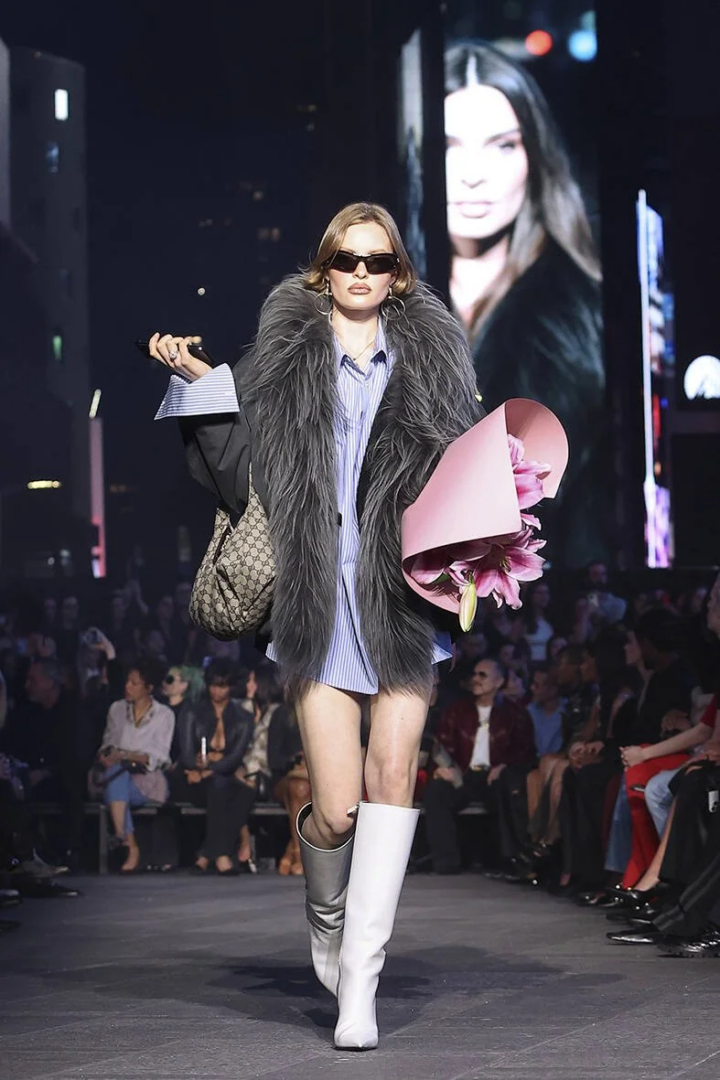
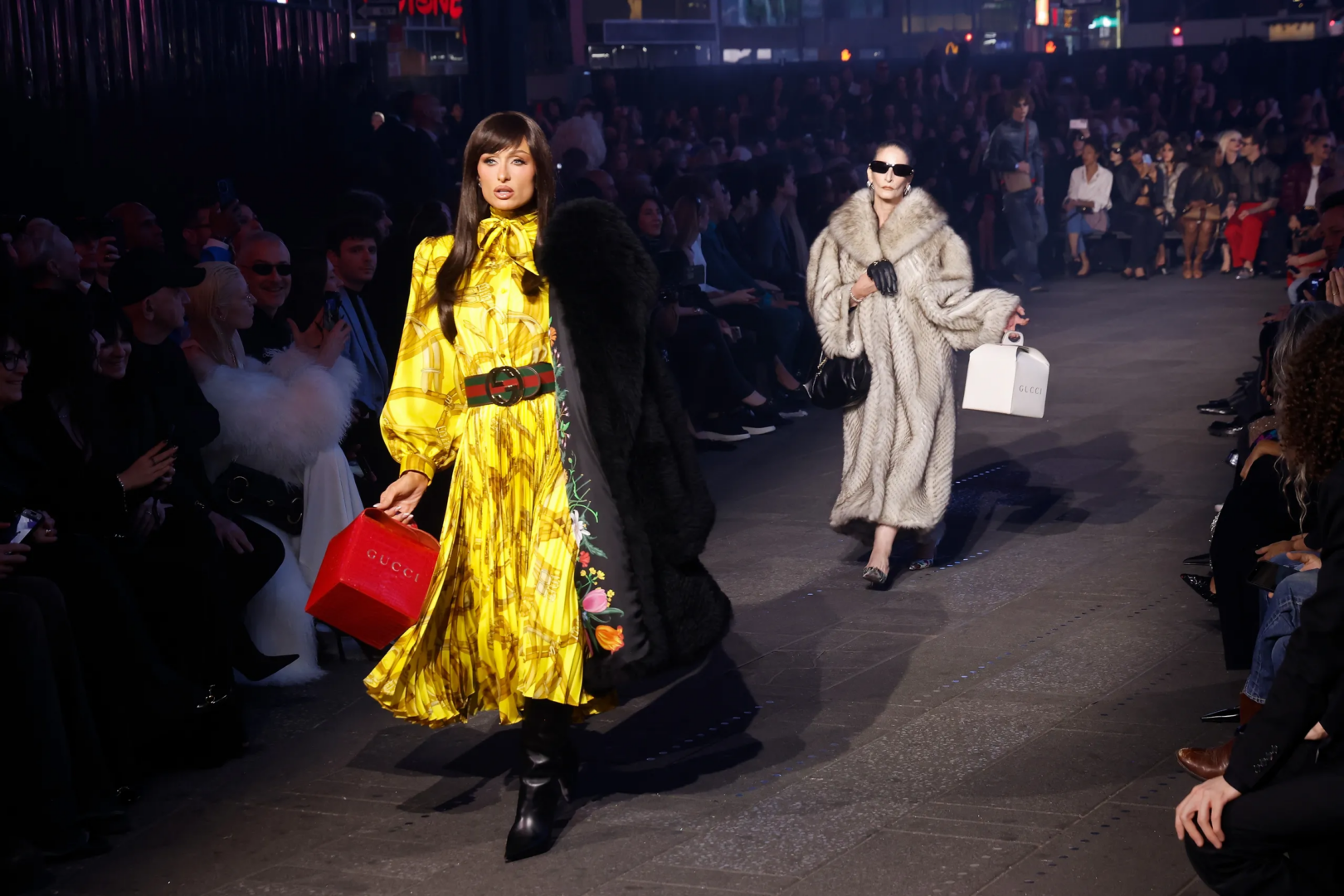
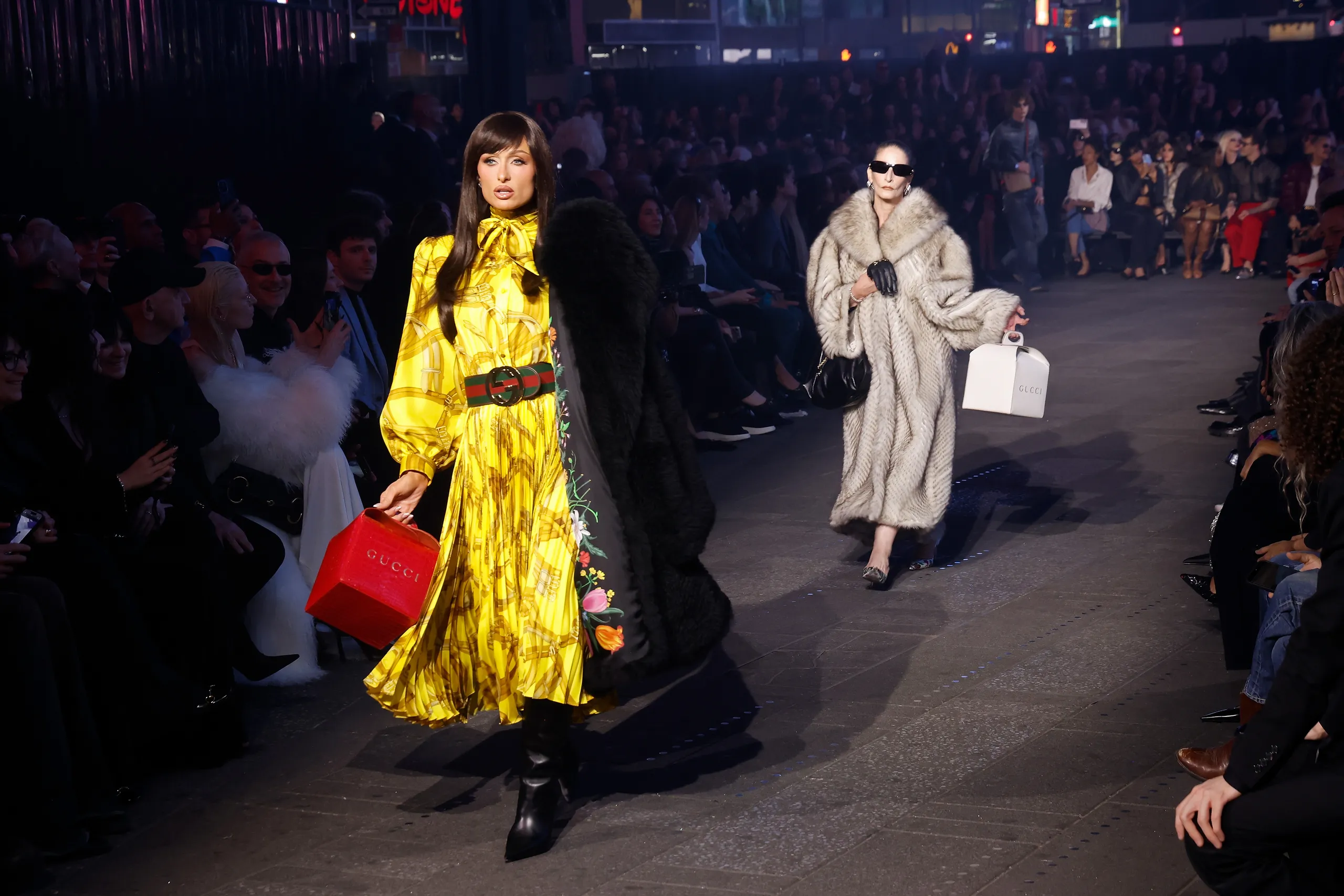
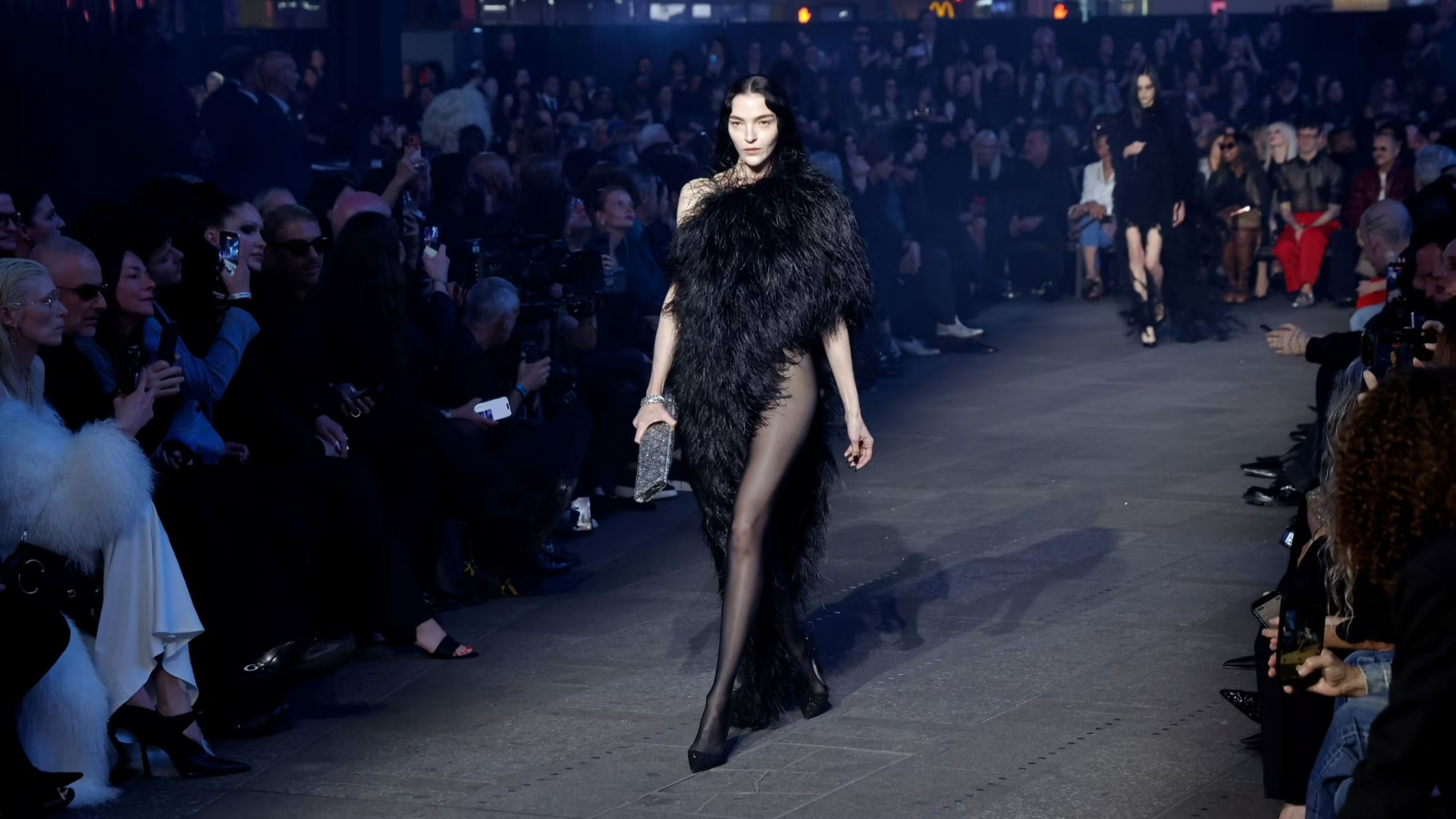
On May 16, Gucci took over Times Square for Demna’s first Cruise show at the house. LED billboards, pedestrian crossings, and commercial signage remained active throughout — not neutralized or dressed down for the occasion, but fully integrated into the staging. Tailored coats, elongated trench silhouettes, and eveningwear moved through one of the most commercially dense environments on earth. The casting brought together professional models — Alex Consani, Anok Yai — with figures like Paris Hilton and Tom Brady, leaning toward contemporary archetypes rather than abstraction.
Times Square is the logical endpoint of what the Cruise has become. It is a space built entirely around exposure, where images don’t appear so much as collide. Gucci didn’t attempt to create distance from that condition — it entered it directly, relying on the intensity of the location to carry the weight of the show’s visibility. The collection didn’t need to escape anywhere. It needed to be seen everywhere, immediately.
The fact that this is the same designer who put Bernie Sanders’ logo on Balenciaga’s coats the night before Trump’s first inauguration — and who is now staging spectacle in the heart of Trump’s New York — is not incidental. It is the contradiction made visible.
Louis Vuitton Cruise 2027: institutional legitimacy at the Frick
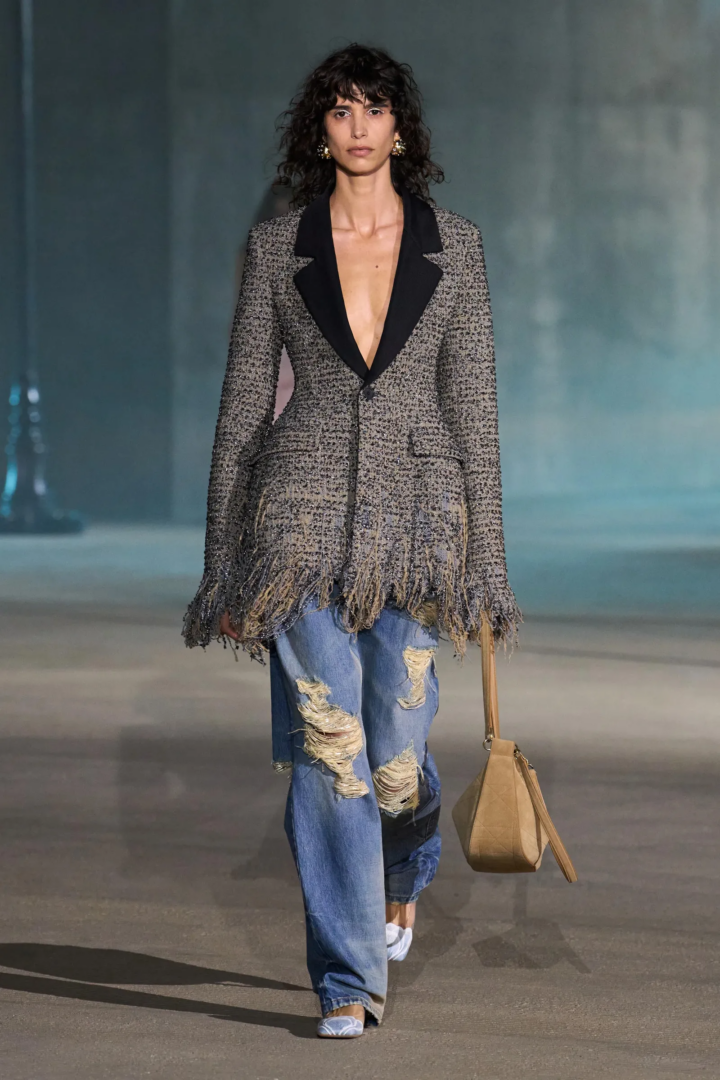
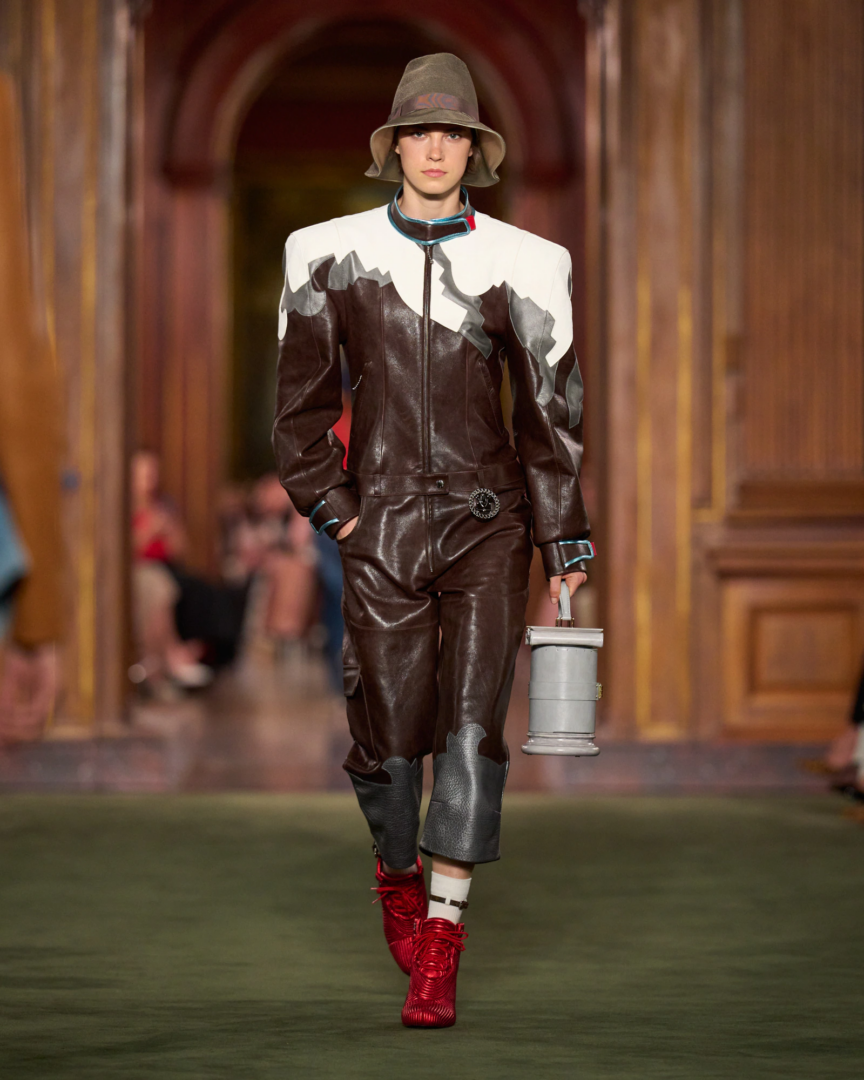
On May 20, Louis Vuitton presented at The Frick Collection in New York — the first time the institution’s historic first-floor galleries were used for a fashion show. Nicolas Ghesquière’s collection moved through Gilded Age interiors defined by European painting, decorative arts, and architectural preservation. Louis Vuitton had also announced a three-year cultural sponsorship of the museum tied to exhibitions and curatorial research, extending the relationship beyond the runway.
Where Gucci operated through saturation, Louis Vuitton worked through legitimacy. The Frick’s atmosphere of permanence and historical continuity became an active layer of the collection — not a backdrop, but a structural argument about the kind of cultural authority Louis Vuitton wanted the show to inhabit. The approach is different from Times Square, but the underlying logic is connected. Both are selecting an American environment already dense with symbolic recognition, where the location itself becomes part of the image being produced.
What this season reveals
With three of the five major Cruise 2027 shows staged in the United States, the pattern is clear. American cities are being selected not for what they mean culturally in any unified sense, but for what they can do operationally: concentrate visibility, accelerate circulation, turn a collection into an event that moves globally before the week is out.
Political language continues to run through the industry’s public positioning — in casting choices, in the statements designers make, in the causes houses align themselves with. That layer is real. But it operates on a different track from where the shows are actually staged. The two don’t contradict each other because, from the industry’s perspective, they were never meant to. One is about articulation. The other is about scale.
What the 2027 Cruise season makes plain is that fashion’s relationship with America is not ideological. It is structural. The country’s political instability, its media saturation, its capacity to turn any image into circulating visual material — these are not problems fashion works around. They are the conditions fashion works with. The contradiction between what designers say and where they show is not a failure of consistency. It is the system functioning exactly as designed.