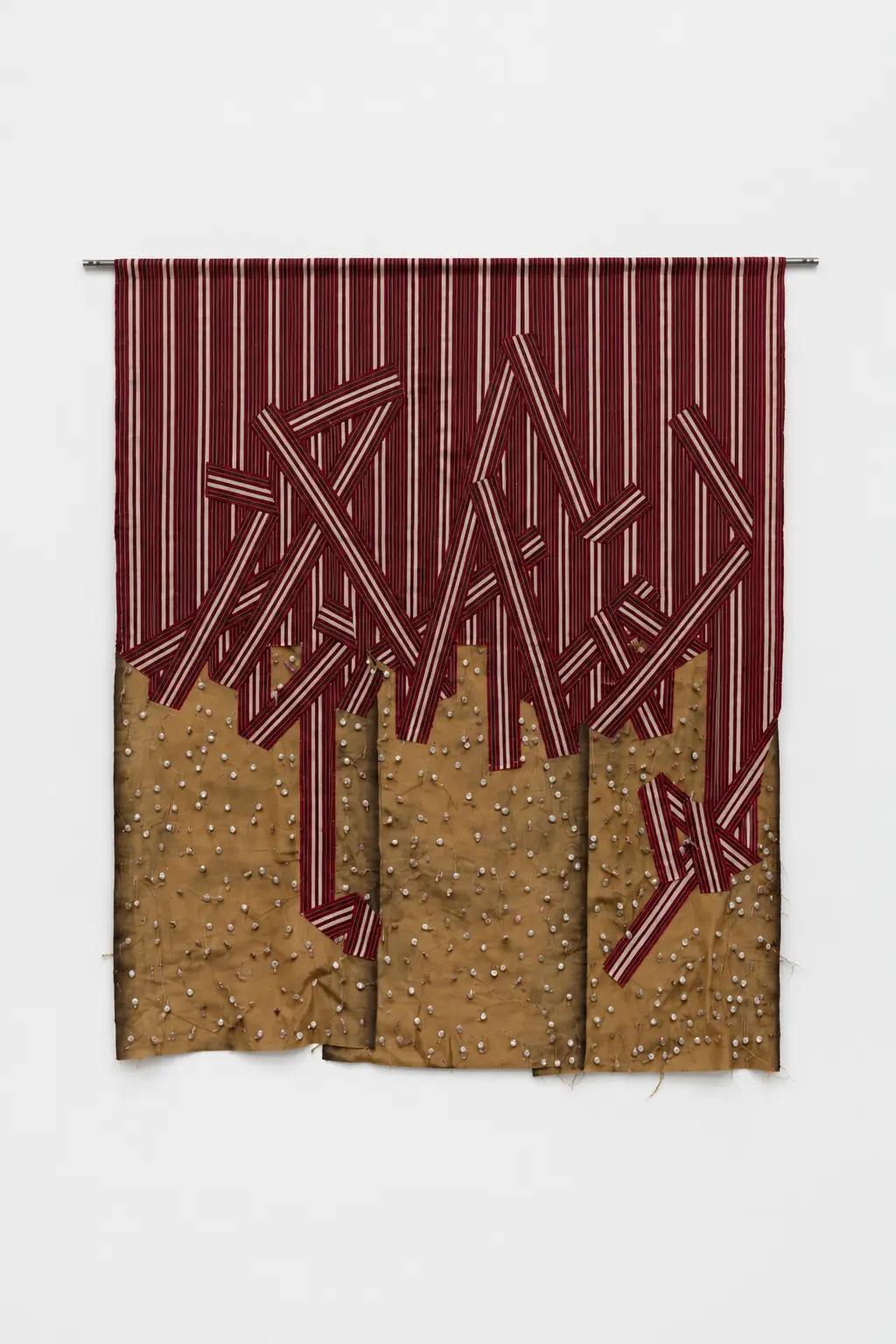
Art Basel Paris 2026: a fifth edition read through its materials
From tar to recycled X-ray silver: how 211 Art Basel Paris exhibitors work their materials, October 23 to 25
Art Basel Paris 2026 at the Grand Palais: the fifth edition
Art Basel Paris opens its fifth edition at the Grand Palais on October 23, 2026. Public days run until October 25, after an Avant-Première on October 20 and two Preview Days. The fair gathers 211 exhibitors from 41forty-one countries and territories. It is the first edition under director Karim Crippa. Coverage of art fairs tends to follow names and prices. This chronicle follows another line: the building and the materials inside it. Glass, steel, bronze, tar, leather, silk, X-ray film and code pass through the Nave and the streets around it.
From FIAC to Paris+ par Art Basel: the history of the Paris fair
For nearly half a century, the October slot at the Grand Palais belonged to FIAC, the Foire Internationale d’Art Contemporain. In January 2022, the Grand Palais management company gave the slot to MCH Group, Art Basel’s parent company. Parisian galleries split between concern and optimism.
A contract barred the name Art Basel Paris at first. The 2022 and 2023 editions ran as Paris+ par Art Basel, in a temporary structure near the Eiffel Tower. In 2024, the fair took its current name and moved into the restored Grand Palais. That edition counted 195 galleries from forty-twocountries and territories and more than 65,000 visitors. It also launched Premise, a sector for research-led curatorial projects. In 2025, the fourth edition welcomed more than 73,000 visitors. Hauser & Wirth sold a Gerhard Richter Abstraktes Bild (1987) for 23 million dollars during the Avant-Première. White Cube placed a 2007 painting by Julie Mehretu for 11.5 million dollars. David Zwirner reported a hanging sculpture by Ruth Asawa at 7.5 million dollars. The Louisiana Museum of Modern Art acquired works by William Kentridge through Goodman Gallery.
The Grand Palais as apparatus: glass, steel and daylight
The Grand Palais was built for the Exposition Universelle of 1900. Henri Deglane, Albert Louvet, Albert Thomas and Charles Girault designed it. Its Nave rises under a roof of glass on a steel frame. Chatillon Architectes, led by François Chatillon, restored the building between 2021 and 2025. The works cost 500 million euros and cover 72,000 square meters.
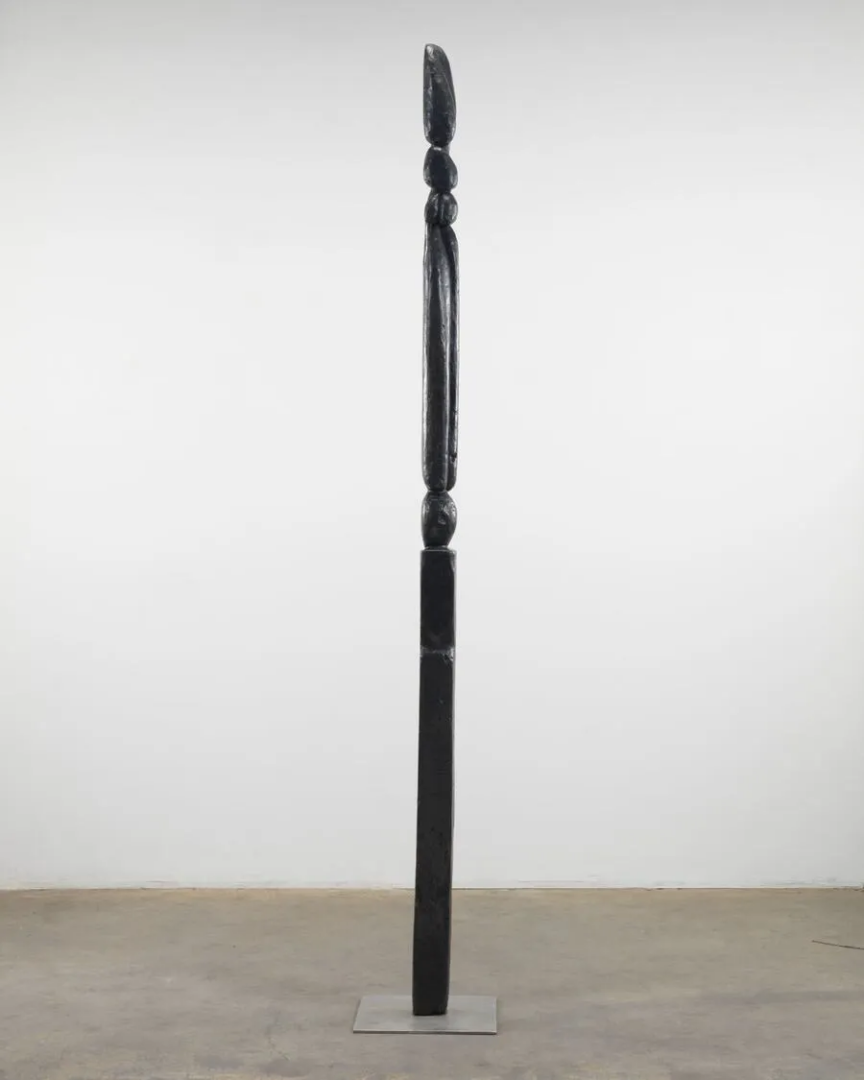
A fair booth is a temporary architecture of walls, lighting, climate control and shipping crates. Under the Nave, daylight becomes part of that apparatus. At Pilar Corrias, a triptych by Christina Quarles hangs behind a matte black divider. Its panels rotate daily, lit through the skylights of the Grand Palais. The sixteen Emergence booths sit on the balconies around the Nave. Premise moves this year to the larger Salon Seine.
Karim Crippa: the new director of Art Basel Paris
Art Basel appointed Crippa director of the Paris fair from November 1, 2025. He was born in Zurich in 1991 and raised in Lausanne. Before joining Art Basel in 2018, he worked at Thyssen-Bornemisza Art Contemporary in Vienna, Haus der Kunst in Munich and Duve in Berlin. At Art Basel, he was Head of Communications for Art Basel Paris and Senior Editor. He reports to Vincenzo de Bellis, Chief Artistic Officer and Global Director of Art Basel Fairs.
His first edition counts 183 galleries in the Galeries sector, sixteen in Emergence and twelve in Premise. Sixty-four exhibitors operate spaces in France. Thirty-two galleries take part in Art Basel Paris for the first time. A record twelve joint booths pair twenty-four galleries.
Art Basel Paris Galeries: walnut stain, aluminum and photographs
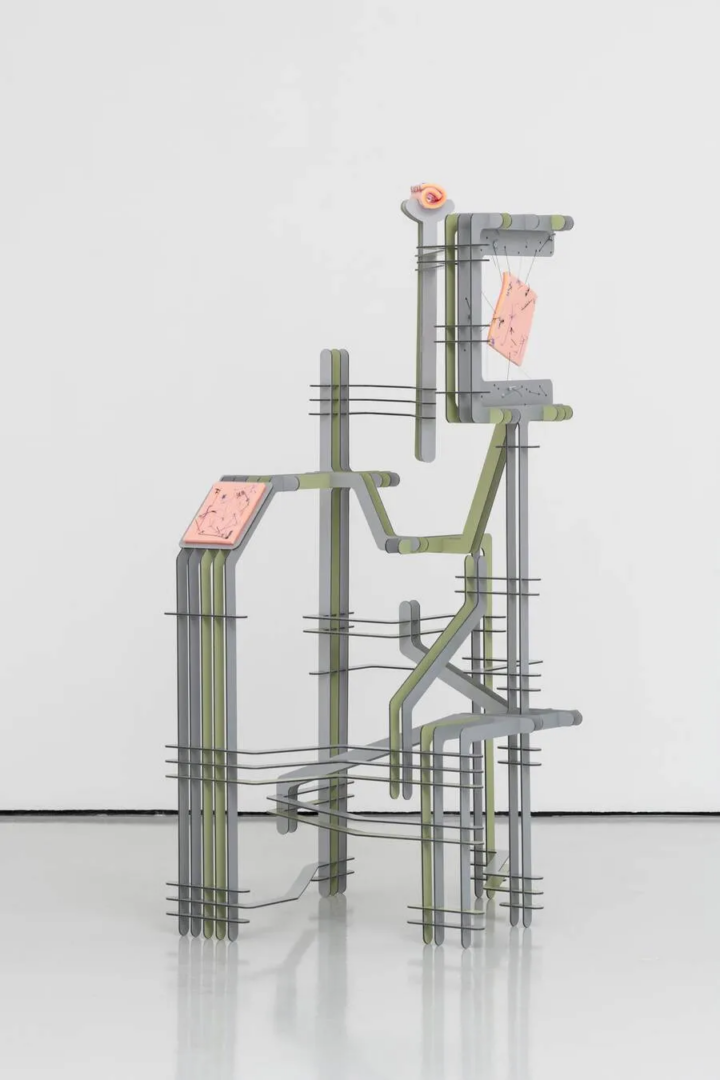
In the main sector, several booths turn on the physical make-up of works. Applicat-Prazan shows a 1952 work on paper by Pierre Soulages in walnut stain. It hangs alongside Hans Hartung, Jean-Paul Riopelle and Gérard Schneider. Galerie Karsten Greve brings ceramics by Lucio Fontana, with Joseph Cornell and Soulages. Tim Van Laere presents an aluminum sculpture by Franz West that visitors may touch. White Cube shows Tracey Emin, Georg Baselitz, Ibrahim Mahama and Marguerite Humeau. Esther Schipper brings Pierre Huyghe, Anri Sala, Tuan Andrew Nguyen and Ann Veronica Janssens. At Galerie Poggi, Kapwani Kiwanga shows the sculpture Sentinelalongside paintings by Manuel Mathieu.
Hauser & Wirth pairs a tribute to Louise Bourgeois with one of Jenny Holzer’s Redaction Paintings. Galerie Isabella Bortolozzi shows fourteen photographs by Annie Ernaux and Marc Marie. They formed the basis of the book L’Usage de la photo (Gallimard, 2005). Larkin Erdmann, from Zurich, makes its debut with Man Ray’s Le Violon d’Ingres, Marcel Duchamp’s L.H.O.O.Q. and On Kawara’s NOV 7, 1977. The Kawara has stayed in the same collection since 1978.
Emergence and Premise: X-ray film, tar and leather at Art Basel Paris
Emergence presents sixteen solo booths, twelve of them from first-time galleries. At Brunette Coleman, Nat Faulkner shows electroplated objects made from recycled X-ray film. At Lo Brutto Stahl, Clémentine Adou works with dismantled umbrella structures. At ROH, Thảo Nguyên Phan returns with works in silk and lacquer. At P21, from Seoul, Haneyl Choi presents Sleepwalking, four mixed-media sculptures. Bank shows six metal-cast sculptures by Yibei Zhang. Galeria Stereo installs slide projectors for Ant Łakomsk.
Premise looks back through research-led presentations. Amanda Wilkinson shows Derek Jarman’s Black Paintings (1989–1991), made with tar. Le Violon Bleu, from Tunis, presents leather and pigment works by Farid Belkahia. Galerie Zlotowski brings Vera Molnár’s works from 1947 to 1956. Eric Mouchet shows about twenty works by Robert Michel from the Weimar Dada period, with a new catalog. Pavec hangs three canvases from Jacqueline Lamba’s Sourcesseries. kó, from Lagos, brings Uche Okeke, Obiora Udechukwu and El Anatsui. Almeida & Dale, from São Paulo, presents Tarsila do Amaral’s Pau Brasil and Anthropophagic phases.
Art Basel Paris Public Program: bronze, Cor-Ten and concrete
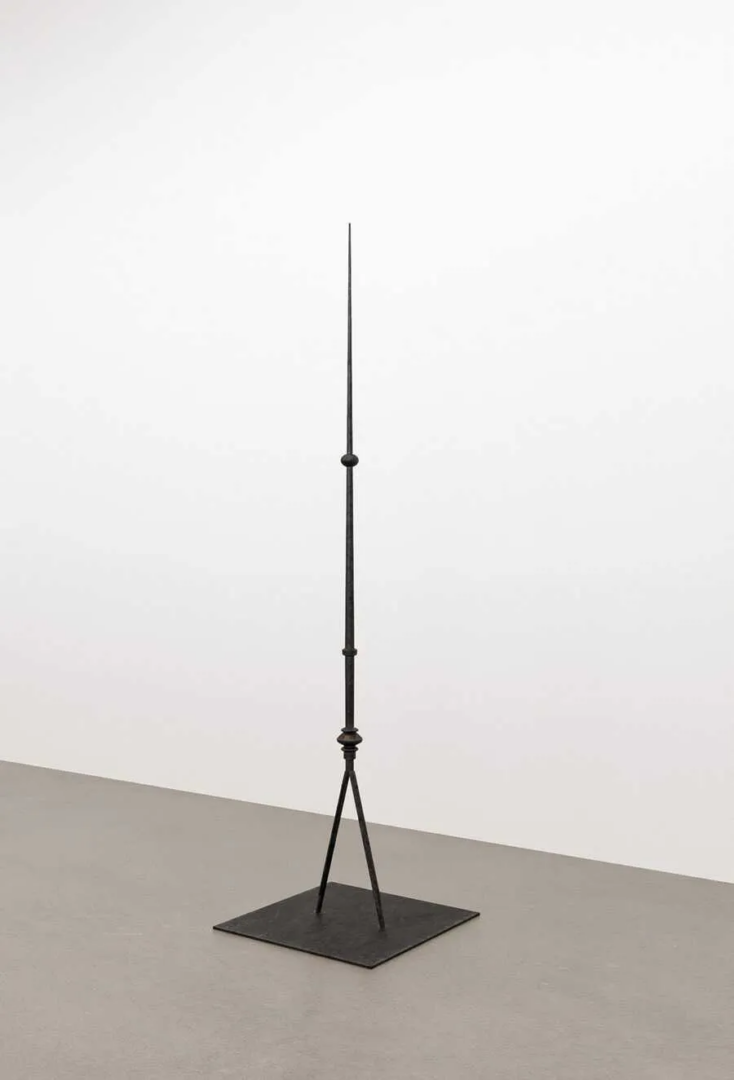
The Public Program, with Miu Miu as Official Partner, takes the fair into the eighth arrondissement. On Avenue Winston-Churchill, Marcello Maloberti installs CIEL (2026), a neon about twenty meters above the street. Manfred Pernice sets out bank-group (2026), a group of concrete benches. Alicja Kwade places the stone spheres of L’Élévation des Mondes (2026). Carmen Herrera’s Angulo Amarillo (2017) is in aluminum and acrylic. Keita Miyazaki’s A Symbiotic Form (2025) combines recycled car parts and washi paper. Niki de Saint Phalle’s Cat Head Totem (2000) is a mosaic. Simone Fattal’s Door (2024) and Yinka Shonibare’s Abstract Bronze VIII are cast in bronze.
On Place Clemenceau, Almine Rech presents Robert Indiana’s LOVE Wall (1966–2006) in Cor-Ten steel. Three bronzes by Tracey Emin stand on the Parvis des Droits de l’Homme. At the Cité de l’architecture, Kennedy Yanko shows metal structures with flexible acrylic skins in the Galerie des moulages. In the Chapelle des Petits-Augustins, Kutluğ Ataman’s Küba (2004) runs on fortyscreens. At the Petit Palais, Cosima von Bonin installs Dollys & Beaux (2026), plush sea creatures and dogs. On Square Jean Perrin, Lionel Sabatté shows the bronze Champs d’Oiseaux(2026). In the Jardin de la Nouvelle-France, Boz Deseo Garden presents a steel work, Celia, or the Misfortunes of Virtue (2026).
At the Palais d’Iéna, filmmaker Alice Diop curates Geste de Consolation. The program includes Zanele Muholi, Mary Lee Bendolph and readings of Audre Lorde and Zadie Smith. It ends with Simone Leigh’s bronze Sentinel (Mami Wata) (2020–21). «I want my curation to center on acts of consolation», Diop said.
Oh La La! and Conversations at the Grand Palais
On October 23 and 24, the Oh La La! initiative asks galleries to rehang their booths with new works. Actress Philippine Leroy-Beaulieu art-directs this edition around the theme Myths and Legends. Works by Nina Childress, Ossip Zadkine, Portia Zvavahera and Philippe Mayaux are part of the rehang.
The Conversations series moves into the Grand Palais Auditorium for the first time. Talks are free and open to the public. Simone Fattal speaks with Hans Ulrich Obrist on October 22. Ibrahim Mahama, whose exhibition The Harvest Season is on view at Fondation Cartier, speaks on October 23. In separate talks, Laurent Le Bon and Christophe Leribault discuss the futures of the Centre Pompidou and the Louvre.
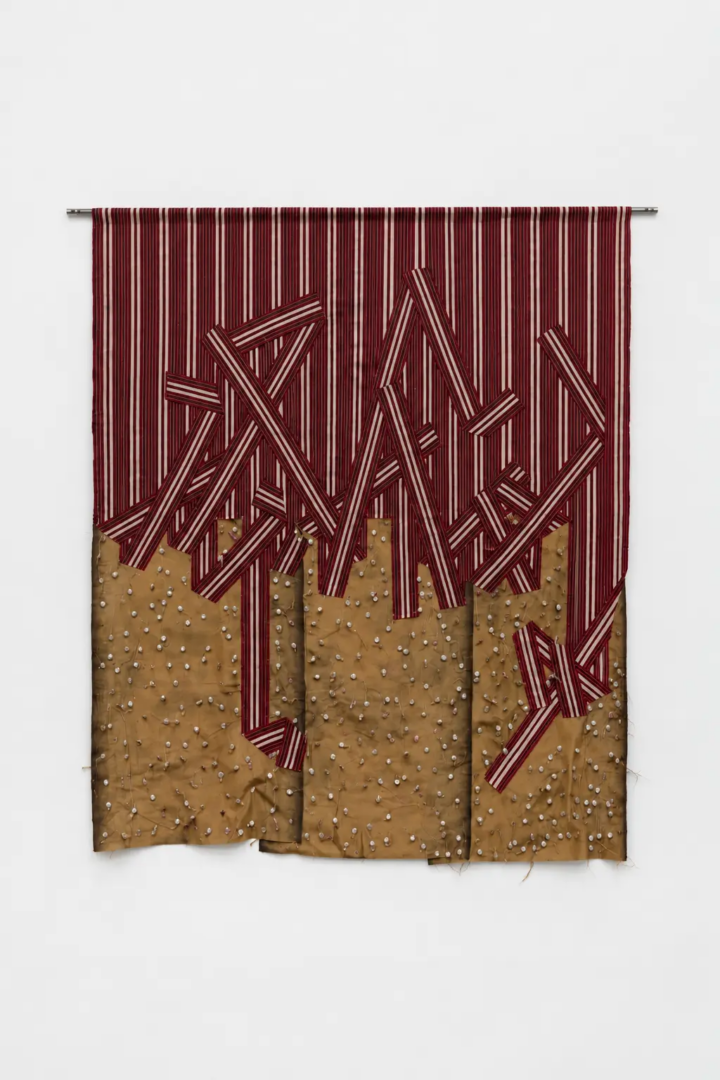
Paris museums during Art Basel Paris week
The fair coincides with exhibitions across the city’s institutions. The Grand Palais itself hosts Cezanne et nous. At the Bourse de Commerce, Remember Me gathers nearly 700 works by more than seventy artists for the bicentenary of photography. The Musée d’Art moderne de Paris presents Kerry James Marshall: The Histories. The BnF opens Louise Bourgeois, Extrême tension on October 20.
From tar on canvas to bronze on the avenue, Art Basel Paris arranges the conditions under which art becomes visible in the city for one week.
Art Basel Paris
Art Basel Paris takes place each October at the Grand Palais. It began in 2022 as Paris+ par Art Basel and took its current name in 2024. Its sectors are Galeries, Emergence and Premise, with a citywide Public Program. Karim Crippa has directed the fair since November 2025. The 2026 edition runs from October 23 to 25.