The red that changed everything: Baccarat Rouge 540
In 2014, Maison Francis Kurkdjian created Baccarat Rouge 540 as a limited edition of 250 bottles. A documentary now available on Prime Video reconstructs what happens when a perfume is taken seriously as a cultural object
On a June evening in Milan, the intimate Teatro Gerolamo — the historic marionette theatre tucked behind Piazza del Duomo — hosted the Italian screening of ICON(S): Maison Francis Kurkdjian, a documentary produced by Terminal 9 Studios that traces the origins and cultural life of Baccarat Rouge 540. Francis Kurkdjian was present for the occasion, one of a string of European dates accompanying the documentary’s release ahead of its global premiere on Prime Video in May 2026.
ICON(S) is a documentary series dedicated to luxury maisons whose creations have come to shape contemporary culture. The Maison Francis Kurkdjian episode — subtitled L’Alchimie des Sens — is built around a specific artistic project: L’Alchimie des Sens, the multisensory installation inspired by Baccarat Rouge 540 that debuted at the Palais de Tokyo in Paris in November 2025, as part of the retrospective exhibition Parfum, Sculpture de l’Invisible, marking thirty years of Kurkdjian’s creative output. The documentary is not a perfume advertisement. It is a film about collaboration, translation, and the act of making the invisible legible.
Kurkdjian assembled a group of artists he considers friends of the Maison — each invited to interpret Baccarat Rouge 540 through their own discipline. The result is a portrait of a creative process that resists reduction: a fragrance approached as musical composition, as gastronomy, as kinetic sculpture, as theatre. The film is intelligent without being dense, intimate without being self-congratulatory. At the Milan screening, the atmosphere in the gilded hall was appropriately absorbed.
Baccarat Rouge 540: the origin of an icon
The story begins in 2013, when the crystal house Baccarat — founded in 1764, making it one of France’s oldest luxury manufactures — commissioned Kurkdjian to create a fragrance for its two-hundred-and-fiftieth anniversary. The brief, in its ambition, was almost impossibly abstract: to translate crystal into scent. Not to evoke it decoratively, but to find its olfactory equivalent — the luminosity, the weight, the particular quality of light passing through a dense, coloured body.
Kurkdjian reached back to an experimental formula he had developed the previous year — a structure built around synthetic ingredients, designed to explore what a contemporary gourmand could look and feel like in an era of digital abstraction. Revisiting it in late 2013 and refining it through testing in early 2014, he arrived at a composition organised around three auras. The first: jasmine and saffron, bright and airy, evoking the lightness of air. The second: an ambergris accord built on Ambroxan, paired with dry cedar, giving mineral density. The third: ethyl maltol, a synthetic molecule with a warm, caramelised quality — the aura of fire, the heat of the furnace. Together, they produced a fragrance that was simultaneously sweet and smoky, transparent and intense.
The number 540 refers to the temperature in degrees Celsius at which Baccarat crystal is produced — specifically to the Rouge à l’Or technique, in which transparent crystal is fused with twenty-four-carat gold powder to produce the house’s signature deep red. That transformation, glass becoming something richer and stranger in the heat, is what the fragrance encodes.
The first release, in autumn 2014, consisted of exactly 250 hand-blown Baccarat crystal bottles, priced at three thousand euros each and intended as collector’s objects for the house’s most important clients. All 250 sold immediately. Kurkdjian gave one to Kelly St. John, vice president of beauty at Neiman Marcus, who began wearing it and received so many unsolicited compliments that she contacted Kurkdjian and proposed selling it through the department store. A commercial agreement with Baccarat allowed the fragrance to be bottled in Kurkdjian’s signature square-cut glass flacon and released into the permanent collection. The first six-month supply sold out within a single month.
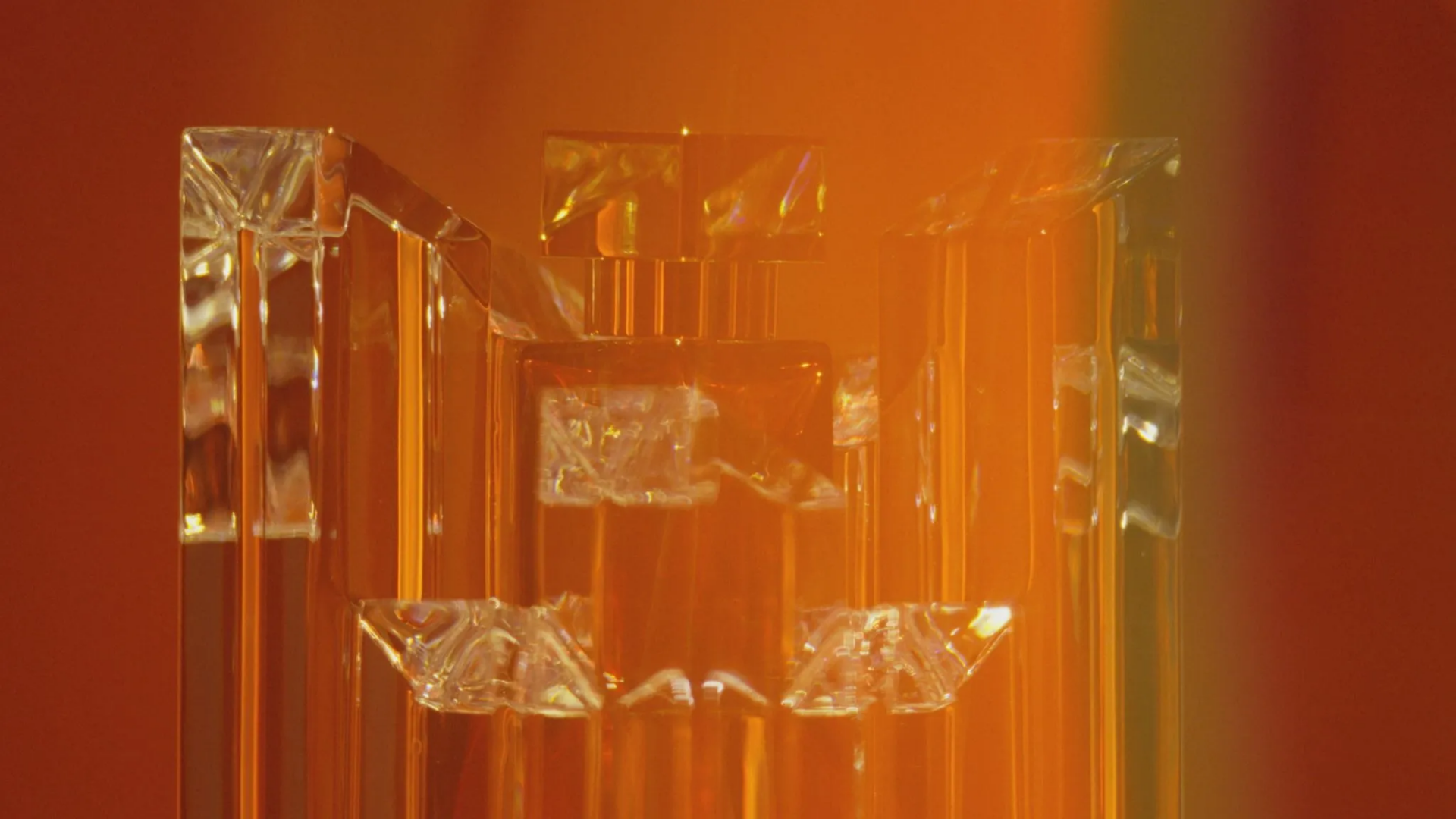
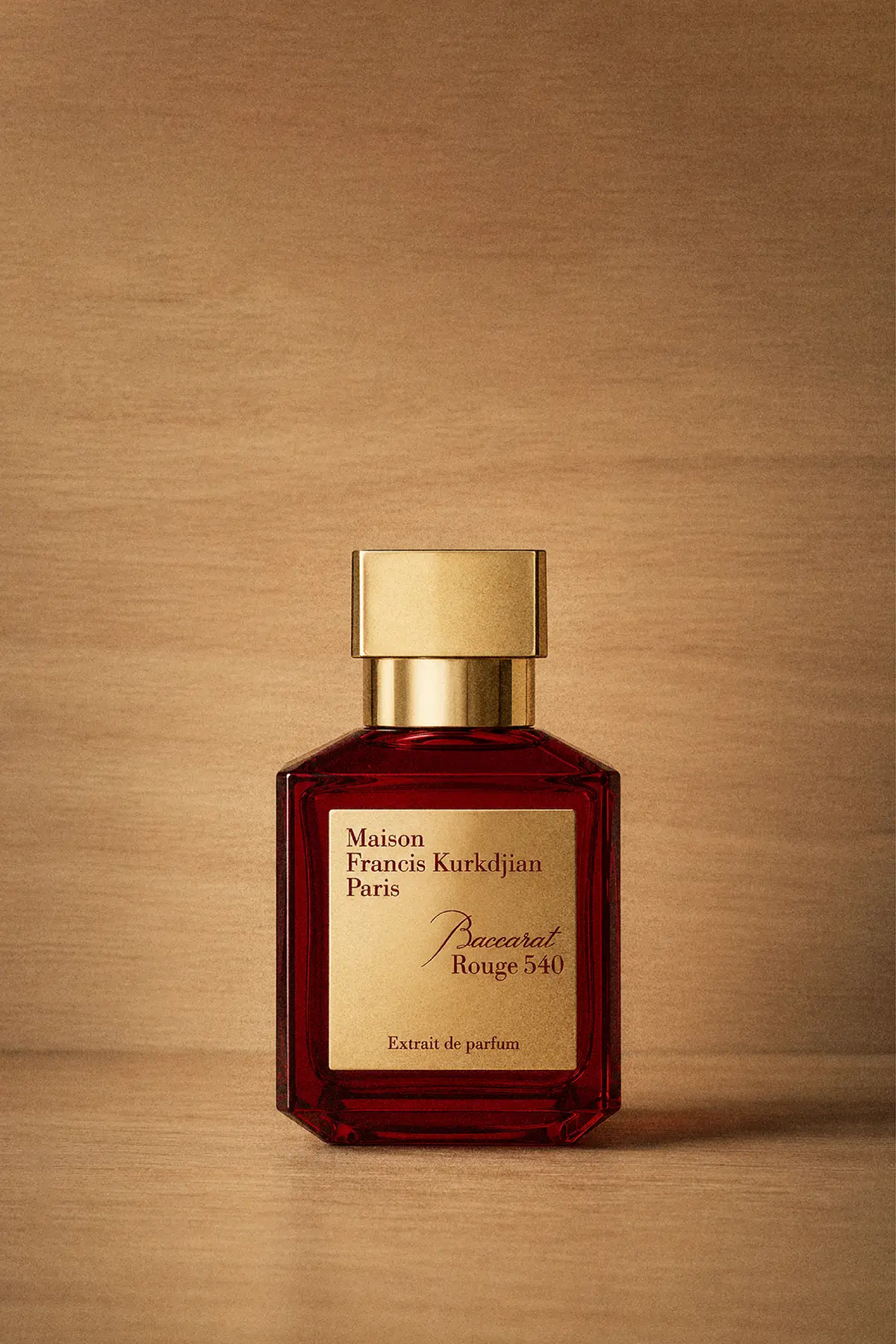
The bottle deserves its own mention. The square glass flacon — transparent, architectural, almost brutally simple — is a direct translation of the fragrance’s own logic: something that appears uncomplicated and reveals, on closer inspection, a considerable density. The amber-orange liquid inside catches light. On a shelf, even among competitors, it announces itself.

Francis Kurkdjian: a nose built from elsewhere
Francis Nurhan Kurkdjian was born in Paris on 14 May 1969, into an Armenian family whose history is marked by displacement: his ancestors fled the Ottoman Empire during the Armenian Genocide and eventually settled in France. He grew up in the eastern suburbs of the capital, in a milieu that had nothing to do with the perfume industry. His first ambition was ballet — he trained seriously, failed to pass the entrance examination for the Paris Opera School of Dance, and redirected his attention to what had been a secondary passion since the age of thirteen or fourteen: scent.
He enrolled at ISIPCA — the Institut Supérieur International du Parfum, de la Cosmétique et de l’Aromatique Alimentaire, in Versailles — graduating in 1993. Two years later, at twenty-five, he composed Le Male for Jean Paul Gaultier. The fragrance became one of the best-selling masculine perfumes in history. The trajectory could have settled here, into the comfortable career of a commercially successful nose working within major beauty conglomerates — creating fragrances for Dior, Guerlain, Saint Laurent, Burberry, Lancôme, Nina Ricci, Giorgio Armani, among others. He did all of that. But in 2001, Kurkdjian did something unusual: he opened a bespoke fragrance atelier, working against the dominant logic of perfume democratisation. He accepted commissions from visual artists (Sophie Calle, Christian Rizzo, Sarkis) and created site-specific olfactory installations for institutions including the Grand Palais, the Palace of Versailles, and the Grande Mosquée de Paris.
The name on the label — Maison Francis Kurkdjian — is unusual in a field where the nose is conventionally invisible. Industry convention attributes fragrances to fashion houses and fashion designers, not to the perfumers who compose them. When Kurkdjian and his business partner Marc Chaya co-founded the Maison in 2009, near the Place Vendôme in Paris, the decision to put the perfumer’s name front and centre was both a creative statement and a structural argument: that the maker of a fragrance deserves the same recognition as the maker of a garment or a painting. In 2008, Kurkdjian had been appointed Chevalier des Arts et des Lettres. The Prix François Coty, the French perfumery industry’s most prestigious lifetime achievement award, came in 2001. In 2021, he was named creative director of Parfums Christian Dior — one of the most significant appointments in contemporary fragrance.
A maison that grew from two people to hundreds
Maison Francis Kurkdjian launched with a line of twenty-five products and a single boutique in Paris. Marc Chaya — who had built his career as a partner at Ernst & Young, where he oversaw global telecommunications markets — brought the structural rigour that Kurkdjian’s creative ambition required. Their partnership rests on a shared conviction: that the fragrance, not the brand narrative, must remain the primary object.
In 2017, LVMH acquired the Maison — a move that gave it distribution scale while, as Kurkdjian and Chaya have consistently maintained, preserving its creative independence. Bernard Arnault described the house’s avant-garde spirit as the basis for a promising future. Both founders remained in their roles and as shareholders. What began as a two-person project is now a company with approximately five hundred employees operating across four continents, with points of sale approaching eight hundred locations worldwide. The growth has been sustained and steep: the workforce increased by more than twenty percent in both 2024 and 2025. The engine, in any account of this expansion, is one fragrance.
What the documentary shows: the five senses of an icon
ICON(S): Maison Francis Kurkdjian unfolds through a series of sustained creative dialogues, each organised around a different sensory discipline. Kurkdjian’s collaborators — all artists who have worked with or alongside the Maison — were invited not to explain Baccarat Rouge 540 but to enter into resonance with it, translating its qualities into their own language.
Anne-Sophie Pic, the French chef who holds three Michelin stars at her restaurant Pic in Valence and who is today the most decorated female chef in the world, brings the fragrance into dialogue with taste. Her culinary philosophy — which she calls Permeation, centred on the interpenetration of flavours across textures — is not far from what Kurkdjian does with notes: building structures where individual elements resist identification but combine into something recognisable as a whole. At the Pic Lab, her research and development kitchen, the collaboration with Kurkdjian becomes almost synaesthetic: how does a fragrance taste? The film gives this exchange space and weight.
David Chalmin — a French composer, producer, and multi-instrumentalist whose collaborators include The National, Thom Yorke, and Barbara Hannigan — provides the score, composing a piano piece titled Rouge 540 in direct response to the fragrance. The composition was performed live by Katia and Marielle Labèque, the celebrated Italian-French pianist duo who achieved early international fame with their contemporary recording of Gershwin’s Rhapsody in Blue — one of the first gold records in the history of classical music. The sisters have since performed with every major orchestra in the world. At the Paris premiere of ICON(S) at the Olympia, following the screening, the screen lifted to reveal the Labèque sisters at a piano, performing the Baccarat Rouge 540 composition live with Chalmin. It is a moment the documentary prepares for with unusual care.
Elias Crespin, the Venezuelan-French kinetic artist born in Caracas in 1965 — who studied computer engineering before relocating to Paris and has since become one of the most significant practitioners of kinetic and algorithmic sculpture, with a permanent installation at the Musée du Louvre — translates the fragrance into movement. His contributions to L’Alchimie des Sens engage the fragrance’s quality of diffusion: its spread, its persistence, the way it occupies space without occupying volume.
Cyril Teste — the theatre director who co-founded MxM in 2000 and has since directed productions at the Opéra-Comique in Paris and the Wiener Staatsoper — brings staging and vision. His practice is deeply concerned with synaesthesia, with what happens when senses are deliberately confused or superimposed. He is also the director of the Cocteau/Glass Trilogy, in which the Labèque sisters and Kurkdjian are currently collaborators, a touring project that debuted at the Philharmonie de Paris. Teste directed the documentary itself, giving it a quality of immersion rather than explanation.
Baccarat Rouge 540 in the culture: from Rihanna to rap lyrics to Netflix
The cultural history of Baccarat Rouge 540 is peculiar — and worth narrating, because it has followed a path that few luxury fragrances manage. The fragrance crossed from niche to mainstream not through advertising but through proximity: the right person wearing it in the right room.
The most cited version of this story involves Rihanna. Before launching her own fragrance line, the artist wore Baccarat Rouge 540 regularly in public, generating a sustained stream of questions from journalists, co-stars, and strangers. When Jim Parsons — her co-star in the animated film Home — appeared on The Ellen DeGeneres Show, he described the scent she wore on set with visible difficulty, reaching for analogies. The exchange circulated. Rihanna became one of the fragrance’s most significant vectors, not as a paid ambassador but as a devoted wearer.
The TikTok chapter of this story is well documented. By 2021, the hashtag #BaccaratRouge540 had accumulated tens of millions of views on the platform; by 2023, that figure had reached nearly 600 million, making it the most-viewed women’s fragrance on TikTok globally that year, ahead of Miss Dior. The content ranged from first-person reviews to comparisons with less expensive alternatives — the so-called dupe economy, in which the aspiration to smell like Baccarat Rouge 540 became a genre in itself. Videos about affordable dupes — including comparisons with Ariana Grande’s Cloud and store-brand alternatives — generated millions of views and, paradoxically, continued to market the original.
The fragrance entered the hip-hop vernacular as a status marker. Meek Mill name-checked the bottle in a track — a shorthand for a particular register of achieved wealth and taste, the kind that prefers the niche to the obvious. Olivia Rodrigo wears it on tour. Pro basketball players have cited it in interviews. Vogue has described it as a staple of high-fashion wardrobes. It has appeared as a plot element in Netflix’s Emily in Paris — itself a programme about the performance of taste. In 2024, Kurkdjian received the Hollywood Beauty Award for Fragrance of the Year.
The economic trajectory confirms what the cultural indicators suggest
At Neiman Marcus, per-door sales of Baccarat Rouge 540 have risen from $300,000 to between $3 and $4 million annually. The US now accounts for approximately half of all global sales. A 2025 ultra-luxury edition — the Baccarat Rouge 540 Édition Millésime, limited to 54 bottles worldwide and priced at $28,000, incorporating rare ambergris and reviving the original Baccarat crystal bottle — sold out immediately. A fragrance launched as a commemorative object in 250 units has, over a decade, generated one of the most commercially significant olfactory phenomena in the history of niche perfumery.
Matteo Mammoli