Guerlain Vétiver Fauve: eau de parfum, rewriting a classic ingrédient
With Vétiver Fauve, Guerlain hands perfumer Delphine Jelk a difficult raw material — vetiver root — and asks for something the molecule has rarely produced: lightness
Vétiver Fauve is an eau de parfum within Guerlain’s L’Art & La Matière haute parfumerie collection, composed by in-house perfumer Delphine Jelk. The fragrance is built around vetiver root and is described by the house as a unisex woody-fresh sillage. It launched in September 2025, available exclusively at Rinascente Milano Duomo and Roma Tritone, and on guerlain.com.
The conceptual reference is Rudyard Kipling’s The Jungle Book — specifically the quality of a jungle at dawn: dense, damp, teeming. This is relevant not merely as brand narrative but as an olfactory problem: the challenge was to make vetiver evoke something botanical and alive rather than dark and desiccated.
What does vetiver smell like — and where does it come from
Vetiver is not a wood. It is a root. Specifically, it is the dried rhizome of Chrysopogon zizanioides, a tufted perennial grass in the Poaceae family — the same botanical family as wheat, sugarcane, and bamboo. The roots grow vertically, penetrating up to three meters into soil, and must be harvested only after eighteen to twenty-four months of growth. Young vetiver roots smell thin and grassy; the complex olfactory profile develops slowly, over time, in the earth.
The word itself comes from Tamil — vettiveru, meaning roots that are dug up. India, particularly Tamil Nadu, is one of the primary cultivation regions, alongside Haiti and the island of Réunion. Each terroir produces a chemically distinct oil: Haitian vetiver is clean and ethereal, with iris-like warmth; Indian khus is denser, earthier, with strong smoky undertones; Java vetiver is the most abrasive, dusty and camphoraceous; Réunion (Bourbon) vetiver falls somewhere between, with a hazelnut-rosy quality.
The essential oil is obtained by steam distillation of the dried roots and is produced in yields of only 0.2 to 0.3 percent. The resulting liquid is thick, almost viscous, and chemically among the most complex in perfumery. Depending on which analysis is referenced, vetiver oil contains between 150 and 300 identified aromatic compounds — sesquiterpenes, ketones, alcohols, aldehydes — present in proportions that vary with soil composition, climate, and distillation parameters.
Why vetiver oil is one of the most complex fragrance ingredients
For decades, vetiver’s characteristic transparent woody-ambery quality — what perfumers describe as its specific aura — remained chemically unexplained. Research published in Angewandte Chemie International Edition in 2021 identified the active smelling principle as (+)-2-epi-ziza-6(13)en-3-one, a sesquiterpene ketone with an olfactory threshold of 29 picograms per liter of air. This makes it extraordinarily potent: the compound operates at concentrations so low it produces what researchers described as a quasi-pheromone-like effect, an ambient presence rather than a legible note.
Three molecules define the chemical core most commonly understood: khusimol (earthy, humid), vetivone in its alpha and beta forms (woody, dry), and nootkatone (bitter citrus, the same compound found in grapefruit peel). Geosmin — also present in the vetiver chemical profile — is the molecule responsible for petrichor, the smell of rain on dry earth; it is detectable by the human nose at concentrations as low as 0.4 parts per billion. When vetiver is described as smelling of wet ground, the association is chemically accurate, not metaphorical.
No synthetic reconstruction of vetiver has succeeded at replicating the full profile. Laboratories have assembled the key identifiable compounds — khusimol, vetivone, zizanal, cedrene — and the result holds for approximately thirty seconds before collapsing. The minor compounds, present at 0.01 percent or below, carry the temporal depth: the humidity, the shift over time, the quality that makes vetiver one of perfumery’s most effective fixatives. High molecular weight means slow evaporation, which in turn means vetiver slows the evaporation of lighter notes alongside it, extending a composition’s coherence on skin.
Guerlain Vétiver 1959: the fragrance that defined a category
The house has a documented history with the material. The original Vétiver — still in production — was created by Jean-Paul Guerlain and launched in 1959. Structurally it is a woody aromatic composition with citrus top notes (bergamot, lemon, mandarin, neroli), a heart built on vetiver with pepper, sage, and carnation, and a base of tobacco, oakmoss, amber, and Tonka bean. For decades it served as the Western fragrance world’s primary reference for the ingredient — the composition that established vetiver as a solo protagonist rather than a background material.
The 1959 original was gendered masculine, coded through its tobacco and leather accord, its austerity. A 2024 interpretation, Vetiver Parfum — also composed by Delphine Jelk — intensified that framework: smoky, resinous, darker. Vétiver Fauve represents a third point on the same map, but one that moves in an entirely different direction.
Delphine Jelk on reinventing vetiver for L’Art & La Matière
Delphine Jelk joined Guerlain as house perfumer in 2014, having trained at the Grasse Institute of Perfumery and worked at Drom Fragrances under Grasse master perfumer Philippe Romano. Her previous work includes La Petite Robe Noire, various L’Art & La Matière entries, and the Aqua Allegoria line. In 2021 she was named Chevalier de l’Ordre des Arts et des Lettres. Her compositional signature, according to the house, centers on oppositions and tensions — warm against cool, round against sharp — with iris, musks, and powdery materials among her preferred building blocks.
Vétiver Fauve operates on a calculated inversion. Vetiver’s conventional positioning is dark and heavy — a base note, a fixative, a masculine anchor. Jelk reverses the logic. She combines the vetiver accord with a green tropical fruit opening — fig and sun-drenched pineapple — that shifts the material toward something vegetal and damp rather than smoky and deep. The effect is described as a dry root acquiring a lush freshness, as if the botanical origin of the ingredient were made audible rather than suppressed.
The sillage moves from a top accord of tropical green and fruit through the vetiver core and resolves in a base of Tonka bean and what the house calls Cipriolo — a powdery, slightly animalic musky material — that provides depth without reverting to the 1959 framework. The result is classified unisex, which is structurally accurate: the fruit-and-green opening removes the gendering cues that tobacco and leather traditionally supplied, while the vetiver core remains as formal architecture.
Guerlain Vétiver Fauve bottle, price, and sizes
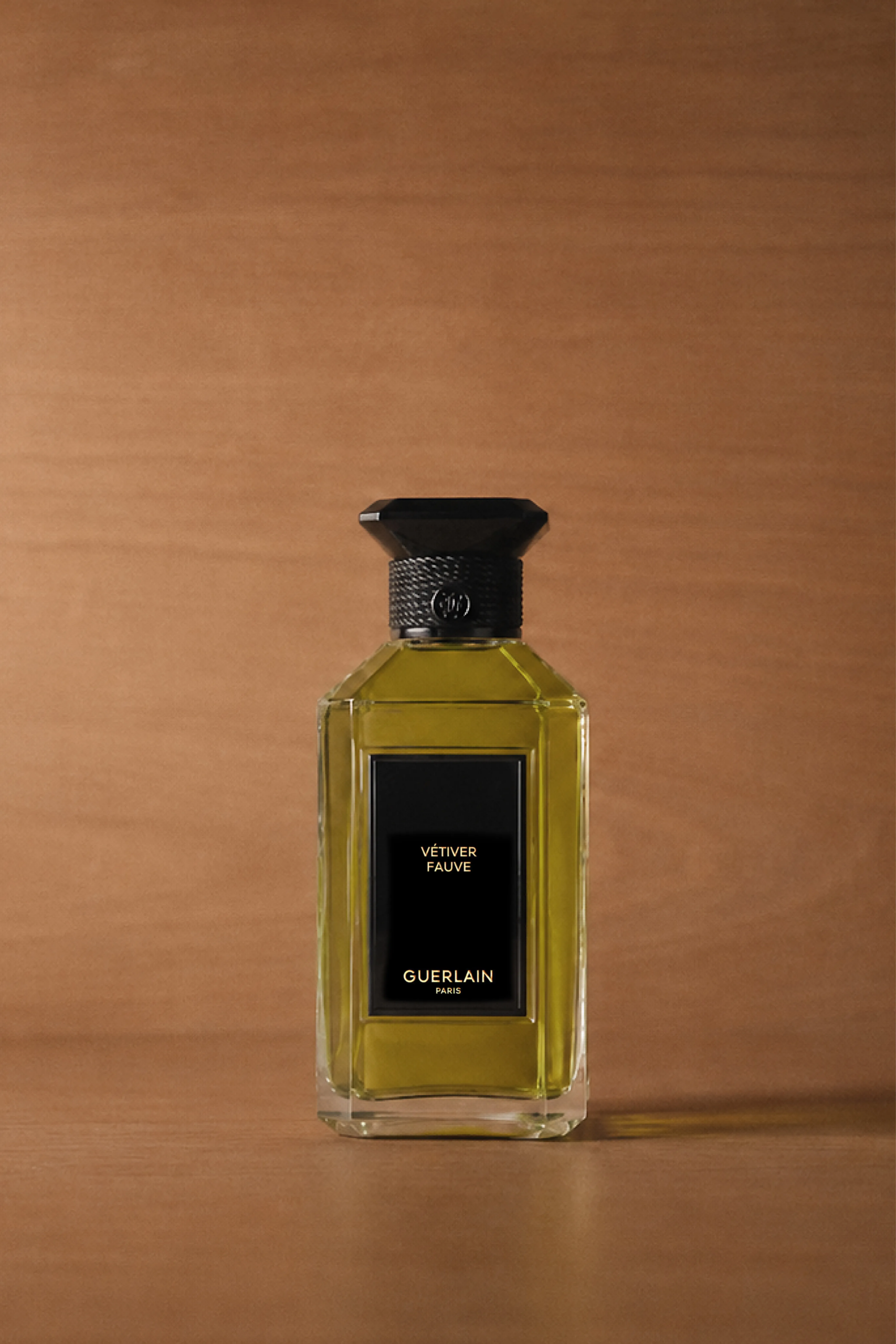
The flacon is the standard L’Art & La Matière format: a cut-glass rectangular bottle with a textured black cap carrying the Guerlain monogram. For Vétiver Fauve, the liquid itself is tinted a saturated leaf green — the same visual register as the tropical foliage in the campaign imagery. The customization cap, in silver-toned metal with a lightly hammered surface, is designed to reference water droplets on leaves and grass stems. The visual language is consistent with the olfactory proposition: dew, chlorophyll, roots in wet earth.
The bottle is available in three sizes: 50 ml at €235, 100 ml at €330, and 200 ml at €470. Available at Rinascente Milano Duomo, Rinascente Roma Tritone, and guerlain.com.
Vétiver Fauve and the vetiver fragrance category
The contemporary vetiver fragrance landscape is crowded. Chanel’s Sycomore (composed by Jacques Polge, 2008) took the ingredient in a smoky, cool direction. Hermès’ Vétiver Tonka by Jean-Claude Ellena (2004) softened it with coumarin. Tom Ford’s Grey Vetiver (2009) placed it in a citrus-floral framework. Most niche entries — Memo Paris, Diptyque, Comme des Garçons — have leaned into either the earthy or the smoky facets, rarely the green.
Guerlain’s approach with Vétiver Fauve is to read the ingredient through its botanical identity rather than its conventional olfactory positioning. Chrysopogon zizanioides is a tropical grass. Its roots absorb mineral-rich soil. Its context is heat, moisture, dense vegetation. The 1959 Vétiver ignored all of that in favor of a European masculine ideal; Vétiver Fauve attempts to return the material to its terroir — not geographically, but conceptually.
Whether the composition succeeds in this depends on how the transition from the green-fruit opening to the vetiver base is experienced over time. The opening is relatively conventional by niche standards; the interest lies in the drydown, in how much of that damp botanical quality persists once the Tonka bean and Cipriolo take hold.