Where does heavy leather come from, and what happens before it becomes a shoe?
From the structure of collagen to chestnut, mimosa and quebracho tannins: the collaboration between Cuoio di Toscana and Paul Andrew becomes the occasion for an inquiry into heavy leather
There remains a methodological knot: what share of the impact of livestock farming should be attributed to the hide. If the raw hide is considered a residual material of food production, the agricultural and livestock impacts fall on the meat. If it is considered a co-product with its own economic value, a share of the upstream impacts is allocated to it.
Heavy leather versus TPU: Cuoio di Toscana’s radiocarbon study
Cuoio di Toscana commissioned a study titled Il Cuoio di Toscana come biomateriale. Paragone dei parametri di sostenibilità in ottica anti green-washing (Cuoio di Toscana as a Biomaterial: A Comparison of Sustainability Parameters from an Anti-Greenwashing Perspective), authored by Gustavo Adrián Defeo and developed with CTC and Ars Tinctoria. The comparison examines, on one side, the heavy leather sole of a double-buckle shoe and, on the other, that of a sneaker marketed as vegan, made of thermoplastic polyurethane, TPU. The aim is to verify, parameter by parameter, what distinguishes the two materials, rather than assuming natural, bio-based or vegan to be synonyms for lower impact. [In the file the sentence breaks off here: please confirm the ending]
The Consortium – Cuoio di Toscana is a consortium of tanneries – cites French Décret n° 2022-748 of 29 April 2022, which implements France’s AGEC law (the 2020 anti-waste and circular economy law). The decree requires consumers to be informed about defined environmental qualities – recycled content, renewable resources, durability, compostability, reparability, reusability, recyclability, hazardous substances, traceability – and prohibits generic terms such as biodegradable. At European level, Directive (EU) 2024/825 applies from 27 September 2026 and bans generic environmental claims lacking demonstrable performance, along with neutrality claims based on offsetting.
The study therefore shifts the comparison from the commercial name to the composition of the material. One of the parameters used is the origin of the carbon. Radiocarbon analysis distinguishes carbon from recent biomass from carbon of fossil origin: it measures the share of modern carbon in the sample and makes it possible to establish how much of the carbon in the material comes from biological resources and how much from petrochemical feedstocks. In Cuoio di Toscana’s comparison, the vegetable-tanned heavy leather shows a predominantly biogenic component, while the synthetic sample analysed is of fossil origin. The term vegan therefore identifies the absence of animal components, and leaves open both the origin of the raw materials and the overall environmental footprint.
Radiocarbon measures one component of a material’s circularity and origin, and is something different from a life-cycle assessment. A material can contain almost exclusively renewable carbon and still have significant impacts in the processing stages; likewise, a synthetic material can be recyclable and continue to depend largely on fossil carbon.
Heavy leather and leather: the difference under Italian law
Italian has two words where English generally uses one, leather. In everyday usage, pelle is the soft material used for bags, clothing and shoe uppers; cuoio is heavy leather, the thick material used for soles, belts and saddlery. Technically, the distinction does not hold up well.
Legislative Decree 68 of 9 June 2020, the Italian law governing the use of these terms, defines cuoio and pelle in Article 2.1(a) with the same wording: the hide or skin of an animal that has retained its original fibrous structure more or less intact and has been tanned so as to resist putrefaction. The law also regulates cuoio pieno fiore (full-grain leather), cuoio rivestito and pelle rivestita (coated leather), and rigenerato di fibre di cuoio (bonded leather fibre). In legal terms they are the same material.
In the Italian footwear sector, heavy leather denotes a firm, compact bovine hide, processed for structural components and above all for soles. A raw hide becomes heavy leather after stabilisation.
How a hide becomes heavy leather: soaking, liming and tanning
Animal skin is a tissue made up mainly of collagen. In its raw state it degrades through the action of water, micro-organisms, temperature and enzymatic processes. Tanning means acting on the collagen matrix so that it becomes stable and resistant to putrefaction.
The process begins before the tannins. Soaking restores the hide’s water content and removes salt and unwanted substances. Then, depending on the product to be obtained, come unhairing and liming, fleshing, splitting, deliming and bating. Fleshing removes residual tissue and fat from the inner side; splitting mechanically divides a thick hide into several layers.
In vegetable tanning, tannins extracted from plant material come into play: polyphenolic compounds that interact with collagen and stabilise its structure. Historical sources document the use of barks, woods and fruits, applied directly in the past and today in the form of concentrated extracts.
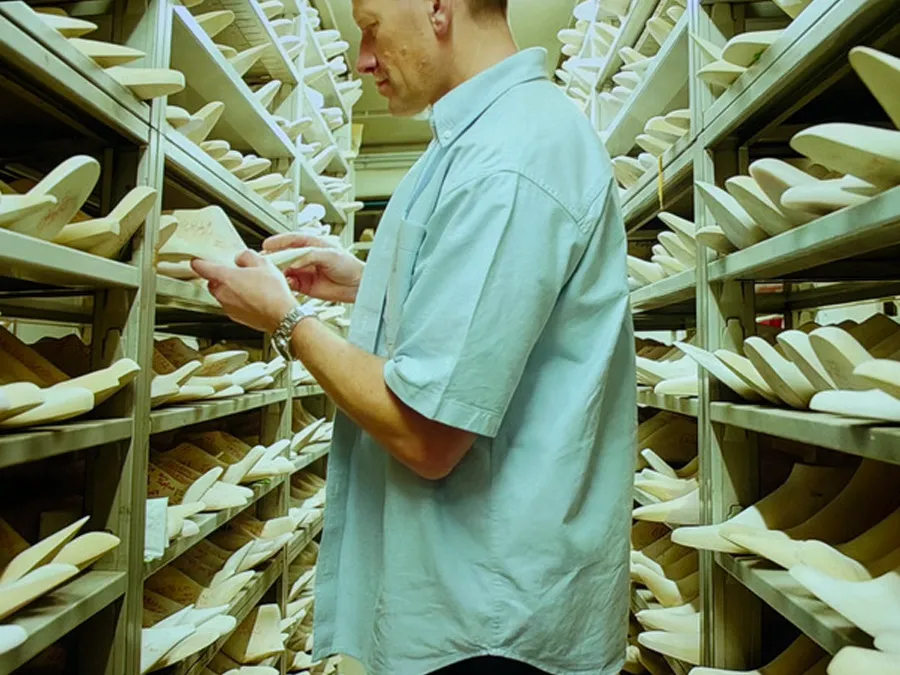
Heavy sole leather occupies the least visible position in a shoe. For centuries it has been selected because it forms a continuous surface, resistant to compression and abrasion. Paul Andrew works precisely on that continuity: he cuts, reduces, repeats, interweaves.
Chestnut, mimosa and quebracho: the vegetable tanning of heavy sole leather
Cuoio di Toscana states that it processes its heavy sole leather through slow pit tanning, based on extracts of chestnut, mimosa (acacia bark) and quebracho (a South American hardwood). The tannins do not stay on the surface: they penetrate the fibrous matrix and modify its physical response. Firmness, shape retention, flex behaviour, thickness and response to moisture are determined here, long before the designer steps in.
The Consortium gives a typical composition for its heavy leather of 42–49 per cent collagen, 32–44 per cent total tanning substances, 6–9 per cent water, 1.6–4.7 per cent fat, and 3.2–5.9 per cent sulphur, expressed as SO₃. The ratio of tanning agents to hide substance is high, consistent with its function: a sole must be compact, resistant to deformation and slow to absorb water.
Vegetable tannins account for 30–43 per cent, synthetic tannins for 1–6. It is a tannage with a clear predominance of natural extracts, in which small amounts of syntans (synthetic tannins) act as auxiliaries, to help the extracts penetrate or to adjust the colour. The sulphur may derive from sulphited extracts and sulphonated syntans.
Paul Andrew – From Pitti Uomo 110 to Milan: the three models of the He(ART) capsule
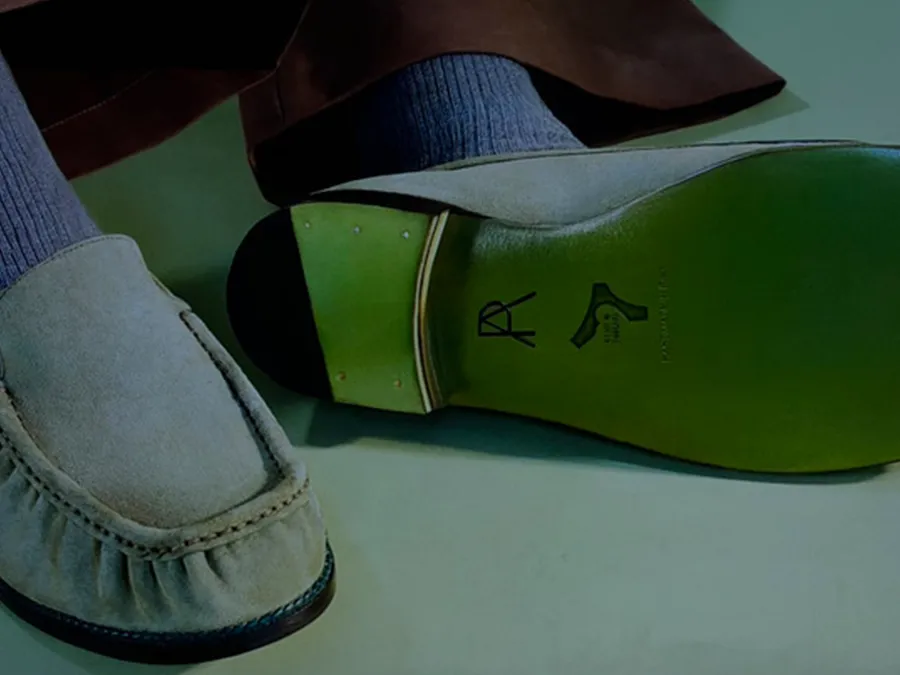
Antonioli, the Milan boutique, hosts the second chapter of He(ART), the capsule developed by Cuoio di Toscana with Paul Andrew. The collection remains exclusive to the store. The new model is called The Fettuccine. The name – fettuccine, the flat ribbon pasta, literally means “little ribbons” – describes a process: cutting thin, regular strips from heavy sole leather, controlling their thickness and length, and using them to build the upper. The surface comes from the succession of strips, rather than from a single piece cut to a pattern. It comes in black, gold and green.
Paul Andrew has worked with Calvin Klein, Donna Karan, Narciso Rodriguez and Alexander McQueen, and in 2014 became the first footwear designer to win the CFDA/Vogue Fashion Fund. He joined Ferragamo in 2016 as head of women’s footwear and served as its creative director until 2021. He was creative director of Sergio Rossi from July 2024 until the split announced at the end of January 2026.
He(ART) had been launched three months earlier. Cuoio di Toscana presented the capsule in June 2026 at Pitti Uomo 110, the Florence menswear trade fair. Three models each isolated one property. Model 1 – Softy, a loafer for men and women, tested the material’s flexibility. Model 2 – Intertwist brought thin strips into a woven construction. Model 3 – Facet combined a sandal with a sculptural heel, in the green of the Consortium’s visual identity.
Where the hides come from: more than 90 per cent from abroad
The tannery does not produce its own raw material. Hides come from the food supply chain: the European Commission defines hides and skins as by-products of the meat and dairy industries, and according to UNIC (Unione Nazionale Industria Conciaria, the Italian tanners’ association), more than 99 per cent of raw hides processed in Italy come from the cattle, sheep and goat, and pig supply chains.
An increase in demand for heavy leather therefore leaves the number of raw hides unchanged. Quantities depend on the size of livestock herds and on slaughter. Eurostat records 71.6 million cattle, 55.3 million sheep and 10.2 million goats in the European Union in 2025: compared with 2015, down 9.7, 12.2 and 17.5 per cent respectively. Between livestock numbers and the supply available to a single tannery lie slaughter, international trade, hide size and quality, prices and demand; the figure nonetheless signals a shrinking European base.
Italy imports much of the material it processes. According to UNIC, foreign supply covers more than 90 per cent of Italian tanneries’ needs and involves 103 countries: 45 per cent of imports by volume are raw hides, 54 per cent material already processed to the wet blue stage (chrome-tanned but not yet dried), and around 1 per cent crust (tanned and dried but unfinished).
The place where the animal is born, where it is slaughtered and where the hide is processed may therefore differ. Under rules of origin, a hide acquires Italian origin through substantial transformation carried out in the country, even when the raw material comes from abroad; UNIC refers to the technical standard UNI EN 16484. The Italian origin of heavy leather leaves open the possibility that the animal was raised or slaughtered elsewhere.
The circularity of tanning: where it begins and where it stops
A hide derived from slaughter has already originated within another production cycle. The tannery intercepts it and turns it into a product that can remain in use for years; without this destination, the material must be handled through other channels for managing animal by-products. The European Commission identifies this recovery of value as a characteristic of the sector.
Recovering a by-product nonetheless carries impacts. Tanning requires water, energy and chemicals, and generates wastewater, solid residues and emissions. The EU Best Available Techniques reference document for tanneries sets, for the processing of bovine hides, water consumption of 16–25 cubic metres per tonne for unsalted hides and 19–28 for salted hides, covering processing from raw hide and post-tanning together.
The second level concerns what leaves the tannery. Fleshings, trimmings, shavings and sludge follow different paths: in Italy, supply chains have been developed that turn part of the protein residues into gelatines, hydrolysed collagen, fertilisers and biostimulants. UNIC documents the recovery of vegetable-tanning sludge in the Tuscan tanning district for fertiliser production.
From material to object: end of life and ecodesign of a heavy leather shoe
A second level of the study concerns end of life, where the viable destinations differ from one biomaterial to another. Several options are considered: recycling, organic recovery, composting where demonstrated by specific tests, biodegradation, energy recovery and controlled management of the residue. Possible outputs of organic recovery include biogas, fertilisers, biochar, compost and biostimulants. The theoretical possibility, however, remains distinct from the actual one for a single heavy leather item: finishes, coatings, adhesives, threads, metals and other materials in the shoe must be considered separately. The assessment concerns first the material, then the object in which that material is incorporated.
This is where ecodesign comes in. Information on composition, biomass origin and end-of-life options can be used as early as the design stage. For a shoe, this means assessing whether different materials can follow the same recovery path, or whether the product must be built so they can be separated. The environmental profile therefore depends on a sequence of data – origin of raw materials, bio-based content, processing, durability, the possibility of repairing or replacing parts, the separability of components and the end-of-life destination – and not on a label such as natural, vegan or biodegradable.
Santa Croce sull’Arno and Ponte a Egola: the heavy sole leather district
The tanneries are concentrated in the lower Arno valley between Florence and Pisa, in Santa Croce sull’Arno, Castelfranco di Sotto, San Miniato, Montopoli Val d’Arno, Bientina, Santa Maria a Monte and Fucecchio. UNIC attributes around 35 per cent of national tanning turnover to the district and identifies the San Miniato and Ponte a Egola area as the source of almost all Italian heavy sole leather production.
Cuoio di Toscana was founded in 1985. It brings together seven companies and attributes to its production 98 per cent of the Italian heavy sole leather market and more than 80 per cent of the European one. These figures are declared by the Consortium; the 98 per cent is the value currently published on its website and replaces the 95 per cent still found in some press materials.
Tanning in Tuscany: the Serristori and medieval leather manufacturing
Tanning in Tuscany predates the industrial district by centuries. The economic historian Sergio Tognetti, who used account books to reconstruct the activity of the tannery run by the Serristori, a Florentine merchant family, in Figline Valdarno near Florence in the early sixteenth century, describes an enterprise in which tanning, trade and investment were connected: the tannery was part of a system that included workshops, mercantile relationships and distribution channels between Figline, Florence and other centres.
Even then, the geography of raw materials was wider than that of processing. The historian Laura Righi, who has studied the techniques, supply and organisation of leather manufacturing in Italy’s communal era – the age of the self-governing city-states, roughly the twelfth to fourteenth centuries – documents that when local supply fell short, leatherworkers, shoemakers and tanners turned to interregional and international markets: the Iberian peninsula, Ireland, the Maghreb, Sardinia and Sicily. For the Serristori, Tognetti documents purchases from circuits that included Greece, the Levant, Portugal, Castile, Barbary (the North African coast) and Flanders.
Historical depth is not the same as direct continuity. Righi places the formation of industrial districts in the nineteenth century and stresses that they must be kept distinct from any continuation of medieval productive specialisations. What emerges from the sources is the persistence, in some areas, of skills, resources and territorial relationships linked to leatherworking.
Editorial Team