3D Printing in Fashion: today’s aesthetics are pornographic experiences
From on-demand production and recyclable materials to CGI, technology promises to challenge fashion’s culture of excess. Iris van Herpen, Heron Preston, Francis Bitonti, and Grace Ling offer four case studies
In 2026, Dear Hannah Prep is considered the preppiest store in Texas: a white cube topped with a pink awning, bursting with stickers, fuzzy bathrobes, tie-dye T-shirts, and the technicolor atmosphere of a beach vacation. Dear Hannah’s version of preppy has little to do with New England prep schools, noblesse oblige, Oxford shirts, or the sand-colored chinos of Miami Beach. Nor does it resemble Tommy Hilfiger’s nostalgic reinterpretation of prep or J.Crew’s early-2000s revival. That was old preppy. This new version looks like a Pinterest board brought to life: ruffled miniskirts, salted caramel creams, Stanley tumblers, saturated colors against white backgrounds. It belongs to another planet entirely from Lisa Birnbach’s The Official Preppy Handbook (1980).
Throughout the twentieth century, subcultures formed around art, music, and politics. Style developed within those communities, absorbing their codes and contradictions. Today, a magnetic landscape of aesthetics has taken their place: a hyperactive body of images circulating online through outfits, hashtags, and shopping lists. They appear and disappear like clouds passing through the sky. Little context, little connection to real life. An endless supply of content.
Grunge, for instance, has been reduced to a collection of visual references that reproduce its atmosphere: cigarettes, oversized clothing, cargo pants, a tomato stain on a T-shirt. A woman with a preference for red becomes a Tomato Girl. If an Instagram grid looks sufficiently cohesive, someone will declare it an aesthetic. The degree of specificity, and the gratification it provides, resembles pornography: an extension of social media’s ability to satisfy increasingly specialized desires. Many contemporary aesthetics are pornographic in the way they are experienced, too. They offer private pleasures, designed to be consumed alone. Those who sift through these digital details, much as previous generations rummaged through record-store bins, are looking for something more than inspiration. They want their tastes to be recognized and validated. Even the most superficial subcultures once connected their members to physical places and communities. If you were a skateboarder in suburban California in the 1990s, you dressed like a skater, went skating, and spent time in places where other skaters gathered. Today’s aesthetic categories rarely carry that kind of social meaning.
The Rhythm of Our Time Has Changed: 3D Printing and CGI
If there is a contemporary form of resistance to mood-board aesthetics, it may lie in technological experimentation. Digital manufacturing across textiles, footwear, and jewelry, particularly 3D printing and computer-generated imagery (CGI), is producing radical forms and materials that interact with the human body.
As curator Andrew Bolton has suggested, we are accustomed to treating handmade objects as the highest expression of craftsmanship and machine-made products as inherently inferior. In the twenty-first century, that distinction has become increasingly difficult to sustain. Consider Chanel’s 1926 little black dress. It was made from jersey, a fabric previously associated with underwear. When Chanel introduced hand-sewn details, the dress acquired an air of refinement in the eyes of conventional society. Yet its apparent simplicity also prompted comparisons to the Ford Model T, evoking the logic of industrial mass production.
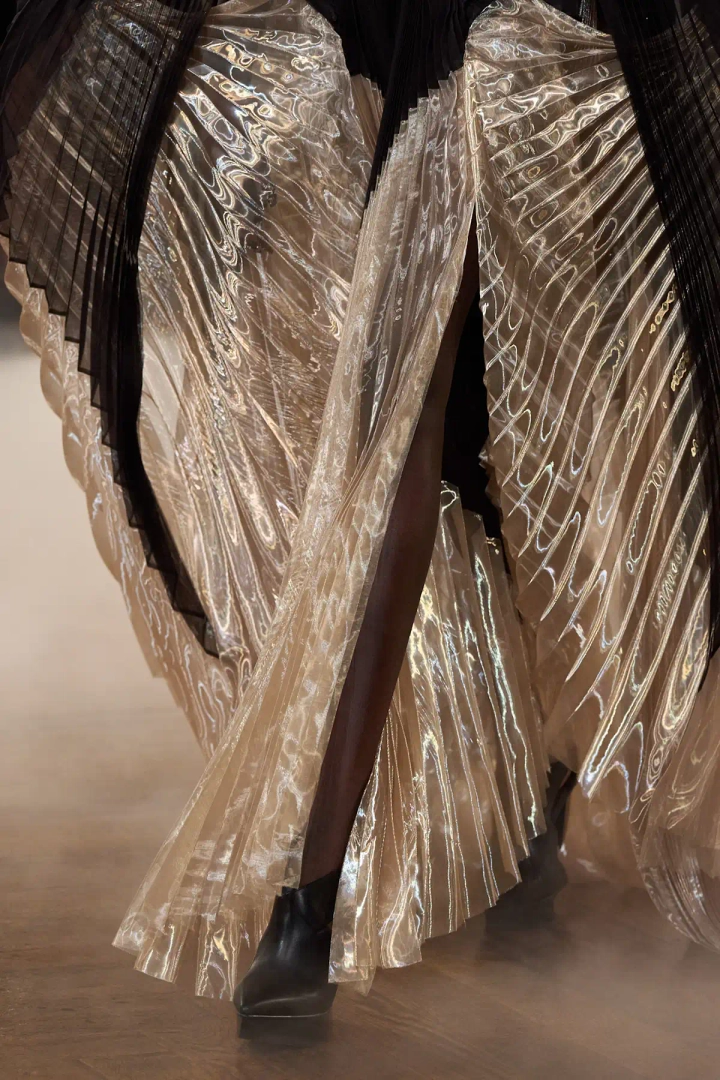
The rhythm of our time has changed. In 2010, Dutch designer Iris van Herpen presented Crystallization, introducing the first 3D-printed haute couture garment on the runway. Constructed from nine undulating, shell-like sections, the top stretched across the model’s shoulders and chest like a futuristic shield. Six years later, the piece appeared in Iris van Herpen: Transforming Fashion, an exhibition of wearable sculpture at Atlanta’s High Museum of Art.
Zero-Waste Fashion: Laser Cutting, Digital Weaving, and On-Demand Production
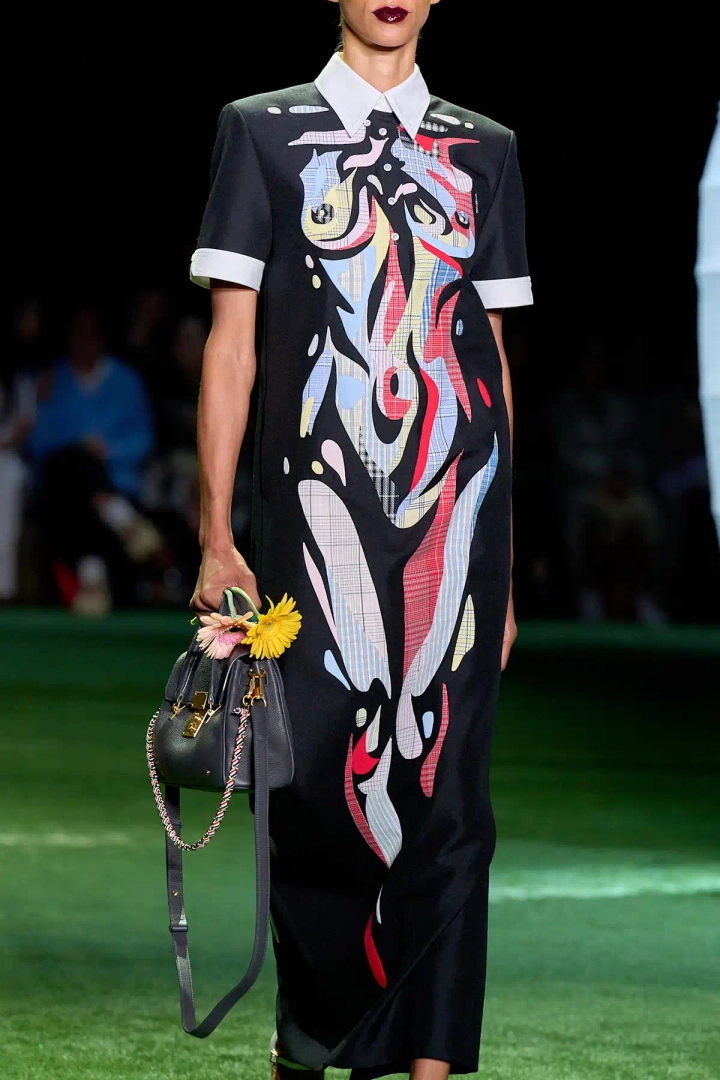
Iris van Herpen stands at the forefront of a generation of designers integrating new technologies, including laser cutting, digital weaving, and 3D printing, into traditional craft processes to produce radical garments. A dress by Pauline van Dongen incorporates solar panels capable of charging a cellphone after two hours of sunlight exposure. A voice-activated top and shorts by Ying Gao, covered in dressmaker’s pins, move like a shimmering creature.
One advantage of 3D printing is the ability to design and customize garments with a degree of structural complexity that would otherwise be impractical. The limitations of thread and conventional construction give way to the possibilities of digital design. Creating a garment becomes closer to developing an artwork than sketching a ready-to-wear collection.
New York-based designer Francis Bitonti has worked with 3D printing since 2007. In 2013, he collaborated with costume designer Michael Schmidt on a dress for burlesque performer Dita Von Teese. Produced through laser sintering, the garment featured 3,000 articulated joints. These experiments introduce a different production model, with garments and objects manufactured on demand and limited financial exposure. For designers seeking to minimize waste while pushing beyond established technical boundaries, the possibilities extend well beyond aesthetics.
3D Printing Versus Ultra-Fast Fashion: Can Technology Change the Production Model?
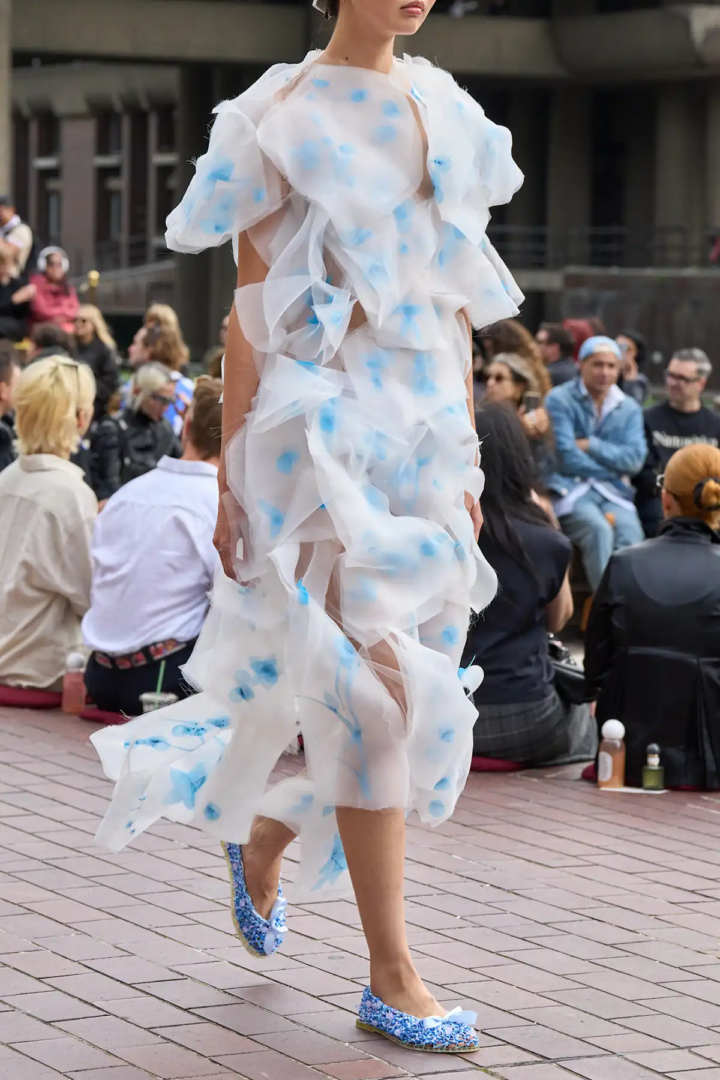
In 2021, a young engineer named Cornelius Schmitt sent designer Heron Preston a WhatsApp message. He had figured out how to 3D-print a material that behaved like a sock. Preston, who helped bring streetwear into high fashion during the 2010s through the Been Trill collective, immediately thought of his next sneaker. Manufactured in Germany by Schmitt’s company, Zellerfeld, the resulting shoes were soft, cushioned, and vaguely reptilian, despite having been developed from a mood board of birds. A limited number of customers were invited to participate in a beta program. The sneakers were designed to be fully recyclable: owners could return them to the factory, where the material could be processed and the shoes reprinted as the technology evolved. Preston compared the experience to descending into a cave with a headlamp, uncertain of what he might discover.
According to Bradley Rothenberg, co-founder and CEO of nTop, a future in which consumers can print their clothes at home minutes before going out, or wear garments that respond to their emotional state, remains some distance away. Meanwhile, ASOS introduces approximately 7,000 new products every week. H&M has experimented with computer-generated bodies to display clothing, combining them with the faces of real models. The department store, once a commercial sanctuary of display pedestals and upholstered furniture, is approaching obsolescence. Against this backdrop, 3D printing begins to look like a technological savior. Unwanted merchandise continues to accumulate. Some of it enters a vast, largely invisible global network of wholesale resellers. Some is dismantled to recover valuable components. Some ends up in incinerators. Digitally manufactured garments offer a different possibility: when designed with compatible, recyclable materials, they can support circular production systems in which products are recovered, processed, and manufactured again.
Grace Ling: Why Shouldn’t Fashion Be Furniture, Sculpture, or Printed Technology?
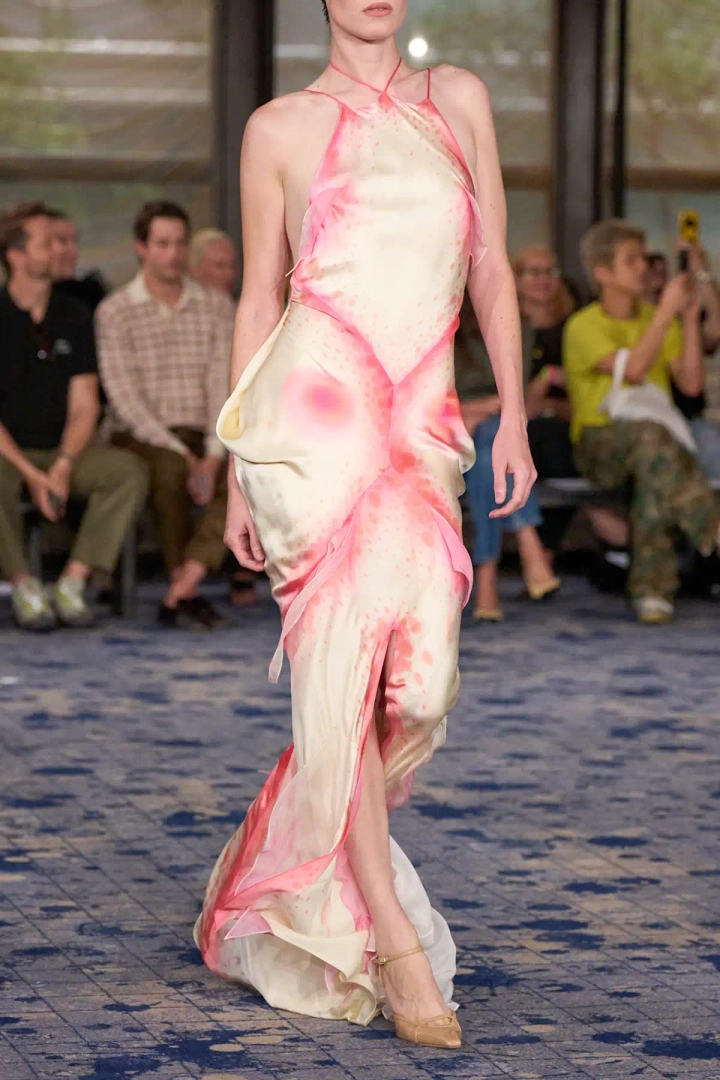
Using 3D technology, computer-generated imagery (CGI), and computer-aided design (CAD), Grace Ling calculates the materials required for each collection before production begins, with the aim of eliminating material waste. Her work is rooted in anthropomorphism: she attributes human characteristics to inanimate objects. Over the years, she has combined multiple CAD programs, gradually incorporating them into her design process.
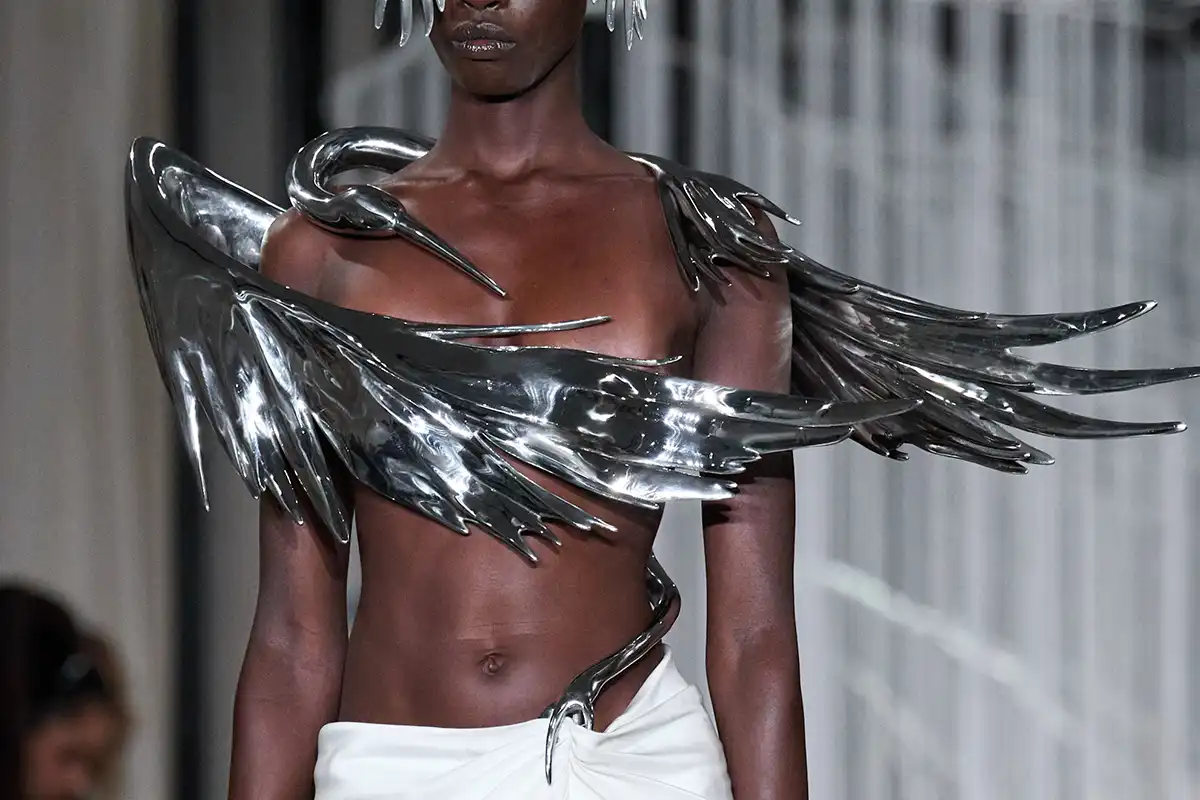
For her latest collection, Spring/Summer 2027, presented in New York in September, Ling explored the archetype of the femme fatale. Chrome leaves rested against the bust and waist. An asymmetrical moss-green skirt introduced an organic element, while a silver apple held in the hand evoked the biblical story of Adam and Eve. For the finale, two silver-metal ravens wrapped themselves around a model’s torso and waist, shielding her eyes from the outside world. The talons of one raven appeared to support a floor-length white skirt. Why shouldn’t fashion be furniture, sculpture, or printed technology? As long as it can be worn.