Wasted Waste: the Czech design project turning textile waste into a systemic question
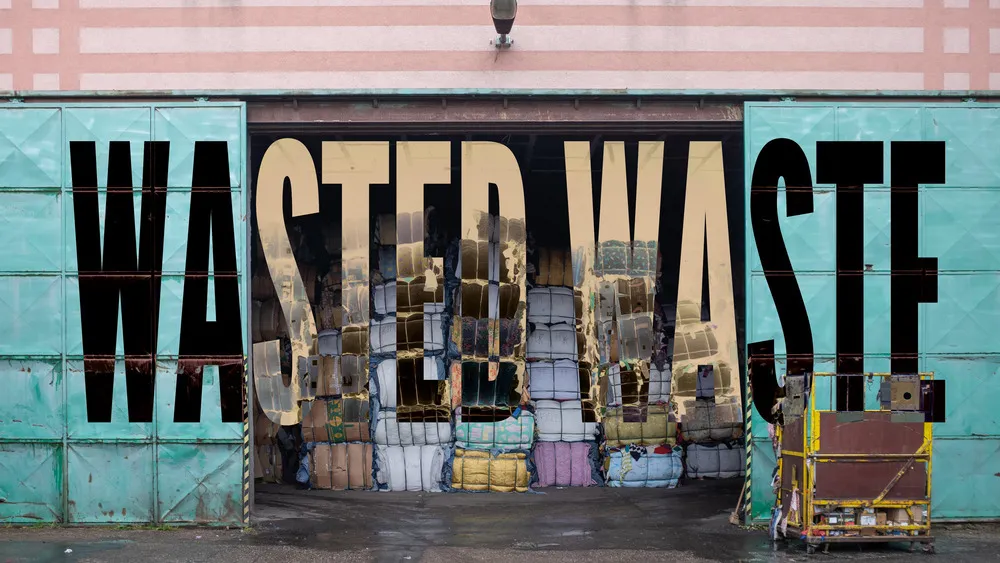
Wasted Waste began at a waste management facility on the Czech-Polish border – a design project on post-consumer textile disposal, first shown at Milan Design Week
Since 2024, students at Prague’s Academy of Arts, Architecture and Design (UMPRUM) have been traveling to a textile sorting facility on the Czech-Polish border to confront something the fashion industry rarely shows: what happens after the garment leaves. Wasted Waste — the project that emerged from those visits — brought together three studios (Product Design, Fashion and Footwear Design, Fine Arts IV) under the conceptual direction of Michal Froněk, head of the Studio of Product Design, alongside Simona Rybáková and Jiří Thýn, with production by Michaela Kaplánková. Their research partner on the ground was Diakonie Broumov, a social cooperative operating in a former Sudetenland textile region; their scientific collaborator, the Technical University of Liberec. The result was an installation presented at Milan Design Week 2026, inside the Alcova platform at the former Baggio Military Hospital. The voices in this piece belong to Froněk; to students Alica Grebáčová and Miloslav Chytil; and to Kaplánková.
The most uncomfortable reality uncovered was also the simplest: waste persists because producing new goods remains easier than recovering what already exists.
Michal Froněk: The uncomfortable reality uncovered was the simplest: producing new goods remains easier than recovering what already exists. Waste doesn’t accumulate because of ignorance. It accumulates because the system is built that way.
Michal Froněk: Throughout Wasted Waste, we kept returning to the same question: how can objects remain valuable for longer? Not only economically, but materially and culturally. If the economics continue to favor extraction over recovery, the volume of waste will keep growing — regardless of how efficient sorting systems become. This conversation can’t stay inside design schools. It has to involve producers, manufacturers, the industries responsible for putting these materials into circulation in the first place. Right now, it’s still faster, cheaper, and far less complicated to make something new than to sort, separate, and recycle what already exists. That’s the reality.
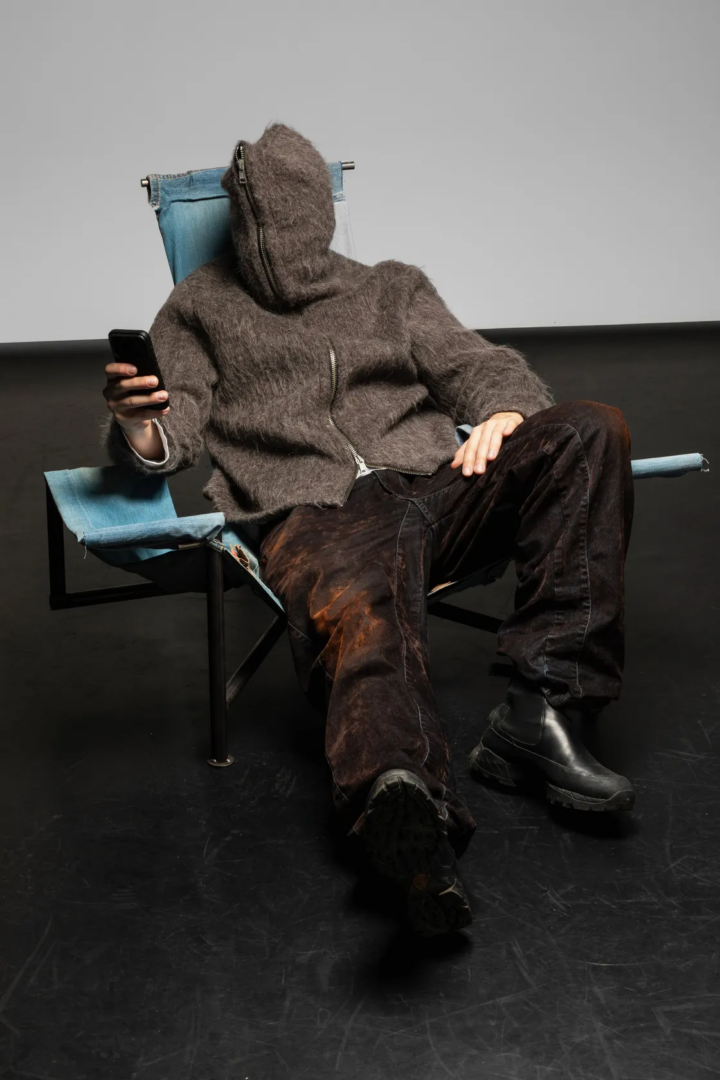
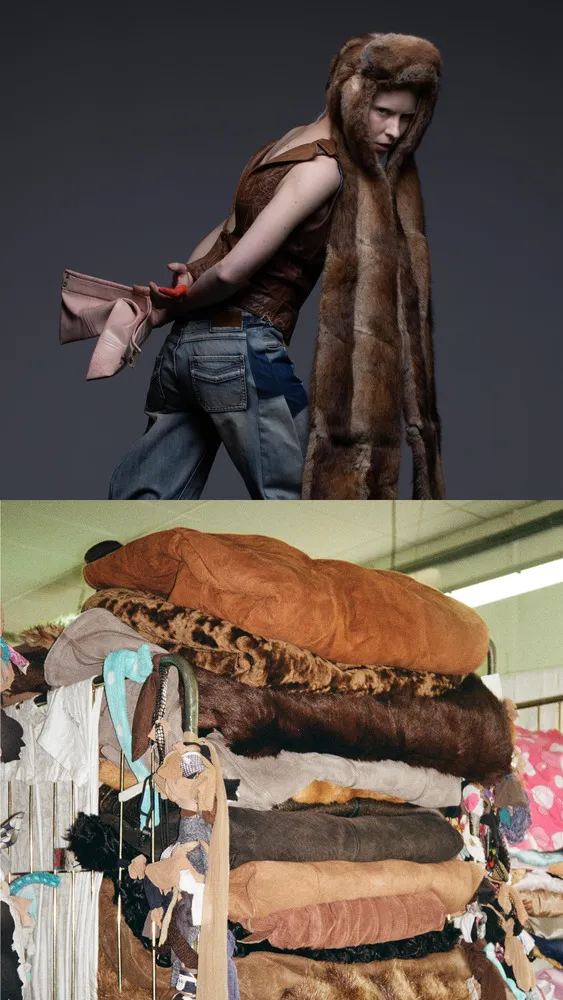
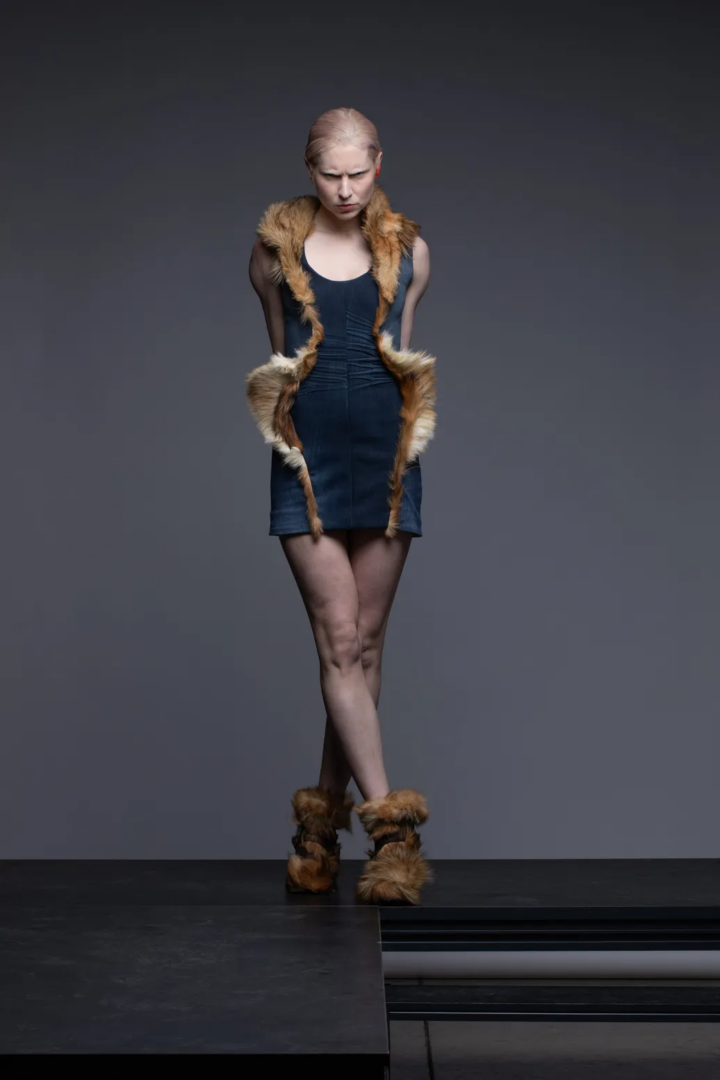
Alica Grebáčová: We arrived with expectations: materials we’d encounter, the scale of the facility, the condition of the garments. The reality was different. The first shock was volume — nothing prepares you for that. Then the clothes themselves. I expected worn pieces, things that had reached the end of their life. Instead, a significant proportion looked almost new. Many came from recent collections, barely used. What’s being produced the fastest is often what’s being discarded the fastest. There were older things too — piles of fur coats, thrown away like everything else. Fur is one of the most difficult materials to dispose of, and seeing that quantity of it, knowing how resistant it is to reuse or recycling, revealed another contradiction embedded in the system.
The waste wasn’t the biggest surprise. What shifted everything was the labor behind it. The sorting process still relies almost entirely on human hands. Workers stand at the line handling every garment, piece by piece. No automation. No distance.
Miloslav Chytil: I didn’t expect the facility to be so low-tech. Only people — standing at the sorting line, touching every fabric, every object that passes through. This is the end of a garment’s life: other people deal with what we choose not to see. They know our consumption better than we do. As much as we try to distance ourselves from that reality, we remain fully inside the system.
Textile waste doesn’t disappear. It changes location, ownership, and visibility — and keeps moving.
Alica Grebáčová: Many wearable garments are exported to Africa, but that’s not a solution. It’s a displacement of the problem. The clothes leave our field of vision, but the waste remains. Receiving countries can only absorb so much surplus before they begin rejecting it. The real question is what happens when there’s no “away” left.
Miloslav Chytil: We didn’t want to aestheticize the problem or pretend we had solved it. Wasted Waste was never conceived as a solution — it’s clearly not one. What interested us was the system itself: the endless movement of materials, the repetition of sorting, the labor required to keep everything in motion. We were far more interested in exposing that reality than in presenting an optimistic answer.
The conveyor belt didn’t represent recycling. It represented repetition — the endless movement required to keep waste in circulation.
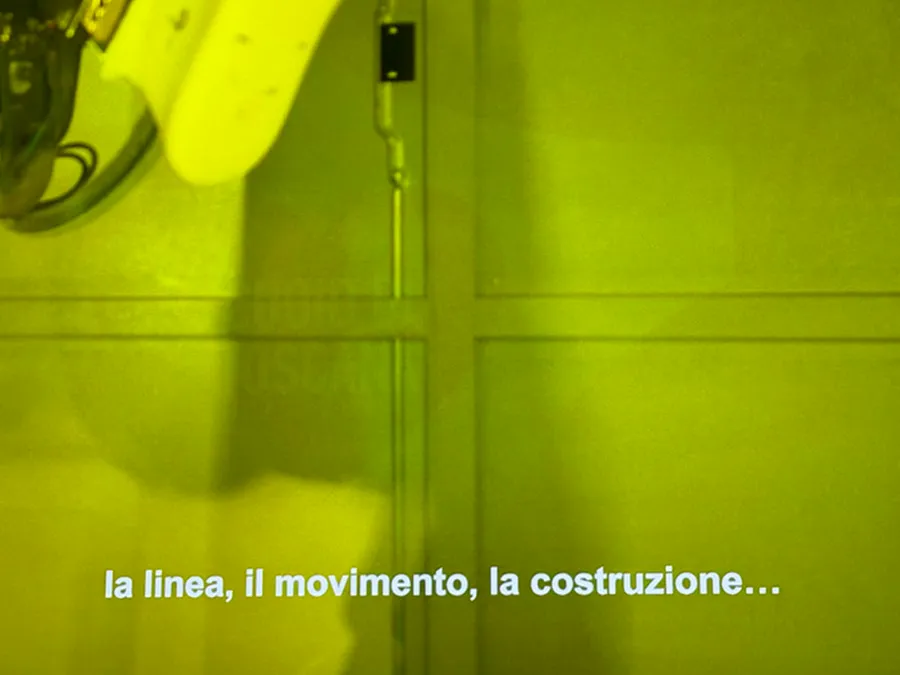
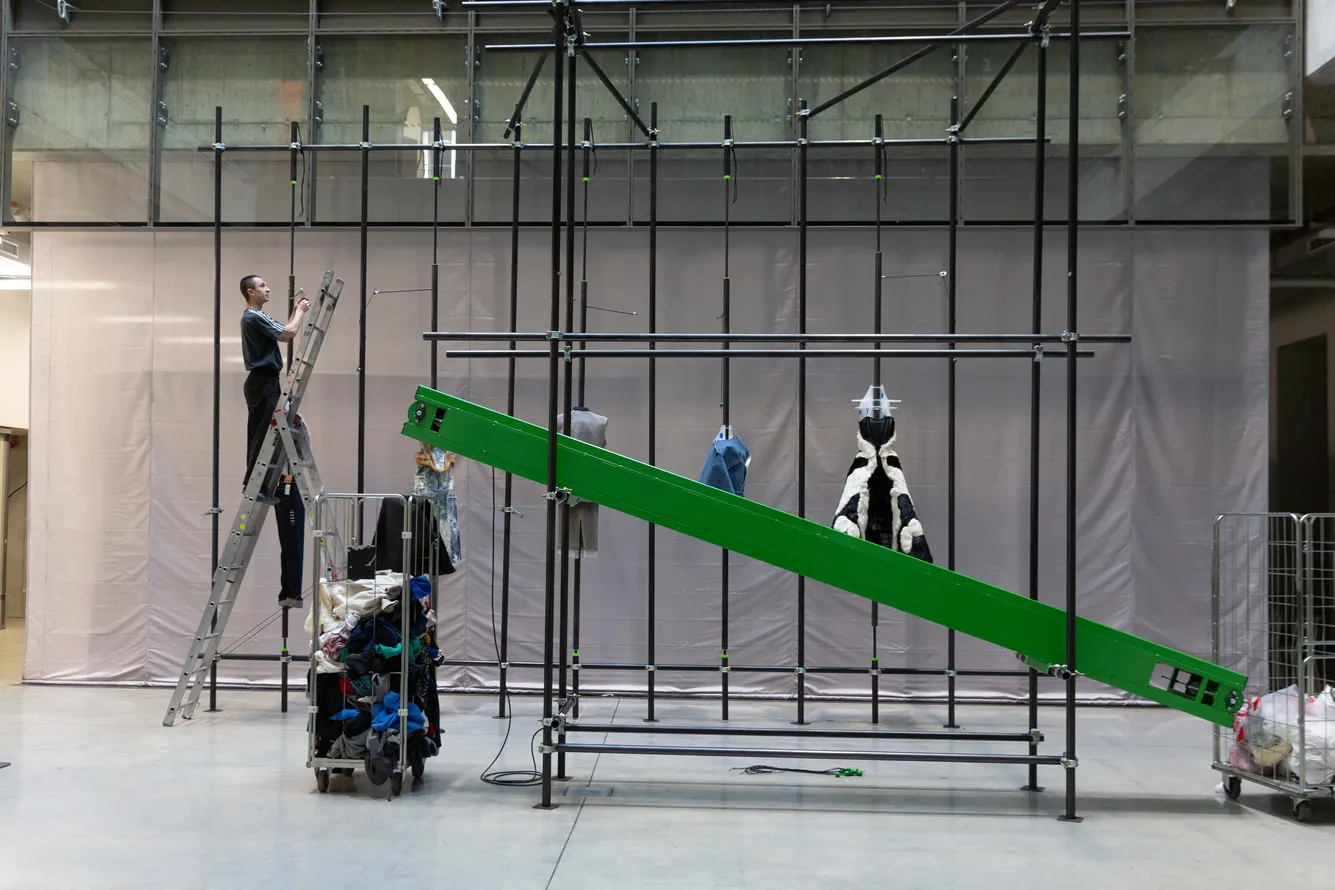
Miloslav Chytil: Reconstructing the rhythm of Diakonie Broumov became central to the installation. We used a segment of the sorting facility itself — a conveyor belt — as its core element. A Sisyphean metaphor for the labor surrounding waste. The performer feeds clothes onto the belt, follows its movement, empties the bin, returns everything to the beginning. Again and again.
What interested us was not the idea of a circular system, but the reality of maintaining one. Waste doesn’t disappear. It keeps moving. Every product eventually becomes something that has to be sorted, carried, processed by someone. The conveyor makes that repetition visible.
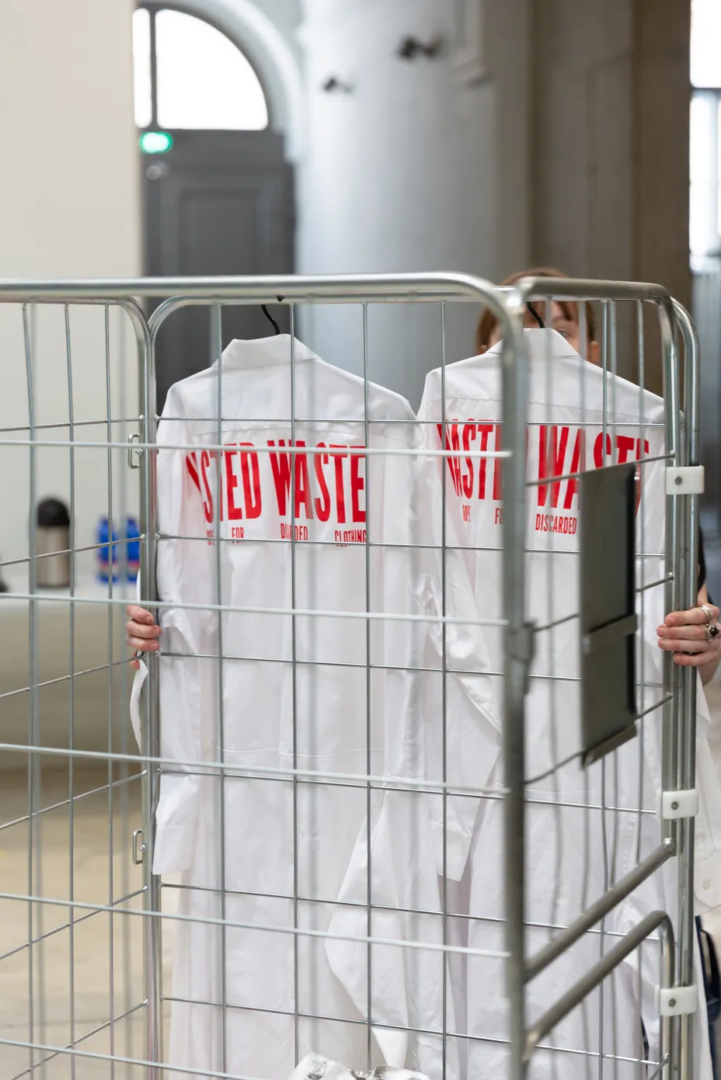
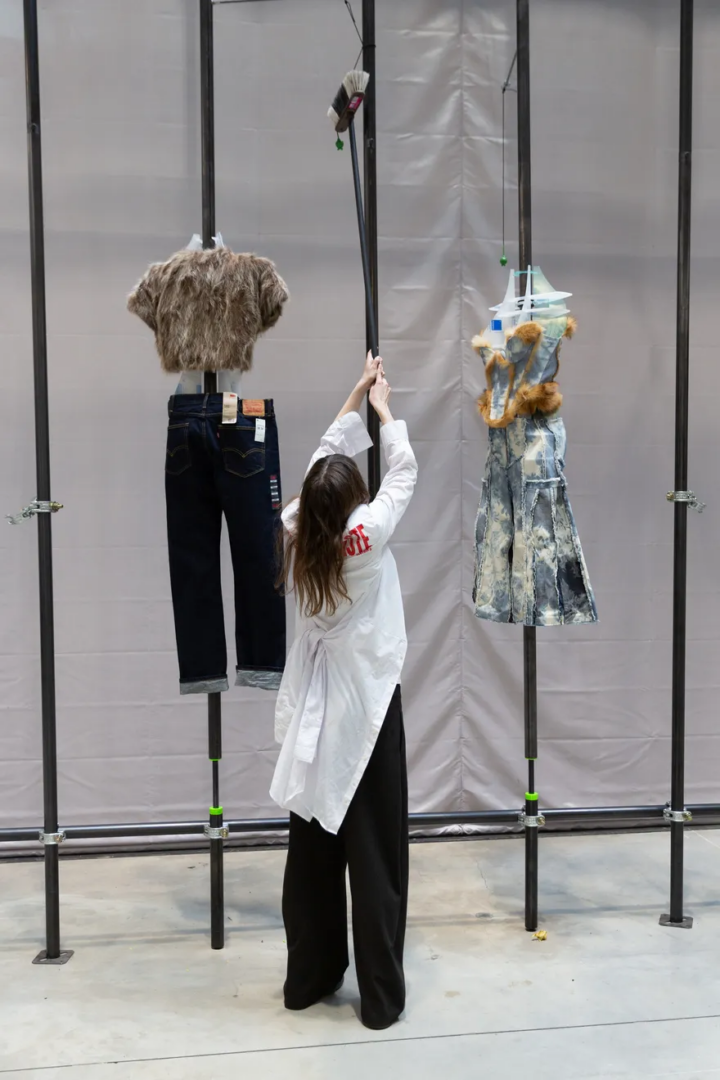
Michal Froněk: These processes are very difficult to communicate through objects alone. A conventional exhibition can show the result, but not the work required to sustain the system behind it. Human presence became essential — not only through the conveyor, but through what we called living hangers. Bringing Broumov to Milan was impossible. What the students attempted was to bring visitors into contact with its rhythm: not the finished garment, but the movement, labor, and repetition surrounding it.
In Broumov, the materials refused to behave like raw materials. They arrived with histories, limitations, and demands of their own.
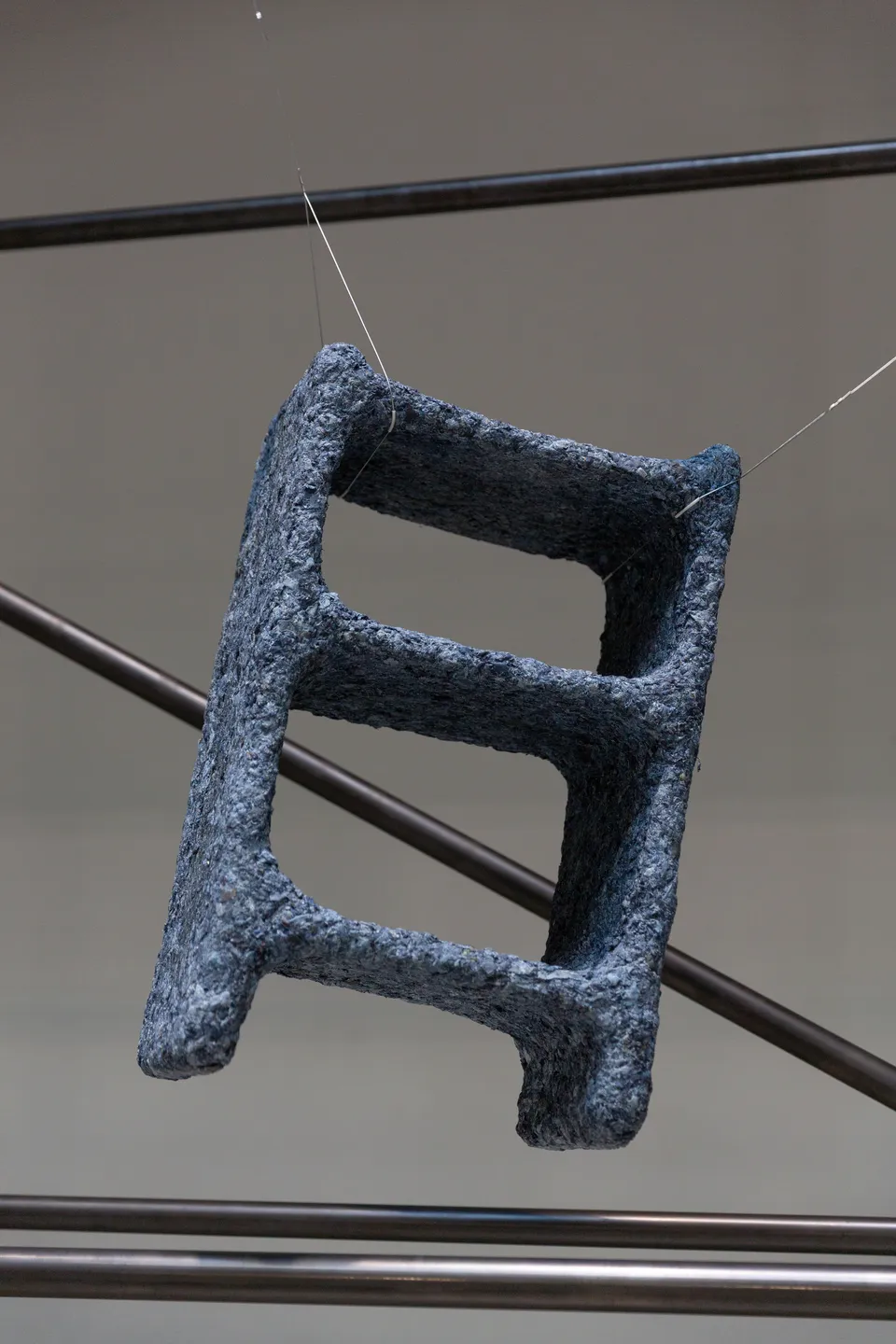
Miloslav Chytil: My project began with a concept already in place: an experience-based design proposing a less harmful alternative to polyurethane. But when I encountered the actual material inside the sorting facility, the project changed. The concept and the material stopped existing separately. What seemed possible in theory had to confront what was physically available. That confrontation is where the project truly began.
Alica Grebáčová: You arrive with expectations, but the material takes control quickly. Everything depends on what is actually there, what survives, what can still function, what resists.
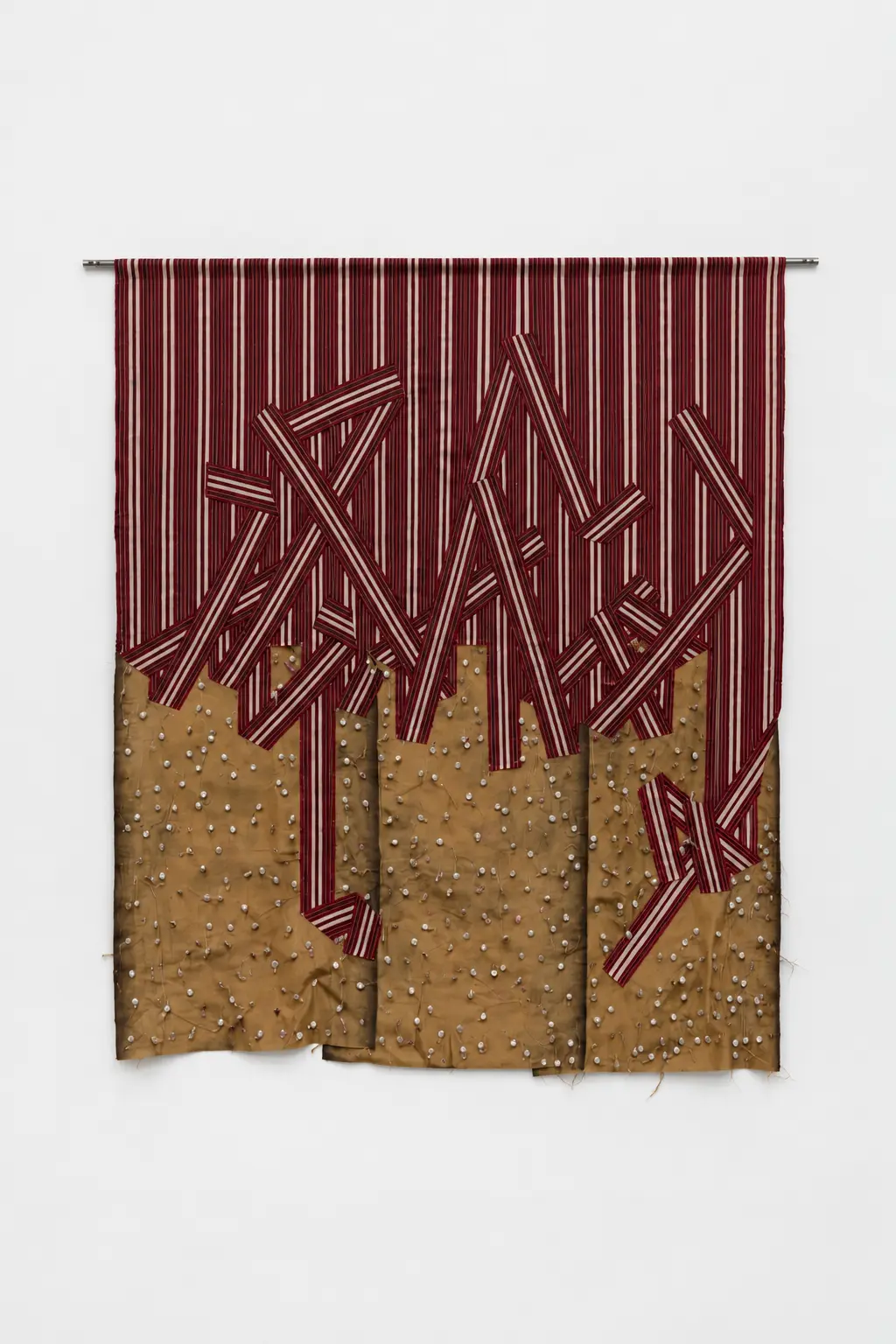
A large part of my original idea had to be abandoned. I had planned to cut into the garments, reconstruct them, push them into new forms. Once inside the facility, that gesture felt too violent. Every garment already carried labor before I touched it — someone designed it, produced it, wore it. Even inside a waste facility, these objects didn’t feel neutral. The question stopped being what I could do to them and became what I could do without erasing what was already there.
One piece was a dress made from curtains. I didn’t cut the fabric — only rearranged it. The intervention stayed reversible. Traces of wear remained part of the object’s identity. I treated damage and imperfection as information rather than defect. The material was no longer passive. It began setting its own terms.
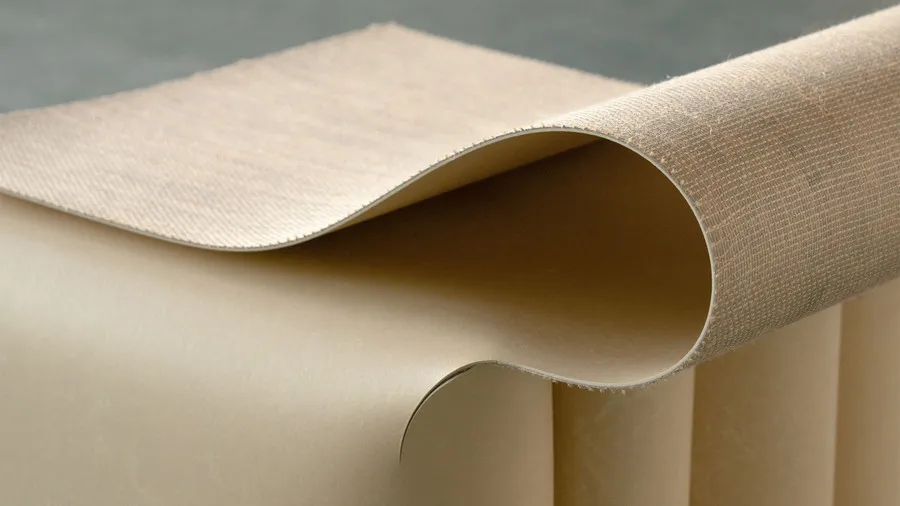
What enters the sorting facility as waste can leave it as a material. The challenge is deciding how far that transformation can go.
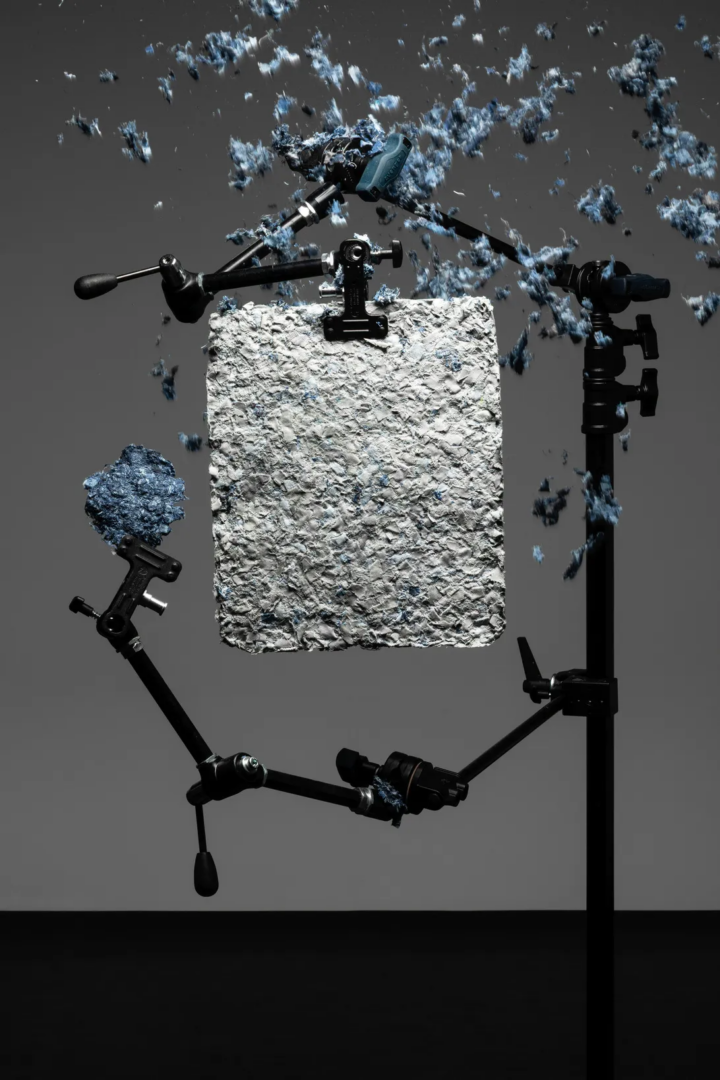
Miloslav Chytil: The laboratory work changed how I understand materials. Until then, I thought mostly in terms of form — shape, function, experience. Working with textile waste pushed that thinking much further back, towards the material itself. What interested me was the possibility that something already considered useless could become the starting point for an entirely different process. Working with researchers, I began exploring how discarded polyester textiles could be transformed into new material forms. Waste stopped being the end of a product’s life and became the beginning of another cycle.
Environmental constraints are usually discussed as limitations. But they can force new ways of thinking. When the starting point is a problematic material rather than a perfect one, the design process changes entirely — and that’s what makes it interesting.
Broumov became the starting point not because it is exceptional, but because it concentrates the realities most consumers never see.
Michal Froněk: Broumov sits on the border between the Czech Republic and Poland. On paper, peripheral — far from the centers of production and consumption. Yet it’s precisely in places like this that the consequences of those systems become visible. The ambition was never simply to produce an exhibition. It was to begin from an existing reality and follow it: to understand how a local facility, local workers, and local communities fit into a system that stretches far beyond the region.
Miloslav Chytil: In many ways, Broumov mirrors the story of textile waste. Both exist on the periphery of attention. Both remain invisible until you decide to look directly at them.
Alica Grebáčová: Wasted Waste emerged through our collaboration with Diakonie Broumov. What began as research into textile waste gradually became research into everything surrounding it — labor, infrastructure, disposal, reuse, the mechanisms required to keep the system operating. Through that, each of us developed an individual position, a distinct material vocabulary, a specific way of engaging with the subject.
Wasted Waste brought together fashion, product design, photography, and scientific research — connected not through a common aesthetic language, but through a shared attempt to understand the system
Michal Froněk: When the Product Design Studio joined, the Fashion Design Studio was already well advanced. Our role shifted towards the installation itself, and towards understanding what these materials could become beyond fashion. Together with researchers from the Technical University of Liberec, we explored how textiles that have already left circulation might enter entirely different fields. The work presented in Milan belonged to the students. Our task was to create the conditions for it to happen.
Michaela Kaplánková: The project was never only about waste. Each studio entered the same subject from a different position, looking at different parts of the same system. The Photography Studio approached it through social reality: the workers, the region, the economic conditions, the contrast between industrial labor and the cultural history of Broumov. The facility employs people for some of the lowest wages in the Czech Republic — performing labor most consumers never see, yet essential to the functioning of the entire system. That contrast was impossible to ignore: mountains of discarded clothing passing through the hands of workers in a region often overlooked, carrying the burden of processing the consequences of global consumption.
There were other contradictions too. The facility exists within a landscape marked by Baroque monasteries, churches, a long cultural history. On one side, heritage and preservation. On the other, a constant flow of materials designed to be consumed and discarded.