Goshka Macuga: when systems work too well power takes over
“Growing up with nothing trained me to build everything” – Goshka Macuga on memory, archives, AI, and why systems become dangerous when efficiency starts to override human truth
Political Propaganda: Systems, engineering, and the risk of emotional erasure
HS There’s a perceived coldness to the figure of the engineer or mechanic—a distance from what’s being handled. When you’re working with vast, interconnected systems of information, do you ever feel the logic of the structure threatening to overtake the human truth of the materials?
Goshka Macuga It’s political propaganda. It is a form of information engineered to function efficiently, but that efficiency comes at the cost of human best interest. Propaganda is built to manipulate and control, not to understand or be sympathetic. It reduces individuals to targets and emotions to tools, disregarding their emotional and lived needs, and the truths attached to their existence.
I learned about this as a child growing up in Eastern Europe. With the collapse of the Soviet Union the threat of such control had gone away for good. This does not seem to be the case today, as we are once again facing high levels of censorship and laws that limit freedom of speech across the globe.
I see the role of engineers as often tied to political or institutional representation, establishing structures and mechanisms of control. This happens outside of myself, and my role as an artist becomes focused on finding ways of working within such restraints. I respond to this by building systems of expression rather than systems of counter-control.
In the last few months, my focus has been on new research around computing and how this might alter our thinking about the future of artificial intelligence. I have been developing a proposal connected to this field, and it has occupied some of my time, though not enough to feel accomplished at this stage.
Where play enters the work: Goshka Macuga on brainstorming and making
HS Meccano is a toy designed to teach proper engineering, but children often use it to build things that don’t make sense. In your own practice, where do you feel a sense of play?
Goshka Macuga In the brainstorming phase, when the generation of ideas and the conceptual exploration take place. This stage allows me to imagine possibilities without constraints. The making itself can also be playful, when I work with techniques that are new to me or collaborate with another person. I’m attracted to new experiences and to the process of learning itself, so every project becomes a kind of playful exploration of the unknown.
Growing up without toys: Cold War Warsaw in Goshka Macuga’s practice
HS The toys and games you remember playing with as a child. Do you recognise any continuity in that early form of play?
Goshka Macuga I spent my childhood in Warsaw, Poland, during the Cold War, a time when toys, clothing, and even food were difficult to find. What we had was often dictated by seasonal coupons and limited options. Toys were a luxury and mostly self-made from whatever materials were available: paper, wood, clay. I remember collecting chestnuts, acorns, and sticks to create toys and arrangements, and I often made my own clothes.
Learning by doing – how skill and curiosity shaped Goshka Macuga
HS There’s a thirst for knowledge in your work, but also for skill—the fact that you take things into your own hands and learn by doing.
Goshka Macuga From the age of fifteen, I attended a secondary art school named after Wojciech Gerson, where everything revolved around being creative. We not only focused on creating images and objects, but also on constructing one’s own identity from very little. Looking back, I feel that being an artist in Poland during the ’70s and ’80s was a way to assert agency and creativity in such a constrained environment. My resourcefulness and inventiveness in childhood probably reflect how I approach projects today.
Beyond gaining academic knowledge and practical skills, I was conscious of what was true and what was false within the context of my own history. Growing up under a state controlled by the USSR, I learned that official narratives were often propaganda; discovering facts for myself, through word of mouth or research. This early experience of navigating limited information formed a deep curiosity and a DIY approach.
Memory as structure: research, selection, and narrative in Macuga’s projects
HS Your projects involve absorbing huge amounts of information, histories, and voices. How much do you consciously hold onto, and how much do you let fall away once a project is finished?
Goshka Macuga I collect information that interests me in many formats, often following a subjective, intuitive path rather than a strictly academic method. From this collection, I select elements to form the skeleton of a project, around which a narrative begins to emerge. Only after this point do I decide on the medium of the final artwork. Often, my projects include texts or works by other people, as anything can contribute to the construction of meaning. Not everything I encounter ends up in the final work.
Forgetting on purpose: technology, distraction, and intuition in Goshka Macuga’s process
HS Do you have any strategies for organising or jogging your memory, or is forgetting a part of how you move forward?
Goshka Macuga I need support to enhance my memory. It need a mental space, a state in which magical but also meticulous connections can spark. I am not sure whether today’s technology is beneficial for my brain, or whether it makes it lazy to some extent—an undisciplined mind that can easily become hyperactive and distracted. My phone, social media, and the internet are sources of information, but much of that information feels useless or unreliable. As a result, I must discipline myself to remain focused and structured. At the same time, many things still come to me intuitively, or by chance, rather than through strictly organised systems.
When a structure fails: intuition, risk, and reconfiguration in Macuga’s work
HS When something in a project isn’t functioning, do you tend to replace a single component, or does it trigger a more radical reconfiguration?
Goshka Macuga After many years of working with a method, I have learned to trust my instincts and take risks. Not all projects feel equally successful in retrospect. Most artists have only a few works that truly stand out, at least from a subjective perspective. I need to take good projects to the next step. Along the way, there are levels of experimentation and refinement.
When nothing moves alone: collaboration inside Goshka Macuga’s practice
HS Meccano teaches that nothing moves alone—every piece depends on another.
Goshka Macuga Collaboration has been at the core of my working method, even when the final outcome might appear idiosyncratic. From my early projects developed for artist-run spaces such as Cubitt and Sali Gia in London, where I included the work of other artists, to more recent, deeply layered projects, collaboration has been a necessity rather than a supplement.
My ongoing collaboration with theatre director Fabio Cherstich on Tales and Tellers, created for Miu Miu demands a mode of working that is dynamic and multifaceted. While I develop the conceptual framework independently, the realization of performance works requires trust in others’ expertise, when it comes to casting, rehearsals, timing, and the physical direction of people in space. Authorship becomes shared.
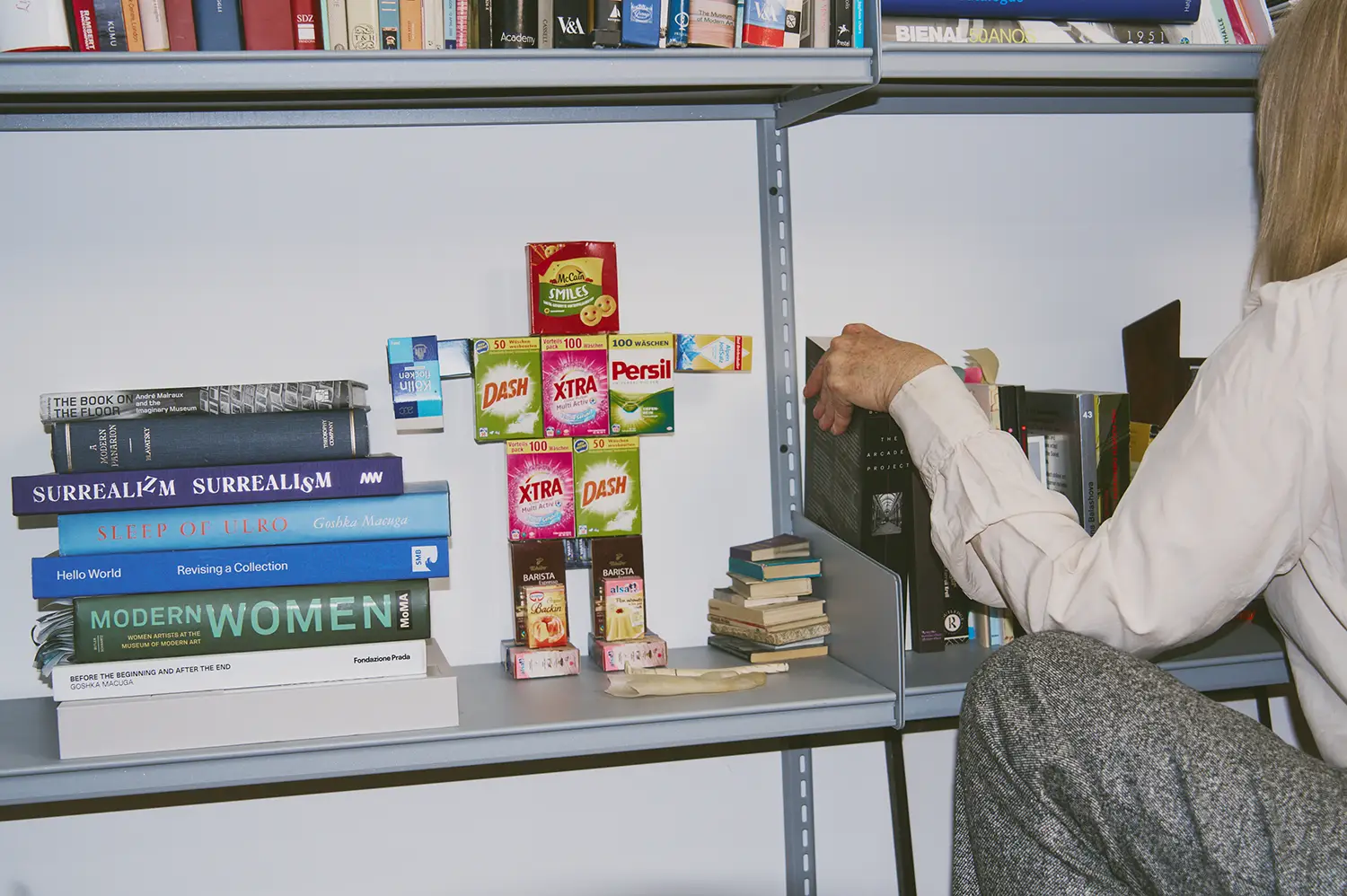
From humanoid robots to AI: how Goshka Macuga rethinks artificial intelligence
HS 2026 will mark ten years since To the Son of Man Who Ate the Scroll at Fondazione Prada, whose protagonist was a humanoid robot fed on famous speeches, movie scripts, and book passages.
Goshka Macuga My interest in artificial intelligence was inseparable from a longer historical inquiry into artificial memory. Rather than approaching AI as a futuristic replacement for human cognition, the project traced humanity’s enduring desire to extend its mnemonic capacities—a desire that can be observed as early as ancient Greece and becomes explicit during the Renaissance. I was interested in pre-technological systems of thought, and I referenced hermetic philosophers such as Ramon Llull and Giordano Bruno, who devised complex systems and symbolic machines to expand the human ability to memorise and generate knowledge. These systems were not external tools designed to replace the mind, but cognitive architectures meant to train and intensify inner capacities.
In that sense, the robot in the work functioned less as an independent intelligence and more as a mirror to humankind. From this perspective, the project was not so much about the development of such technology as it was about how it has impacted us as a species. This remains an open question today.
Research under pressure: how Goshka Macuga defines a rigorous practice today
HS There’s a sense that the art of research itself is under threat: underfunded archives, lost histories, online resources proving less permanent than once assumed, and the outsourcing of thought to LLMs used as research assistants. To you, what are the staples of a good research practice?
Goshka Macuga Research can’t disappear. As long as humanity remains alive, the impulse to search, to connect, and to remember will persist.
What is under pressure today is not research itself, but the conditions that support its practice. The fragility of our planet —ecological, political, and economic—can affect the preservation of knowledge. Archives are underfunded, materials may deteriorate or disappear, and institutional memory becomes increasingly vulnerable. The question, then, is not only how we research, but how knowledge is safeguarded, transmitted, and maintained over time.
At the same time, research has become diffuse and constant. We all research daily, often unconsciously: scrolling through vast amounts of information, collecting fragments, images, quotations, and references as we move through digital space. This mode of research lacks the rigour and slowness of working in a physical archive, but it reveals the contemporary condition. It produces a kind of knowledge—associative and provisional—that exists in contrast to the structured authority of archival research. It moves between analogue and digital, between deep, sustained attention and incidental discovery. It requires time, repetition, and physical engagement, but also an awareness of how information circulates and mutates. What matters most is not the tool itself—whether an archive, a database, or an algorithm—but the responsibility of the researcher.
How Goshka Macuga resists “just existing”
HS You’ve spoken before about finding the idea of “just existing” frightening.
Goshka Macuga Many aspects of my life are inseparable from my work, not because I deliberately blur boundaries, but because making is the way I orient myself in the world. My practice is highly social; it involves interaction with many people across different disciplines.
In contrast, my private life is driven by the need for solitude. I seek it as a necessity in order to recharge. I travel, but most of the places I visit are tied to work rather than leisure, which means that movement itself becomes part of a working rhythm rather than an escape from it. I have a second home where I spend roughly three months each year, in a setting where the appearance of another person on the horizon is unlikely. There, I am more often accompanied by birds, insects, and bats than by human presence.
Wherever I find myself, I tend to create tasks—often self-imposed projects that remain creative even on a small scale. This has always been the case for me, as long as I can remember. Activity, thinking, and making, rather than simply existing without direction or a plan. I find a state genuinely frightening. I am aware of the physical and mental limitations that time can impose, and this awareness shapes both how deliberately I work. Making becomes a way of staying alert—intellectually, physically.
When history resists structure: building with fragments in Goshka Macuga’s work
HS The Meccano set is satisfying because the pieces fit perfectly, but archives are often jagged, incomplete, or broken. When you’re incorporating historical fragments into a new structure, where does the system tend to jam? Can you recall an “uncooperative” piece of history you’ve tried to build with?
Goshka Macuga The system tends to jam when history is still charged with unresolved anxiety—when material carries too moral ambiguity, or proximity to trauma. I am involved in exactly this kind of exercise: working with historical material that remains unresolved, or is still in the making, marked by layered trauma and manifestations of human cruelty that repeat themselves across time. These are not isolated events but patterns, and that makes them harder to treat as discrete or archival findings.
Certain places seem to paralyse rather than inform. They carry an atmosphere, a negative charge that resists any sense of play or creative distancing. In these cases, the Meccano logic of clean joints and functional connections breaks down.
Goshka Macuga – a short biography
For Polish artist Goshka Macuga, growing up in Cold War-era Warsaw meant making do. “Toys were a luxury,” she remembers, and childhood games were exercises in improvisation. What existed was rationed through seasonal coupons, and what didn’t exist had to be made. She built her own toys from whatever was at hand: chestnuts, acorns, sticks, scraps of paper and wood; sewed her own clothes; and learned early that creativity meant working with constraints. From those small, self-fashioned worlds, a habit of invention took hold—a logic of construction that still drives her practice today.
From her early interventions to the 2008 Turner Prize-nominated Objects in Relation—which interwove works by early-modernist group Unit One, tree trunks from English forests and letters from art world lovers—Macuga is less interested in arriving at answers than in staying with questions, especially those that refuse to resolve quickly. “Curiosity allows me to approach historical material without a fixed agenda, to follow unexpected paths, and to remain open to things that resist immediate understanding.”
Relocating to London in the early ’90s after the fall of communism, Goshka Macuga established a practice shaped by institutional critique, collaboration, and a sustained engagement with history as a contested terrain. Trained at Central Saint Martins and Goldsmiths, her work has questioned where authorship ends and curation begins, and how meaning shifts as objects, images, and narratives move across contexts.
From early projects developed within artist-run spaces to large-scale institutional exhibitions, Macuga has worked with borrowed materials, other artists’ works and historically charged artefacts. In Picture Room (2003), she reactivated Sir John Soane’s dense hanging method by placing contemporary works alongside William Hogarth. In The Nature of the Beast (2009) at Whitechapel Gallery, she exhibited a woven replica of Picasso’s Guernica—the same tapestry long used as a backdrop for diplomatic events at the United Nations, and famously concealed during Colin Powell’s 2003 speech ahead of the invasion of Iraq. By relocating the object, Macuga exposed how images acquire power through use, concealment, and repetition.
More recently, her collaboration with theatre director Fabio Cherstich on Tales and Tellers, commissioned by Miu Miu, has extended her practice into performance and rehearsal, where authorship becomes distributed and provisional. Across different media and formats, Macuga’s work returns to a persistent set of concerns: how histories are constructed, how systems of knowledge operate, and how structures designed to organise meaning can also become tools of control. In this conversation, she reflects on research, memory, collaboration, and the point at which systems begin to work too well.
Harriet Shepherd
TEAM photography Sandra Seaton, photography assistant Scott Archibald