How porn, once a political project, became the most catalogued sector on the web
The passport to pleasure: how porn went back to asking for your documents: from the magazine under the mattress to the hundred billion of the digital market
There is a screen, today, that stands between an adult and a naked body: a form. Upload a document. Take a selfie. Authorise the biometric verification of your face. Only then, perhaps, does the content unlock. This is the Identity Check for porn: the age verification, carried out in practice as identity verification, that since 2025 the United Kingdom, and other jurisdictions in its wake, impose on anyone who wants to watch pornography online. Passport or driving licence uploaded to third-party platforms such as Yoti or Persona, a scan of the face, in certain cases even the number of one’s SIM. Aylo, the group that owns Pornhub, YouPorn and Tube8, chose to block British users wholesale rather than collect this volume of data. For the first time in the history of commercial desire, watching a body undress requires showing, with more rigour than it takes to open a bank account, who you truly are.
The irony is total, and it deserves to be taken seriously: the most anonymous object of mass culture — pornography, historically consumed in the dark — has become the object that today demands maximum demographic transparency. To grasp how radical this reversal is, one has to retrace the recent history of porn along two axes that have just crossed: the technical one, from paper to digital, and the political one, from a project of liberation to a product, all the way to its present commodification as data inside a pornography market now worth tens of billions.
From the shop window to the webcam: porn on paper against digital porn
Pornography on paper had a protective paradox that no one, at the time, called privacy: to buy it you had to expose yourself physically — walk into a newsstand, look the seller in the eye, carry the magazine to the till — yet that exposure left no trace. The flush in the face dissolved on the way out of the shop; no database remembered what you had bought. It was a system of acute social shame and zero memory.
Digital pornography overturned this equation. From the Nineties on, with the arrival of the first sites such as sex.com, porn became free, infinite and — above all — anonymous: no clerk, no gaze, no till. For a quarter of a century desire could move online without showing its face to anyone. But that anonymity was not a right that had been won: it was simply a regulatory void, and a single law was enough to close it again — the British Online Safety Act, fully in force since July 2025. Today the Identity Check asks for exactly what pornography on paper never asked for: a document, a face, a name, and it asks for them, moreover, from a digital infrastructure capable of keeping them indefinitely. The most shameful system of all, the newsstand, archived nothing. The most “secure” system of today archives everything.
When sex was a political project: the lounge, the jazz, the intellectual who smoked
Before it became a data infrastructure, porn had been, for a precise historical moment, a declared political project. It was Wilhelm Reich, the Viennese psychoanalyst, who coined in the Thirties the very phrase sexual revolution, explicitly binding the liberation of desire to the liberation of class. Herbert Marcuse, in 1955, in Eros and Civilization, theorised eros as a force antagonistic to the repressive rationality of mature capitalism: to liberate the body meant, for the Frankfurt School, to undermine the social order itself.
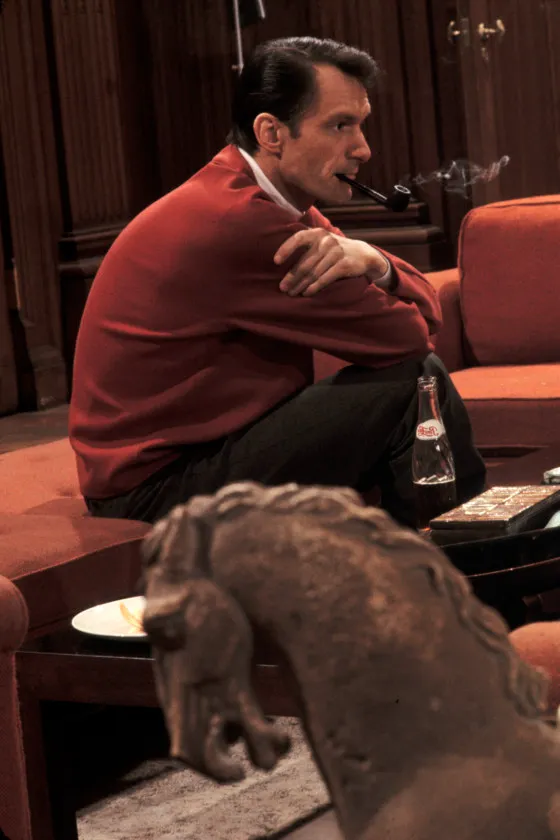
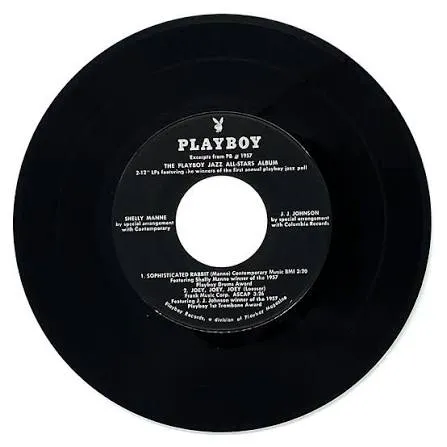
This idea, translated into a bourgeois and American register, finds its most complete incarnation in Hugh Hefner and his Playboy Philosophy, the series of editorials published between 1962 and 1965 in which Hefner argued that American puritanism was an oppression to be dismantled with the same intellectual seriousness reserved for politics. Playboy sold an entire legitimising cultural apparatus, made of modular sofas designed to Scandinavian taste, velvet smoking jackets, debates on censorship, interviews with Martin Luther King. Hefner personally staged jazz as the soundtrack of liberation, bringing Ella Fitzgerald and Miles Davis to the first Playboy Jazz Festival in 1959 and integrating Black artists into venues still segregated; he published fiction by Kerouac, Vonnegut, Ian Fleming, Ray Bradbury; he built the image of the ideal reader as an intellectual smoking a pipe or a cigarette while discussing existentialism before women. To read Playboy, in those years, was not a shameful act to be hidden: it was, or claimed to be, an act of belonging to a cultured and progressive elite, aligned for civil rights and against state censorship.
From philosophy to revenue: how porn lost its politics
That political project does not survive its own success. In the Eighties and Nineties, with the explosion of pornographic video on cassette and cable, porn detaches from the ideological apparatus that had legitimised it — the lounge, the jazz, the engaged intellectual — and becomes simply a mass product, distributed with no need for any philosophy to justify it.
The radical feminism of Andrea Dworkin and Catharine MacKinnon attacks Hefner’s legacy head-on, while the Reaganite right targets it from an entirely different direction: politics, in short, remains, yet no longer as legitimation but as a battlefield. When the internet then makes porn free and instant, even the ideological conflict fades: desire ceases to be a public discourse and becomes pure private infrastructure, consumed in silence, with no need — nor benefit — of any cultural frame.

A hundred billion dollars of desire: the pornography market today
That private infrastructure is today one of the largest digital economies on the planet. The most recent estimates place the value of the global pornography market between ninety and a hundred billion dollars in 2026, a figure higher than the combined takings of the entire world cinema box office and comparable to that of the music industry multiplied by three. Direct subscription platforms between creator and public — the model made mainstream by OnlyFans — have on their own passed ten billion dollars paid to creators, shifting the sector’s centre of gravity from the centralised production studio to the single body that monetises its own image directly. More than seventy per cent of global traffic now passes through smartphones. It is a sector that generates more revenue than most listed companies, while remaining excluded from mainstream advertising, from standard banking circuits and from much of public discourse.
Onto this enormous turnover has been grafted, since 2025, the compliance cost of the Identity Check: according to some estimates, platforms have had to raise legal and digital-identity-management spending by twenty-two per cent simply to stay operational in the markets that impose age verification. Porn, in short, now pays an entry toll that no other entertainment industry pays with the same intensity: the toll of identity.
Identity Check: the privacy of sexual data sold together with the pleasure of porn
It is here that the circle closes, and tightens. The Identity Check is not a simple demographic control: it is the creation of a new database, run by third-party companies — Yoti, Persona, AU10TIX — that puts at risk the privacy of the sexual data of millions of people, collecting identity documents, the biometric data of the face and, in practice, the cross-referenced proof of which sexual content that specific identity has consulted. In the United Kingdom, the data gathered for the Identity Check can in theory be requested by the authorities under the Investigatory Powers Act: the very infrastructure conceived to protect minors becomes, potentially, an archive of the sexual preferences of every verified adult, accessible according to logics that have nothing to do with pornography itself.
Ario Mezzolani