A body that refuses style: Ohad Naharin and the Engine of Gaga
Inside Batsheva Dance Company, Ohad Naharin pushes Gaga beyond technique – 30% power, radical control, repetition and chaos forging a body that refuses style
Batsheva Dance Company and Gaga: Ohad Naharin’s Movement Research in Tel Aviv
Ohad Naharin builds movement as a system. Born in Israel and raised on a kibbutz, he trained “late” by dance-world standards, entering the U.S. pipeline through the School of American Ballet and Juilliard. Modern dance followed, with the Martha Graham lineage as a point of contact. He then returned to Israel and took charge of Batsheva Dance Company, the Tel Aviv–based contemporary troupe founded in 1964 that became Israel’s most visible dance export and one of the main international touring companies in the field. It functions as a research environment: daily training, creation built in-house, an ensemble identity defined by physical intelligence and risk. Under Naharin’s leadership, the company became the primary platform for his choreographic work and the vehicle through which his training language spread globally.
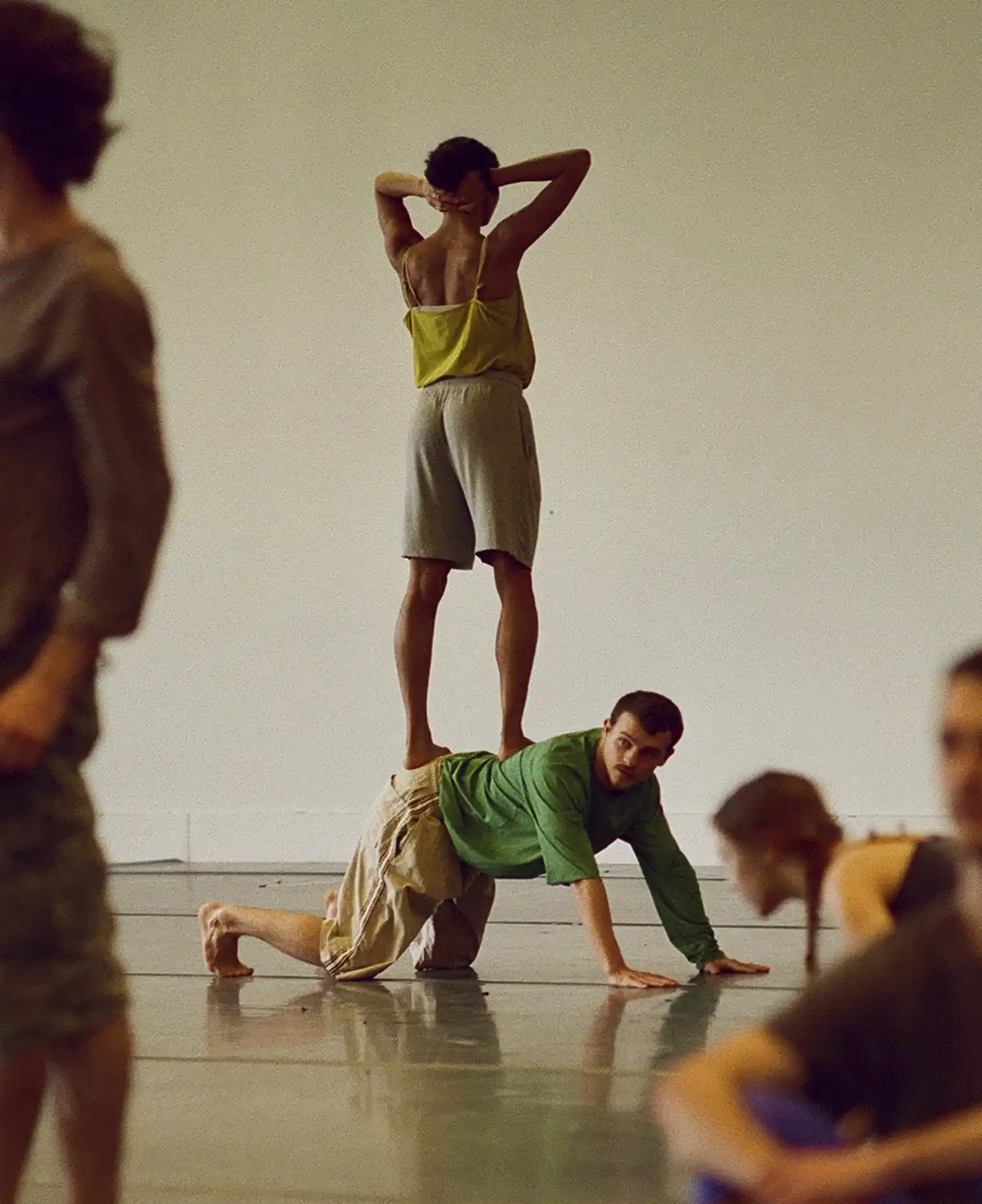
That language is Gaga. Not a style, not a codified syllabus, not a set of steps to copy. Gaga is a practice: a structured set of tasks that routes dancers through sensation, texture, timing, effort, and imagination. The system stays provisional by design. Terms shift, tools expand, rules mutate, and what looks like instinct is built through methodical attention to what the body registers before it performs. Naharin’s vocabulary runs on friction: control and the loss of control; repetition as propulsion; chaos that retains form. In works developed with Batsheva—Sadeh21, The Hole, ZŌ—movement reads like an organized living structure, engineered for change. The point is not decoration. It is translation: dancers as interpreters of a system that keeps upgrading itself, even after the premiere.
An interview with Ohad Naharin on Gaga, Batsheva Dance Company and the Language of Movement
ON: I like my dancers to work at 30% – but it’s 30% of a Lamborghini, not 30% of a scooter. At 30%, we can do everything. We don’t need more than 30% of a powerful engine to lift the heaviest weight. Roughness moves toward lightness as a virtue. I’m drawn to roughness because it connects me to strong feelings, to the animal in me, to acts of force—not only efficiency.
To be soft or dense is not an opposition; it’s a matter of texture. To be excessive or delicate is part of a range. Stretching requires pulling in two directions. It’s about range, not conflict, and there is space for all of it. I’m addicted to emotion, yet I don’t instruct dancers what to feel. I create conditions where feeling can emerge.
There are rules. It’s ongoing research that makes the language develop constantly. It can be one system one day and a different system another day. There is logic, structure and reason to it. It’s not a method I can pass on right now. I’m sharing the ongoing research. Even in the last month a lot of things have changed. Terms and ideas that I didn’t discover even a month ago are already being shared and put into what you write, into the ‘toolboxes.’
Ballet Training and the Origins of Gaga
JEI: You trained at 22, at the School of American Ballet and Juilliard, inside the strict systems of ballet technique. Gaga later emerged from you as something sensory and intuitive.
ON: Ballet is like the volleyball that I played, the swimming that I did, the gymnastics that I did. It’s a style of practice but Gaga is not a style. Gaga is the essence, whereas a style is a way to represent something. For example, there are many different ways to eat. Chopsticks, spoons, by hand – at the end, it’s the food that we need – not how we eat it. For me, Gaga is the food; it’s not how I eat it. Gaga does not contradict or negate ballet.
Control, Awareness and the Dancer’s Engine
JEI: Mikhail Baryshnikov once said ‘fundamentals are the building blocks of fun.’ In your work, you speak about listening to the body before you tell it what to do, a kind of feedback system instead of command-and-control. You’ve spoken about Gaga as ‘multilayered tasks’ and ‘strengthening one’s engine.’
ON: It’s about control – the loss of control. This control comes from an awareness of what the scope of sensations are when we are alive. Many of us are numb to a lot of the sensations, or the range of our awareness is not as wide as it could be, and it can constantly grow. We’re always working within the limitations of the body. At the same time, I use the power of imagination, and not only mine but also the people I work with. The idea is to discover things I didn’t know existed. I’m invested in how to help the dancers be the best interpreters and translators of the movement. You can see two dancers doing the same movement, one of them will bore you, and one of them will move you to tears.
Repetition, Structure and Chaos in Sadeh21
JEI: Many of your works feature movement like a loop, until one aberration shifts everything.
ON: We live through repetition. Think of how many things you’ve done today that you’ve done countless times before. Repetition can move you forward, like walking: each step repeats, yet takes you somewhere. It accumulates, creates groove, anchors you in the present. It lets you return to something beautiful and activate your imagination. As a choreographer, I’m interested in what repetition does to us.
JEI: In Sadeh21, dancers behave almost like a living molecular structure.
ON: It’s about organization, and timing. Tension between elements that need to be organized – but it’s also about chaos. Machines can be chaotic. The chaos happens when you can no longer describe it, yet it still has a kind of clear form. I can move in a chaotic way, and I can also organize chaos.
Once the performance is over, it doesn’t go back on a shelf, so it remains open to change. Often — including in my latest work, ZŌ — I alter the music. I edit it, speed it up, reverse it. There is a connection between the dancers and the music, yet we don’t rely on it to dance. Music is not the fuel. We can dance in silence. Because there is no dependency, I’m free to modify and play with it. I don’t change the music for the sake of change. I do it because the process continues after the premiere, and that time allows me to refine and upgrade the work.
Biography, Batsheva Dance Company and Artistic Integrity
JEI: The kibbutz, the army entertainment unit, your work with Martha Graham and Maurice Béjart, your time in New York, returning to Israel to lead Batsheva, your injury; each feels like a structural beam in your life. Do you see your biography as something engineered by circumstance or assembled by choice?
ON: It’s structured by decisions. You have many choices in life, and you have to decide. Even if you have an accident or injuries, the decision is how you deal with it, what you do with it. What you call my biography – it didn’t happen to me. I made a decision; to go to New York or to start dancing.
JEI: You once refused to compromise on artistic integrity during the underwear controversy in 1998, turning a costume into a political object.
ON: I speak for movement first. Movement can take you out of feeling trapped; the body that confines you can also release you. If you look at history, art often stands as a pillar amid cruelty and abuse of power. At the same time, artists are not inherently pure. Art is not separate from the flaws of the world. What matters are codes—ethics. If you act ethically, you can influence your immediate environment, even improve it. You may feel anger; you may carry violence. If you respect ethical principles, you can redirect that force toward something constructive.
You should create art that is meaningful and personal. It has to be rooted in passion and imagination, and in the sense that your skills are evolving. If you remain curious and caring, the work can contribute to improving the world. At the same time, culture and art are not separate from the world’s illness. They exist within it.
Dance Beyond Gender and the Human Body
JEI: Dance in its purest form, you’ve said, is above gender. In a world obsessed with categorizations, is that statement a utopia?
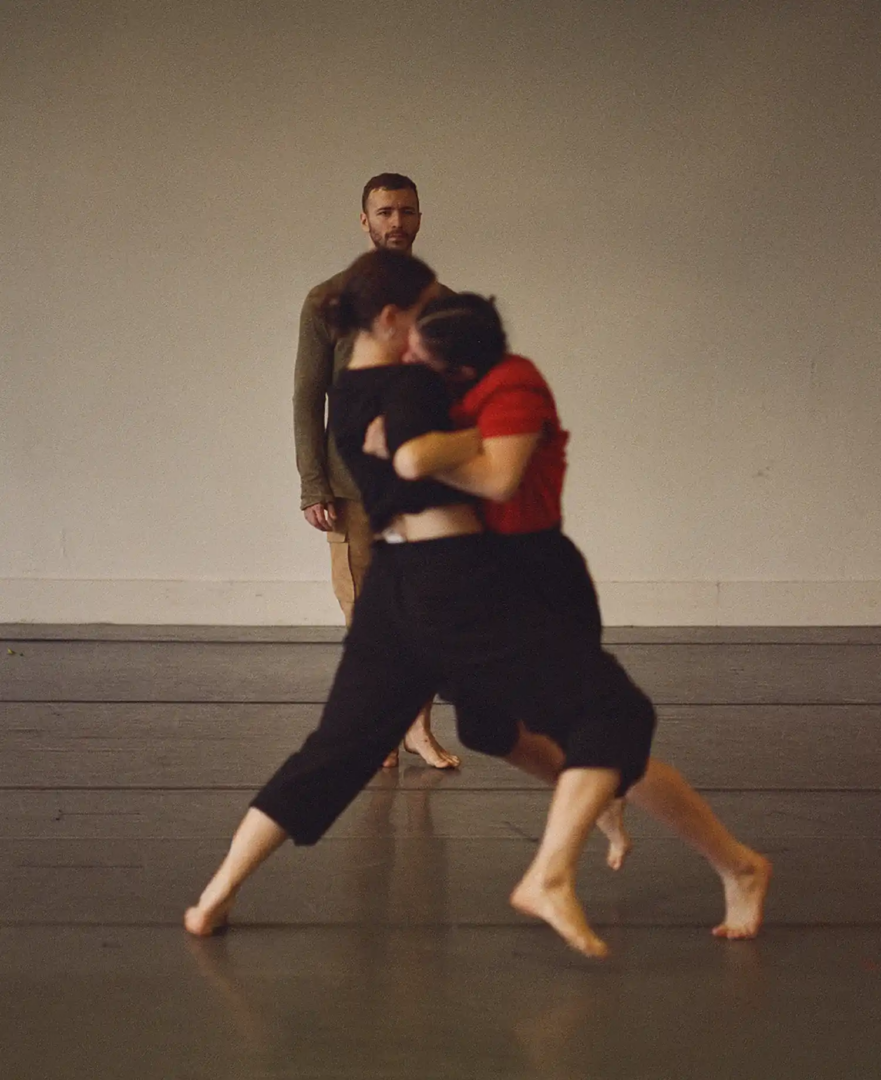
ON: I don’t care – we have dancers in the company that want to be called she, and we have dancers that want to be called they. For me, it’s meaningless. People put too much energy and time into this issue instead of just working to become better human beings. The human body, whether you are disabled or an Olympic record holder, a female, a male, old or young, our bodies have so much more in common than different. What we have in common – that’s the ground for my research.
Costume and the Evolution of Choreography
JEI: Dance is material; fabric touches skin, sweat transforms clothing, movement gives life to garments.
ON: Decoration is part of the performance—it shapes what we see. It’s like makeup. I appreciate a face without it, and I can also appreciate makeup, as long as you recognize it as makeup and not the essence.
I choose how to dress a work. When you open your closet in the morning, that choice carries weight. You may not want to be cold or exposed; you may care about color, proportion, what suits you. It’s the same with costumes. Each piece has its own atmosphere, its own universe. The costume must correspond to that world.
JEI: Do you ideate the costume after the choreography?
ON: Usually during, but there’s no formula. Sometimes I imagine a costume before I begin choreographing; sometimes it emerges in the final week. I mostly work with my wife, Ari. She’s involved from the start—I speak to her about the work even before meeting the dancers. Only once she sees it in process do we begin testing options.
Proximity, ZŌ and the Architecture of Perception
JEI: In The Hole, the confined space and proximity to the audience create an architectural friction. Is roughness something you construct spatially as well as physically?
ON: In ZŌ, the proximity is more intense. I value small gestures; the closer you are, the more you perceive them. We easily zoom in, but zooming out is harder. To perceive detail while sensing the whole. To remain slightly out of focus allows you to experience more than what is directly in front of you. I live out of focus. I teach dancers to remain there. In a confined space, that becomes necessary.
JEI: It depends where you’re sitting as well, because your focus and perspective changes.
ON: Yes, but also to realize that to experience the work, it’s not about the ability to see everything. When you see a storm and you see a sunset you don’t see the whole, but you sense the whole. That sense of the whole without feeling that you capture it is how we should experience art and this kind of site-specific dance.
Jemma Elliott-Israelson