About Netsuke – carved in ivory or wood, hidden in kimonos
Netsuke are carved counterweights, worn at the waist to balance a pouch tied to a kimono sash. Merchants wore them against silk for decades, and the friction finished the carving
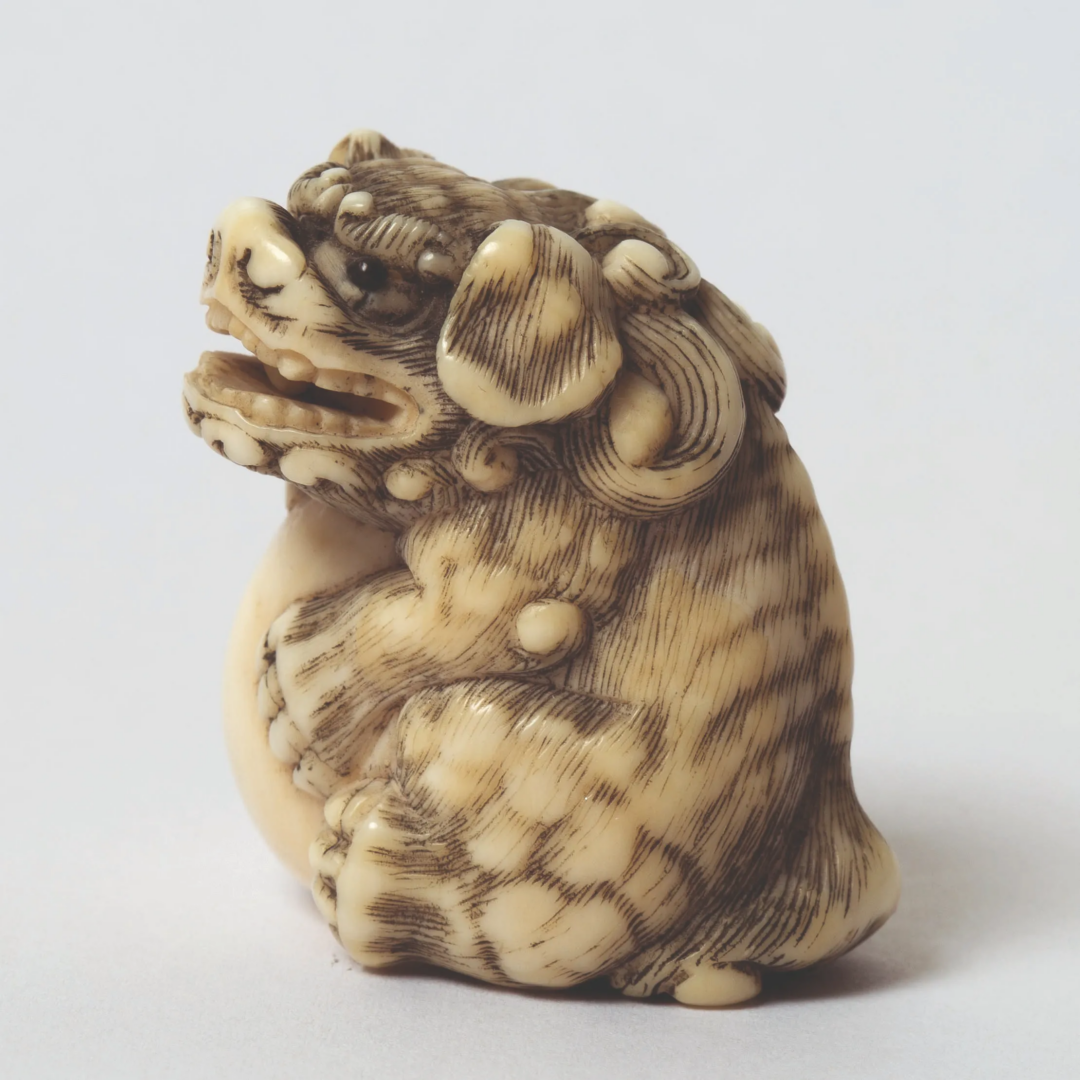
Netsuke, from ne ‘root’ and tsuke ‘attach to’, is a Japanese art form that needs to be held. They were purchased similarly to how one might buy cufflinks, with an eye on their appearance. Choosing a shishi indicates a hint of superstition, yet the value lies in the shishi, not the netsuke.
Japan, 1600. General Tokugawa Ieyasu triumphed in the battle of Sekigahara, eliminating the opposition by cutting off some forty thousand heads. In 1603, he was elected shōgun and moved the capital to Edo, today’s Tokyo. The country closed its doors to foreign contact and established strict class divisions: samurai, peasants, craftsmen, and merchants. At the base of the social pyramid were craftsmen and merchants, the latter at the bottom as they did not produce anything. They were called chōnin—citizens or bourgeois. They lived in the ukiyo, the floating world.
There was no cultural elite in Edo; no literati. Stories of the floating world—populated by courtesans, sumo wrestlers, and actors—were narrated in images by craftsmen born in the ukiyo, who had to work for a living. Illustrators were not the only ones who struggled to make ends meet. Leveraging the vanity of merchants and their desire to flaunt wealth, sculptors and engravers in the ukiyo specialized in producing fine accessories that were not valuable enough to be banned by law. These were mainly small containers (sagemono) to be attached to an obi, the sash worn around the waist over the kimono; a drilled pearl, the ojime, holding the cords together, counterbalanced at the other end of the obi by a miniature no bigger than the palm of a hand, called a netsuke—from ne, ‘root’, and tsuke, ‘attach to’.
Netsuke and sagemono tell two separate stories in Japanese craft, paired accessories carved from ivory, wood, and horn
A merchant in the ukiyo would select his accessories, almost like a dandy. It is easy to conceal sagemono and netsuke among the folds of a kimono, hiding them from curious eyes. If those eyes belong to a courtesan, however, they can be swung into view instead. Different sagemono serve different purposes—a tobacco pouch, a coin purse, a small writing set, or a medicine holder. These cases are usually made of lacquer or ivory, decorated with animal or floral motifs.
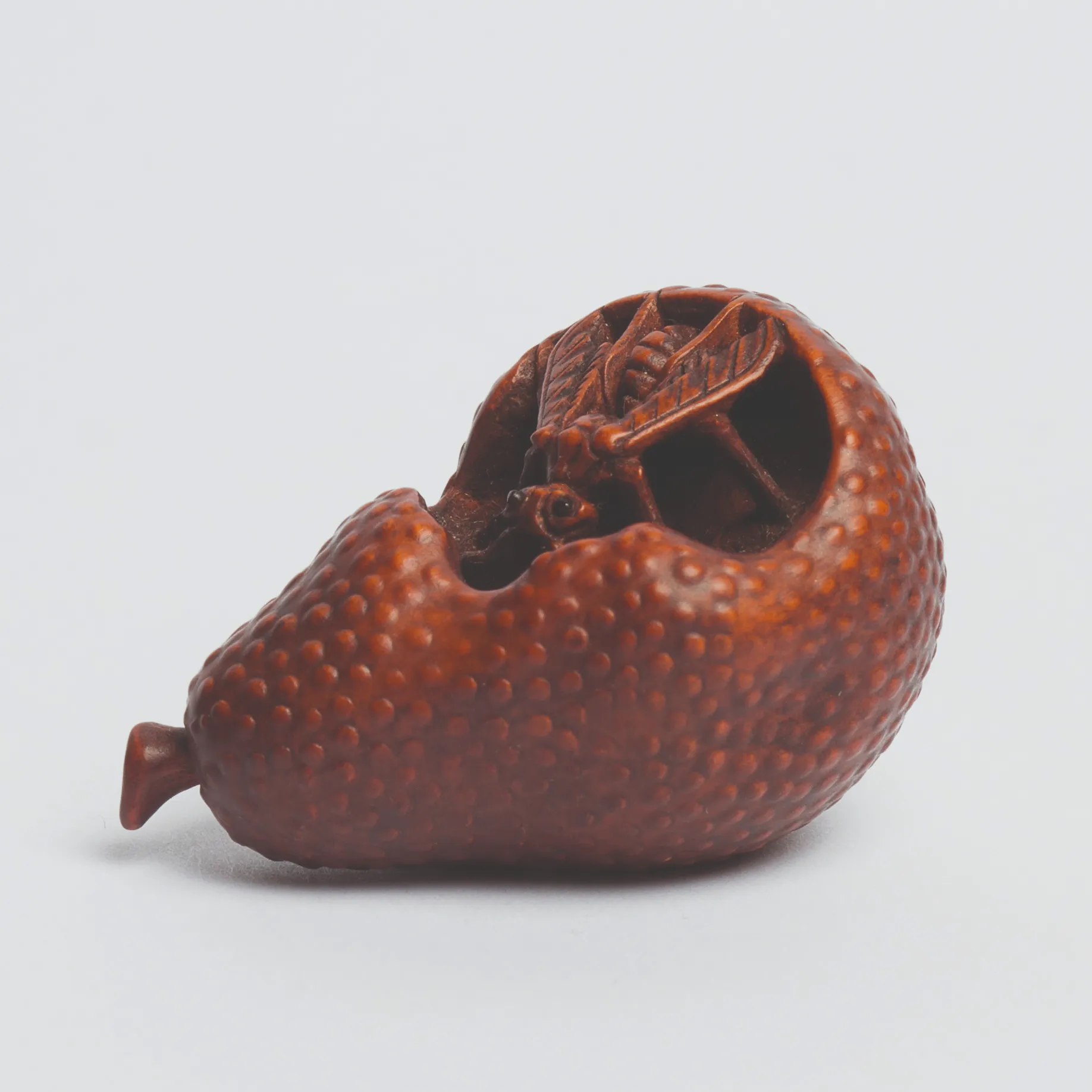
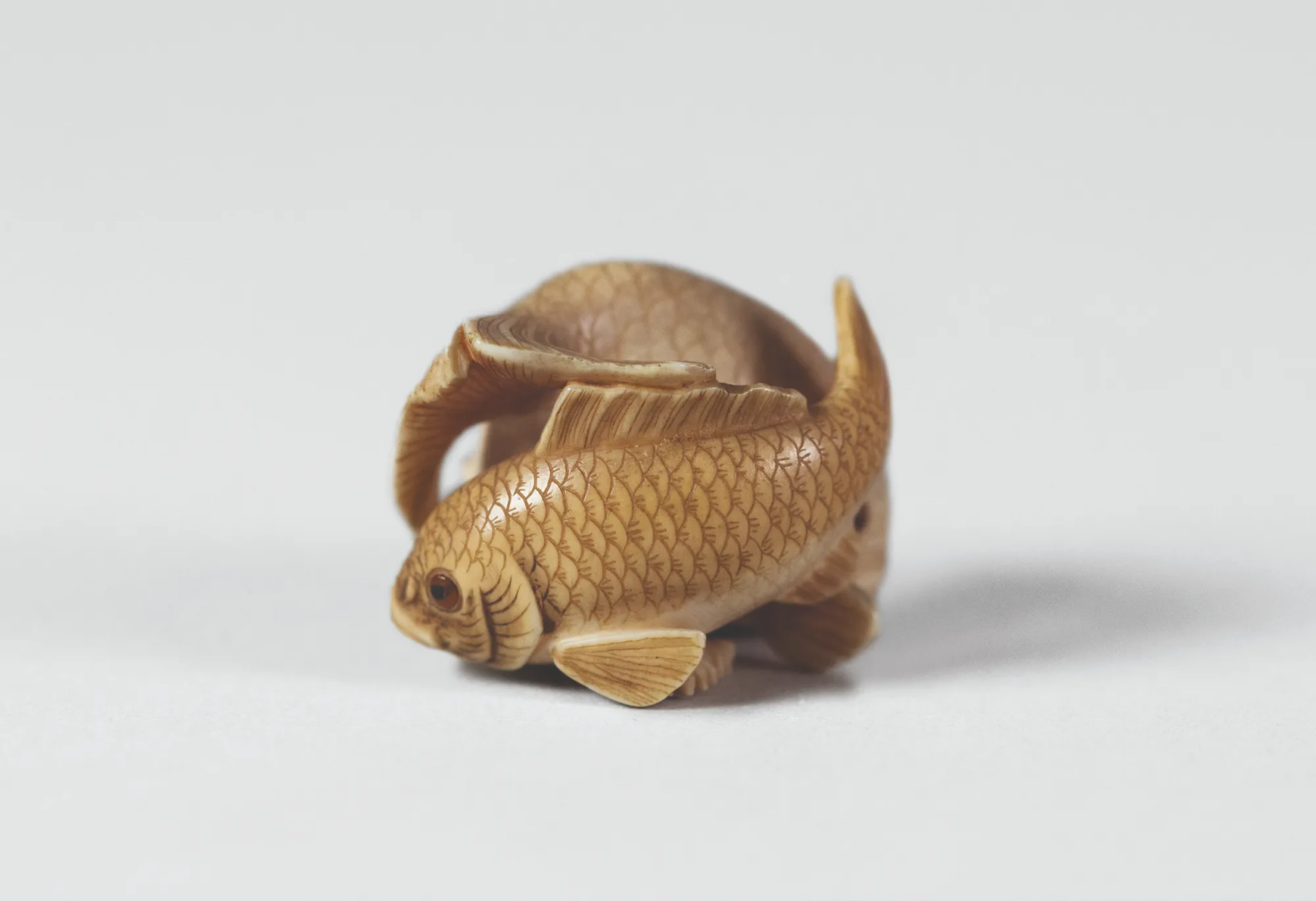
Unless the set was commissioned—a rare occurrence—netsuke and sagemono told two different stories. They were purchased separately and balanced each other according to Zen principles: on one hand, the nobility of lacquer; on the other, the irreverence of the button. The netsuke that have survived to modern days are mainly of three kinds: round flat manjū, small round katabori sculptures, and sashi, elongated and slender. The most common materials included ivory, wood, and horn, though exceptions existed—amber, for example, or coral, toucan beak, and tortoiseshell. Much depended on the imagination of the netsukeshi, along with the availability of materials. A wide variety of subjects emerged: men, animals, plants, mythological and fantastic beasts. Favorites included shishi, the Chinese guardian lion; shoki, the less than fearsome demon queller; and Okame the peasant, who danced to entice the sun goddess out of the cave where she was hiding. Then, in the mid-nineteenth century, it all unexpectedly ended.
Commodore Perry’s Black Ships forced Japan open in 1854, ending the Edo-era craft of netsuke as Western clothing replaced the kimono and its sagemono
The Commodore of the United States, Matthew Perry, sailed to Japan with four warships—their color and thick, dark smoke earning them the name “the Black Ships.” The aim was to force trade relations with the West upon a Japan that had to agree. The twelfth shōgun of the Tokugawa dynasty died a few days later—due to the pain. In 1854, the Treaty of Kanagawa sanctioned the reopening of the ports, and Western culture poured into Japan, marking the beginning of rapid modernization. Western clothing, complete with pockets, replaced the less practical kimonos. Wallets, purses, and cigar holders eliminated the need for sagemono and, consequently, their counterweights, the netsuke. Meanwhile, European and American collectors began acquiring these small statues. The craftsmen in the ukiyo sold them, as they were nearly impossible to sell in their home country.
The legacy of netsuke lives on in Western collections, from the British Museum to Milan gallerist Giuseppe Piva
Today, the largest netsuke collections are found in the West, with the British Museum holding more than two thousand one hundred pieces, acquired over the centuries. Giuseppe Piva operates a Japanese art gallery in Milan. Mr. Piva says the material value of a netsuke depends on neither its age nor the material it is made from. Some producers count for more than others, but what matters is the netsuke’s quality itself. Several pieces in the collection are singled out as candidates for his own choices. None matches them.
Only experience helps in judging that. Even collectors are sometimes surprised by auction results: a piece sold in Cologne the previous year went for double or triple its initial estimate. He describes an ivory netsuke depicting a foreigner with a rabbit—a Dutch sailor in a French Navy uniform, trousers fastened diagonally with agate buttons—carrying a starting price of twenty-six to thirty thousand euros that sold for more than two hundred thousand. The netsuke that reached the highest price he recalls at auction was an ivory deer by Okatomo, a maker he holds in high regard, sold for two hundred sixteen thousand euros in 2011 in London.
The original symbolic value of the netsuke differed from an initial assumption that they served as tokens or amulets for their owners; the Japanese of the Edo era attached no such meaning to their buttons. «They bought them like we would buy cufflinks, focusing on their appearance. If they chose a shishi, they must have been a bit superstitious, yet the value lay in the shishi, not in the netsuke.»
Mr. Piva is a member of the International Netsuke Society, which organizes a day when members can touch a netsuke from the British Museum’s collection; he learned the opportunity was limited to a small group only after boarding his flight, and could have held a sleeping mouse from the collection.
What it means to pass Japanese art down through a family
The Hare with Amber Eyes: A Hidden Inheritance, a 2010 book by Edmund de Waal—writer, potter, and art historian. In the middle of the book is a collection of two hundred sixty-four netsuke that belonged to Charles Ephrussi—a Jew, dandy, art patron, and collector—who left them to the author, prompting him to reconstruct their story.
The book centers the story of the objects, not the people who owned them or the sentimentalism attached to them. Mr. de Waal writes that melancholy amounts to a default vagueness, a way out, a lack of focus, while a netsuke represents exactitude and, in his account, calls for the same precision in return.
As the collection’s story unfolds, Mr. de Waal reaches two conclusions. First, inheritances cannot be separated from their sentimental value. He describes the handing down of objects as a form of narration in itself: an inheritance carries its own reasons—affection for the recipient, the fact that it was left to the giver by someone else, the place where it was acquired, a wish for it to be cared for, or even a wish to complicate the recipient’s life or provoke another party.
The second conclusion: objects carry traces of those who valued them, and touching them in turn is part of how that transfer is completed for the next owner.
Stricter ivory law has pushed netsuke carving toward materials like boxwood, mammoth ivory, and tagua nut
Stricter enforcement of ivory law, including the UK Ivory Act and updated CITES rules in the EU and the United States, has made trade in vintage elephant ivory illegal in many jurisdictions without documented pre-convention provenance, dated before 1947 or before 1975 depending on jurisdiction. Carvers and collectors have moved toward other materials, among them boxwood, known as tsuge, ebony, stag antler, mammoth ivory—an extinct, legal fossil material—and tagua nut, known as vegetable ivory.
Netsuke carving continues beyond the nineteenth century. Living carvers across Japan and elsewhere, among them Ryushi Komada, Akira Kurita, and Leigh Sloggett, continue the craft. The Kyoto Seishu Netsuke Art Museum, housed in a preserved 1820 samurai residence, holds more than six thousand pieces, with a focus on contemporary work. The Japan Foundation’s touring exhibition Contemporary Wood-Carved Netsuke, shown across Latin America, the Caribbean, and Europe between 2024 and 2025, included pop-culture motifs and abstract forms alongside traditional technique. The International Netsuke Society marked its fiftieth anniversary, spanning 1975 to 2025, with conventions in Boston in 2024 and Brussels in 2026.
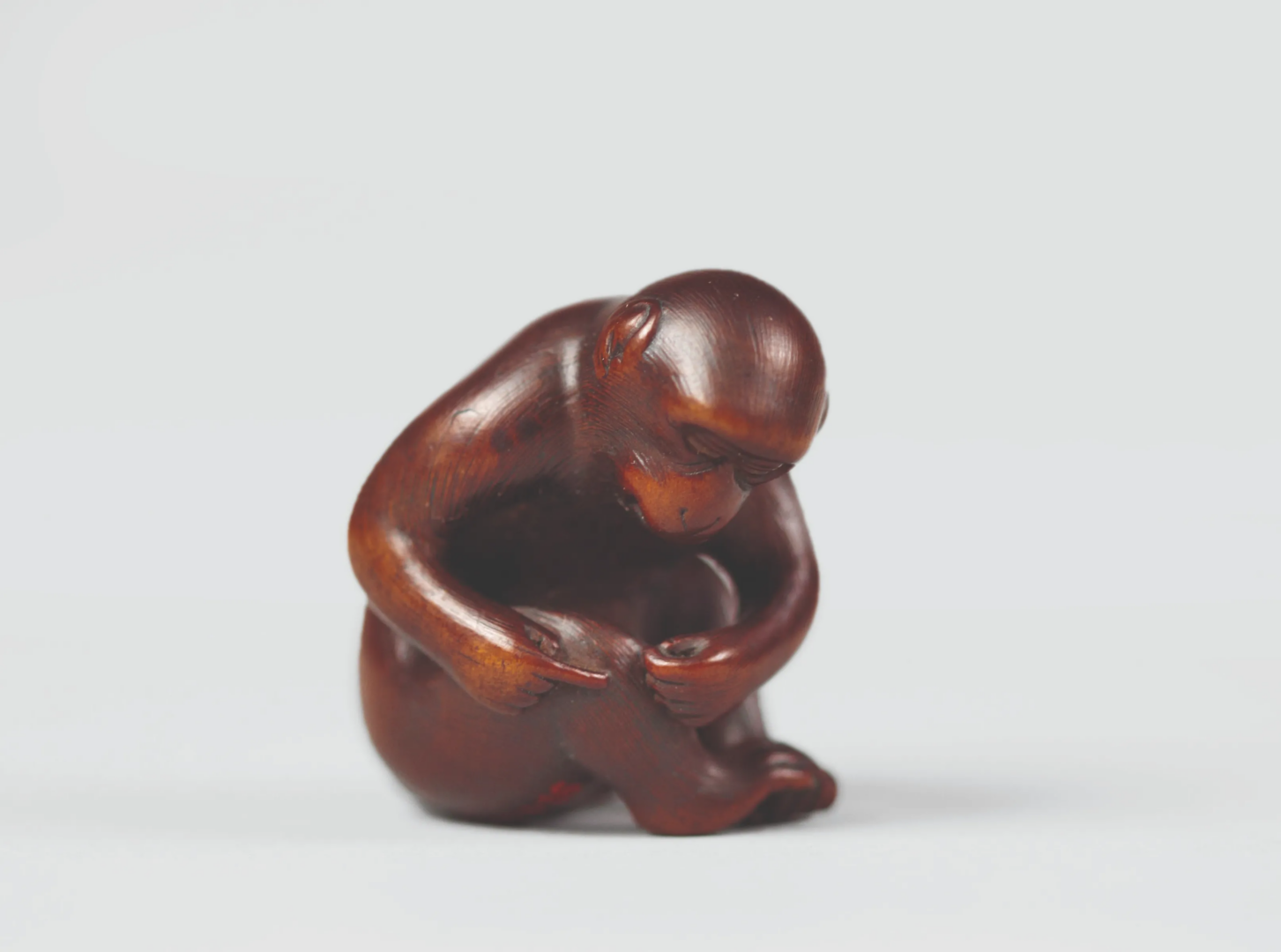
Auction prices for wood netsuke from the Edo period have kept climbing since 2023, led by a record New York sale of a monkey carving
Wood netsuke from the Edo period continue to draw bidding. At Bonhams New York in October 2024, an eighteenth-century Kyoto wood netsuke of a seated monkey by Masanao sold for one hundred forty thousand two hundred dollars, more than twenty-eight times its estimate.
The himotoshi cord holes and rounded marumi carving reveal whether a netsuke was made to be worn, while forged gimei signatures complicate this craft’s history.
Two details are commonly left out of general accounts of the form: the himotoshi and marumi. The himotoshi are two channels drilled into the body of the netsuke and connected internally: one hole, larger, holds the knot of the suspension cord; the smaller hole releases the double cord that runs to the ojime bead and the sagemono. In some pieces, a natural gap in the carving—between an animal’s tail and leg, for instance—performs the same function without drilled holes; this is called natoshi. A cord runs behind the obi, through the himotoshi, down through the ojime, to the sagemono suspended below.
Because a netsuke was worn against silk, it was carved with marumi, meaning roundness: a functional piece has no sharp projection, thin tip, or rough edge that could catch on fabric or break during regular movement.
Many Edo-period carvers, including names now well known, left their work unsigned. During the late nineteenth and early twentieth centuries, as demand from the West grew, export pieces were often given forged signatures, known as gimei, attributed to established masters such as Masanao or Tomotada. A signature alone is not an indicator of age or origin.
Some netsuke carry hidden karakuri mechanisms or take the kagamibuta and ryusa forms, developing the aged patina known as aji over decades of wear.
Some netsuke include moving parts: a demon with a mechanism that extends its tongue, a double-faced mask that rotates, or a wooden ball carved loose inside a dragon’s mouth that cannot be removed from it—a form known as karakuri.
Beyond the katabori (sculptural) and manjū (round, flat) forms, two further types are functional: kagamibuta, a bowl-shaped base in wood or ivory fitted with a decorated metal lid, and ryusa, carved in openwork, hollowed-out filigree. The patina found on older netsuke, called aji, meaning taste or flavor, developed through decades of contact with hand oils and friction against silk sashes.
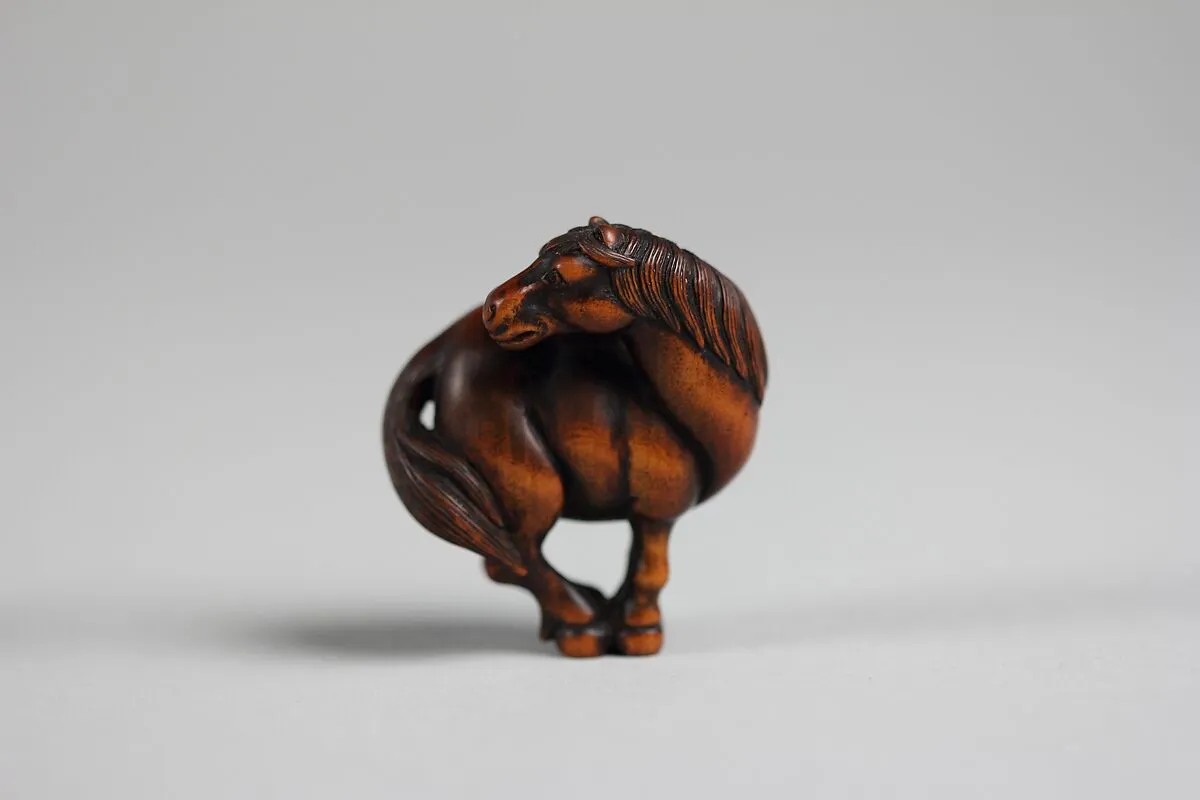
Identifying and caring for a netsuke means reading its carving, then protecting this Japanese craft from heat, light, and humidity
A few checks help distinguish a netsuke made to be worn from a display carving. Inside the himotoshi, hand-drilling marks and wear or darkening from cord friction indicate age and use. Rolled gently between the palms, a piece that feels sharp, uneven, or top-heavy was likely carved as a display object, known as okimono, rather than a toggle meant to be worn. The underside, visible when the piece hung upside down or rested on a table, was carved with the same attention as the front.
Wood and ivory keep best at forty-five to fifty-five percent relative humidity; a sudden drop dries out and can split both materials. Clean, dry hands are preferable for handling, since they add a small amount of natural moisture that benefits wood, whereas oils or chemical polish do not. Direct sunlight and halogen display lighting bleach pigment and dry organic material, and are avoided.
La Galliavola Arte Orientale gallery exhibits hundreds of ancient netsuke, as well as Chinese porcelains and lacquers, Chinese and Tibetan bronzes, paintings, jade and hard stones. The gallery first opened in the early nineteen-eighties with Patrizia Chignoli, a scholar of oriental art. Since 2001 it has been run by her husband, Roberto Gaggianesi, and daughter, Carla. Since April 2007, La Galliavola has been publishing the quarterly bulletin Netsuke.