Brigitte Niedermair and Madame Hirsch, a year spent photographing Renate Giacomuzzi
At Galleria Richard Saltoun, the series shot on 6×7 film between 2004 and 2005 inside a Bolzano castle, followed by three years of post-production and twenty-four images agreed one by one with the woman in them
Brigitte Niedermair at Galleria Richard Saltoun: introducing the narrative behind the exhibition Madame Hirsch
Your photographs move in a borderland between art and fashion, and challenge the conventions of both systems. How do you feel in that in-between place?
Brigitte Niedermair:
It was a conscious choice. I have watched how art and fashion — distinct systems — resemble each other in their privileges and their failures. At the start the two worlds were rigid and separate: in art, being a fashion photographer was stigmatised, while in fashion my artistic work was ignored. Today the two systems work together, in a conflictual way. Anyone who does not know these logics risks becoming their victim. Living in both worlds, I learned to «ride a runaway horse», carving out a freedom of my own inside systems that seek control and exclusivity.
My strategy is to push the limits, like a climb from a precarious balance. I try to balance the art of the commission with that of the self-commission. In art I commission myself, as in the Madame Hirsch project, keeping control over my private research. In fashion I use the playground the houses offer to make works a gallery could not support, and get a different kind of engagement.
Irving Penn, the birth of styling and the return of the mono-look
Brigitte Niedermair:
Over the years I have watched the structural changes in the field. Fashion is a young system; it does not have the long history of art. Fashion photography is born when a photographer photographs a garment from a brand. Complex styling, with garments from several brands, comes later, in the 1980s. Today we have gone back to the origins, because styling no longer exists. You can no longer mix the pieces, you cannot put a Dolce & Gabbana and an Armani on the same page. You need the mono-look.
It reminds me of Irving Penn, of the early experiments in fashion photography: he took a dress, photographed the woman in that dress, and that was the picture. Then the magazines came, and the idea of styling was born in England. These are opposing events. Styling comes from a need to mix, from the idea of a fashion that cannot be taught. In under fifty years the place of styling has changed from when I started. The role of the curator in art has shifted too — artists and photographers now curate themselves, with no need for outside mediation. These systems change with the economies and the needs of the moment. Surviving in this context takes technical skill, and a political and cultural awareness, adapting without losing your artistic identity.
How Madame Hirsch began, from Marion Piffer Damiani to a Bolzano castle
The exhibition is described as both a photographic diary and a tableau vivant. How did the project come about, and what does this woman mean to you?
Brigitte Niedermair:
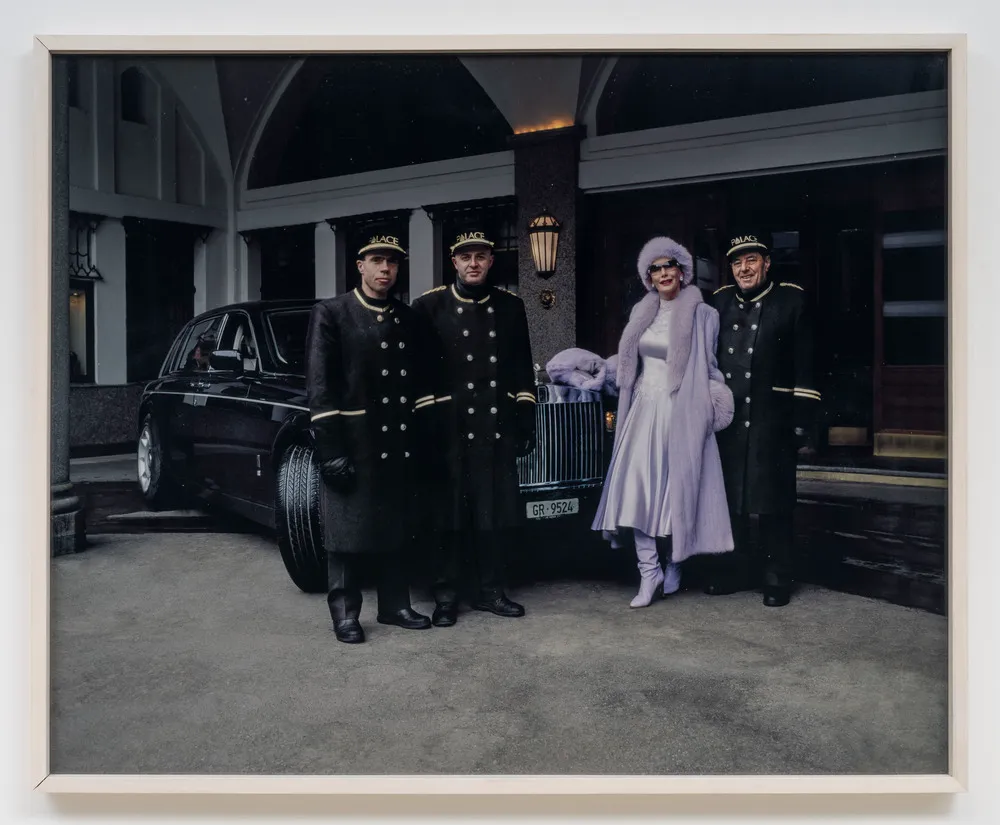
At first I wanted to make a book, without a precise direction. It was a meeting with Marion Piffer Damiani, president of the Museum of Bolzano, that led me to Renate Giacomuzzi. They set an appointment for 2.55 pm, a time that already announced an unusual woman. When she opened the door of her Bolzano castle, I was speechless. We had never met. It was 2004-2005, a time with no social media and no internet as we know it today. Renate was already what we would now call a socialite before the term, an influencer before the profession could be imagined.
Meeting her deepened my wish to look into female roles and the aesthetics tied to them. I proposed a collaboration between equals: I would bring my photographic competence, she her life. I became her «court painter», entering her routine and learning her bon ton. It taught me how she handled relationships and her own image.
6×7 medium format film and three years of post-production
Brigitte Niedermair:
On the technical side, I refused digital — which I never loved, and which was still immature — and chose 6×7 medium-format film. That approach introduced the element of risk I needed: on one hand the wait to find out whether the picture had worked, on the other the risk itself. It is more stimulating to work in a visual space made of waiting, because that is where something that surprises you is born. The time it takes to make the image strikes you. With the superficiality of seeing everything instantly, the creative process empties of meaning.
The relationship that formed was symbiotic, and I gave a year to the project, following Renate’s time windows until I was part of her daily life. I became her court photographer, with an autonomy close to that of eighteenth-century artists, though the payment was an agreement of trust instead of money. In the photographic process a reversal of roles takes place: the photographer stays in the shadow, while the subject, exposed to the light, seems to take on greater power. The work comes from the balance between light and shadow, between the one who observes and the one observed. Madame Hirsch is the documentation of an identity, built consciously and lived in freedom.
Bolzano, Hollywood and the female roles of 2004
What is the cultural and social context that inspired the project?
Brigitte Niedermair:
With this work I tried to observe the life of a woman, without judging her. I wanted to tell the story of a woman immersed in the cultural influences of her time, from the province of Bolzano to the United States. Back then America held an influence over our lives and our consciences, because Hollywood cinema was everywhere. There was no Netflix to level the cultures, no TV series to accustom us to a European aesthetic language. Everything was Americanised. The collective dream was to leave for America; every photographer dreamed of making it in New York.
In 2004-2005 society was different from today, and so was female behaviour. We did not ask ourselves the questions we ask now. In twenty years the world has changed. One day our own professions may no longer exist. Who knows how we will evolve. Perhaps we will go back to where we began, though I think that is still to be discovered.
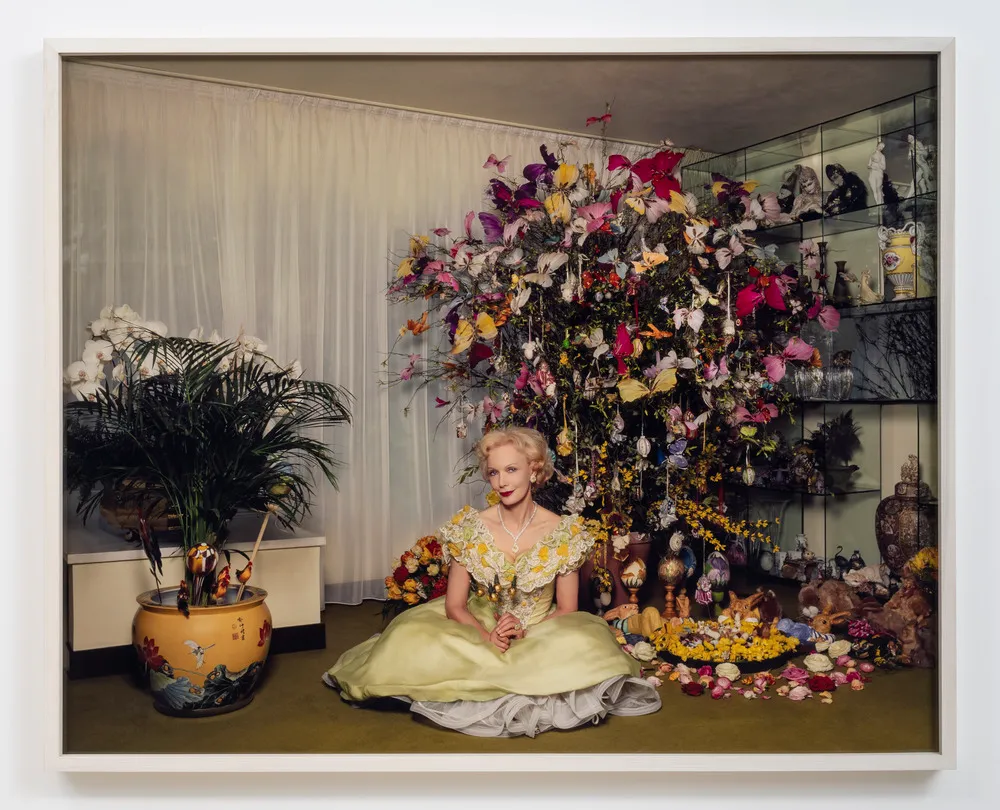
The work with Renate marked me. I made it out of an inner need, with no result in mind. We spent three years on post-production alone, because retouching is part of photography, from the scans to the fine-tuning. Like all women, Renate wanted to hide a wrinkle or have an arm «catch the light» the right way. I shared every image with her. I would tell her: «Look, I like this one more than that one». It was a constant discussion about her life, and I wanted to publish only the photographs she agreed with. The final result is a synthesis of her story. I wanted her to recognise herself in those twenty-four images.
The jogging scene, the Obstmarkt and the refusal of staging
Where do you place the boundary between reality and performance in Madame Hirsch’s identity? Was it a construction made for the camera, or the image she held of herself?
Brigitte Niedermair:
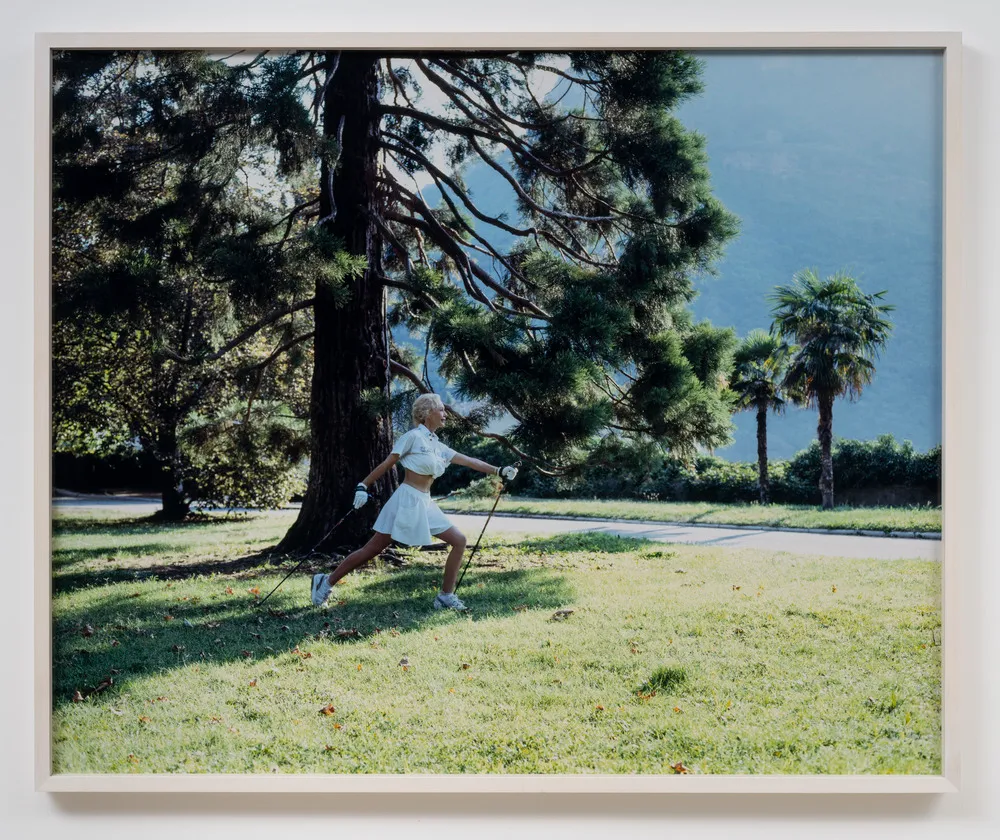
It was her life; I added nothing. Madame Hirsch is a document, not an adapted reportage. The tableau vivant is my artistic capacity, and her life was authentic, with no fiction. Renate lived aware of her own existence, for herself instead of to be seen. She called herself a princess, and princesses live like that. Though she had met figures like David Bailey or Andy Warhol, she refused to be photographed by anyone who did not accept her for who she was. With me she found room, because she felt I wanted nothing from her but her essence.
I observed her as you watch a person in the street, without projections. When I photographed the jogging scene, I thought she had dressed only for me. The people of Bolzano confirmed it was her everyday style, visible among the stalls of the Obstmarkt. In that case we refused to photograph her among the fruit and vegetables: it would have been like asking her to pose with her horse, building an artificial superstructure over her life.
Renate did not see herself as a performer, but as a woman faithful first of all to herself. She lived in her own skin, building over time a diva mythology that she herself refused: «I don’t sing, I don’t act, I don’t write. I am who I am». She had a life like ours, made more colourful, with sequins and bold styles. In those years her choices were unwatchable in the province; today her way of dressing looks normal, which shows how far ahead of her time she was. Today she might be a socialite or the star of a reality show. Her authenticity stays intact, documented as the testimony of a life lived with courage and coherence.
The criticism of 2009 and the cost of photographing a famous subject
A reality show?
Brigitte Niedermair:
She would never have allowed it, because even then she was aware. She told me Hollywood producers had come to make a film about her life, and she had said: «No, I won’t be the actress of my own life». That statement shows lucidity: «I make this choice because I am like this, I like it like this, and I live my days like this without having to prove it to anyone».
When her way of life entered the art system, the project was treated as gossip walking into a museum, instead of being read as the testimony of a person who had built her existence through effort. Did Renate live a «constructed» life? Leaving the house every day made up and dressed that way, in the province, took constant commitment, an unpaid and costly profession.
The criticism I received, which was politically exploited, comes from this misunderstanding. I felt a brutality, fed by envy, toward a woman who lived outside the conventional schemes. The art world struggled to accept this narrative, preferring to reduce her to a caricature. It was hard, because I understood that touching a person who is «strange» or «different» can trigger hostility. That cruelty, which in 2009 was limited to a few newspapers and soon forgotten, today lives on social media, where every negative judgement leaves an eternal trace.
That is why I decided to stop photographing famous people. The difference, since then, is that the «ugliness» of criticism is amplified and permanent. Renate lived her life with coherence, seeing herself as a princess in a world that did not understand her. Her photograph is a portrait of identity instead of wealth. She is a woman who chose to be herself, without compromise, and through my lens was freed from outside judgement. Her legacy is the freedom to be authentic in a world that keeps trying to flatten everyone.
Does Renate’s identity anticipate the contemporary obsession with image and self-control?
Brigitte Niedermair:
Today almost all women live under the lens of judgement, becoming victims of a machine that produces unhappiness. Renate had internalised this question long before, choosing her own aesthetic. When the outside becomes a mask, there is a price to pay: building an identity can deform the one who wears it. The question remains: was Renate happy? Was she faithful to her choice?
Her greatness showed itself at the moment of passing. She starved for coherence with her image, refusing treatment that would have let her decline physically. Her last phone call was a farewell: «I’m going on a long journey, and we’ll meet again». It was an act of light instead of despair. For me, her final coherence surpasses any aesthetic expression.
Brigitte Niedermair on artificial intelligence and lived experience.
What is your perspective on the future of photography in a world dominated by artificial intelligence?
Brigitte Niedermair:
AI is a machine like any other; it produces variable results depending on how it is used. I come from analogue and never accepted digital, preferring to work with craftsmen as in the past. In my work the heart of photography stays the experience in the world. To remove experience is to remove life. What do I care about an image generated by a computer? I would call it a system of calculations instead of «intelligence». There is room for AI, as there is for analogue and digital, and it pains me that man would deprive himself of lived experience.
Photographing today is a collective act: it involves photographer, model, stylists. These are situations that create emotions, and removing them empties the world of meaning. Man lives to have experiences; if he delegates his life to the machine, he loses his function. I will keep making images tied to my identity and my history, by choice instead of out of fear. If humanity decides it is useless, I will take note, like the dinosaurs swept away by an asteroid.
AI is a mask we put on ourselves. The beauty of life is the unknown. Not knowing how it will end is what makes everything interesting. Life is a mystery not even AI can solve. We have to learn to stand in the world, to experience our body in space, as Renate did. It is that physical presence that makes life meaningful, whatever the technological future.
Brigitte Niedermair at Galleria Richard Saltoun presents Madame Hirsch
Brigitte Niedermair builds a visual language on formal rigour and a suspension of time, across the codes of fashion and art. Born in Merano in 1971, the artist and photographer has worked with fashion houses including Dior on an approach she sums up as «to make, to wait and to see».
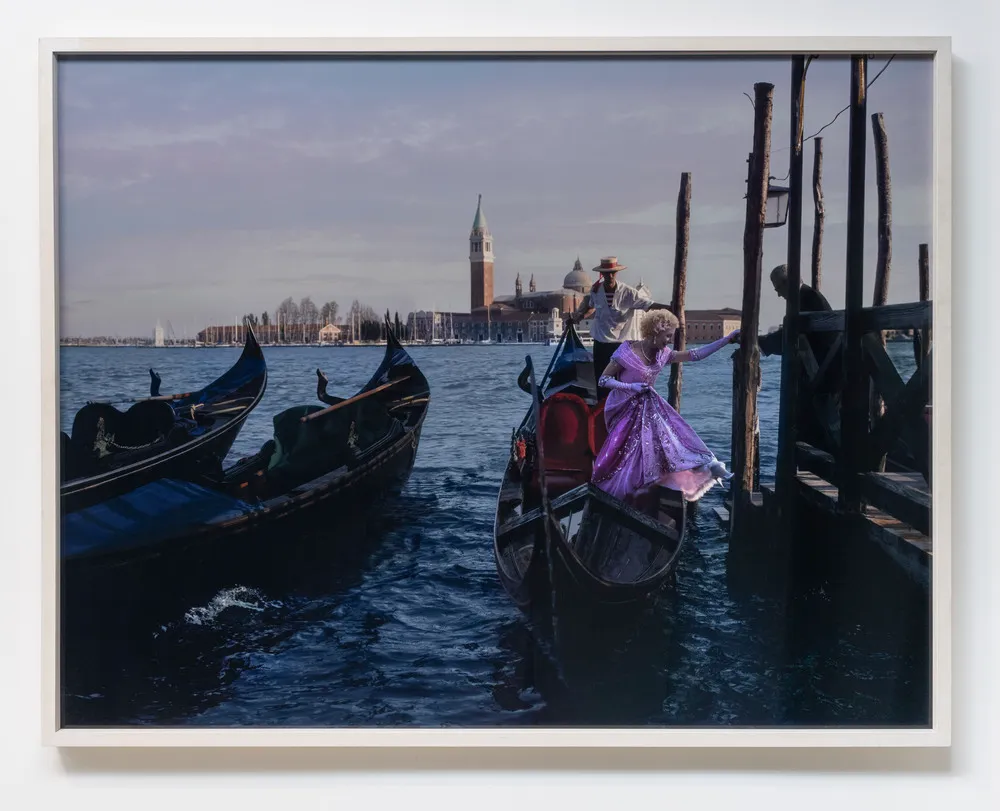
Galleria Richard Saltoun presents Madame Hirsch, a photographic series on Renate Hirsch Giacomuzzi, a figure active between art and fashion since the 1990s. Made between 2004 and 2005, the project follows the rhythm of its subject’s life — parties, travel, the everyday — in an installation closer to a diary than to a conventional show.
Niedermair works outside the logic of reportage. What she documents is a reality in which every gesture and every garment takes part in defining the lifestyle of an icon, and the routine of daily life turns into representation. The pictures hold in the ambiguity between document and staging.