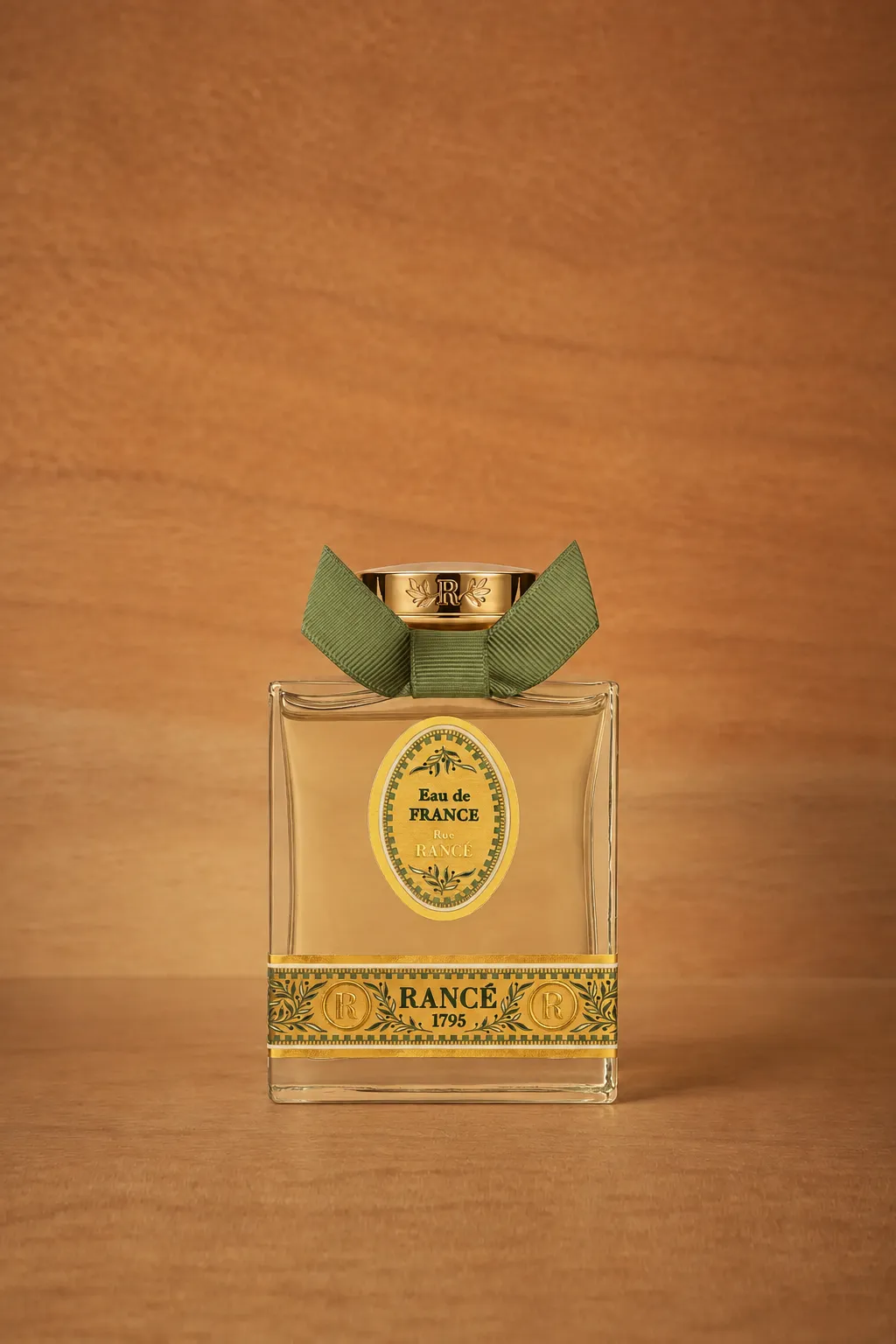
Eau de France, bergamot and tomato leaf in the Rue Rancé collection
Rancé 1795 puts a green, sappy material next to citrus in its spring eau de toilette, in a line named after the Grasse street where the family palace stood
Eau de France opens on bergamot and goes green within seconds, on tomato leaf. The fragrance is genderless, built as an eau de toilette, with faint floral nuances in the middle and a base of sandalwood and white musk. What the house calls its signature is the unripe, transparent, herbaceous quality that the leaf gives it.
Eau de France and the tomato leaf, a green note that comes from the laboratory
Tomato leaf is one of the materials perfumery mostly builds instead of harvesting. The plant yields little absolute, at a price that keeps it out of most formulas, so the note is reconstructed, around leaf alcohol — cis-3-hexen-1-ol, the molecule behind the smell of cut grass — with green, sappy, slightly bitter facets layered over it. The result reads as stem and leaf: the part of the plant nobody eats.
The material entered fine perfumery in 1974, with Eau de Campagne, composed by Jean-Claude Ellena for Sisley, and it has stayed a minority register since. In Eau de France it sits against bergamot, which carries the citrus brightness, and the two hold the composition in a green, vegetal territory before sandalwood and white musk close it. The freshness is the structure, in place of a decorative opening.
Rue Rancé, a collection named after a street in Grasse
Rue Rancé takes its name from what the people of Grasse called the street where the Rancé family palace stood. The line is composed entirely of eau de toilette, written around Provence, its gardens and its light, in citrus and aromatic notes, and built to be worn through a day at low volume. The collection now carries a redesigned range of caps across the bottles.
Les Elixirs, a higher concentration on Hélène and Le Vainqueur
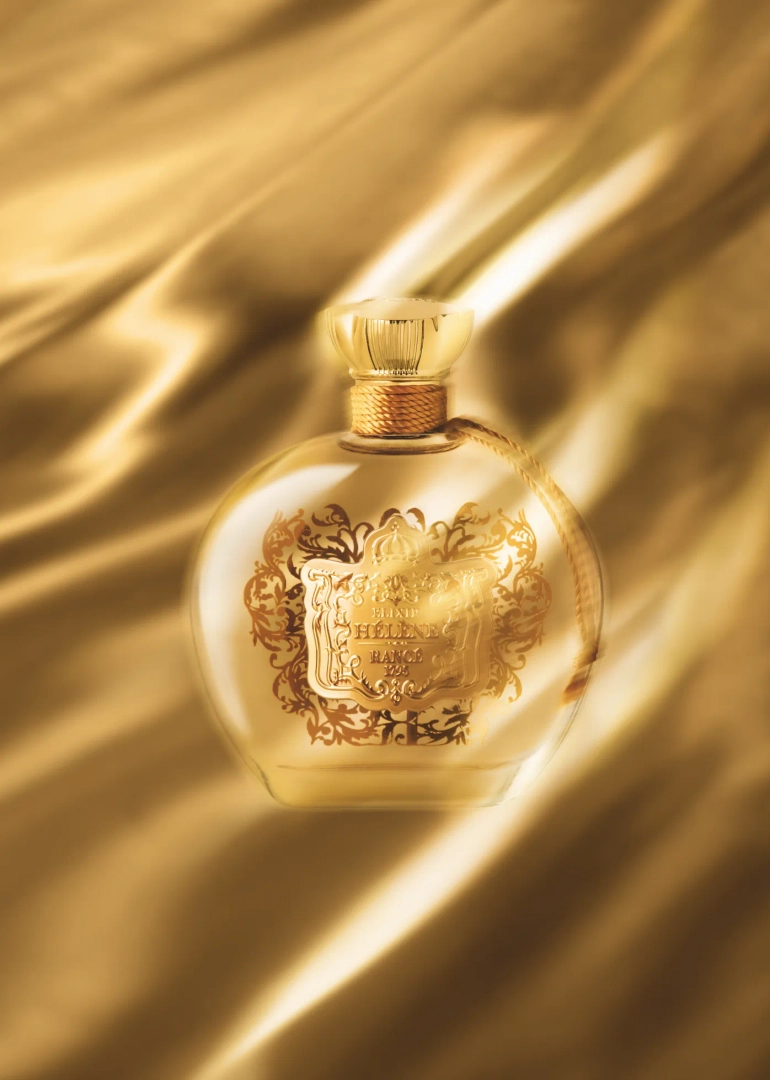
The other direction of the catalogue came to Esxence 2026, at Milan’s Allianz MiCo, from 3 to 6 June, in the fair’s sixteenth edition, with more than three hundred brands in the halls. There Rancé 1795 presented Les Elixirs, a chapter inside the Imperial collection with no separate line of its own: Hélène and Le Vainqueur keep their olfactory identity and are reformulated at a higher aromatic concentration.
Concentration in perfumery is the proportion of aromatic compound dissolved in alcohol — around two to five percent for eau de cologne, five to fifteen for eau de toilette, fifteen to twenty for eau de parfum, above twenty for extrait. Raising the ratio slows evaporation instead of introducing new materials: the heavier, less volatile molecules stay once alcohol and top notes have receded. The accords hold their shape, and what grows is depth and persistence. The flacon follows, with a metallic label and gilt detailing inside a case built as a coffer, decorated with motifs from Napoleonic-era ornament. Houses with a historical archive have been reworking existing formulas at higher concentration, and Les Elixirs belongs to that practice.
Cristal Givré, aldehydes and cashmeran in the same line as Eau de France
The second preview at the fair, Cristal Givré, moves Rue Rancé toward cold, silence and suspension, keeping the luminosity and leaving the warmth out. The composition rests on aldehydes, synthetic aliphatic compounds that entered fine fragrance through Ernest Beaux’s 1921 formula for Chanel No. 5. Aldehydes come out of a laboratory, with no plant or animal source behind them, and give a metallic lift that reads as cold.
Beaux used them at a dose high enough that early critics called the effect soapy. Later formulas used smaller quantities, for a top accord that fades within minutes and leaves heart and base to carry the composition. In Cristal Givré the aldehydes stay present further into the development, and that persistence produces the effect the house calls brina, frost. Musk and cashmeran hold the base: cashmeran is a synthetic ketone developed at International Flavors and Fragrances in the late nineteen-sixties, used first in detergents and fabric softeners and taken into fine fragrance the decade after, with woody, musky and spiced facets that round out sharper materials. In a line of gardens and citrus, Cristal Givré stands on mineral ground.
Rancé 1795 from perfumed gloves in Grasse to Milan in 1902
The Rancé family has worked in Grasse since the sixteenth century, first as glove makers supplying scented leather to the French aristocracy. In 1795 François Rancé turned the business toward perfumery, which gives the house its name and its founding date, and the fragrances entered the household of Napoleon Bonaparte. Archival accounts credit François Rancé with formulas commissioned by the Emperor, among them L’Eau Impériale and L’Eau d’Austerlitz, and with L’Impératrice, dedicated to Joséphine Bonaparte and presented to her in a Sèvres porcelain case still held in the company archive.
Jean Rancé, who succeeded his father, went on naming compositions after the Bonaparte dynasty, and Hélène and Le Vainqueur come from that chronicle. Both sit today in the Imperial collection, the historic core of the catalogue. The house traces Hélène to a daughter attributed to Napoleon and never formally acknowledged by him: the claim rests on the family chronicle, with no independent documentation behind it.
François Alexandre Rancé, who led the house through the middle of the nineteenth century, introduced pomades and other body-care products and was recognised at the 1855 Paris Exposition. In 1902 his successor Alexandre Rancé moved the headquarters from Grasse to Milan, and the house’s later development is Italian. The Milan headquarters hold a company museum of historical products and archival material.
About Rancé 1795
Perfume house founded in Grasse in 1795 by François Rancé, whose fragrances supplied the household of Napoleon Bonaparte and Empress Joséphine. Alexandre Rancé moved the company to Milan in 1902, where the headquarters and a company museum remain. Led by its seventh generation, it distributes across more than fifty international markets through the Imperial collection and the Rue Rancé line, with a boutique in Milan.